Florida uses modified comparative negligence. If a jury finds you more than 50% at fault for your own injury, you recover nothing. If you are 50% or less at fault, you can recover damages, reduced by your percentage of fault. That is the rule for most negligence cases filed after March 24, 2023. Medical negligence cases are the main exception and still follow the older pure system.
Below, we explain what changed, how the math works, what it means for car accidents and other injury claims, and what to do in the first weeks after you are hurt.
TL;DR
- Under Fla. Stat. § 768.81, a claimant found greater than 50% at fault may not recover any damages in most negligence actions.
- At 50% fault or less, your award is cut by your share of blame. At 20% fault, you keep 80% of the damages.
- Florida was a pure comparative negligence state from 1973 until the 2023 reform. Medical negligence claims remain under the pure rule.
- Florida also ended joint and several liability in most negligence cases, so missing a responsible party can leave part of your loss uncollectible.
- Insurers and defense lawyers now work to push your fault above 50%. Evidence gathered early matters more than it used to.
Table of Contents
- What comparative negligence means
- The three systems states use
- How Florida got here: from pure to modified
- The rule in the statute
- What the math looks like in real cases
- Who is still under the pure system
- Joint and several liability is gone too
- What juries are told
- Perspective: what we see in Brevard County
- What to do after an accident in Florida
- Talk to a Brevard County injury lawyer
- FAQ
- Sources
What comparative negligence means
In most injury cases, more than one person’s choices contribute to the harm. A driver may be speeding while the other driver turns left without yielding. A customer may be looking at a phone while walking over a spill the store never cleaned up.
Comparative negligence is the system courts use to split that responsibility. A jury assigns each party a percentage of fault, and the percentages total 100%. Those numbers then control the money.
To reach that stage, the claimant must first prove negligence. The Florida Standard Jury Instructions describe it as the failure to use reasonable care, meaning the care a reasonably careful person would use under like circumstances. A negligence claim has four elements:
- Duty: the defendant owed you a duty of care.
- Breach: the defendant failed to use reasonable care.
- Causation: that failure was the legal cause of your harm.
- Damages: you suffered actual harm or loss.
Comparative fault comes in after those elements are met. It asks a second question: how much of the harm did you bring on yourself?
The three systems states use
Across the country, states take one of three approaches, as the Justia 50-state survey lays out:
| System | Rule | Effect on a partly at-fault claimant |
|---|---|---|
| Contributory negligence | Any fault by the claimant bars recovery | Recover nothing at 1% fault |
| Pure comparative negligence | Recovery is reduced by the claimant’s percentage | Recover something even at 99% fault |
| Modified comparative negligence | Recovery is reduced, but barred past a threshold | Recover only below or at the cutoff |
Modified systems come in two flavors: a 50% bar and a 51% bar. Florida’s cutoff is described as a 51% rule because you are barred once you reach 51%. You can still recover at exactly 50%.
How Florida got here: from pure to modified
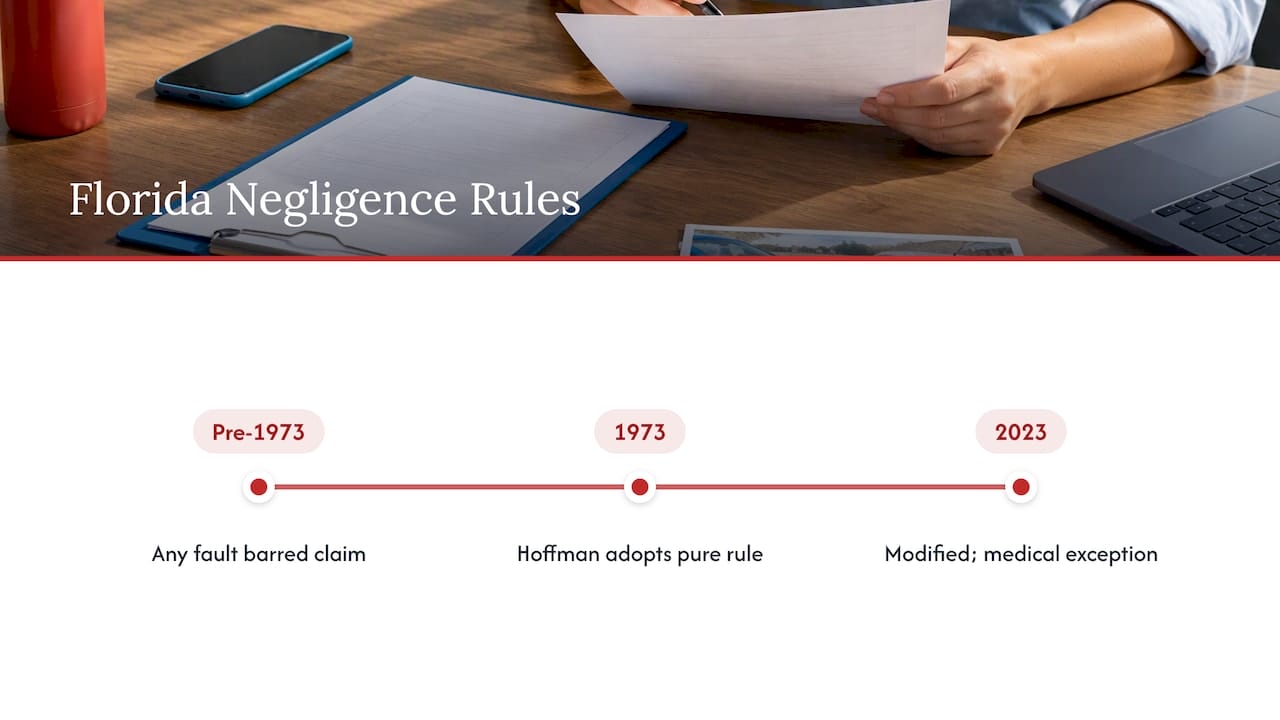
For decades Florida followed the harsh common-law rule that any fault by the injured person defeated the claim. In 1973 the Florida Supreme Court changed that in Hoffman v. Jones, abolishing contributory negligence as a complete bar and adopting pure comparative negligence. A plaintiff’s damages were reduced in proportion to their own fault rather than eliminated.
That meant a person found 90% responsible for a crash could still collect the other 10%. It stayed that way for roughly 50 years.
In 2023 the Legislature passed HB 837. Per the House staff final bill analysis, the bill changed Florida from a pure to a modified system, except for medical negligence cases. The same package also shortened the negligence statute of limitations. Our own page on HB 837 and the two-year deadline walks through that change.
Why does the history matter? Because plenty of online material, and plenty of what friends and family remember, still describes the pure system. If you have heard that you can always collect something no matter how much you were to blame, that was true before the reform and is no longer true for most claims. Tracking down old claims you may have forgotten about is a separate exercise, and there is a way to uncover forgotten lawsuit compensation in other contexts, but a Florida injury claim is governed by the rule of the date it was filed.
The rule in the statute
The operative language is in section 768.81. In a negligence action, the court enters judgment against each liable party based on that party’s percentage of fault. A party found to be greater than 50% at fault for their own harm may not recover any damages.
Two points deserve attention:
- The line is at more than 50%. Exactly 50% at fault still lets you recover half.
- The bar is all-or-nothing. At 51% you recover nothing, regardless of how large your medical bills or lost wages are.
The statute’s timing rules depend on when the cause of action was filed relative to the March 24, 2023 effective date. Cases filed before that date can be treated differently, so the filing date is the first fact a lawyer checks.
What the math looks like in real cases
Take a hypothetical claim with $100,000 in total proven damages. These are illustrations, not predictions for any case.
| Your fault | Other party’s fault | What you can recover |
|---|---|---|
| 0% | 100% | $100,000 |
| 20% | 80% | $80,000 |
| 40% | 60% | $60,000 |
| 50% | 50% | $50,000 |
| 51% | 49% | $0 |
| 70% | 30% | $0 |
The jump between 50% and 51% is why a single point of fault can be worth $50,000 in this example. Under the old pure system, the 51% row would have paid $49,000.
A car accident example
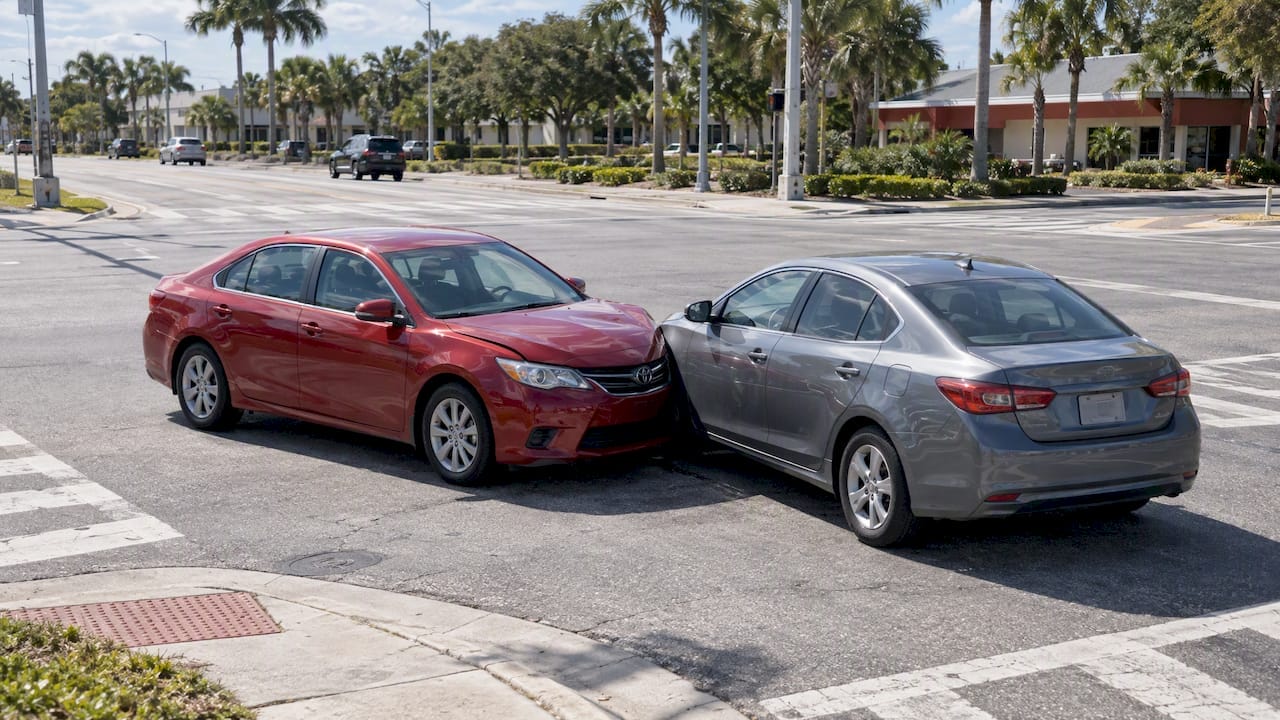
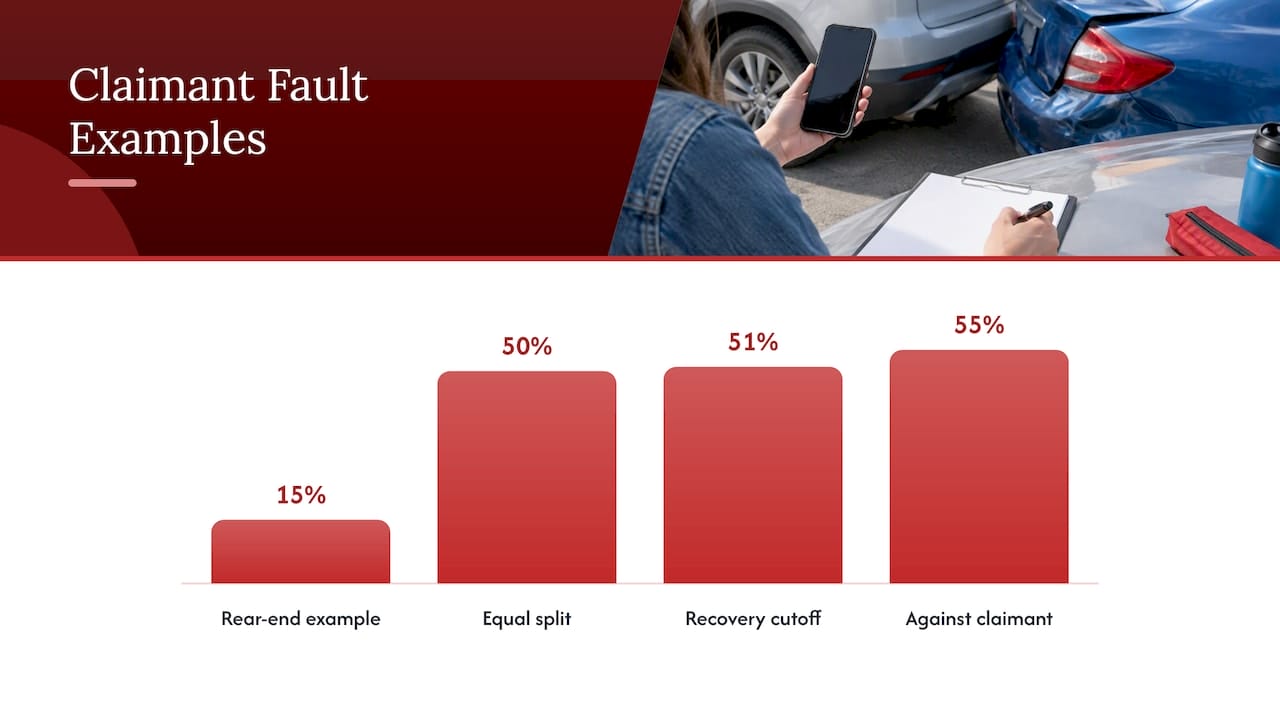
Say you are rear-ended while stopped, but the other driver’s insurer notes your brake light was out. A jury might split fault 85/15. You would still recover most of your damages. Now imagine a left-turn crash at an intersection where you were also over the speed limit and the other driver had a yield obligation. Fault could land at 50/50, or tip to 55/45 against you. In that case the distance between the two verdicts is the entire claim.
For how fault is actually assigned, see our explanation of how liability is determined after a car accident. For the money side of auto claims, including PIP, see Florida car accident settlements and fault rules.
Who is still under the pure system
The reform does not apply to every negligence case. Per the statute, claims for personal injury or wrongful death arising out of medical negligence are excluded and remain under pure comparative negligence. A patient found mostly at fault in a medical malpractice case can still recover a reduced award.
If your case involves a doctor, hospital or other health care provider, ask the lawyer you consult which rule applies. A claim that starts as a car crash can also involve medical errors afterward, and the analysis may differ for each part.
Joint and several liability is gone too
The comparative fault rule is only half the picture. Florida has abolished joint and several liability in most negligence actions, according to section 768.81. Each defendant generally pays only their own percentage of fault, not the whole judgment.
This changes how cases are built:
- If three parties share fault and one has no insurance or assets, you cannot collect that share from the other two.
- A defendant who wants to blame an absent person must affirmatively plead and prove that nonparty’s fault so it can go on the verdict form.
- Failing to name every responsible party can leave part of your loss uncollectible, a point the House bill analysis highlights.
In practice, a rideshare crash might involve the other driver, the company, and a vehicle owner. A slip and fall might involve a tenant, a landlord and a maintenance contractor. Identifying all of them early is part of protecting what you can collect.
What juries are told
In June 2024 the Florida Supreme Court’s jury instructions committee adopted standard instructions telling jurors the consequence of assigning more than 50% fault to a claimant. According to RumbergerKirk’s summary, jurors who put the claimant above that line are told not to consider damages.
Lawyers debated whether this could influence how juries divide fault. The practical lesson for you: jurors may know that a 51% finding ends the case, so how clearly you can show what the other side did wrong carries real weight.
Perspective: what we see in Brevard County
We handle injury claims for people in Brevard County, and the 51% bar has changed how we talk to clients from the first meeting. Before 2023 a client’s own mistakes were a reason to reduce a number. Now they can decide whether there is a number at all.
Here is what we tell people:
- Do not assume you are out. Many people believe any shared blame ends a claim. In Florida, being partly responsible does not disqualify you, as long as you are not mostly responsible.
- Do not guess at your own fault. Adjusters ask casual questions that sound routine, such as whether you were in a hurry or glanced at your phone. Your answers become the other side’s evidence. Talk to a lawyer before giving a recorded statement.
- Look for everyone responsible. With joint and several liability gone, naming only the obvious defendant can leave money on the table.
- Move on evidence quickly. Photos, witness names, video footage and the police report all fade or disappear. They are how fault percentages are won.
- Watch the calendar. The reform also shortened deadlines, so waiting costs more than it used to.
We give clients direct access to their attorney, and our first consultation is free. We would rather tell you on day one that fault is a problem than let you find out at trial.
— John
What to do after an accident in Florida
These steps protect your position on fault:
- Get medical care. Your health comes first, and records link your injuries to the accident.
- Report the accident to police when required and get the report number.
- Photograph everything: vehicles, road conditions, signage, injuries, the spill or the broken step.
- Collect names and contact details for the other parties and any witnesses.
- Do not apologize or speculate about who caused it. Stick to what you know.
- Decline a recorded statement to the other side’s insurer until you have spoken with a lawyer.
- Keep a record of missed work, bills and how the injury affects daily life.
Some of the most costly errors are small and avoidable. Our guide to common personal injury case mistakes covers more of them, and our page on avoiding the loss of pain and suffering damages explains the Florida auto injury threshold that sits alongside the fault rules.
Talk to a Brevard County injury lawyer
If you were hurt in a crash, a fall or another accident and the other side says you share the blame, we can review how the 51% bar applies to your facts. We offer a free 30-minute consultation. Learn more about our personal injury practice or contact the firm to set up a time.
FAQ
Does Florida have modified comparative negligence?
Yes. For most negligence claims filed after March 24, 2023, a claimant who is more than 50% at fault recovers nothing. At 50% or less, damages are reduced by the claimant’s percentage of fault. The statute is § 768.81.
Is Florida still a pure comparative negligence state?
Only for certain claims. Medical negligence cases remain under the pure system, where a claimant can recover a reduced amount at any level of fault. Most other negligence actions, including typical car accident and slip-and-fall cases, now follow the modified rule.
What are the four elements of negligence in Florida?
Duty, breach, causation and damages. The defendant must have owed you a duty of reasonable care, failed to meet it, and legally caused you actual harm. Comparative fault only becomes relevant once those elements are proven.
Can I recover if I was partly at fault for a car accident?
Often, yes. If a jury finds you 50% or less responsible, you can recover the remaining share of your damages. If you are found more than 50% responsible, Florida law bars recovery in most negligence cases, so evidence on fault is critical. A lawyer can assess your specific facts.
Sources
- Florida Statutes § 768.81, Comparative fault (2026)
- Hoffman v. Jones, 280 So. 2d 431 (Fla. 1973)
- House of Representatives Staff Final Bill Analysis, CS/CS/HB 837
- RumbergerKirk: Florida’s Comparative Negligence Jury Instructions After HB 837
- Florida Standard Jury Instructions in Civil Cases
- Justia: Comparative and Contributory Negligence Laws, 50-State Survey