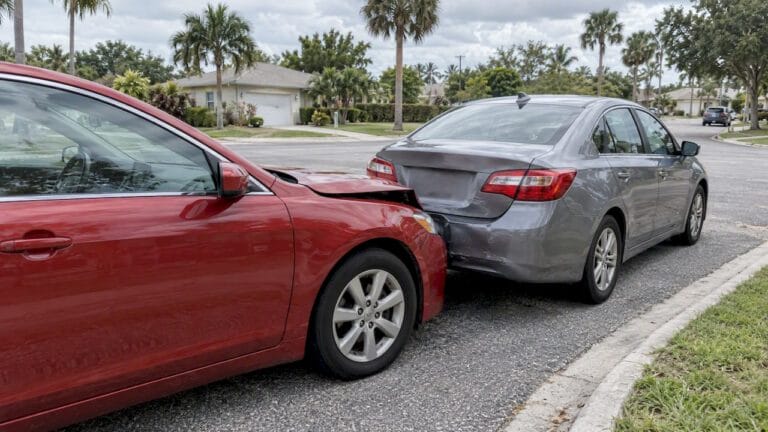
Liability after a car accident is assigned by comparing each driver’s conduct against the applicable state negligence rules and the available evidence. The first fault call usually comes from an insurance adjuster, not a court. If the parties disagree, the dispute can escalate through insurer negotiation, inter-company arbitration, and ultimately a judge or jury. Fault is decided in layers: police form an initial opinion at the scene, insurers run independent investigations, and a court steps in only when everything else fails.
The evidence that most commonly decides fault:
- Police report and the responding officer’s observations and any citations issued
- Scene photographs showing vehicle positions, damage, skid marks, and road conditions
- Witness statements collected at the scene or shortly after
- Surveillance or dashcam video from nearby cameras or other vehicles
- Event data recorder (EDR) data, sometimes called the vehicle’s “black box,” which logs speed, braking, and steering inputs in the seconds before impact
One thing most people miss: the insurer that files a claim first gains no automatic advantage. Adjusters are trained to reconstruct what actually happened, not to reward speed.
Key Takeaways
Liability after a car accident is determined by comparing physical evidence and driver conduct against state negligence rules, with insurers making the first call and courts stepping in only when disputes escalate.
| Point | Details |
|---|---|
| Insurers decide first | The adjuster assigns a fault percentage based on evidence; that finding can be challenged with new information. |
| Evidence quality drives outcomes | EDR data, timestamped photos, and video footage are the most persuasive items; preserve them within hours of the crash. |
| State law controls recovery | Your state’s negligence system (pure comparative, modified comparative, contributory, or no-fault) determines how a fault percentage translates to actual compensation. |
| Immediate action protects your claim | Photograph the scene, collect witness contacts, seek medical care, and avoid admitting fault before speaking with an attorney. |
| Jmoorelegal evaluates fault disputes | The firm reviews evidence, identifies adjuster errors, and advises Brevard County clients on the strongest path to a fair liability outcome. |
Table of Contents
- How insurance companies investigate and assign fault
- How state negligence rules change what you can recover
- What evidence actually decides who is at fault
- What to do at the scene and in the days that follow
- How to dispute a fault finding and when to consider legal action
- Jmoorelegal can help you evaluate and fight a disputed fault finding
- Sources
How insurance companies investigate and assign fault
The adjuster’s job is to build a picture of the crash from scratch, independent of what either driver says happened. Adjusters reconstruct crashes and base fault on consistency across evidence and how events align with traffic laws, and new evidence can change an insurer’s initial fault finding.
Here is the typical workflow:
- Claim intake. One or both drivers report the accident. The insurer assigns an adjuster and opens a file.
- Document collection. The adjuster requests the police report, photos, repair estimates, and any available video.
- Recorded statements. Both drivers are often asked to give a recorded account of what happened. These statements become part of the file.
- Field inspection. The adjuster or an independent appraiser examines the vehicles. Damage location and severity are mapped against each driver’s account.
- Reconstruction (when needed). For serious crashes or disputed facts, the insurer may hire an accident reconstructionist who uses physical measurements, EDR downloads, and damage analysis to produce a technical opinion.
- Percentage allocation. The adjuster assigns a fault percentage to each party based on everything collected. That percentage drives how much each insurer pays.
Each insurer runs its own investigation and can reach a different percentage of blame; discrepancies are often resolved by negotiation or inter-company arbitration. So Driver A’s insurer might find Driver A 30% at fault while Driver B’s insurer finds Driver A 60% at fault. Neither number is automatically correct.
Adjusters look for consistency, not confessions. If your account of the crash matches the physical evidence, the damage pattern, and the traffic laws, that consistency carries more weight than any single statement you make.
Pro Tip: Take your own photos at the scene before vehicles are moved. Capture all four sides of both cars, the license plates, the road surface, any skid marks, traffic signs, and the surrounding environment. Timestamp everything. These photos exist outside the insurer’s file and can be used to challenge a fault allocation later.
Also collect witness contact information directly. Adjusters may not track down every bystander, and a witness who saw the crash from a neutral vantage point can shift a disputed fault finding significantly.
How state negligence rules change what you can recover
A fault percentage only matters once you know which legal framework your state uses. There are four main systems, and they produce very different financial outcomes from the same crash.
| System | Who can recover | How shared fault affects the payout |
|---|---|---|
| Pure comparative negligence | Any party, regardless of fault share | Recovery reduced by your own fault percentage (recovery proportionally reduced by fault) |
| Modified comparative (50% bar) | Parties less than 50% at fault | Recovery barred if you are 50% or more at fault |
| Modified comparative (51% bar) | Parties 50% or less at fault | Recovery barred if you are 51% or more at fault |
| Contributory negligence | Only parties with zero fault | Any fault, even 1%, bars all recovery |

Comparative and contributory negligence rules determine recovery when both parties share blame; modified comparative regimes commonly include 50% or 51% bars, while contributory negligence jurisdictions can bar recovery entirely for any fault.
A handful of states still use contributory negligence: Alabama, Maryland, North Carolina, Virginia, and Washington D.C. If you live in one of those jurisdictions and are found even slightly at fault, you may recover nothing from the other driver.
No-fault systems work differently. No-fault (PIP) systems pay medical bills through each driver’s own coverage, but fault still matters for property damage and for severe injuries that allow stepping outside no-fault thresholds. States like Florida, Michigan, and New York require drivers to carry personal injury protection (PIP), which covers medical expenses regardless of who caused the crash. The catch: fault still controls property damage claims, and if your injuries cross the state’s severity threshold, you can step outside the no-fault system and sue the at-fault driver directly.
- Pure comparative states (e.g., California, New York): you can recover regardless of your share of fault, though your payout reduces proportionally with your fault.
- Modified comparative states (majority of states): the 50% or 51% cutoff is the critical number to watch.
- Contributory negligence states: any shared fault is a complete bar, making evidence preservation especially critical.
- No-fault states: PIP covers your medical bills first; fault matters most for property damage and serious injury claims.
What evidence actually decides who is at fault
Not all evidence carries equal weight. Here is how the most common types rank in practice, and what each one can and cannot do for your claim.
- Police report: Influential but not binding. The officer’s observations, diagram, and any citations issued give adjusters a starting point. Police reports are an officer’s initial opinion, and adjusters commonly re-evaluate fault after conducting their own investigation. Courts treat them as evidence, not as conclusive determinations. Read the role of a police report in your injury claim to understand exactly how adjusters and courts use this document.
- Scene photographs: Among the most persuasive items you control. Photos of vehicle positions, road markings, traffic signals, and environmental conditions lock in facts that memories and accounts distort over time.
- Vehicle damage patterns: Vehicle damage patterns and physical scene clues are often decisive and can refute simplistic assumptions, including exceptions to the typical rear-end liability rule. Side damage on the front quarter panel tells a different story than rear damage centered on the bumper.
- Skid marks: Length and direction indicate pre-impact speed and steering inputs. An accident reconstructionist can translate skid mark measurements into a speed estimate that either supports or contradicts a driver’s account.
- EDR/black box data: Modern vehicles record speed, throttle position, brake application, and seatbelt status in the seconds before a crash. This data is often the most objective evidence available, but it requires a specialist to download and interpret it.
- Surveillance and dashcam video: Footage from traffic cameras, business security systems, or dashcams can show the crash in real time. Preserving video evidence is time-sensitive because many systems overwrite footage within 24–72 hours.
- Witness statements: A neutral third-party account carries real weight, especially when the physical evidence is ambiguous.
- Traffic citations: A citation issued at the scene is strong circumstantial evidence of fault, though it is not automatic proof of civil liability.
| Evidence type | Strength | Key limitation |
|---|---|---|
| EDR/black box data | Very high | Requires specialist download; data may be overwritten |
| Video footage | Very high | Overwritten quickly; must be preserved immediately |
| Vehicle damage patterns | High | Requires expert interpretation for complex crashes |
| Police report | Moderate-high | Officer’s opinion, not a binding determination |
| Witness statements | Moderate | Memory fades; bias is possible |
| Scene photographs | High (if timestamped) | Only as useful as the angles and detail captured |
| Traffic citations | Moderate | Circumstantial; not conclusive in civil proceedings |
Pro Tip: For rear-end collisions, do not assume the tailing driver is automatically at fault. Broken tail lights, a sudden stop with no warning, or a vehicle that cut in front without adequate space can shift liability. Photograph the lead vehicle’s tail lights and brake lights immediately, before the vehicles are moved or repaired.

Avoiding common personal injury case mistakes during evidence collection, like giving recorded statements before you have all the facts, can protect your claim from the start.
What to do at the scene and in the days that follow
The decisions you make in the first hour after a crash shape the entire liability determination. Here is the priority order:
- Check for injuries and call 911. Get medical attention before anything else. Declining an ambulance at the scene can later be used to argue your injuries were minor.
- Call the police. A responding officer’s report is the foundation of the insurer’s file. Even in minor crashes, a report creates an official record.
- Photograph everything. Both vehicles from all four sides, license plates, the road surface, skid marks, traffic signs, weather conditions, and any visible injuries. Do this before vehicles are moved.
- Collect witness information. Name, phone number, and a brief description of what they saw. Do not rely on the officer to gather this.
- Exchange information. Driver’s license, insurance card, vehicle registration, and contact details from every driver involved.
- Note environmental conditions. Time of day, lighting, road surface condition, weather, and any obstructions. These details disappear from memory fast.
- Notify your insurer. Report the accident promptly. Most policies require timely notice as a condition of coverage.
What not to say: Avoid “I’m sorry,” “I didn’t see you,” or any statement that concedes fault. Stick to factual descriptions: “The light was green when I entered the intersection.” Apologies feel natural but function as admissions.
- Days 1–3: Seek medical evaluation even if you feel fine. Some injuries, especially soft tissue and concussions, present symptoms days later. Medical records from this window are critical evidence.
- Days 1–7: Send a written preservation request to any business near the crash site asking them to retain surveillance footage.
- Days 1–14: Gather repair estimates, keep all medical receipts, and photograph any visible injuries as they develop.
Pro Tip: To request EDR data from your own vehicle, contact the manufacturer or a certified EDR specialist. If you suspect the other driver’s EDR holds key evidence, an attorney can send a spoliation letter to preserve that data before it is overwritten or the vehicle is repaired.
How to dispute a fault finding and when to consider legal action
If an insurer assigns you a fault percentage you believe is wrong, you have options before a lawsuit becomes necessary.
- Request the adjuster’s file. Ask for the specific evidence and reasoning behind the fault allocation. Adjusters must be able to justify their conclusions.
- Submit additional evidence. New photos, a witness statement the adjuster missed, or EDR data can reopen a settled position.
- Insurer negotiation. Your insurer and the other driver’s insurer will often negotiate directly. This is the most common resolution path for disputed percentages.
- Inter-company arbitration. When insurers cannot agree, many disputes go to arbitration through industry programs. This is a behind-the-scenes process that resolves many fault disputes without court involvement.
- Demand letter and settlement negotiation. If you are pursuing a personal injury claim, a formal demand letter from an attorney often prompts a settlement offer before litigation begins.
- Filing a lawsuit. If negotiation and arbitration fail, you can file a civil claim. The standard of proof is preponderance of the evidence, meaning your version of events must be more likely true than not. That is a lower bar than the criminal standard, but it still requires organized, credible evidence.
The statute of limitations for personal injury claims varies by state, typically ranging from one to three years from the date of the accident. Missing that deadline ends your right to sue, regardless of how strong your case is. For Florida-specific procedures and deadlines, the auto accident personal injury law in Florida overview covers the current statutory framework.
When to hire an attorney:
- The insurer disputes liability entirely or assigns you a fault percentage you believe is inaccurate
- Your injuries required hospitalization, surgery, or ongoing treatment
- The crash involved a commercial vehicle, government entity, or multiple parties
- You are in a contributory negligence state where any shared fault bars recovery
- The insurer’s settlement offer does not cover your actual losses
Pro Tip: Bring the police report, all photos and video, medical records, repair estimates, insurance correspondence, and witness contact information to your first attorney consultation. An attorney can assess the strength of your fault dispute in that first meeting if the file is organized.
The benefits of hiring an injury attorney are most pronounced in cases where the evidence is disputed or the injuries are serious enough to push past no-fault thresholds.
What most people get wrong about fault disputes
The biggest mistake I see is treating the police report as the final word. It is not. Officers form an opinion under time pressure, often without access to EDR data or surveillance footage that surfaces later. Adjusters know this, and so do courts.
The second mistake is waiting. Video footage disappears within days. Witnesses become harder to reach. Injuries that were not documented immediately become harder to connect to the crash. The clients who come in with organized evidence, timestamped photos, and preserved witness contacts have measurably stronger positions than those who waited to see how the insurer responded.
One piece of advice that experienced attorneys consistently give: never give a recorded statement to the other driver’s insurer without speaking to your own attorney first. Your insurer has a contractual obligation to you. The other driver’s insurer does not.
Jmoorelegal can help you evaluate and fight a disputed fault finding

If you are dealing with a fault percentage that does not reflect what actually happened, or if an insurer is using a police report to close a claim you believe is worth more, the personal injury team at Jmoorelegal handles exactly these disputes for clients in Brevard County, Florida. The firm evaluates the strength of your evidence, identifies gaps the adjuster may have missed, and advises on whether negotiation, arbitration, or litigation gives you the best path to a fair outcome.
To make the most of an initial consultation, bring:
- The police report and any citations issued
- All photos and video from the scene
- Medical records and bills from treatment after the accident
- Repair estimates and insurance correspondence
- Witness names and contact information
From there, the firm assesses the fault allocation, identifies whether additional evidence like EDR data or expert reconstruction is worth pursuing, and outlines realistic next steps. Schedule a consultation directly at Jmoorelegal.
Sources
- How Is Fault Determined in a Car Accident? A Simple Guide | Mercury Insurance
- Who Decides Fault in a Car Accident and How? – LegalClarity
- Understand Who’s at Fault in a Car Accident | Allstate
- Understand Who’s at Fault in a Car Accident | FindLaw
This article is general information, not a substitute for advice from a qualified lawyer. Consult a qualified legal professional about your own circumstances before acting on anything here.
Recommended
- If You Have An Accident In A Public Place, How Do You Claim Compensation? – The Law Office of John Vernon Moore, P.A.
- Auto Accident Personal Injury Law In Florida – The Law Office of John Vernon Moore, P.A.
- Semi Truck Accident Injury – The Law Office of John Vernon Moore, P.A.
- Premises Liability Explained: What It Means for You – The Law Office of John Vernon Moore, P.A.