A motion to suppress asks a Florida judge to keep specific evidence out of your criminal case because the State got it through an unlawful search, seizure or interrogation. It is filed before trial, it must name the evidence it targets, and the judge decides it at a hearing where officers testify. If it succeeds, the State loses that evidence. It does not erase the charge on its own.
This guide explains the rule, the grounds, how traffic stops are litigated, what the hearing looks like and what to do in the first weeks of a case. It is general information, not advice on your facts. If you have been charged, a Florida criminal defense lawyer needs to see your arrest report and video before anyone can tell you whether a motion is worth filing.
TL;DR
- A motion to suppress targets particular evidence or statements, not police conduct in general. Each item needs its own legal ground and factual basis.
- Florida’s Rule 3.190(g), as amended by the Florida Supreme Court in 2025, now covers both physical evidence and unlawfully obtained statements. The motion is due before trial or by the judge’s deadline.
- In traffic stops, the question is often whether police stretched the stop beyond its traffic purpose, for example to wait for a K-9.
- Winning usually excludes the item from the State’s case. Whether the case ends depends on what else the State has.
Table of Contents
- What a motion to suppress does
- What Rule 3.190(g) requires
- Deadlines: when the motion has to be filed
- The grounds people ask about most
- Traffic stops: where timing decides cases
- What happens at the hearing
- What happens after the ruling
- Our perspective
- Work with a Brevard County criminal defense lawyer
- What to do in the first weeks of a case
- FAQ
- Sources
What a motion to suppress does
The Fourth Amendment, the Florida Constitution and the rules on confessions limit how police may gather evidence. A motion to suppress is the tool a defense lawyer uses to enforce those limits in a specific case. The judge is asked to rule, before a jury hears anything, that a gun, a bag of pills, a blood result, a phone extraction or a recorded statement cannot be used.
It helps to think of it as evidence-specific. A complaint that the officer was rude or the arrest felt unfair does not suppress anything. The motion works when a particular constitutional defect connects to a particular item the State wants to show the jury. The stop was unlawful, so what was found afterward is tainted. The interrogation began without proper warnings, so the answers are out.
A granted motion removes that evidence from the State’s case. It does not establish innocence, and it does not automatically dismiss every charge. The practical effect depends on four things:
- Whether the excluded item was essential to the State’s proof.
- Whether derivative evidence, found because of the unlawful act, is also suppressed.
- Whether the State can show an exception or an independent source.
- Whether the State can appeal the ruling.
In a possession case where the contraband is the whole case, losing it often ends the prosecution. In a case with an eyewitness, video and a separate statement, suppression may only weaken the State’s hand.
What Rule 3.190(g) requires
Florida’s pretrial motions rule is Rule 3.190 of the Florida Rules of Criminal Procedure. The Florida Supreme Court amended it after oral argument on April 2, 2025, and the opinion adopting the amendment combined the physical-evidence and statement provisions into subdivision (g). Check the current rule text on the day you file, since rules can change again. The older FindLaw copy of Rule 3.190 can lag the amendment, and older motions and articles cite subdivisions (g), (h) and (i) in the pre-amendment numbering.
As amended, a defendant may move to suppress evidence obtained through an unlawful search or seizure by a government agent, or statements unlawfully obtained from the defendant. The motion must:
- identify the particular evidence or statements,
- state the legal reasons suppression is warranted, and
- give a general factual basis.
The recognized search-and-seizure grounds include:
- property seized without a warrant,
- a warrant that is facially insufficient,
- property seized that the warrant did not describe,
- no probable cause supporting the warrant, and
- a warrant that was executed illegally.
The rule is procedural. It tells you how to ask. The substantive arguments come from the Fourth Amendment, Florida’s constitution, Miranda and its progeny, and Florida statutes. Whether suppression is actually warranted turns on the facts and on exceptions the State may raise.
If the judge grants suppression, the amended rule also provides for written findings of fact and conclusions of law when a party requests them before jeopardy attaches. That matters if either side may appeal.
Deadlines: when the motion has to be filed
Timing is the part of the rule that most often hurts people. The motion must be made before trial, or by the deadline the trial judge sets. The rule keeps exceptions, such as good cause or the State not objecting, but a late motion is a gamble, not a formality.
In practice:
- Ask for discovery early. You cannot write a precise motion without the arrest report, the probable cause affidavit, the dispatch log and any video.
- Calendar the judge’s motion deadline, which often appears in a pretrial order and differs by division.
- Do not assume you can wait until the week of trial because the rule says “before trial.” Judges set earlier dates, and the evidentiary hearing needs time on the calendar.
- Remember the clock on the other side. A suppression motion can interact with speedy trial. Our page on how Rule 3.191 speedy trial works now explains the interplay, and a lawyer should decide whether a continuance for a hearing is worth what it may cost you.
The grounds people ask about most
Stops and detentions
Police need reasonable suspicion to detain you and probable cause to arrest you. A motion can argue the stop never had a lawful basis, or that a lawful stop turned into something longer than the law allows. Florida courts also look at officers’ mistakes of law. A Sixth Circuit appellate opinion on a traffic stop addressed whether the traffic violation relied on had to be objectively reasonable, and a circuit appellate opinion from Orange County shows an entire suppression hearing narrowed to whether the initial stop was legal. These are older and from lower appellate courts, so a lawyer will check what binds the judge in your county today.
Searches without a warrant
A warrantless search is presumptively unreasonable, and the State must fit it into an exception: consent, search incident to arrest, the automobile exception, plain view, inventory, exigency and others. Each exception has elements, and each element is a place to cross-examine.
Defective warrants
If police had a warrant, the attack moves to the paper. Is the warrant facially sufficient? Does the affidavit show probable cause? Did officers take items the warrant did not describe? Did they execute it lawfully?
Statements and confessions
Statements can be suppressed when they were taken in custody without proper Miranda warnings, after you asked for a lawyer or stayed silent, or when they were involuntary. The amended rule puts statement challenges in the same subdivision as physical evidence, so a lawyer can raise both in one filing while still treating each statement separately.
Traffic stops: where timing decides cases
The related search, a motion to suppress after a traffic stop in Florida, is the setting for a large share of these motions. Drug cases, gun cases and DUI cases often begin with a stop for a tag light, a lane violation or a seat belt.
The key question is whether police unlawfully prolonged the stop beyond the time reasonably required to complete its traffic mission. The Fifth District’s 2024 opinion in State v. Denoncourt walks through the rule drawn from Rodriguez v. United States and Florida precedent. A K-9 sniff may occur during a lawful stop. It cannot add time to the detention unless officers have the reasonable suspicion ordinarily required for the extra detention. The decisive issue is whether the sniff added time, not simply whether it happened before or after the citation was finished.
That is why “the dog was called during the stop” is not enough by itself. The court looked at the stop’s mission, the timing of the sniff, unresolved registration and insurance issues, and what the officer observed. Small timing differences can decide the motion.
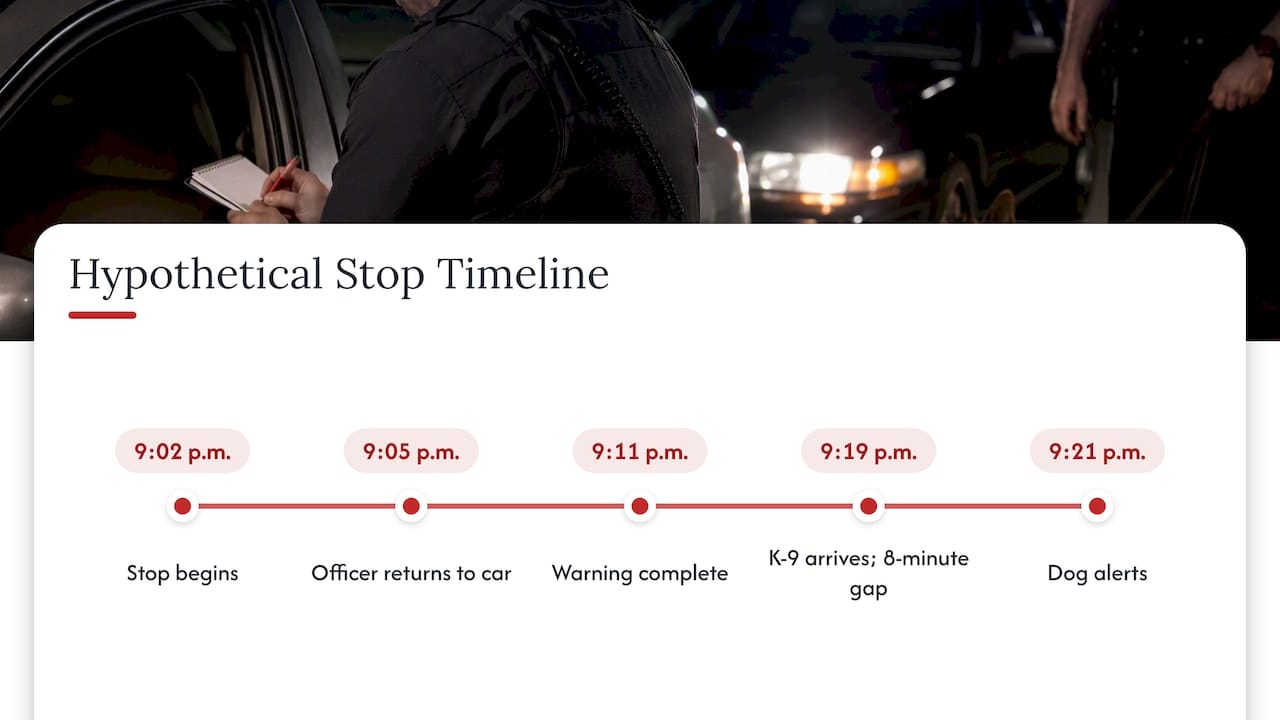
A short example of how a timeline works
This is a hypothetical to show the method, not a real case. Suppose a stop starts at 9:02 p.m. for a broken tag light. The officer asks for license, registration and insurance and returns to his car at 9:05. The body camera shows him finishing the warning at 9:11 but waiting until a K-9 unit arrives at 9:19, and the dog alerts at 9:21. A defense lawyer would ask what the officer was doing between 9:11 and 9:19, whether anything made him suspect more than a tag light, and whether he was still diligently pursuing the stop’s purpose. If the answers are “nothing” and “no,” the extension is the argument. If the officer was still waiting on a return from dispatch about an unresolved registration, the State has a better case.
Passengers and other appeals
You do not have to be the driver. A Fifth District appeal involved a passenger challenging the denial of his motion to suppress evidence found after a traffic stop of the vehicle he was riding in. A Third District appeal involved a driving under the influence conviction after the denial of a motion to suppress. Those opinions show the issue regularly gets to the district courts. They do not predict your result.
Evidence to preserve
Because timelines matter, your lawyer should ask for and preserve:
- body-camera and dash-camera video,
- dispatch and CAD records showing times of each call,
- the citation or warning and when it was written,
- K-9 deployment and training records, and
- the officer’s report and any supplemental narratives.
If you were arrested for DUI, other deadlines run at the same time. A refusal to take a breath test triggers its own clock, covered in our page on the 10-day window after a breath test refusal, and the DUI penalties page explains what is at stake.
What happens at the hearing
The process runs in two steps. First, the judge tests whether the motion is legally sufficient on its face. A motion that only says “the search was illegal” risks failing that threshold, because the rule demands the identified evidence, the legal reasons and a general factual basis. If it clears that step, the judge receives evidence on the disputed facts.
At the evidentiary hearing:
- The officers testify, usually the State’s witnesses first.
- Your lawyer cross-examines, using video and reports to test the timeline.
- Either side may call other witnesses or play recordings.
- Lawyers argue the law.
- The judge rules, from the bench or later in writing.
A good motion separates each challenged event: the stop, the detention, any consent, the warrant, the interrogation and the arrest. For each, it names what evidence flowed from it. That structure helps the judge, and it keeps one weak argument from sinking a strong one.
The defendant usually does not need to testify. Whether you should is a strategy decision for you and your lawyer, because testimony at a suppression hearing can be used to cross-examine you later in some circumstances. Ask your lawyer about that risk before the hearing, not at it.
What happens after the ruling
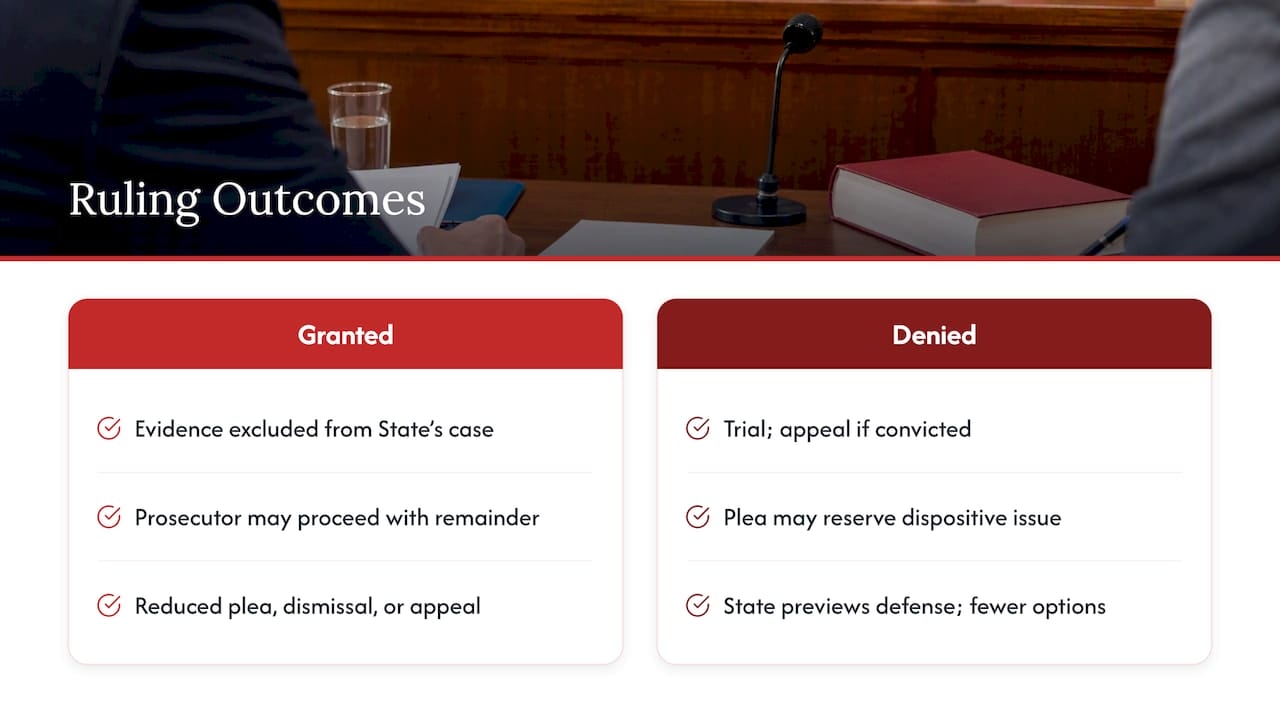
If the motion is granted. The suppressed evidence is out of the State’s case. The prosecutor then decides whether to proceed with what remains, offer a reduced plea, dismiss, or appeal where the law allows.
If the motion is denied. You have several choices. You can go to trial and raise the issue on appeal if convicted. Or you can enter a plea and reserve the right to appeal the ruling, if the evidence was dispositive. In Simmons v. State, the defendant pleaded guilty and reserved the right to appeal the denial of his dispositive motion to suppress a firearm found after a traffic stop. The Second District affirmed. Denoncourt shows the same pattern, a suppression ruling carried through a dispositive plea and appellate review. Reserving the issue depends on the plea terms and the court’s approval, so a lawyer must handle it in writing. Our page on no contest pleas under Rule 3.172 lists questions to ask before you plead.
The risk of losing is real. A denied motion gives the State a preview of your defense and may leave you with fewer good options. A lawyer should weigh that before filing, and a motion can still be worth filing for leverage even when the odds are modest, because it forces officers to testify under oath.
Our perspective
We handle criminal defense in Brevard County, and the first thing we do with a new case is look for the moment the State’s evidence became the State’s evidence. Was it the stop? The question at the car window? The phone request? Cases are often decided there, long before a jury is picked.
Three habits shape how we approach suppression:
- We read the video before we read the story. Officer reports summarize. Body-camera footage has a clock. We build the timeline from the recordings and then compare it to the paperwork.
- We tie every argument to an item. A motion that tries to do everything tends to persuade no one. We decide what the State actually needs and aim at that.
- We tell you the downside. A motion can lose. We explain what that means for your plea options and for your case before we file, and the decision is yours.
Because we are a small office, you speak directly with your attorney, not a rotating cast. That matters in suppression work, since the details you remember about a stop, such as how long you waited, who else was there, and whether anyone asked to search, can be the facts that matter at the hearing.
— John
Work with a Brevard County criminal defense lawyer
If you or someone you love has been charged and you suspect the stop, search or questioning crossed a line, bring us the paperwork and any video you have. We offer free 30-minute consultations to talk through the facts, what a motion to suppress could realistically accomplish and what deadlines apply. You can read about our Florida criminal defense and DUI work, including drug charges, which frequently start with a traffic stop. If you live outside the area, see our page for out-of-town defendants in Brevard County.
What to do in the first weeks of a case
- Write down everything you remember about the stop or search while it is fresh: times, locations, what officers said, who was present.
- Do not discuss the case with police or on social media. Statements can become evidence, and they may be the thing a motion tries to suppress.
- Save your own evidence: photos of the location, texts, receipts or dash-camera footage from your car.
- Hire a lawyer early. Discovery requests, video preservation and motion deadlines all run from the start of the case.
- Ask what the deadline is for filing pretrial motions in your judge’s division, and get it in writing.
- Ask about related deadlines, such as license issues. If your arrest involved a suspended license, see our overview of driving while license suspended in Florida.
FAQ
What are the grounds for a motion to suppress in Florida?
For searches, the rule lists a seizure without a warrant, a facially insufficient warrant, property not described in the warrant, a warrant without probable cause, and illegal execution of a warrant. Statements can be suppressed when they were unlawfully obtained, for example in violation of Miranda or because they were involuntary. Each ground must be tied to specific evidence.
Does winning a motion to suppress get my case dismissed?
Not automatically. A successful motion usually excludes the challenged evidence from the State’s case. If that evidence was essential, the prosecutor may drop the charge or be unable to proceed. If the State has other proof, the case can continue.
When do I have to file a motion to suppress?
Before trial, or by the deadline the trial judge sets. The amended rule preserves exceptions for good cause or when the State does not object, but you should not rely on them. Ask your lawyer for the exact date in your division and request discovery early.
Can I file a motion to suppress after a traffic stop?
Yes, if the stop or what happened during it violated your rights. Common arguments are that the stop had no lawful basis or that officers extended it beyond its traffic purpose, for instance to wait for a drug-sniffing dog without reasonable suspicion. The outcome depends on a precise timeline, so video and dispatch records matter.
Sources
- Supreme Court of Florida opinion amending Rule 3.190
- FindLaw: Florida Rule of Criminal Procedure 3.190
- State v. Denoncourt, Fifth District Court of Appeal (2024)
- Simmons v. State, Second District Court of Appeal (2025)
- Fifth District Court of Appeal opinion on passenger suppression appeal
- Third District Court of Appeal DUI suppression opinion
- Sixth Circuit appellate division opinion on traffic stop and mistake of law
- Ninth Circuit appellate opinion, Norwood v. State