Florida’s speedy trial rule gives the state 90 days to bring a misdemeanor to trial and 175 days for a felony. Since July 1, 2025, those days run from the filing of formal charges, not from the arrest. If you are charged and want a faster track, you can file a demand for speedy trial, which pushes the state to trial within 60 days. If the deadline passes, you do not walk free the next morning. The state still gets a recapture window first.
This guide explains the current rule in plain terms, what changed, how a demand differs from the automatic deadline, and why defense lawyers often advise waiving the right altogether. It is general information, not advice on your case. Deadlines depend on the exact charge, the dates in your file and what the court has already done.
TL;DR
- Under Rule 3.191 as rewritten in 2025, trial is due within 90 days (misdemeanor) or 175 days (felony), counted from formal charges.
- A demand for speedy trial is a separate, faster track: the state must bring the case to trial within 60 days, and you must be ready to try it.
- When a deadline expires, you file a notice of expiration. The court holds a hearing, and the state gets a mandatory 30-day recapture period before any discharge.
- Waiving speedy trial is common because most defenses need time to investigate. Once you sign a written waiver, you can no longer force the state’s hand under the rule.
- Deadlines for filing charges after arrest are governed by a different rule, 3.134.
Table of Contents
- What the speedy trial rule actually promises
- The 2025 changes in one table
- Two clocks: charging deadlines and trial deadlines
- The procedural limbo problem
- Demand for speedy trial: the 60-day track
- What happens when the deadline passes
- Should you waive speedy trial?
- Our perspective
- If you have been charged in Brevard County
- Common mistakes to avoid
- FAQ
- Sources
What the speedy trial rule actually promises
Two sources sit behind the right. Florida law says that in all criminal prosecutions the state and the defendant each have a right to a speedy trial, and it tells the Supreme Court to write the procedures. Those procedures are Florida Rule of Criminal Procedure 3.191. Separately, the state and federal constitutions protect a speedy trial right that exists independently of the rule.
That distinction matters. The rule is a bright-line timetable. The constitutional right is a broader, case-by-case question about delay and prejudice. A defendant can waive the rule’s deadlines while the constitutional right continues to exist, and a rule violation and a constitutional violation lead to different outcomes, as described below.
The rule also has a plain purpose: it keeps cases from sitting for years while a person lives under bond conditions, a pending charge and the stress that goes with them. It also protects the state, which has its own interest in trying cases while witnesses remember and evidence is fresh.
The 2025 changes in one table
The Florida Supreme Court amended the rule on its own motion in March 2025, and the new version took effect July 1. The headline changes:
| Topic | Before July 1, 2025 | Now |
|---|---|---|
| Start of the clock | Arrest | Filing of formal charges |
| Misdemeanor deadline | 90 days | 90 days |
| Felony deadline | 175 days | 175 days |
| Recapture period after notice of expiration | Shorter, and not in every scenario | 30 days, mandatory |
| Demand for speedy trial | Trial within 45 days | Trial within 60 days |
The first row is the one that changes real lives. Under the old approach, an arrest started a ticking clock. Now nothing starts until the state files an information or an indictment. The opinion itself pairs the speedy trial amendment with an amendment to Rule 3.134, which governs how long the state can take to file charges.
Two clocks: charging deadlines and trial deadlines
People often blend these together, so separate them.
Clock one: filing formal charges (Rule 3.134). After an arrest, the state has to file formal charges within set limits. Per the text of Rule 3.134:
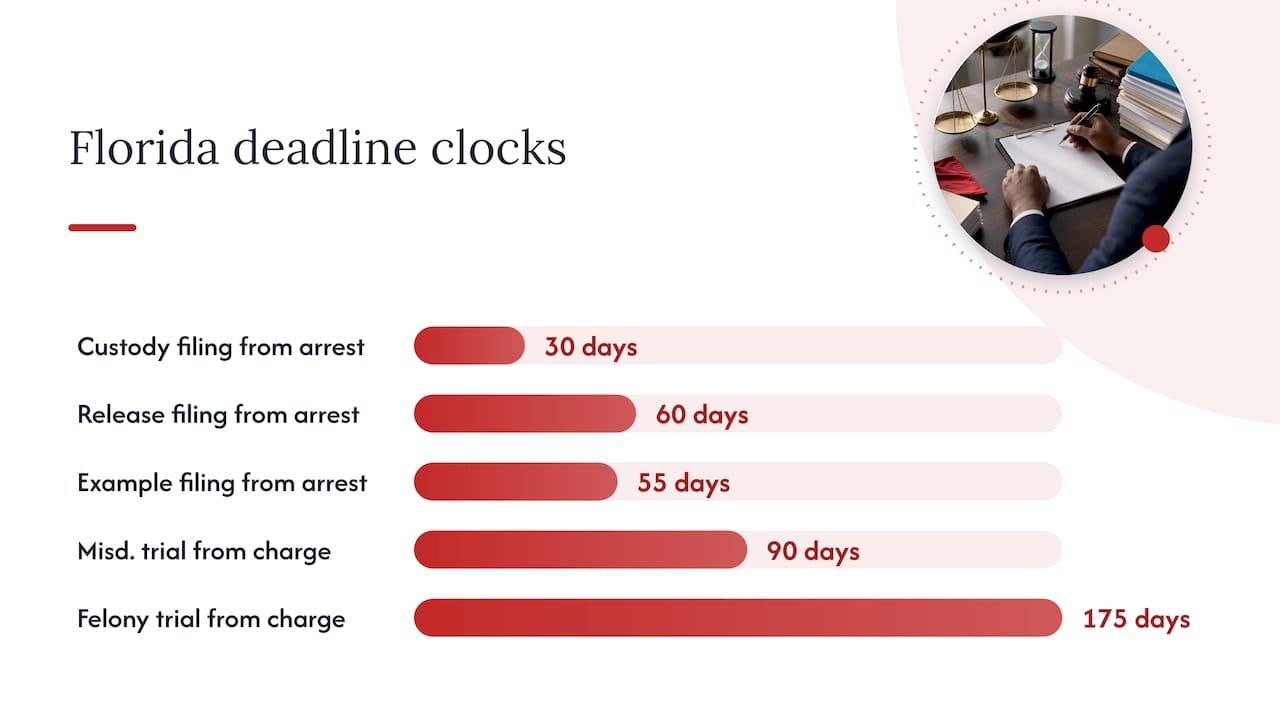
- If you are held in custody, the state has 30 days to file formal charges. If it misses that, the court sets a new deadline on the 33rd or 40th day depending on whether the state shows good cause. No one can stay in custody past 40 days without formal charges.
- If you are out on pretrial release, the state has 60 days from arrest. If it misses that, the court can order release from bail conditions on the 63rd day, or on good cause continue things up to 30 more days.
This is where the “33-day rule” people search for comes from.
Clock two: bringing you to trial (Rule 3.191). Once formal charges are filed, the 90-day or 175-day period starts.
A concrete example: you are arrested on a felony and bonded out on day two. The state has until roughly day 60 after arrest to file charges, subject to the extension described above. Say it files on day 55. The 175-day trial period then runs from day 55, not from the arrest. Your total possible wait from arrest to a required trial date is longer than it used to be.
The procedural limbo problem
Justice Labarga’s dissent to the 2025 amendments raised a concern worth understanding. When the clock starts at charging rather than arrest, investigators have less pressure to move fast. A person can be arrested, released with conditions and left waiting while the investigation continues, without the protection of any trial deadline. The Court’s own opinion is where that dissent appears.
If you are in that gap, practical steps matter more than the rule:
- Calendar the Rule 3.134 dates from your arrest. They are your only hard deadlines before charges exist.
- Keep every bond condition. Falling out of compliance hands the state an easy argument for good cause or a revocation.
- Talk to a defense lawyer before you talk to investigators. Early counsel can sometimes engage with the prosecutor before charging decisions are made.
Bail is a related worry for families. If a loved one is in custody while charges are pending, a Florida bond agency can explain the process, and one bail bond company’s article on why early legal representation changes bail outcomes covers how delayed charging and the lack of a trial clock affect people waiting on a case.
Demand for speedy trial: the 60-day track
You do not have to wait for the 90 or 175 days to run. After formal charges, a defendant can file a demand for speedy trial. According to the Court’s opinion, the demand compels the state to bring the case to trial within 60 days. The same source says that to qualify, the defendant must be prepared for trial and have diligently investigated the case, because the demand is a formal declaration of readiness.
That last requirement is where demands go wrong. Filing one when you have not seen the discovery, interviewed witnesses or hired an expert can backfire. A court can treat a demand filed by an unprepared defense as improper.
When does a demand make sense?
- The state’s case is thin and likely to weaken under time pressure, for example a witness who has been hard to locate.
- You already have what you need: the discovery is complete, the defense is simple and no expert is required.
- Delay is costing you something concrete, like a job that depends on the charge being resolved.
When does it not? Cases that turn on lab results, digital evidence, medical records or an expert witness rarely fit into 60 days. If your case needs expert witnesses, a demand can leave you trying a case before your defense exists.
What happens when the deadline passes
Many people assume that day 176 means dismissal. It does not. The process, per the Supreme Court’s opinion, runs like this:
- The speedy trial period expires without a trial.
- The defense files a notice of expiration.
- The court must hold a hearing within 5 days.
- The state receives a mandatory 30-day recapture period to bring the defendant to trial.
- If trial does not begin within those 30 days, the defendant may be discharged.
Two cautions follow. First, the 2025 amendments make the recapture period mandatory in every scenario, so there is no route to immediate release. Second, dismissals are generally without prejudice. Under the opinion, the state can usually refile unless the defendant proves a violation of the constitutional right to a speedy trial. A rule-based dismissal may therefore buy time rather than end the case, and statutes of limitation and the seriousness of the charge decide whether refiling is realistic.
The rule text itself is available on Florida court rules sites, and your lawyer will check the current version because rules are amended periodically.
Should you waive speedy trial?
Most defendants do, at some point, and it is usually a strategic choice rather than a concession. Good defense work takes time. A lawyer has to receive and review discovery, depose witnesses, test the state’s science, find defense witnesses and sometimes retain experts. Practitioners commonly treat the waiver as the price of doing that properly, since the 60-day track leaves too little room for it.
The waiver is typically a short written document. A sample form used in Brevard County’s circuit shows that the defendant and attorney both sign, and it refers to the constitutions and the Florida rule. Read it as a lawyer would: it is an unconditional statement, and once it is signed you cannot make the state meet the strict timetable.
Case law confirms that the effect can be broad. In Thompson v. State ex rel. Mitchell, the court considered whether an express, unconditional waiver in a stipulation for continuance waived the defendant’s speedy trial rights. Even a request for more time can count, so do not agree to a continuance casually.
A simple way to decide
| Question | Leans toward waiving | Leans toward keeping or demanding |
|---|---|---|
| Is discovery complete? | No | Yes |
| Does the defense need an expert or testing? | Yes | No |
| Are key defense witnesses unlocated? | Yes | No |
| Is the state’s case time-sensitive? | No | Yes |
| Are you in custody on the charge? | Often waived anyway, with a bond fight | Demand may be worth considering |
No table replaces a conversation with counsel who has read your discovery. If you are interviewing lawyers, our list of questions to ask a criminal defense attorney covers trial experience and how fees work.
Our perspective
We see speedy trial more as a tool than a right to protect at all costs. The instinct of most clients is to say “I want this over with,” and we understand it. A charge sits on your life. But the fastest trial is rarely the best trial.
Our job at the start of a case is to find out what the state actually has. That means reading the discovery, talking with you in detail, and deciding where the weaknesses are. Some cases do improve with speed, particularly where the state’s evidence depends on a witness who may not cooperate. Many more improve with time, because the defense has to catch up to months of police work.
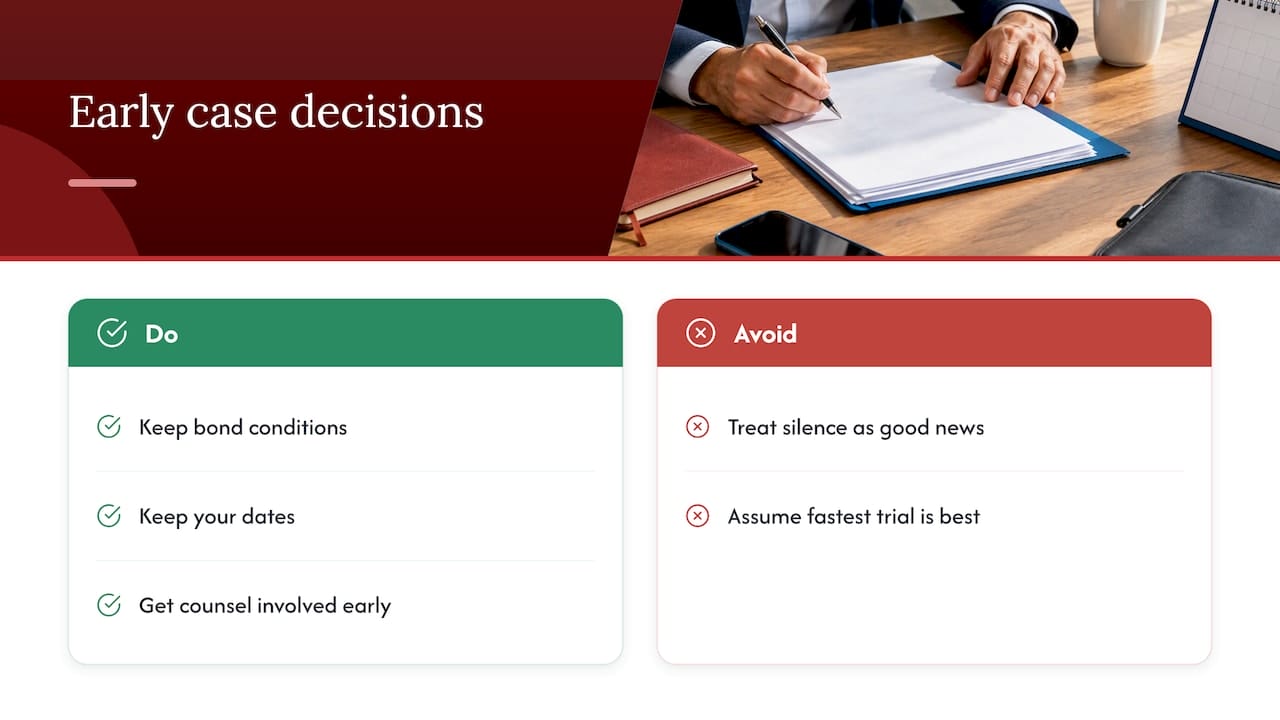
We also think the 2025 change deserves more attention from the public than it has received. When the clock starts at charging, the waiting period before charges is the part nobody can control, and clients feel it. If you have been arrested and nothing has been filed, do not read silence as good news. Keep your bond conditions, keep your dates, and get counsel involved early. We would rather explain the deadlines in a free consultation than have you learn about them after one passes.
We handle criminal matters across Brevard County, and our approach is direct attorney contact, so the person who explains your options is the person in court with you. Our guide to how the criminal defense process works walks through the stages from arrest to resolution.
— John
If you have been charged in Brevard County
A speedy trial question is really a timing question, and timing questions are best answered with your paperwork on the table. Bring your arrest report, bond documents, any notice to appear and anything the court has mailed you. We offer free 30-minute consultations to review where you stand and what the deadlines mean for your case. See our Florida criminal defense practice, including DUI defense, or visit our main page to get in touch. If you live outside the area but are facing a Brevard County case, read about out-of-town defendants.
Common mistakes to avoid
- Filing a demand too early. If you have not investigated the case, the demand can be challenged as improper.
- Assuming expiration means dismissal. The notice, the hearing and the 30-day recapture window all come first.
- Signing a waiver without understanding it. A waiver in a continuance stipulation can be treated as unconditional.
- Counting from the arrest date. For cases governed by the 2025 rule, the trial clock starts with formal charges.
- Ignoring the pre-charging period. Rule 3.134 has its own deadlines, and bond compliance matters during that stretch.
- Forgetting related deadlines. A DUI arrest, for instance, carries separate administrative time limits, such as the 10-day window after a breath test refusal.
FAQ
What is the new speedy trial rule in Florida?
Since July 1, 2025, Rule 3.191 counts the 90-day misdemeanor and 175-day felony periods from the filing of formal charges instead of the arrest. The recapture period after a notice of expiration is now a mandatory 30 days. A demand for speedy trial requires trial within 60 days.
How fast can you get a speedy trial in Florida?
The fastest route is a demand for speedy trial, which calls for trial within 60 days, with a hearing no sooner than the minimum period the rule sets. You must be prepared and have investigated the case. Many cases cannot be responsibly tried that quickly.
What is the 33-day rule in Florida?
It comes from Rule 3.134. If you are in custody and the state has not filed formal charges within 30 days of arrest, the court sets a new deadline on the 33rd or 40th day. No one can be held in custody past 40 days without formal charges.
Can I waive speedy trial in Florida, and can I undo it?
Yes, a defendant can waive the rule’s deadlines, usually in writing and often through a continuance. Once the waiver is signed, you generally cannot force the state to meet the rule’s strict timetable. Ask your lawyer whether a limited or later demand is available in your situation before you sign.
Does missing the deadline get my case dismissed?
Not automatically. You file a notice of expiration, the court holds a hearing, and the state gets 30 more days to try you. A discharge can follow if that window passes, but it is generally without prejudice, so the state may be able to refile.
Sources
- Florida Supreme Court opinion SC2022-1123 (amending Rules 3.191 and 3.134)
- The Florida Bar News: Florida Supreme Court reworks speedy trial and formal charges timeline
- Florida Statutes 918.015: Right to speedy trial (2025)
- Rule 3.134: Time for Filing Formal Charges
- Fla. R. Crim. P. 3.191: Speedy Trial
- Waiver of Speedy Trial form, 15th Circuit
- Thompson v. State ex rel. Mitchell, PlainSite