
Co-parenting with a narcissist works best when you stop trying to cooperate in the usual sense. You communicate in short, factual, documented messages, you rely on a detailed court-approved parenting plan instead of goodwill, and you take violations back to the court rather than arguing about them. This guide explains how to do that, what mediation can and cannot do, and how Florida law fits in. It is written for parents in Brevard County and across Florida.
TL;DR
- Treat the relationship like a business arrangement: written rules, factual messages, and every exchange documented on a platform that keeps timestamped records.
- Focus on behavior you can prove, not on the label “narcissist.” Judges rule on conduct and the child’s best interests, not diagnoses.
- A specific, detailed parenting plan is your best protection. Vague plans give a high-conflict parent room to exploit.
- Mediation can work, but only with a mediator who understands high-conflict dynamics and sets firm ground rules. If there is abuse or a safety risk, tell your attorney before agreeing to mediate.
- When violations pile up, the remedy is the court, not a bigger argument.
Table of Contents
- What “narcissistic co-parent” usually means in practice
- Change the goal: from cooperation to containment
- Communication rules that actually hold up
- Build a parenting plan that leaves no room to maneuver
- Mediation with a narcissist: possible, but not standard
- When safety is the issue
- Our perspective
- When to go back to court
- Protect your child and yourself day to day
- How we can help
- FAQ
- Sources
What “narcissistic co-parent” usually means in practice
Most people who say their ex is a narcissist are describing a pattern: demanding admiration, acting superior, brushing off other people’s feelings. As one co-parenting platform’s guide notes, most co-parents who act this way do not have Narcissistic Personality Disorder, which is a clinical diagnosis only a qualified professional can make.
That distinction matters for your case. You do not need a diagnosis to protect your child, and you probably will not get one for your ex in court. What you need is a record of specific behaviors: late pickups, changed plans, ignored messages, bad-mouthing in front of the child, refusing agreed schedules.
In practice, the pattern looks like this:
- Counter-parenting. Undoing your rules, such as bedtime or homework, to look like the fun parent.
- Gaslighting. Denying things said or agreed to, so you doubt your own memory.
- Using the child as a messenger or a weapon. Last-minute schedule changes, guilt trips, or withholding the child.
- Escalation on demand. Every message becomes an argument, and every argument becomes about you.
If you want a closer look at how this plays out in a divorce, see our piece on the complexities of narcissism in divorce.
Change the goal: from cooperation to containment
Traditional co-parenting advice assumes two adults who both want a calm handoff. With a narcissistic ex, that assumption fails. The custody resource Custody X Change describes the workable approach as treating co-parenting like a business relationship: detailed rules, firm boundaries, and documentation of everything.
That shift changes what success looks like. Success is not your ex becoming reasonable. Success is a predictable routine for your child and a paper trail that protects you if the court needs to step in.
Parallel parenting versus co-parenting
When direct cooperation keeps breaking down, many families move to parallel parenting: each parent runs their own household with minimal contact, and the parenting plan spells out the rest. Exchanges happen at set times and places, communication is limited to the child’s logistics, and neither parent needs the other’s approval for day-to-day decisions made during their own time.
For tools and habits that make this work in Florida, read our guide to co-parenting apps, habits and parallel parenting.
Communication rules that actually hold up
Put everything in writing, on a platform that keeps the record
Legal and mental health professionals commonly recommend dedicated co-parenting platforms. OurFamilyWizard describes its tool as creating a permanent, timestamped record of messages, including logs of when a message was read, which prevents a parent from claiming they never received critical information. Some platforms also flag hostile wording before it is sent. Ask your attorney whether a specific platform can be required in your parenting plan.
Keep your own copies of anything that happens outside the platform: texts, emails, voicemails, photos of schedule violations, with dates.
Use the BIFF rhythm: brief, informative, firm, factual
Experts quoted in the same guide advise focusing on objective, verifiable behavior rather than the label. Avoid feelings, intentions and diagnoses, because emotional content gives a narcissistic co-parent the attention that fuels the conflict. Keep messages to concrete requests and what happens if they are not met.
| Instead of | Write |
|---|---|
| “You always do this. You’re so selfish and you know it.” | “Pickup is 5:00 PM Friday at the agreed location.” |
| “Why did you cancel on her again? She was crushed.” | “You canceled Saturday’s time. Please confirm whether you will use Sunday’s make-up time by 6:00 PM Thursday.” |
| “I’m not going to let you talk to me like that.” | No reply to the insult. Answer only the logistics. |
Do not explain your boundaries
A common mistake is justifying every limit. According to Custody X Change, any explanation tends to become fodder for more argument or manipulation. The cleaner approach is to give the necessary information with no justification, emotion or filler.
Grey rocking, used carefully
Psychologist Amelia Kelley describes grey rocking as being as uninteresting and emotionally unreactive as possible, so the other person gets less of the reaction they seek. She notes that it takes patience and consistent boundaries over time. It is not stonewalling: you still answer legitimate questions about the child promptly and politely. You just stop feeding the drama.
Build a parenting plan that leaves no room to maneuver
Florida law starts from shared parental responsibility unless the court finds it would be detrimental to the child, and the statute directs the court to consider, among other things, each parent’s willingness to honor the time-sharing schedule and be reasonable when changes are needed. A well-drafted plan puts those expectations into concrete terms.
The details that matter most with a high-conflict parent:
- Exact schedule. Days, start and end times, and holiday rules written out, not “reasonable time-sharing.”
- Exchange logistics. Location, who drives, what happens if someone is late. See our guide to custody exchanges in Florida.
- Communication method. One platform, response windows, and limits on contact outside it.
- Decision-making. Which decisions are shared (schooling, major medical) and how a deadlock is resolved.
- Change and make-up rules. How much notice is required, and what counts as a missed visit.
- Consequences. What you will ask the court to do for repeated violations.
Our Florida child custody and time-sharing guide walks through how these terms work in Brevard County.
Mediation with a narcissist: possible, but not standard
Mediation can save time and money, and a parenting plan you helped write is often easier to enforce than one imposed on you. But a narcissistic parent may treat the table as a stage.
Mediator Joy Qiao argues in Mediate.com that traditional neutrality can fail when one party weaponizes the process. She advocates “strategic empathy”: acknowledging the person’s need for validation or image while holding rigid boundaries so the power imbalance is not exploited. The same article stresses firm boundaries and deadlines from the start.
What that means for you:
- Ask about high-conflict experience. A mediator should be able to explain how they handle interruptions, personal attacks and last-minute reversals.
- Prepare an agenda in advance. Keep to issues of the child’s schedule, decisions and logistics.
- Expect posturing. Agreements reached verbally are meaningless until they are written and signed.
- Consider separate rooms. Ask whether the mediator can work with each side in separate sessions if joint sessions turn into confrontation.
- Do not mediate under pressure or fear. If you are afraid of your ex, tell your attorney first. Some cases belong in front of a judge.
For how this works in a family case, see our page on family mediation. Our guide to high-conflict divorce best practices covers the bigger picture.
When safety is the issue
Controlling behavior is exhausting. Violence or threats are a different matter, and they change the legal playbook. Call 911 if you or your child are in immediate danger.
Florida’s domestic violence benchcard for judges notes that, in an injunction case, a court may issue a temporary parenting plan that awards the petitioner up to 100 percent of the time-sharing. Courts also address exchange arrangements with safety in mind. The judiciary’s own injunction hearing protocol tells judges to address time-sharing carefully in a temporary parenting plan with the safety of the parties and children in mind. Your attorney can tell you how these tools apply to your facts.
If police have been involved, the arrested parent’s release conditions can affect contact and exchanges. This overview of domestic violence bail options explains how bail works in these cases generally; rules vary by state, so ask your Florida attorney how they apply to you.
Related reading from our firm:
- Domestic violence and child custody in Florida
- How domestic violence affects custody
- Domestic violence and divorce in Florida
Our perspective
We see the same pattern again and again: a parent arrives exhausted, certain the other side is a narcissist, and wants the court to say so. We understand the impulse, and we do not dismiss it. But the strongest cases we help build rarely hinge on the label.
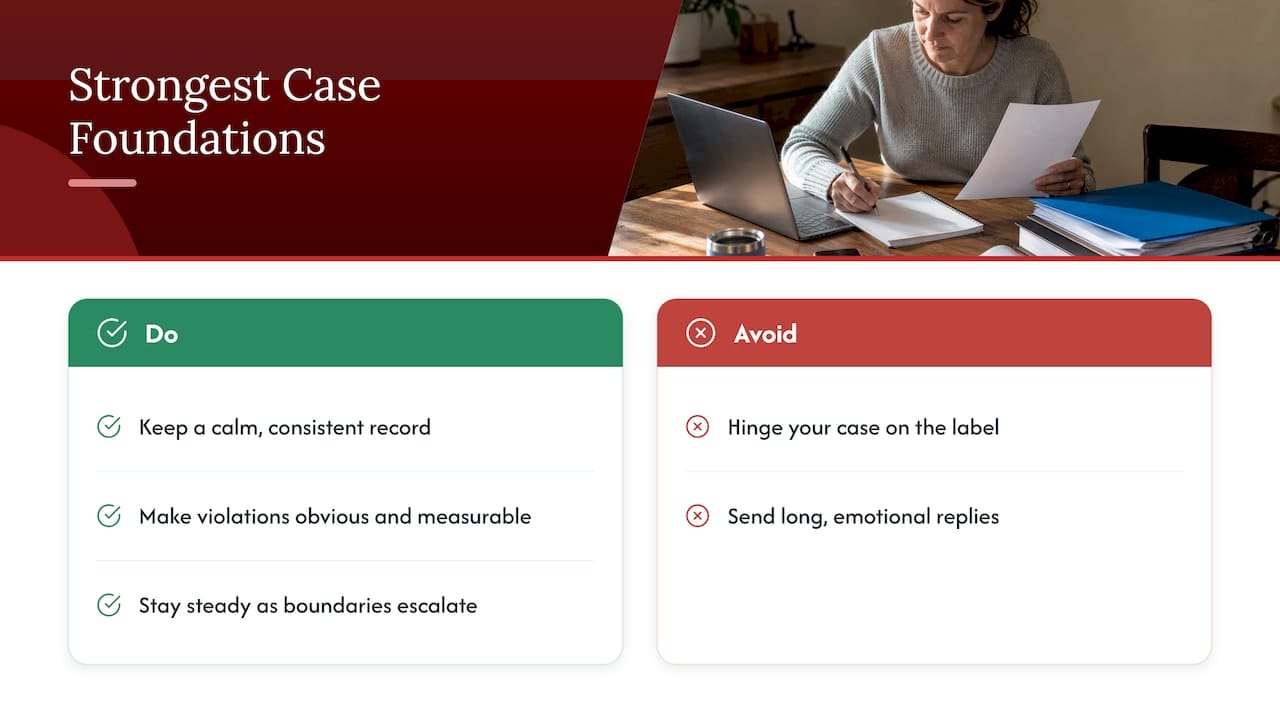
They hinge on three things. First, a calm, consistent record. A parent who answers in two factual sentences, week after week, looks very different on paper from one who sends long, emotional replies, even when the provocation is real. Second, a parenting plan detailed enough that violations are obvious and measurable. Third, patience. High-conflict parents often escalate when boundaries are first set. Staying steady through that stretch is usually what changes the outcome.
Our firm has focused on family law in Brevard County for 85 years of combined experience, including high-conflict divorces, military families, and cases involving narcissistic personality traits. We are also certified in mediation, so we can tell you honestly when mediation is worth trying and when it would hand your ex another platform. You speak directly with your attorney, and we build the strategy around your child and your facts, not a template.
— John
When to go back to court
Documentation is only useful if you use it. Consider talking to an attorney when:
- Your ex repeatedly misses, shortens or changes exchanges without agreement.
- The child is being kept from you or from the schedule.
- Messages cross into threats, harassment or intimidation.
- The plan itself no longer fits your child’s needs or your ex’s behavior.
Florida courts can enforce time-sharing orders through contempt proceedings. We explain the process in contempt for time-sharing violations. If substance abuse is part of the picture, read substance abuse and child custody in Florida.
Also note that Florida may require divorcing or separating parents to complete a state-approved parenting course. The statute describes a course of at least four hours approved by the Department of Children and Families. Ask your attorney whether your judge requires it.
Protect your child and yourself day to day
The court plan covers the structure. These habits cover the rest:
- Keep your child out of the conflict. Never ask them to carry messages, take sides or report on the other home.
- Do not badmouth. It will be used against you, and it hurts the child.
- Be the stable home. Predictable routines are the best counterweight to chaos at the other house.
- Get support. A therapist for you, and for your child if they are struggling, is not a sign of losing. It is part of a good record and a good recovery.
- Keep a simple log. Date, event, evidence. No commentary.
How we can help
If you are co-parenting or preparing for a custody case in Brevard County, our family law team can review your situation, your current order or draft plan, and your documentation. We offer a free 30-minute consultation. If your spouse is on active duty, see our military family law FAQs for the added issues.
FAQ
Can you call someone a narcissist in court?
You can, but it rarely helps. Judges are not deciding whether your ex has a personality disorder; they are deciding what arrangement serves the child. Present specific, dated behaviors with evidence, and let the judge draw the conclusion. Only a qualified professional can diagnose NPD.
How do I communicate with a narcissistic co-parent?
Keep it brief, factual and in writing, ideally on a co-parenting platform that timestamps messages. Stick to the child’s logistics, skip explanations and emotion, and do not respond to insults. Save every message.
Can you mediate with a narcissist?
Sometimes. It works best with a mediator experienced in high-conflict cases who sets firm boundaries and deadlines. If you fear your ex or have a history of abuse, speak with your attorney before agreeing to mediate.
Is parallel parenting better than co-parenting for a narcissistic ex?
Often it is the more realistic option. Parallel parenting reduces direct contact, relies on a detailed written plan and limits communication to essentials. Whether it fits depends on your child’s needs and what the court orders, so discuss it with your attorney.
Sources
- How to Co-Parent with a Narcissist: Strategies & Cheat Sheet, OurFamilyWizard
- Co-Parenting With a Narcissist: Tips and Strategies, Custody X Change
- The Grey Rocking Guide for Co-parenting With a Narcissist, Psychology Today
- When Neutrality Fails: Rethinking Mediation with Narcissists, Mediate.com
- Florida Statutes, Section 61.13
- Florida Statutes, Section 61.21
- Domestic Violence Benchcard, Florida Courts
- Protocol for Injunction Hearings, Florida Courts