
A Brevard County divorce starts when one spouse files a Petition for Dissolution of Marriage with the Brevard County Clerk, after at least one of you has lived in Florida for six months. The other spouse is served and has 20 days to answer. Both sides then exchange financial information. The case ends with a settlement or a trial, and then a final judgment. An uncontested case can move quickly. A contested one takes as long as the unresolved issues require.
This guide walks through each stage in order, explains the three kinds of divorce Florida courts talk about, and covers the practical mistakes that cost people the most.
TL;DR
- You can file in Brevard County if at least one spouse has lived in Florida for six months before filing.
- The case starts with a Petition for Dissolution of Marriage, filed with the Brevard County Clerk along with a filing fee, unless the court waives the fee.
- Your spouse must be formally served, or sign a waiver, and has 20 days after service to respond.
- Financial disclosure is due within 45 days of service, and the type of divorce (simplified, uncontested or contested) sets your timeline.
- The Clerk’s Office cannot give legal advice, so talk to a family law attorney before you make decisions about the house, the children or support.
Table of Contents
- Step 1: Confirm you meet the residency requirement
- Step 2: File the petition with the Brevard County Clerk
- Step 3: Serve your spouse
- Step 4: Exchange financial disclosure
- Step 5: Know which kind of divorce you have
- Step 6: Resolve the issues: settlement, mediation or trial
- How long does a Brevard County divorce take?
- Mistakes to avoid during a Florida divorce
- Our perspective
- Talk to a Brevard divorce attorney
- FAQ
- Sources
Step 1: Confirm you meet the residency requirement
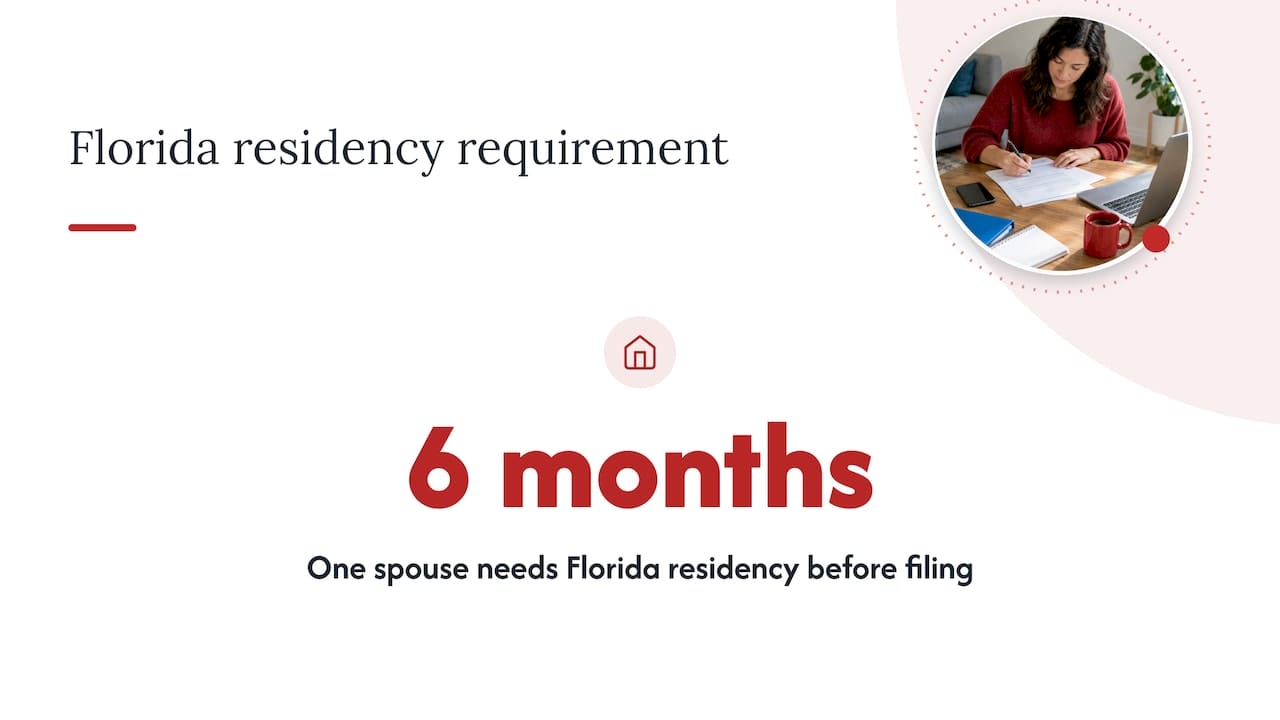
Florida requires that at least one spouse has lived in the state for six months immediately before the petition is filed. That rule comes from Section 61.021 of the Florida Statutes. Only one of you has to meet it. If your spouse moved out of state last year but you have lived in Brevard for a decade, you qualify.
Residency is the first thing a court looks at, so it is worth getting right. If you are close to the six-month mark, or you are a service member whose home state is unclear, read our page on Florida divorce residency requirements before you file. Military families in particular often have questions about which state’s courts apply, and we cover those on our military family law FAQs.
Step 2: File the petition with the Brevard County Clerk
The Brevard County Clerk’s instructions say a divorce case is started by filing a Petition for Dissolution of Marriage. The person who files is the petitioner. The other spouse is the respondent. Which one you are does not decide who wins anything. Florida is a no-fault state in the sense that you are not trying to prove your spouse did something wrong in order to end the marriage.
What you file depends on your situation:
- A petition stating that the marriage is irretrievably broken and that you meet the residency rule.
- Supporting family law forms that fit your case, including forms about any minor children.
- The filing fee, paid at the time of filing.
The fee can be waived. According to the Clerk, a petitioner who cannot afford the costs can file an Affidavit of Indigency (Form Law 929) swearing to that fact. For the current fee amount, check with the Clerk directly, because fees change.
A filing is only as strong as its details. Errors in names, dates of marriage or children’s information create delays later. That is one reason many people have an attorney prepare the petition even when they expect the case to be simple. Our Brevard County divorce overview and complete guide to divorce procedure in Florida go through the paperwork in more detail.
Step 3: Serve your spouse
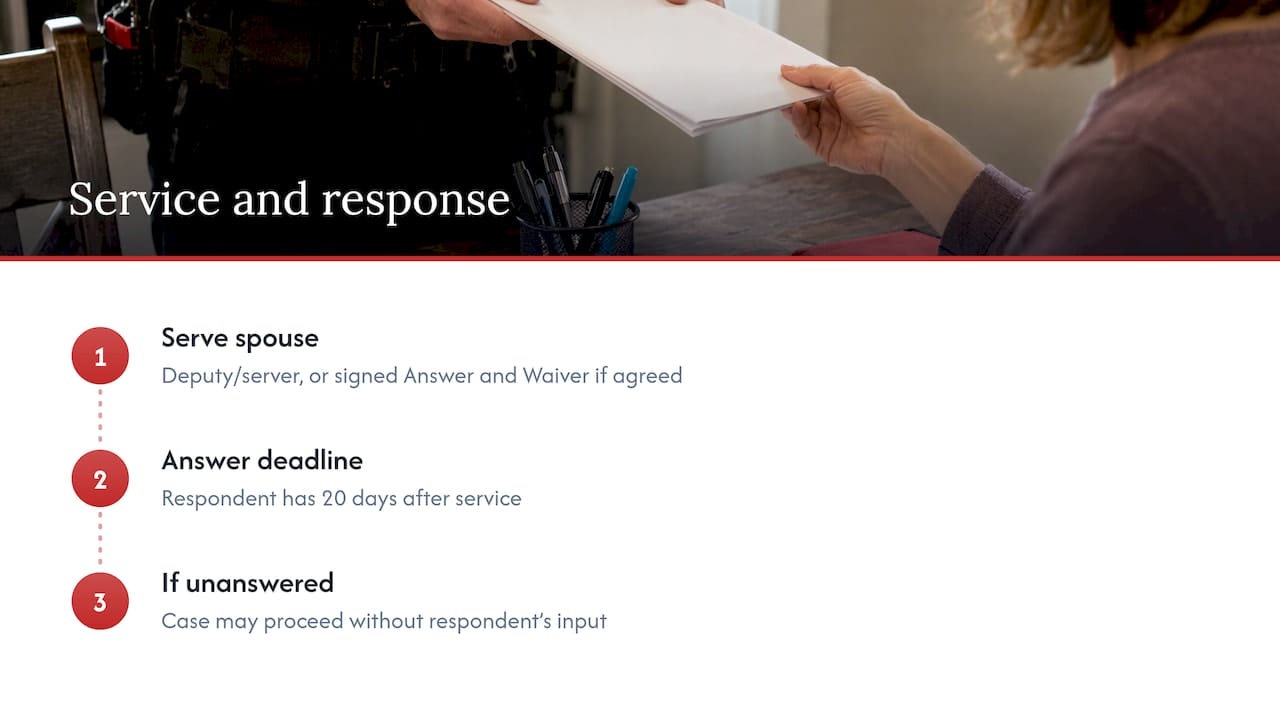
Filing is not enough. Your spouse has to be formally notified. The Clerk’s instructions explain that service of process is typically carried out by a deputy sheriff or a special process server. There is one shortcut: if your spouse agrees, they can sign an Answer and Waiver of Service instead.
After service, the respondent has 20 days to answer. That deadline is firm. A respondent who ignores it risks the case moving forward without their input, which can affect parenting time, property and support.
If you are the one who has been served, do not wait. Our page on responding to divorce papers in 20 days explains what an answer, and a counterpetition, can accomplish.
Step 4: Exchange financial disclosure
Florida expects both spouses to put their finances on the table early. The financial affidavit and a certificate of compliance with mandatory disclosure are due within 45 days of service of the petition, unless they were filed earlier or the spouses agree to waive disclosure. In contested cases, Rule 12.285 requires each side to produce certain documents and information to the other.
In practical terms, expect to gather:
- Tax returns and pay stubs
- Bank, retirement and investment statements
- Mortgage, car loan and credit card balances
- Insurance policies and a list of monthly expenses
Start collecting these before you file. People who wait until the deadline is close often discover missing statements and old accounts they had forgotten. We explain the rule and what to bring on our mandatory disclosure page.
Step 5: Know which kind of divorce you have
The Brevard County Clerk’s divorce FAQs separate divorces into three kinds. Which one you are in shapes the cost, the timeline and how much time you spend in court.
| Type | What it means | Typical fit |
|---|---|---|
| Simplified dissolution | No minor children, the wife is not pregnant, you agree on property and debts, and both of you attend the final hearing | Short marriages or couples with few shared assets |
| Uncontested | Every issue is resolved and set out in an agreement | Couples who settled everything, with or without children |
| Contested | Property, debt or child issues remain unresolved | Disputes over children, the home, a business or support |
If you qualify, the simplified route is the fastest. We cover the requirements on our simplified dissolution of marriage page. If you do not qualify, that does not mean a fight. Many contested cases start with open issues and end in an agreement after mediation.
Step 6: Resolve the issues: settlement, mediation or trial
Most divorces turn on a handful of questions. Each has its own rules.
Property and debt
A common question is whether the wife automatically gets half. She does not, and neither does the husband. Florida law requires that any distribution of marital assets and liabilities be supported by factual findings based on statutory factors, according to a Florida appellate court. The court looks at what is marital, what is separate, and what is fair given the facts. Our page on equitable distribution in Florida lists the documents that matter most.
If the marital home has to be sold, the tax consequences deserve attention before you list it. This guide to selling a house in divorce is a starting point for that conversation.
Alimony
Alimony is not automatic either. The same appellate decision states that a court must specifically determine whether either party has an actual need for alimony and whether the other has the ability to pay. Florida reformed its alimony law in recent years, and we answer the most common questions on our alimony FAQs.
Parenting and child support
When children are involved, the parents need a parenting plan covering time-sharing and decision-making, along with a child support arrangement. Courts focus on what serves the children. Parents who write their own workable plan usually keep more control than parents who leave it to a judge. Our family law practice page covers custody, visitation, child support and paternity, and our page on fathers’ rights in Florida addresses a question many dads ask first.
Mediation versus trial
Mediation puts both spouses and a neutral mediator in a room, often with their attorneys, to work out an agreement. It is private, usually faster than trial, and lets you shape the result instead of handing it to a judge. Our firm is mediation certified. If you are weighing the two paths, read mediation versus trial in a Florida divorce and our parent’s guide to the role of a mediator in family court.
How long does a Brevard County divorce take?
The Clerk’s FAQ says an uncontested divorce takes approximately 4 to 8 weeks once all required forms have been completed and filed. The key words are “once all required forms have been completed.” Missing disclosure, incorrect forms or a spouse who cannot be found will stretch that out.
A contested divorce has no standard timeline. It depends on how many issues are open, how quickly each spouse provides documents, how busy the court calendar is and whether you settle at mediation. A case that settles after one mediation session is a very different case from one that goes to trial over a business valuation.
Things that usually shorten the timeline:
- Filing complete paperwork the first time
- Signing a waiver of service when both spouses cooperate
- Sharing financial documents early
- Settling parenting and property terms before the hearing
Mistakes to avoid during a Florida divorce
People search for the biggest mistake in a divorce, and moving out of the marital home is one of the most common answers. There is no single rule that applies to everyone, and the right choice depends on your children, your safety, your finances and who stays in the house. What matters is that you do not make the decision casually. If you have children, leaving can affect the practical reality of day-to-day parenting before a plan exists. If there is any risk to your safety, your safety comes first, and you should speak to an attorney or a domestic violence advocate right away. Talk to a family law attorney before you move out or before you sign a lease.
Other mistakes we see:
- Missing the 20-day deadline after being served.
- Hiding or undervaluing assets. Mandatory disclosure exists so both sides work from the same facts.
- Posting about the case on social media. Anything you write can end up in front of a judge.
- Making large purchases or moving money while the case is pending without advice.
- Signing a settlement you do not understand because you want it to be over.
- Relying on the court staff for advice. The Clerk’s instructions say the Clerk’s Office cannot give legal advice and tell people who represent themselves to seek an attorney’s advice.
The last point matters. Court staff can explain where to file. They cannot tell you what to ask for, what to give up or what is likely to happen in your case.
Our perspective
Most people come to us on the worst day of their year. They want to know what happens next, and they want someone to tell them the truth. The Brevard process is not mysterious. It is a set of steps, deadlines and forms. The hard part is the decisions inside those steps.
We build each case around the person in front of us, and you work directly with your attorney. That matters in a divorce, where one wrong assumption about the house, the children or support can follow you for years.
Some divorces are not routine. High-conflict cases, including those involving a spouse with narcissistic traits, take a different strategy: clear records, firm boundaries, and a plan for dealing with a spouse who contests everything. Military divorces bring their own questions about jurisdiction, pensions and deployment schedules. We handle both, and we are mediation certified, so we can tell you honestly when a negotiated agreement serves you better than a courtroom.
Our goal is simple: a result you can live with, reached with as little damage to your family as the facts allow.
John
Talk to a Brevard divorce attorney
If you are ready to file, have been served, or are still deciding, we offer a free 30-minute consultation. We will go through your residency, your children, your finances and the type of divorce you are likely facing, and explain your next step. You can read more about our family law services, including mediation, or reach us through jmoorelegal.com.

The Law Office of John Vernon Moore, P.A. represents individuals and military families in Brevard County, Florida. For more general questions first, see our Florida divorce FAQs.
FAQ
Do I need a lawyer to get divorced in Brevard County?
Florida does not require you to hire one. The Brevard Clerk’s instructions do say that the Clerk’s Office cannot give legal advice and that people filing on their own should seek an attorney’s advice. If you have children, shared property, a business or a spouse who disputes the terms, an attorney protects your position at each step.
Does the wife automatically get half in a Florida divorce?
No. Florida courts must base any division of marital assets and debts on factual findings tied to statutory factors, and alimony requires a specific finding of need and ability to pay. Outcomes depend on the facts of your marriage, not on a fixed percentage.
How long do I have to respond if I am served with divorce papers?
You have 20 days after service to file an answer. Missing that deadline can let the case move ahead without your input. Contact an attorney as soon as you are served.
What is the difference between a simplified and an uncontested divorce?
A simplified dissolution requires no minor children, no pregnancy, agreement on property and debts, and both spouses at the final hearing. An uncontested divorce means everything is resolved in an agreement, and it can include children. A contested divorce has open issues that a court must decide if you cannot settle.
Sources
- Florida Statutes, Section 61.021: residency requirement
- Brevard County Clerk: instructions for filing a dissolution of marriage
- Florida Supreme Court Approved Family Law Form 12.903(b)
- Brevard County Clerk of Court: divorce FAQs
- Third District Court of Appeal opinion on equitable distribution and alimony
- Guide to selling a house in divorce