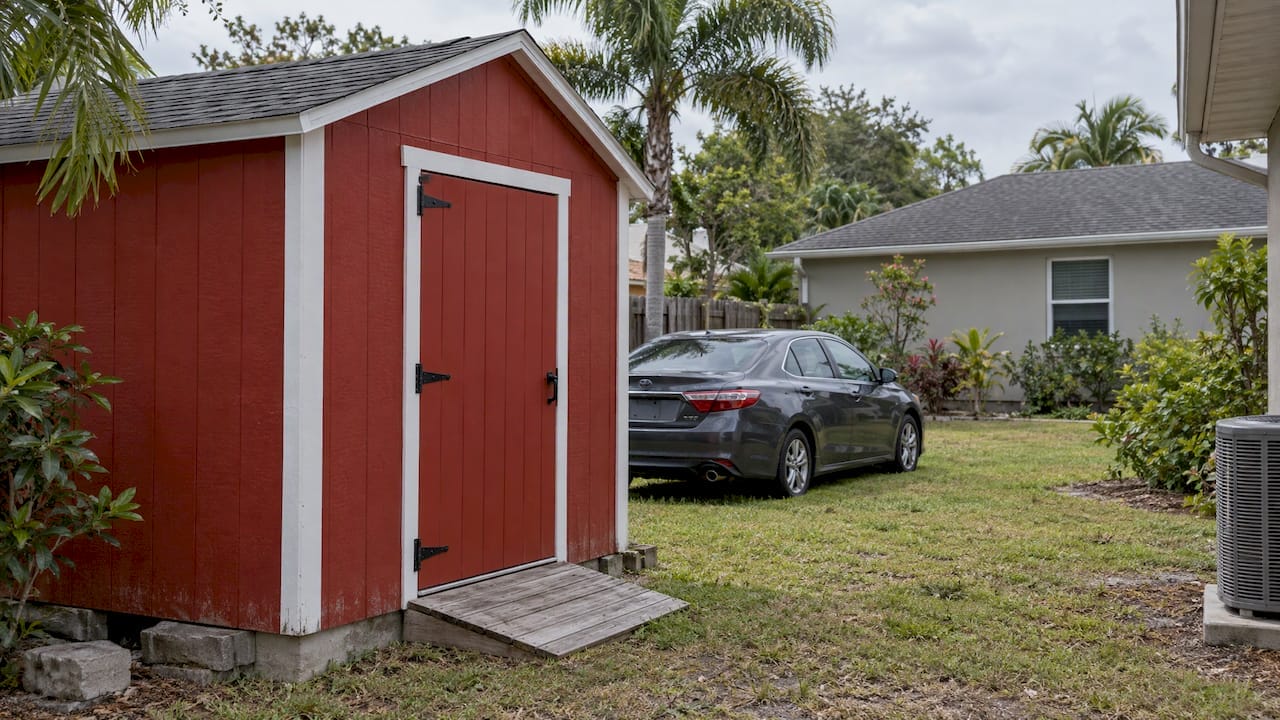
Burglary in Florida is always a felony, and the penalty depends on what was entered, who was inside and whether anyone was hurt or armed. The range runs from up to 5 years in prison for an unarmed entry into an empty building to up to life for the most serious version. If you or a family member has been charged, the exact wording of the charge matters more than the word “burglary” itself, and a Brevard County defense attorney can read it with you before any plea decision.
TL;DR
- Florida burglary means entering or staying in a dwelling, structure or vehicle with the intent to commit a crime inside. Actually stealing something is not required.
- Third degree (unoccupied building or vehicle, no weapon): up to 5 years and a $5,000 fine. Second degree (any dwelling, or an occupied building or vehicle): up to 15 years and $10,000. First degree (assault, battery, weapon or heavy damage): up to life.
- Carrying a firearm during a burglary triggers a mandatory minimum of 10 years, or 3 years for a vehicle.
- The charge can sometimes be reduced or defended, but the details of intent, permission and the type of property decide how.
Table of Contents
- What counts as burglary under Florida law
- The three degrees and their penalties
- What is the sentence for armed burglary in Florida?
- How sentences are actually set
- A worked example
- Common defenses and ways charges change
- From arrest to sentence
- Perspective from our firm
- If you have been charged
- FAQ
- Sources
What counts as burglary under Florida law
The definition sits in Florida Statute § 810.02. Burglary means one of two things. You enter a dwelling, structure or conveyance (a vehicle, boat or similar) with the intent to commit an offense inside. Or you stay inside surreptitiously, meaning secretly, with that intent. There is also a version where you stay after permission is withdrawn in order to commit or attempt a forcible felony.
Two points surprise most people:
- Intent is the core. Prosecutors do not have to show anything was taken. They have to persuade a jury that you meant to commit a crime once inside, whether theft, assault, vandalism or something else.
- Permission and public access are defenses to the entry element. The statute excludes premises that are open to the public at the time and entries where the person was licensed or invited. A shop during business hours is the usual example.
A “dwelling” is a home. A “structure” is a building with a roof, such as a shed, store or garage. A “conveyance” is a vehicle, trailer, boat or similar. Each one changes the degree.
Burglary versus trespassing
Trespass is the lesser neighbor. Under Chapter 810, trespass in a structure or conveyance is a second-degree misdemeanor, and a first-degree misdemeanor if someone is inside. The difference is intent. Walking into a building you had no right to enter is trespass. Doing it intending to commit a crime inside is burglary. That gap is why many burglary cases turn on what the state can actually prove about your state of mind, and why a reduction to trespass is a realistic goal in some files.
The three degrees and their penalties
Florida sets the maximum prison term and fine by the degree of felony. The prison caps come from § 775.082, and the fine caps from § 775.083, which allows up to $5,000 for a third-degree felony, $10,000 for a first- or second-degree felony and $15,000 for a life felony.
| Degree | What it usually covers | Maximum prison | Maximum fine |
|---|---|---|---|
| Third-degree felony | Unarmed burglary of an unoccupied structure or conveyance, no assault or battery | 5 years | $5,000 |
| Second-degree felony | Unarmed burglary of any dwelling (occupied or not), or of an occupied structure or conveyance | 15 years | $10,000 |
| First-degree felony | Assault or battery, being armed with explosives or a dangerous weapon, or certain damage over $1,000 | Up to life | $10,000 |
The fine is a ceiling, not a set amount, and a judge can order it on top of prison, probation, restitution and court costs. A conviction also leaves a permanent felony record, which affects work, housing, firearm rights and voting rights, so the consequences reach well beyond the sentence itself.
Third degree: unoccupied buildings and vehicles
Under § 810.02(4), an unarmed burglary of an unoccupied structure or conveyance, with no assault or battery, is a third-degree felony. Think of an empty work shed or an unoccupied parked car. Two reclassification rules can raise it. If the burglary happens during a riot, or in a county under a governor-declared state of emergency and is facilitated by conditions arising from that emergency, it becomes a second-degree felony.
Second degree: homes and occupied places
This is the degree most people face. Under § 810.02(3), the offense is second degree, without assault, battery or a weapon, when the place is:
- a dwelling, whether anyone was home or not;
- an occupied structure or an occupied conveyance;
- an authorized emergency vehicle; or
- a structure or conveyance entered with intent to steal a controlled substance.
So an empty house and a house with the family asleep upstairs carry the same degree. A person who walks into an unlocked garage attached to a home can face a second-degree charge, because the statute treats the dwelling as including its attached enclosed areas. Whether the garage qualifies is a factual question worth raising early.
First degree: assault, weapons and damage
Burglary rises to a first-degree felony, punishable by up to life, when the person:
- commits an assault or battery while inside, or
- is armed, or arms themselves inside, with explosives or a dangerous weapon, or
- causes damage to the property above $1,000 in the circumstances the statute lists, including damage done with a vehicle.
A riot or state-of-emergency reclassification can also lift a second-degree burglary to first degree. Anyone arrested for burglary in those situations cannot be released until they appear before a committing magistrate at first appearance.
What is the sentence for armed burglary in Florida?
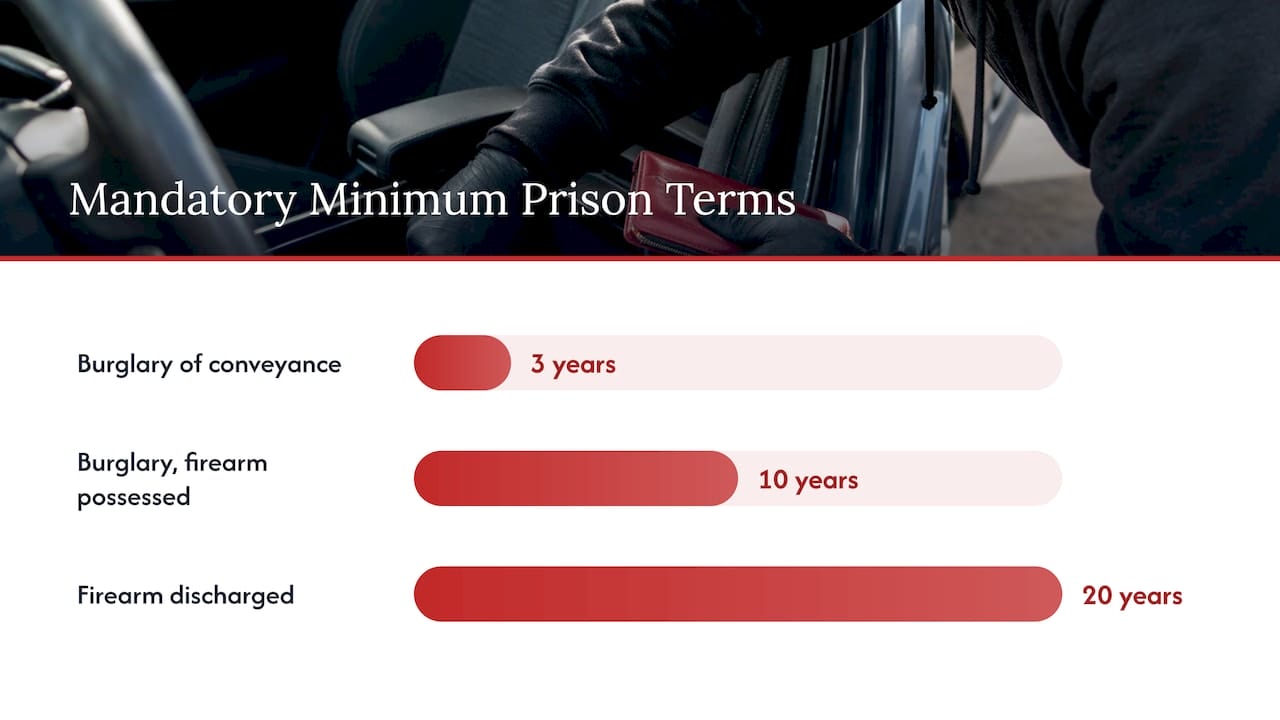
Armed burglary carries mandatory minimums on top of the degree. Under § 775.087, a person convicted of burglary who actually possessed a firearm or destructive device during the offense must be sentenced to at least 10 years. For burglary of a conveyance the minimum is 3 years. Discharging a firearm during the listed felonies carries a 20-year minimum.
The same statute adds two things people miss:
- Possession is defined broadly. It means carrying the firearm on your person, or having it within immediate reach with ready access and the intent to use it.
- Weapons also reclassify the felony one level up. When someone carries, displays, uses or threatens to use a weapon or firearm during a felony (where a weapon is not already an element of the crime), a third-degree felony becomes second degree, second becomes first, and first becomes a life felony. The offense is also ranked one level higher for sentencing purposes.
Where a mandatory minimum is longer than the normal maximum, the minimum must be imposed. This is the area where early legal advice changes outcomes most, because the question of whether a person “possessed” a weapon is often contested. For the related concept in drug cases, see our explanation of constructive possession in Florida.
How sentences are actually set
The statutory maximum is the ceiling, not the likely result. Florida judges sentence under the Criminal Punishment Code, which uses a points scoresheet. Points are added for the primary offense, any additional offenses, prior record, victim injury and other factors. The total sets the lowest sentence a judge may impose without a legal reason to go below it. Burglary of a dwelling scores higher than burglary of an unoccupied structure, and a prior record can push the score up fast.
An experienced defense lawyer checks the scoresheet line by line. Errors in prior-record points or in how the offense is categorized are common, and each point matters near the thresholds.
Other consequences can follow the same case:
- Probation or community control instead of or after prison, with conditions such as curfew and no-contact orders.
- Restitution to the victim for stolen or damaged property.
- Habitual offender sentencing if you have qualifying prior felonies, which can raise the maximums.
- Additional charges that are often filed together, such as theft, criminal mischief or resisting an officer. Theft depends on the value of the property, which we explain in how $750 decides Florida theft thresholds. If the arrest involved a struggle, see resisting with violence charges.
A worked example
Suppose a 24-year-old with no record is accused of entering a neighbor’s detached, unoccupied storage shed and taking tools. That is an unoccupied structure and no weapon, so the charge is a third-degree felony: up to 5 years and a $5,000 fine. Now change one fact: he enters the neighbor’s house while they are at work. That is a dwelling, so the same act becomes a second-degree felony with a 15-year maximum and a $10,000 fine. Change another: he is carrying a firearm. Now the 10-year mandatory minimum applies and the first-degree classification is in play.
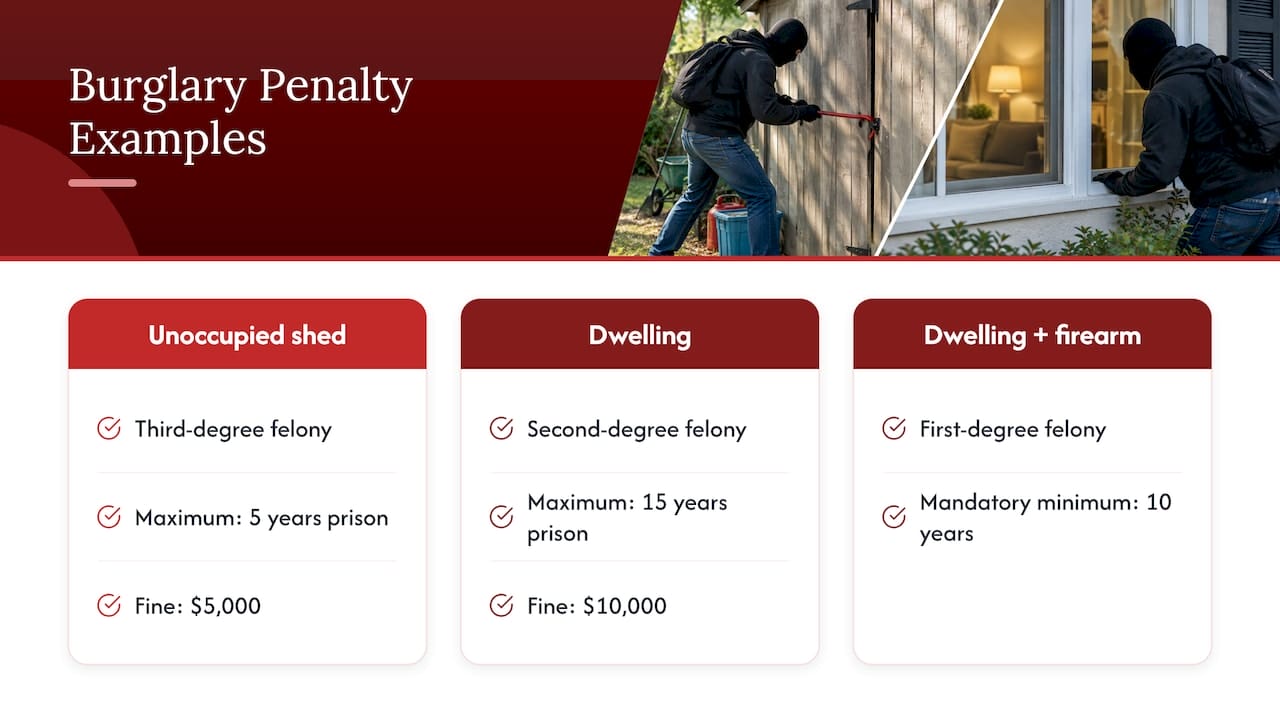
Nothing about the person changed. Only the type of property and the weapon did. That is why the first review of a burglary case should be of the charging document and the police report, not of the penalty table.
Common defenses and ways charges change
Every case is different, and no lawyer can promise an outcome. These are the issues a defense attorney usually examines:
- Consent or license. If you were invited, lived there or had permission, the entry element fails.
- Open to the public. Entry into a business during open hours is not burglary entry.
- No intent. Without evidence you meant to commit a crime inside, the state may be left with trespass.
- Identity. Burglary cases often rest on fingerprints, video or a witness glimpse, and each can be tested.
- Unlawful search or statements. Evidence from an illegal search, or statements taken without proper warnings, may be excluded.
- Degree and scoresheet. Whether the place was a dwelling, whether it was occupied and whether a weapon was truly possessed all change the exposure.
From arrest to sentence
The process usually runs in this order: arrest and booking, first appearance before a judge where bail and conditions are set, formal charges and arraignment where you enter a plea, pretrial discovery and motions, then plea negotiation or trial, and sentencing if convicted. Decisions made at the first stages, including what you say to officers and what bail conditions you accept, shape everything after them. Do not discuss the facts with police or anyone else before speaking with a lawyer.
Perspective from our firm
In burglary cases the penalty table is only the start. Two people charged with the same statute can face very different outcomes because one case involves a dwelling and a weapon, and the other involves a shed and a misunderstanding.
Our job is to read the charge, the evidence and the scoresheet before anything is decided, and to talk to you directly about what each choice means. We handle criminal defense for people across Brevard County, and the free 30-minute consultation is there so you can understand your exposure before you commit to anything.
The earlier we see the case, the more options there are: challenging intent, testing the evidence, pressing for a lesser charge or building the strongest record for sentencing.
John
If you have been charged
The Law Office of John Vernon Moore, P.A. defends people charged with felonies in Brevard County, and you speak directly with the attorney handling your case. Our criminal defense practice covers burglary and related charges, and the first 30-minute consultation is free. Bring the charging paperwork, any bail or release conditions and your court dates so the review can start with the real documents.

If the case also involves a family matter, such as a no-contact order or a custody dispute running alongside the charge, our firm’s other practice areas can coordinate with the criminal defense.
FAQ
Is burglary a felony or a misdemeanor in Florida?
It is always a felony. Even the lowest version, an unarmed burglary of an unoccupied structure or vehicle, is a third-degree felony. The related offense of trespass is usually a misdemeanor, which is why the difference between the two charges matters so much.
Do you have to steal something to be charged with burglary?
No. The offense is complete when someone enters or remains with the intent to commit a crime inside. Nothing needs to be taken. Prosecutors must still prove that intent, and that is often where the defense focuses.
What is the penalty for burglary of a dwelling in Florida?
Burglary of a dwelling without a weapon, assault or battery is a second-degree felony, whether or not anyone was home. It carries up to 15 years in prison and a fine of up to $10,000. If an assault, battery or weapon is involved, it can become a first-degree felony punishable by up to life.
Can a burglary charge be reduced to trespassing?
Sometimes. If the state cannot prove you intended to commit a crime inside, or the evidence on entry or permission is weak, a lesser charge may be possible through negotiation or at trial. Whether it is realistic depends on the facts, so have a criminal defense attorney review the file.
Sources
- Florida Statutes § 810.02, Burglary (2026)
- Florida Statutes Chapter 810, Burglary and Trespass (Online Sunshine)
- Florida Statutes § 810.02 (Online Sunshine)
- Florida Statutes § 775.082, Penalties (2026)
- Florida Statutes § 775.083, Fines (2026)
- Florida Statutes § 775.087, Possession or use of weapons (2026)