
Florida decides military custody cases under the same best-interest standard as every other family, but it adds specific protections for a parent who deploys. A court can set a temporary arrangement while a service member is away, it cannot make that change permanent without the service member’s consent, and a PCS move is treated as a relocation with its own rules. Handled early and in writing, a deployment does not cost you your place in your child’s life. Our Brevard County family law practice works with military families, and this guide walks through what the statutes say and what to do first.
TL;DR
- After a parent receives deployment notice, a Florida court may enter a temporary custody order, but it may not enter a permanent one without the deploying parent’s consent.
- A court may not consider past or possible future deployment when deciding a child’s best interest.
- A PCS move is not exempt: a move of at least 50 miles for at least 60 consecutive days falls under Florida’s relocation statute.
- Which state hears the case depends on the UCCJEA, and a Florida court that already ruled usually keeps continuing jurisdiction.
- Put any deployment plan in writing, signed by both parents, and file early if you cannot agree.
Table of Contents
- How Florida treats custody when a parent is in the military
- What a court can and cannot do during deployment
- Two ways to set up care while you are away
- Child support while a parent is deployed
- PCS orders and moving with a child
- Which state’s court decides: the UCCJEA
- Common mistakes military parents make
- Where we come in
- Our perspective
- FAQ
- Sources
How Florida treats custody when a parent is in the military
Florida has no separate “military custody” system. Custody is called parental responsibility and time-sharing, and the court decides it by the best interest of the child. What the military adds is a set of rules for the period around deployment, found in Chapter 61, Part IV of the Florida Statutes, the Uniform Deployed Parents Custody and Visitation Act, sections 61.703 to 61.773.
Two definitions matter. A “deploying parent” is a service member who is deployed or has been notified of an impending deployment and who is a parent or has custodial responsibility for a child. “Deployment” means a movement of less than 18 months under orders that are unaccompanied or do not allow family members to travel to the location. A routine duty station change with the family is not a deployment. It is a PCS move, covered below.
The act also requires the deploying parent to tell the other parent about the deployment as soon as possible. In practice that notice starts the clock for everything else.
What a court can and cannot do during deployment
The rules are protective in both directions: they keep the child’s life stable and keep the service member from losing a parenting role because of orders.
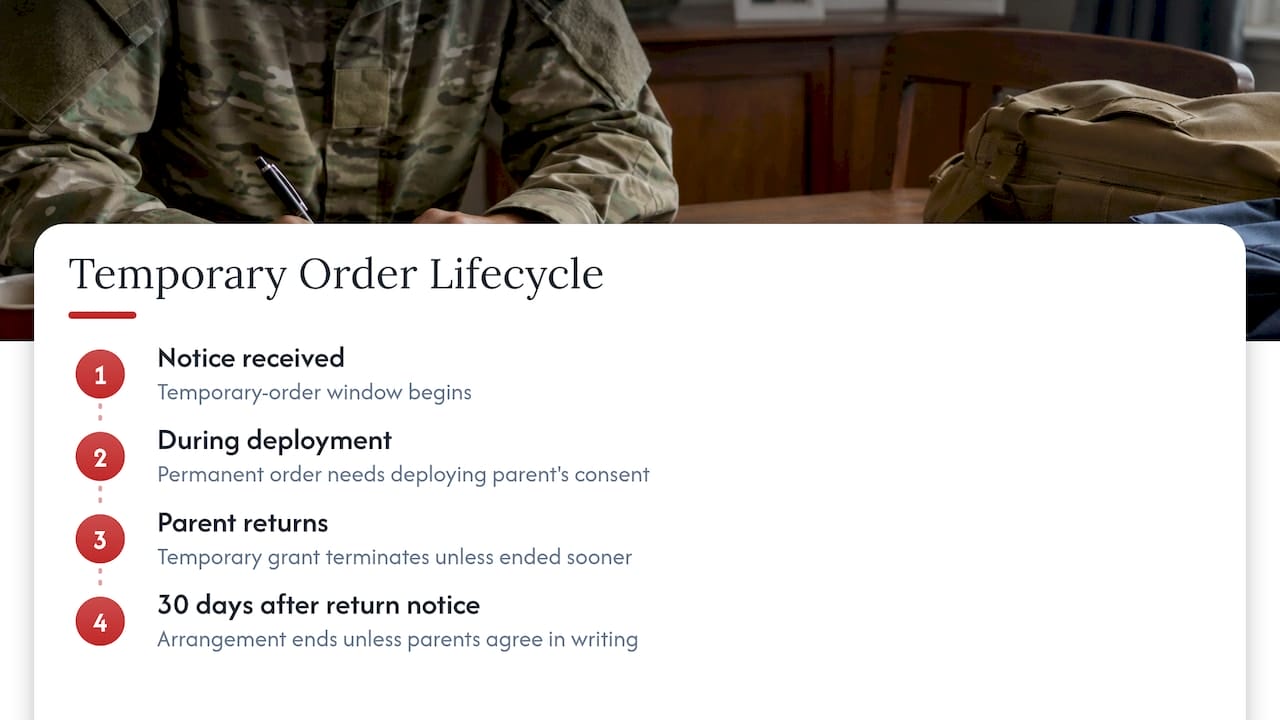
It can set a temporary arrangement. After a deploying parent receives notice and until the deployment ends, a court may issue a temporary order granting custodial responsibility, unless the Servicemembers Civil Relief Act prohibits it.
It cannot make that arrangement permanent on its own. The same section bars a permanent order without the deploying parent’s consent. Federal law points the same way: under 50 U.S.C. § 3938(b), a court may not treat a service member’s deployment, or the possibility of one, as the sole factor in a permanent custody modification.
It cannot hold deployment against you. Florida courts may not consider a parent’s past deployment or possible future deployment in deciding the child’s best interest. Other facts still count. The point is that service itself is not a mark against a parent.
It ends when the deployment ends. A temporary grant terminates after the deploying parent returns unless ended earlier, and it does not create a lasting right to caretaking or decision-making for anyone. The official Florida court forms say the arrangement automatically ends 30 days after the deploying parent gives notice of return, unless the parents agree otherwise in writing or a court ends it sooner.
Two ways to set up care while you are away
Option 1: a written agreement
If the parents get along, an agreement is the fastest route. Florida requires a temporary deployment agreement to be in writing and signed by both parents, plus any nonparent who will be given responsibility, such as a grandparent.
When feasible, the agreement should cover:
- the destination, duration and conditions of the deployment;
- who has day-to-day caretaking authority and who makes major decisions;
- any limited contact granted to a nonparent;
- how disputes will be resolved;
- how often, how long and by what means the deployed parent contacts the child, including during leave;
- a statement that the agreement does not change child support;
- termination after the deploying parent returns.
That list comes straight from section 61.721(3). The usual failure is vagueness. “Video calls when possible” invites a fight six months in. A schedule that accounts for time zones and watch rotations, and a clear line on who handles school and medical decisions, prevents most of them.
The deploying parent’s contact provisions matter as much as the caretaker’s authority. The agreement is where you protect your time with your child, including leave periods, so draft it as carefully as the rest.
Option 2: a motion filed with the court
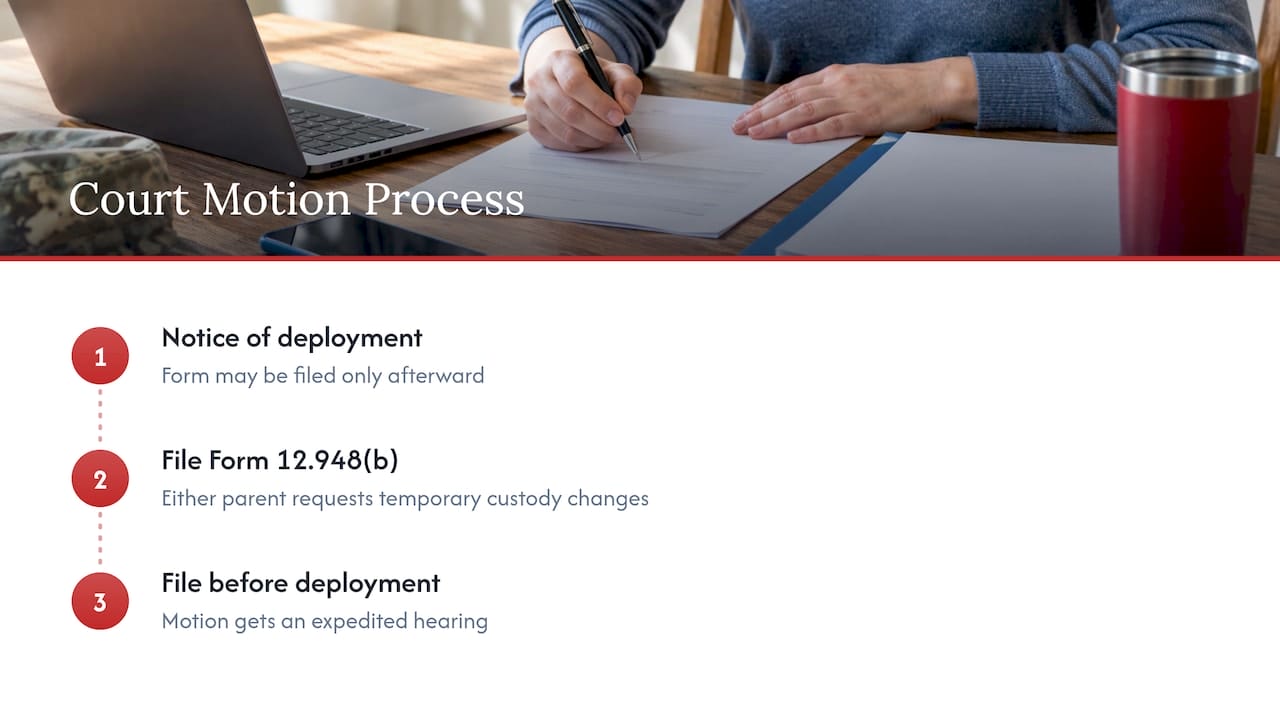
If you cannot agree, either parent can ask the court. At any time after the deploying parent receives notice, either parent may file a motion about custodial responsibility during deployment, in the pending case or in a new action if none exists. A motion filed before the deployment gets an expedited hearing.
Florida’s approved form for this is Family Law Form 12.948(b), used when a service member is being deployed and either parent wants to temporarily set or change custodial responsibility, the parenting plan or the time-sharing schedule. It can only be filed after a Notice of Deployment. Its instructions also say a nonparent who is an adult family member, or someone with a close and substantial relationship to the child, may be granted temporary caretaking authority.
Timing is the practical issue. The expedited hearing helps only if you file before orders put you on a plane. Waiting until the last week leaves little room to fix a defective filing. A step-by-step custody legal help guide shows how a motion and an urgent hearing request fit into the broader process. For a Florida case, we can prepare and file the motion for you. See our page on parenting during deployment.
Child support while a parent is deployed
Deployment does not erase support. The agreement itself must state that it does not modify child support. Where a court has issued an order granting caretaking authority during deployment, it may also enter a temporary child support order, require the deploying parent to enroll the child in DEERS, TRICARE or similar benefits, or suspend, abate or reduce the other parent’s support obligation until the earlier time-sharing order is reinstated.
If you pay support and are about to deploy, or receive it and the arrangement is about to change, put the support question into the same filing as the custody question. Handling them separately leaves gaps.
PCS orders and moving with a child
A permanent change of station creates a different problem from deployment. The family can move together, but when parents are separated or divorced, a move by one parent affects the other’s time-sharing.
Florida defines relocation as a move of the principal residence at least 50 miles from where it was at the last time-sharing order, for at least 60 consecutive days, not counting temporary absences for vacation, education or health care. Under the relocation statute, section 61.13001, a service member’s PCS move is governed by the same rules, so orders alone do not excuse you from the process.
A parent who wants to relocate with the child generally needs either the other parent’s written agreement or a court petition. The petition is sworn and includes the new address if known, the move date, detailed reasons and a proposed new time-sharing schedule with transportation arrangements. If the other parent objects, there is no presumption for or against the move. The court weighs the statutory factors.
What to do with PCS orders in hand:
- Get the orders and report date in front of the other parent early. Surprises make a contested case out of a negotiable one.
- Propose a long-distance schedule before you move. Summers, spring break, holidays and who pays for travel should be specific.
- Do not move the child first and sort it out later. An unauthorized relocation can harm your position on the merits.
- Update the parenting plan if the move is agreed. An informal handshake does not bind anyone.
Our page on PCS orders and child custody in Florida covers this further, and our Florida parenting plans guide explains what a workable plan contains.
Which state’s court decides: the UCCJEA
Military families move constantly, so the first question is often which state has the power to decide. All states use the Uniform Child Custody Jurisdiction and Enforcement Act (UCCJEA), and Florida’s version starts at section 61.514.
The core idea is “home state.” Florida has initial jurisdiction if it is the child’s home state when the case starts, or was the home state within the prior six months while a parent still lives here. An Army legal assistance office explains the home state as the place where the child lived with a parent for at least six consecutive months right before the case began.
Two points help military families in particular:
- Deployment does not change residence. Under section 61.707(2), a deploying parent’s residence does not change because of the deployment where a court has issued a temporary order, where a permanent order is modified temporarily by agreement, or where another state’s court has issued a temporary order due to deployment.
- An existing Florida order tends to stay in Florida. A Florida court that made a custody determination keeps exclusive, continuing jurisdiction until a Florida court finds that the child, the parents and anyone acting as a parent lack a significant connection with Florida, or until a court finds none of them still lives here. A child who spends a few years at a duty station elsewhere does not automatically move the case.
Because filing in the wrong state can mean months of delay and cost, check jurisdiction before you file anything.
Common mistakes military parents make
- Relying on an informal deal. A verbal promise to “keep things the same” cannot be enforced, and a deployment agreement must be in writing to count.
- Waiting for the deployment date. The expedited hearing is available only if the motion is filed in time.
- Treating the temporary order as permanent. It ends after return, so plan the transition back, including the 30-day period, rather than assuming it.
- Ignoring support. Enrollment of the child in military health benefits and the effect on support belong in the same plan.
- Moving first. A PCS move still has to satisfy the relocation rules.
- Overlooking nonparent caregivers. If grandparents or other relatives will care for the child, name them in the agreement. Our page on third-party custody in Florida explains how that works.
Where we come in
Military custody cases turn on timing and on drafting details, which is where legal help makes the difference. The Law Office of John Vernon Moore, P.A. represents military families in Brevard County, including Patrick Space Force Base families, on divorce, custody, time-sharing and PCS questions. We are mediation certified, which matters when two parents can still reach an agreement, and we offer a free 30-minute consultation.
Bring your orders or deployment notice, any existing custody order, and your proposed schedule. From there we can draft the agreement, file the motion or prepare the relocation paperwork. Our military divorce and custody page outlines how we approach these cases, and our family law practice page lists every service.

If the other parent is hard to work with, we also handle high-conflict cases, including those involving narcissistic personality disorder. Our mediation services are an option when a signed agreement is the goal.
Our perspective
Over decades of practice, with 85 years of experience behind our firm, we have learned that deployment custody problems are mostly timing problems. Parents who start early get to choose between an agreement and a motion. Parents who start late get whatever the calendar leaves them.
We tell every service member the same thing: your service is not a strike against you in a Florida courtroom, and the statutes say so. But a protection you do not invoke on time does little. Put the plan in writing, make the contact schedule specific, and treat support and benefits as part of the same plan.
Direct contact with your attorney matters here, because orders change and you may need an answer from another time zone. That is how we work with military families, and it is why we make the first conversation free.
John
FAQ
Can a Florida court permanently change custody because I deployed?
No, not on that basis alone. A court may enter a temporary order after you receive deployment notice, but it cannot enter a permanent order without your consent. Federal law likewise bars treating deployment as the sole factor in a permanent modification.
Can my child stay with a grandparent while I am deployed?
Yes. A written agreement signed by both parents and the relative can give that person caretaking authority. The court form’s instructions say an adult family member, or someone with a close and substantial relationship to the child, may receive temporary caretaking authority. The grant ends after you return and creates no lasting rights.
Does child support stop while I am deployed?
Not automatically. The deployment agreement must state that it does not modify child support, and a court that has ordered temporary caretaking may adjust support or require DEERS or TRICARE enrollment. Ask for any change in the same filing as the custody arrangement.
Do PCS orders let me move my child out of Florida?
No. A move of at least 50 miles for at least 60 consecutive days is a relocation under Florida law, and a PCS move is governed by the same statute. You need the other parent’s written agreement or a court order before relocating the child.
What happens when I return from deployment?
The temporary arrangement ends. Under the court forms, it automatically terminates 30 days after you give notice of return unless you agree otherwise in writing or a court ends it sooner. Give written notice promptly and plan the transition back to your regular schedule.
Sources
- Florida Statutes § 61.733 (2026)
- Florida Statutes § 61.703 (2026)
- Florida Statutes Chapter 61 contents index (2025)
- Florida Statutes § 61.713 (2025)
- Florida Statutes § 61.721 (2026)
- Florida Statutes § 61.749 (2026)
- Florida Statutes Chapter 61 (2026), including § 61.747
- Florida Statutes § 61.13001 (2026)
- Florida Statutes § 61.514
- Florida Statutes § 61.515 (2025)
- Florida Statutes § 61.707 (2025)
- 50 U.S.C. § 3938, U.S. Code (2024)
- Florida Supreme Court Approved Family Law Form 12.948(b)
- Florida Supreme Court Approved Family Law Form 12.948(a)
- U.S. Army Legal Assistance Office, Fort Stewart newsletter, June 2024