
A military parent cannot move a child more than 50 miles for 60 days or longer on PCS orders alone. Florida law requires the other parent’s written agreement or a court’s permission first, and orders from the service do not waive that. Deployment is a separate track with its own statutes. If you are planning a move in or out of Brevard County, the order of your steps matters more than the speed of your orders. Our PCS orders and custody page explains how we approach these cases, and we offer free 30-minute consultations.
TL;DR
- A move of at least 50 miles for at least 60 consecutive days is a legal relocation under Florida Statute 61.13001. You need written consent or a court order before the child goes.
- Military orders do not replace that process, whether or not you have primary custody.
- A PCS move falls under the relocation statute. A deployment falls under the deployed-parent statutes, which allow temporary orders only.
- If the other parent objects within 20 days, the relocating parent carries the burden of proving the move is in the child’s best interests.
- Moving first and filing later can lead to contempt and an order to bring the child back.
Table of Contents
- PCS and deployment are two different legal situations
- What counts as a relocation under Florida law
- Two routes: agreement or petition
- What happens after the petition is served
- How courts weigh best interests in a military move
- The cost of moving first
- Deployment: temporary orders, not permanent changes
- Building a plan that survives future orders
- A practical sequence for a military parent facing a move
- Why local, military-literate representation matters
- Our perspective
- Talk to us about your move
- FAQ
- Sources
PCS and deployment are two different legal situations
Most of the confusion in military custody cases comes from treating every service-related absence the same. Florida does not.
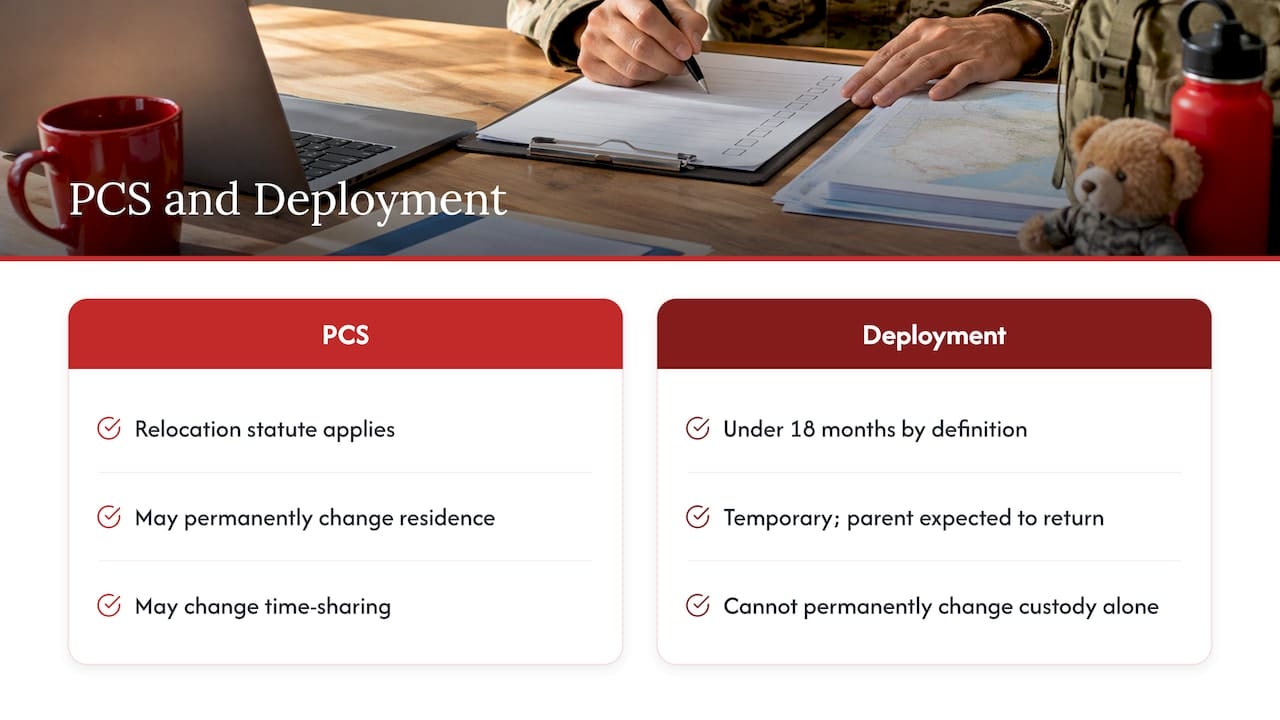
A permanent change of station (PCS) moves the household to a new duty location. When a parent wants the child to move too, the relocation statute governs. The same is true when the parent is stationed at a new base and the child lives with the other parent: the question is where the child’s principal residence will be.
A deployment is something else. Florida defines it as a movement of a servicemember for less than 18 months under orders that are unaccompanied or do not allow family members to travel. Because the servicemember is expected to return, the law treats the arrangement as temporary.
The practical difference is large. A relocation can permanently change where a child lives and how often the other parent sees the child. A deployment order, by statute, cannot do that. Knowing which situation you are in tells you which rules, forms and deadlines apply.
What counts as a relocation under Florida law
Florida Statute 61.13001 defines relocation as a change in the principal residence of a parent that is at least 50 miles from the residence at the time of the last time-sharing order, or the filing of the pending action, and lasts at least 60 consecutive days. A temporary absence for vacation, education or the child’s health care does not count.
Two details trip up military families:
- The 60 days is about the principal residence, not the orders. A move to a new duty station that lasts for years clearly qualifies. A short temporary duty assignment generally does not change the child’s principal residence.
- The rule applies to both parents. According to MacDill Air Force Base’s co-parent guidance, the requirements apply whether or not the parent has primary custody, and military orders do not waive them.
If you are not sure whether your new address crosses the line, measure it from the residence named in your last order. A move from Melbourne to Jacksonville clearly exceeds 50 miles. A move from one Brevard County community to another usually does not.
Two routes: agreement or petition
The statute gives you two ways to relocate lawfully. Both start before the child moves.
Route one: a written agreement
When the other parent consents, the parents can sign a written agreement. Under section 61.13001(2)(a), it must reflect consent to the relocation, set a time-sharing schedule for the parent who is not moving, and describe the transportation arrangements.
If there is already a judgment, decree or case on record about the child’s residence or time-sharing, the parents then ask the court to ratify the agreement. The court enters the order without an evidentiary hearing unless a hearing is requested in writing within 10 days after the agreement is filed. MacDill’s guidance points to Florida Family Law Form 12.950(a) for an agreed relocation where an order already exists.
A good agreement is specific. Vague promises such as summers and some holidays invite a second dispute a year later. Spell out which holidays, who books and pays for flights, where exchanges happen, and how video calls work.
Route two: a petition to relocate
When the other parent will not agree, the parent who wants to move must file a petition and serve it on the other parent and anyone else entitled to access or time-sharing. According to section 61.13001(3)(a), the petition must be sworn and must include:
- the intended residence’s state, city and physical address, plus mailing address and home telephone number if known;
- the intended move date;
- the reasons for the move;
- a proposed revised time-sharing schedule and transportation arrangements.
The petition must also state that any objection has to be filed and served within 20 days after service. Where a case already exists, MacDill’s guidance refers parents to Form 12.950(b) when consent is not available.
We cover the 20-day clock in more detail in our article on the Florida relocation statute and the 20-day objection period.
What happens after the petition is served
The next steps depend entirely on what the other parent does in those 20 days.
| Other parent’s response | What follows |
|---|---|
| No timely objection | Relocation is allowed unless it is not in the child’s best interests, without further notice or a hearing |
| Timely objection | The relocating parent may not move without court permission and must prove the move is in the child’s best interests |
That second row is the one to plan around. The burden of proof rests on the parent who wants to leave. A servicemember cannot simply point to a duty assignment and expect a court to sign off. The judge will look at the child’s life and the statutory factors, not at the Army, Navy, Air Force, Space Force, Marine Corps or Coast Guard’s needs.
How courts weigh best interests in a military move
Florida courts apply the statutory best-interest factors to military relocations the same way they do to civilian ones. Two recent appellate decisions show how that plays out.
In Lawler v. Lawler, the Third District Court of Appeal affirmed a trial court that allowed a Coast Guard father to temporarily relocate to Charleston, South Carolina with the children. The record supported the finding that the children were better served living with him in the blended family, and the move reduced the distance between the two households by roughly 300 miles. The result turned on the children’s circumstances and the evidence presented, not on the father’s rank or orders.
In Vanderhoof v. Armstrong, the Fifth District Court of Appeal described the process as beginning when the parent seeking to move files a petition, and noted that the child’s preference is a factor, weighed according to the child’s age and developmental stage.
What these cases suggest for your preparation:
- Show the child’s day-to-day life in the new location. School options, childcare, extended family, health care and housing are the details a judge can actually evaluate.
- Propose a realistic schedule for the other parent. A plan that preserves meaningful time, with transportation costs allocated fairly, reads very differently from one that leaves the other parent with a few weeks a year.
- Document your history as a parent. Involvement in school, medical appointments and routines carries weight.
The cost of moving first
Some service members assume that orders with a report date create urgency the court will excuse. The case law points the other way. In Milton v. Milton, the First District Court of Appeal held that a parent who moved a child to New York without filing a petition under section 61.13001 or getting the other parent’s agreement was subject to contempt and other proceedings to compel the child’s return. The court also held the trial court erred in allowing the temporary move to continue while the case was pending.
The lesson is about sequence. If your report date is close, the answer is to start the written agreement or petition sooner, not to move and sort it out afterward. Ask for the process to begin as soon as you have orders in hand, and keep copies of everything you send and file.
Deployment: temporary orders, not permanent changes
When the issue is a deployment rather than a move, Florida’s version of the Uniform Deployed Parents Custody and Visitation Act applies. NCSL’s summary of the act notes that Florida adopted it at section 61.703 and following, that the deploying parent must notify the other parent as soon as possible, and that courts may not count past or future deployment against a parent when deciding the child’s best interests.
The key limits come from section 61.733. After a parent receives notice of deployment and until it ends, a court may issue a temporary order granting custodial responsibility unless the Servicemembers Civil Relief Act prohibits it. A court may not issue a permanent order without the deploying parent’s consent. Either parent can file a motion in a pending case or start a new action, and a motion filed before deployment gets an expedited hearing.
What a temporary deployment order must say
Under section 61.745, a temporary order must:
- state that it is temporary and end after the deploying parent returns;
- identify the destination, duration and conditions of the deployment, to the extent permissible;
- allocate caretaking authority, decision-making authority or limited contact;
- provide for liberal communication during deployment, including electronic contact, and liberal contact during leave, unless that is not in the child’s best interests;
- provide for reasonable contact after the parent returns until the order ends.
The Florida Supreme Court’s approved Form 12.948(b) is the motion for a temporary order during deployment. It is filed after the parent receives a Notice of Deployment. Any order entered under it ends automatically 30 days after the deploying parent gives notice of return, unless the parties agree otherwise in writing or the court has already ended it.
If you are facing both a deployment and a later move, our guides on parenting during deployment and deployment custody modifications walk through the differences.
Building a plan that survives future orders
The best time to deal with relocation is before anyone has orders. A parenting plan written with military service in mind can prevent a fight later. Consider including:
- A notice clause. Require each parent to share new orders, report dates and housing plans within a set number of days of receiving them.
- A communication schedule. Set regular video calls that work across time zones and can adapt to a deployment.
- Travel terms. Say who pays for transportation, how far in advance tickets are booked, and who accompanies a young child.
- A holiday and summer framework. Longer blocks of time with the other parent are common when parents live far apart. Define them so that a move does not require reopening the entire plan.
- A process for disagreement. Naming mediation as the first step often saves both sides time and expense.
Our resources on Florida parenting plans and the broader custody and time-sharing guide show how these provisions fit together. If your case already has a plan, the question is whether it addresses relocation at all. A plan that is silent on relocation still leaves the statute in place, so a move beyond 50 miles still needs agreement or court approval.
A practical sequence for a military parent facing a move
- Read your current order. Find the residence it names, the time-sharing schedule and any relocation language.
- Measure the distance. If the new principal residence will be 50 miles or more away for at least 60 days, the statute applies.
- Talk to the other parent early. Share the orders and a draft schedule. A signed written agreement is the fastest route.
- Prepare the petition in parallel. If agreement looks unlikely, a sworn petition with the required details should be ready to file and serve.
- Track the 20 days. Note the service date and the objection deadline.
- Do not move the child until you have consent or an order. Waiting protects you from contempt and return orders.
- Plan the new schedule. Whatever the outcome, build a transportation and communication routine you can follow consistently.
Why local, military-literate representation matters
Relocation cases combine strict statutory procedure with a fact-heavy best-interests hearing. A missed objection window or an incomplete petition can cost months, and months are what a report date does not allow. Military cases add questions about deployment orders, the Servicemembers Civil Relief Act and whether a given absence is a PCS or a deployment.
Our firm’s attorneys handle military divorces and family law in Brevard County, and the firm has 60 years of combined experience. You work directly with an attorney. We are also mediation certified, which matters because many relocation disputes settle once both parents see a workable schedule on paper.
Our perspective
Parents come to us after the orders arrive, and the first thing they want to know is how fast they can go. The honest answer is that speed comes from starting the right process on day one: a written agreement if the other parent will sign, a petition if not.
We built our military family law practice around the fact that service life does not pause for a court calendar, and that a child’s stability should not depend on a duty assignment. We work with parents on both sides of a relocation, and we take direct responsibility for every case, because these disputes are personal and the deadlines are short.
Where parents can still talk, we use our mediation certification to help them reach a schedule both can live with. Where they cannot, we prepare the evidence a judge needs: the child’s routine, the new community, and a realistic plan for the other parent’s time.
John
Talk to us about your move
If you are a servicemember or the co-parent of one, and a PCS move or deployment is on the calendar, we offer a free 30-minute consultation. We can look at your current order, your timeline and your options, and tell you what the statute requires in your situation. You can reach us through our family law practice page.

FAQ
Can I take my child with me on PCS orders if I have primary custody?
Not automatically. MacDill’s guidance says the requirements apply whether or not you have primary custody. If the move is 50 miles or more for at least 60 days, you need the other parent’s written agreement or a court order.
How long does the other parent have to object to a relocation petition?
The other parent has 20 days after service to file and serve an objection. If none is filed on time, relocation is allowed unless it is not in the child’s best interests. If an objection is filed, the parent who wants to move must prove the move is in the child’s best interests.
Can a court permanently change custody while I am deployed?
No. Under section 61.733, a court may enter a temporary order during deployment but may not enter a permanent order without the deploying parent’s consent. A temporary order must also state that it ends after the parent returns.
What if I already moved without permission?
The risk is serious. In Milton v. Milton, the court held that moving a child without a petition or agreement exposed the parent to contempt and proceedings to compel the child’s return. If you are in that position, speak with a family law attorney promptly about how to address it.
Sources
- Co-Parent guidelines: Child relocation during PCS (MacDill Air Force Base)
- Florida Statutes, section 61.13001 (2026)
- Florida Statutes, section 61.733 (2026)
- Florida Statutes, section 61.703
- Florida Statutes, section 61.745
- Florida Supreme Court Approved Family Law Form 12.948(b)
- NCSL: Military Parent Custody and Visitation
- Lawler v. Lawler, Florida Third District Court of Appeal, 2025
- Vanderhoof v. Armstrong, 383 So. 3d 868 (Fla. 5th DCA 2024)
- Milton v. Milton, 113 So. 3d 1040 (Fla. 1st DCA 2013)