Mediation lets you and your spouse write the terms of your divorce with a neutral third party. A trial hands those decisions to a judge. In Florida the two are not really rivals: the court often sends contested cases to mediation first, and trial is what remains when mediation does not settle everything. The real question is how much you can resolve at the table and what you are prepared to put in front of a judge.
This guide compares the two on cost, timing, privacy and control. It also covers the situations where trial is the safer route and how to prepare for either.
TL;DR
- Mediation is usually faster, cheaper and more private than trial, and you keep control of the outcome. A judge decides only what you cannot.
- In Florida, a judge can refer your case to mediation before trial, so you may end up in mediation whichever route you pick.
- Mediation is a poor fit when there is domestic violence, a serious power imbalance or untreated substance abuse. Trial and protective court measures exist for those cases.
- Many cases settle some issues and try others. You do not have to choose all or nothing.
- We offer free 30-minute consultations to help you decide which path fits your situation.
Table of Contents
- How the two paths work
- Mediation vs. trial at a glance
- What mediation offers
- When trial is the better route
- What a trial asks of you
- What we think about this choice
- How to prepare for mediation
- Settling some issues and trying others
- Talk to us about your case
- FAQ
- Sources
How the two paths work
Mediation
Florida law describes mediation as a process where a neutral third person, the mediator, helps the parties resolve a dispute. It is informal and nonadversarial. The mediator does not decide anything. If you reach agreement, it is written up and submitted to the court, and it becomes part of your final judgment.
Trial
If you and your spouse cannot agree on all the issues, either of you can ask for a trial. The California Courts self-help guide (California’s procedure, but the basic structure is common across states) explains that at trial a judge listens to both spouses, hears from witnesses, reviews evidence and decides the disputed issues. Florida works the same way in outline. Our own page on the Florida divorce trial walks through what that looks like in Brevard County.
Where Florida sits in between
Florida’s family rules let the presiding judge refer all or part of a pending matter to alternative dispute resolution. Rule 12.710 of the Florida Family Law Rules of Procedure covers that referral. In practice, many contested divorces are sent to mediation after the response is filed and before a trial date is set. The exception is a documented history of domestic violence that would compromise the process.
Before any trial, you also have to complete the financial groundwork. Florida requires exchange of financial disclosures, and skipping them can keep a case from reaching trial. We explain the requirement in our guide to mandatory disclosure under Rule 12.285.
Mediation vs. trial at a glance
| Factor | Mediation | Trial |
|---|---|---|
| Who decides | You and your spouse | The judge |
| Typical cost | Lower: fewer hours, little discovery, no expert witnesses unless you choose them | Higher: preparation, discovery, exhibits, witnesses, court time |
| Speed | Can be scheduled as soon as both sides have the information they need | Depends on the court calendar and pretrial deadlines |
| Privacy | Communications are confidential and protected by statute | Hearings and filings are generally public |
| Flexibility | Terms can be tailored to your family | Judge applies the statutory factors to the evidence |
| Outcome certainty | Nothing is final unless you both sign | Binding decision, whether you like it or not |
| Best for | Spouses who can negotiate, even with difficulty | Cases with abuse, hidden assets, or a spouse who will not negotiate in good faith |
What mediation offers
Lower cost
Research from the Program on Negotiation at Harvard Law School notes that mediation is generally faster and less expensive than a trial, partly because it reduces the need for extensive discovery, expert fees and long court appearances. When mediation works, you file an uncontested divorce, which moves faster than preparing for and conducting a trial.
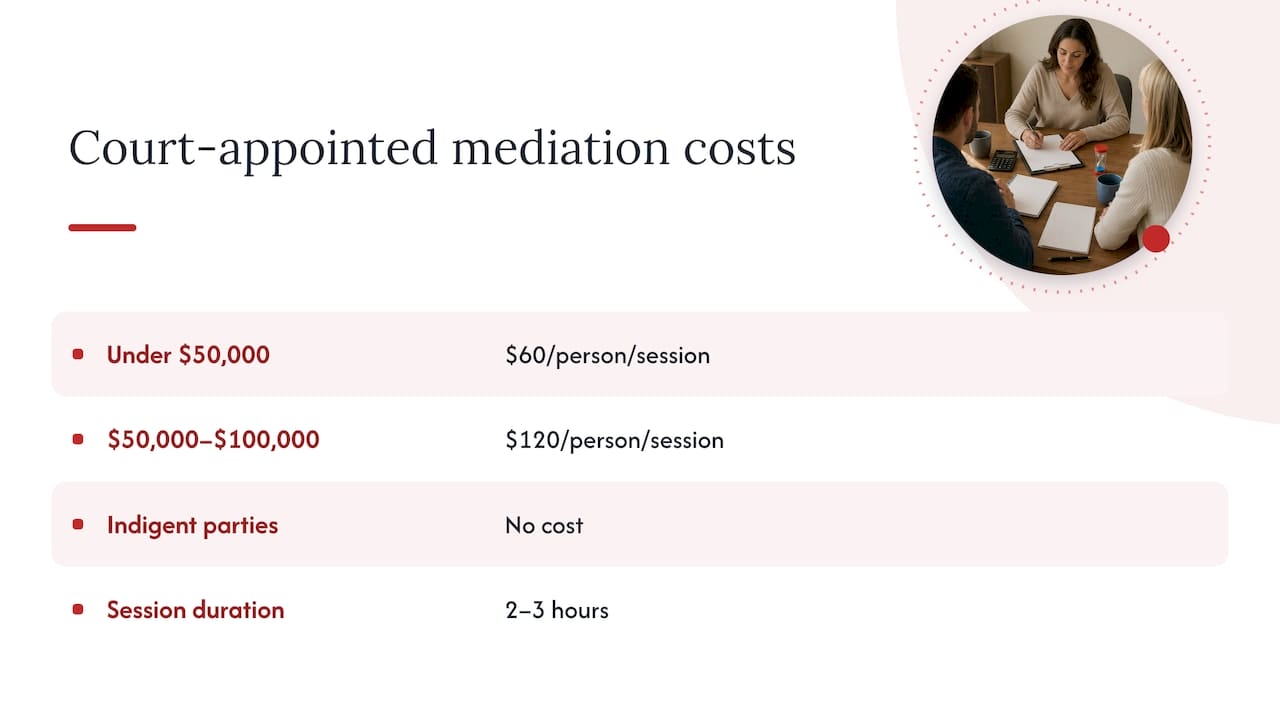
The mediator’s fee itself is modest when the court appoints one for a family case. Under a Florida Supreme Court administrative order, family mediation fees are set by income: $120 per person per session for combined income between $50,000 and $100,000, and $60 per person under $50,000. Indigent parties receive the service at no cost. Sessions are scheduled for two to three hours. Privately hired mediators set their own rates, so ask before you book. For your total budget, including attorney fees, see our honest numbers on the cost of divorce in Florida.
Control and tailored terms
The American Bar Association’s Family Advocate magazine says mediation lets couples, especially parents, design flexible plans for children and assets that reflect their family’s needs, which a judge’s order often cannot replicate. Think of a parenting schedule built around a rotating shift, a deployment cycle or a child’s activities. A judge works from the evidence and the law. You know your own calendar.
The Harvard Program on Negotiation article also notes a study in which mediation participants reported reaching higher-quality, more comprehensive agreements than those in litigation. Agreements you wrote yourselves also tend to be easier to live with. Our guide to Florida parenting plans shows what a complete one contains.
Privacy
A trial is a public proceeding. Mediation is not. Florida’s Mediation Confidentiality and Privilege Act makes mediation communications confidential, with exceptions listed in the statute. A participant who knowingly and willfully discloses one can face civil remedies, which can include the other side’s fees and costs. That protection lets you float a compromise without it being used against you later.
When trial is the better route
Mediation depends on two people who can speak for themselves and negotiate honestly. When that is missing, trial may protect you better. The ABA’s guidance says mediation may be ineffective or even unsafe where there is significant power imbalance, a history of domestic violence or untreated substance abuse, and that trial or protective court measures may be needed.
Other situations where we would think hard before relying on mediation alone:
- Suspected hidden assets. Mediation runs on voluntary information. If you think income or property is being concealed, formal discovery matters. See how hidden assets get found.
- A spouse who uses sessions to stall or intimidate. In high-conflict cases, including those involving a spouse with narcissistic personality traits, a mediator cannot force good faith. A judge can enforce deadlines and orders.
- A single issue that is a true deal-breaker. Custody of the children or the amount of alimony may be the one question neither side will move on. Even then, you can mediate everything else and try only that issue.
If your case does go to court, a private investigator is sometimes used to document facts in a custody dispute. One example of that kind of work is this page on child custody investigation, written for Massachusetts. Ask your attorney whether outside evidence would help in your case, and what rules govern it in Florida.
What a trial asks of you
Before trial, you will normally have gone through disclosure, discovery and court-ordered mediation. The judge will set deadlines for exhibit lists and witness lists. Missing them can mean evidence is excluded. Trial days run on the court’s schedule, not yours, and you will be cross-examined about your finances, your parenting and your conduct.
Two practical realities:
- You give up control. The judge may split an asset or set a time-sharing schedule in a way neither of you proposed.
- Timelines stretch. Pretrial steps and the court calendar set the pace. Our guide to the realistic timeline for a Florida divorce lays out the stages.
None of this makes trial the wrong choice. When the other side will not engage, or safety is at stake, a judge’s order is the tool you need.
What we think about this choice
We have handled divorces on both paths, and the firm cites 60 years of combined experience behind its approach. Our view is simple: start by asking what you actually need, not which route sounds better.
Most clients we meet want less conflict and a clear plan for their children and finances. For them, mediation is the right place to begin. John Vernon Moore is mediation certified, so we prepare clients to use sessions well rather than treat them as a formality. That means knowing your numbers, knowing your priorities and knowing what you will not accept.
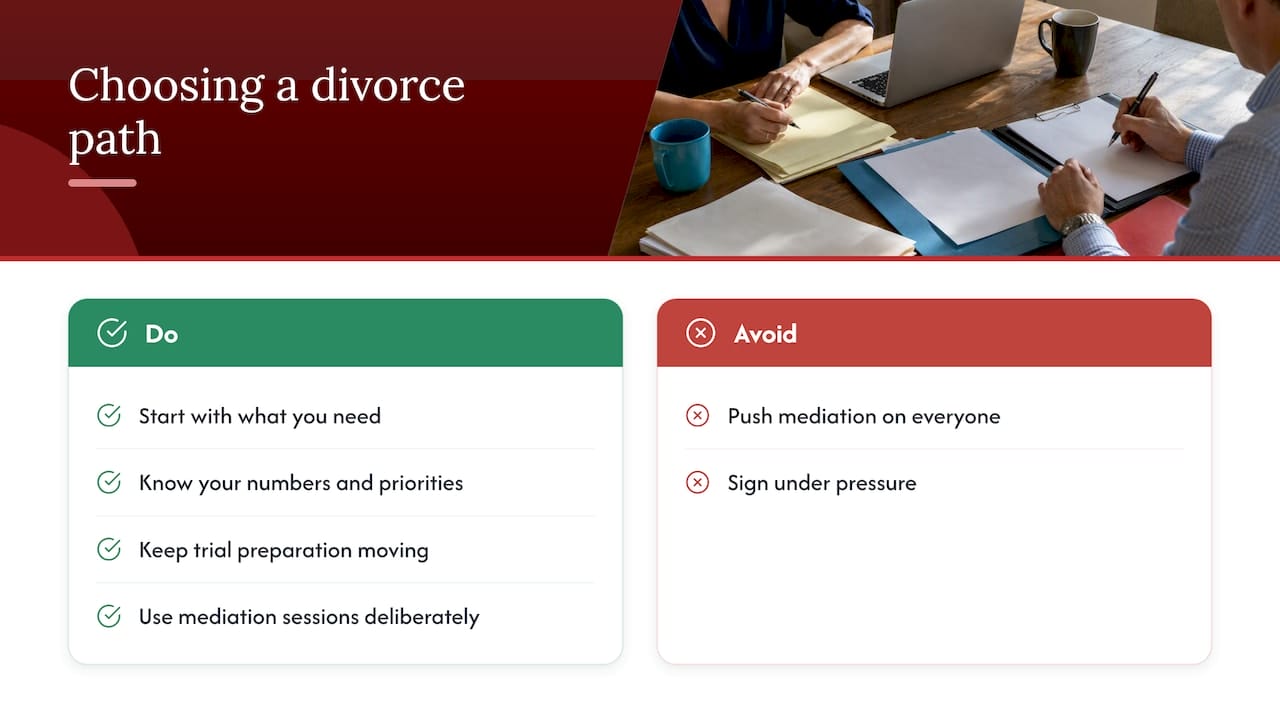
But we do not push mediation on everyone. In high-conflict divorces, including those with a spouse who manipulates or controls, and in military divorces with complicated benefits and relocations, a signature obtained under pressure can cost you for years. We keep trial preparation moving alongside negotiation so that your spouse knows you have an alternative. Negotiating from strength usually produces a better agreement.
You will deal directly with your attorney, not a rotating cast. That matters most on the day you have to decide whether to sign or walk away.
— John
How to prepare for mediation
A session is short, and the preparation is where it is won or lost.
- Gather your financial documents. Pay stubs, tax returns, account statements, a list of debts and the financial affidavit. Our Florida divorce checklist lists them.
- Rank your priorities. Decide what matters most, what you can trade and what is non-negotiable.
- Draft a proposed parenting schedule. Bring a specific proposal, not a general wish.
- Talk to your attorney first. Ask what a judge would likely do on each issue, so you know how a settlement compares with the alternative.
- Plan for the day. Follow our pre-session checklist for divorce mediation.
Bring your attorney if you can. Mediation does not mean going without legal advice, and you should not sign a final agreement before someone has reviewed it.
Settling some issues and trying others
The choice is rarely all or nothing. Many Brevard County cases settle most issues and narrow to one or two for the judge. Spouses can stipulate to what they agree on, such as dividing the retirement account or the parenting schedule, and try only the contested point. That saves time and money and keeps the judge’s decision small and focused.
If you are unsure, begin with mediation, keep your discovery rights, and let the first session show whether the other side is negotiating in good faith.
Talk to us about your case
If you are weighing mediation against trial in Brevard County, we can walk through your facts and tell you which path we would take in your place. The first 30-minute consultation is free. See our family mediation services or our family law practice for how we work, or read about Florida divorce and dissolution of marriage if you are just starting out.
FAQ
Is mediation required before a divorce trial in Florida?
Often, yes. Under the family law rules, the presiding judge may refer all or part of a case to mediation, and many contested cases are sent there before trial is set. Exceptions apply, such as a documented history of domestic violence. Your attorney can tell you how it works in your circuit.
What are the benefits of divorce mediation?
Mediation is usually faster and less expensive than trial, and it is confidential under Florida law. You also keep control over the terms, which helps most when children are involved. Nothing is binding until you both sign.
What happens if mediation fails?
Your case continues toward trial on the issues that remain unresolved. Anything you did agree on can be recorded, so the judge decides only the open points. What was said in mediation stays confidential under the statute, with limited exceptions.
Can I use mediation if my spouse is abusive or controlling?
Usually it is not advisable. Where there has been domestic violence or a serious power imbalance, mediation may be unsafe or ineffective, and court protections are the better route. Talk to an attorney, and contact the National Domestic Violence Hotline if you are in danger.
Sources
- What is Divorce Mediation? Program on Negotiation, Harvard Law School
- Choosing the Divorce Route That Is Best for You, American Bar Association
- Florida Statutes, Chapter 44 definitions
- Florida Statutes 44.405, confidentiality and privilege
- Florida Statutes 44.406, civil remedies
- Supreme Court of Florida administrative order on mediation fees
- Florida Family Law Rules of Procedure, Rule 12.710
- What to know about a divorce trial, California Courts Self Help Guide
- Child custody investigation overview