
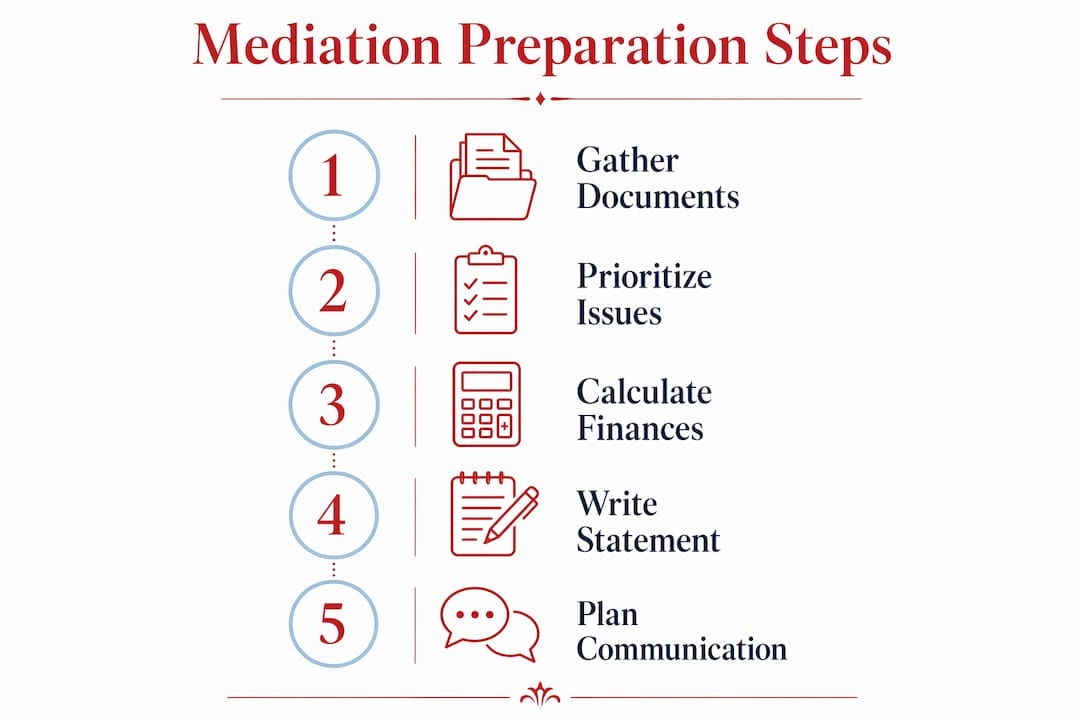
Before your first mediation session, six actions will determine whether you walk out with a workable settlement or leave empty-handed: (1) assemble your mandatory financial disclosures and federal tax returns for multiple years, (2) draft a proposed parenting plan if children are involved, (3) list and rank your negotiation priorities into needs, wants, and tradeables, (4) prepare a confidential pre-mediation settlement statement and submit it roughly 10 days before the session per local court rules, (5) calculate baseline child support, spousal support, and your post-divorce monthly budget, and (6) decide whether you need an attorney present and schedule a pre-mediation review. The Law Office of John Vernon Moore, P.A. — a mediation-certified family law practice serving Brevard County, Florida — guides clients through every one of these steps before they ever sit across the table.
Your six-step pre-mediation checklist:
- Gather financial disclosures: paystubs, tax returns, bank and retirement statements
- Draft a parenting plan with a proposed schedule (school year, holidays, summer)
- Rank your issues: needs (non-negotiables), wants (preferred), tradeables (concessions)
- Write and submit your pre-mediation settlement statement at least 10 days before the session, as required by many courts and mediation programs.
- Calculate child support inputs, spousal support estimates, and a post-divorce budget
- Schedule an attorney review before the session, especially if complex assets are involved
Table of Contents
- What should you bring to mediation? Full documents checklist
- How do you prioritize what to discuss in mediation?
- Financial preparation: what calculations should you complete before mediation?
- How do you write a pre-mediation statement, and when should you submit it?
- Communication in mediation: what to say, what to avoid, and the golden rule
- How does mediation actually work? Caucuses, confidentiality, and enforceable agreements
- When should you bring a lawyer to mediation?
- What does mediation cost, and how long does it take?
- Key Takeaways
- What actually works when clients prepare for mediation
- Jmoorelegal’s mediation preparation services in Brevard County
- Useful sources and where to learn more
What should you bring to mediation? Full documents checklist
A mediator cannot help you reach a fair deal if the financial picture is incomplete. Courts and opposing counsel expect full disclosure, and surprises mid-session kill momentum fast.
The Florida divorce checklist for mandatory disclosure is specific. Gather these before your session:
| Category | Documents to Bring |
|---|---|
| Income | Paystubs, W-2s, recent pay stubs |
| Tax & Legal | Federal tax returns covering multiple recent years, business returns if applicable |
| Assets | Bank statements, investment accounts, retirement statements with loan balances |
| Real Estate | Mortgage statements, deed copies, HOA records, appraisals |
| Debts | Credit card statements, auto loans, student loans, medical debt |
| Insurance | Life, health, auto, homeowner’s policy declarations |
| Business | Profit/loss statements, ownership agreements, valuation reports |
| Other Assets | Crypto wallet records, stock option grants, vehicle titles |
Florida’s mandatory disclosure rules under Rule 12.285 require a sworn financial affidavit. Label every asset and debt clearly as marital or separate property before you arrive — the mediator will ask, and being unprepared on this point signals weakness.
Pro Tip: For hard-to-value assets like cryptocurrency, stock options, or a small business, hire a certified appraiser or CPA before mediation. A rough estimate you cannot defend will be challenged immediately. For real estate, an independent appraisal almost always produces a more defensible number than an automated valuation tool.
How do you prioritize what to discuss in mediation?
Walking in without a ranked agenda is one of the most common mistakes. You will face pressure, time limits, and an emotionally charged room. Knowing in advance what you will fight for and what you will trade away keeps you from making reactive decisions you regret.
Divide your issues into three buckets:
- Needs: Non-negotiables. Primary residence for the children, a specific retirement account, the family home. These are the issues where you will not move without a very good reason.
- Wants: Preferred outcomes you would like but can live without. A specific holiday schedule, a particular debt split, keeping a vehicle.
- Tradeables: Concessions you are willing to make to gain something in the “needs” column. Agreeing to a lower spousal support amount in exchange for keeping the house, for example.
A typical mediation session follows this sequence:
- Opening statements from each party (brief, factual, forward-looking)
- Joint identification of all open issues
- Discussion of each issue, starting with the least contested
- Caucus sessions for sensitive topics or bottom-line conversations
- Exchange of offers and counteroffers through the mediator
- Drafting of a memorandum of understanding or settlement agreement
Parenting plans should cover the school-year schedule, holidays, summer rotation, and decision-making authority. California’s court self-help guidance confirms that parenting and financial issues are the core mediation agenda items — fault-based evidence belongs in litigation, not in this room.
Pro Tip: Print the mediator’s agenda template and write your own notes in the margins before the session. When the mediator moves to a new issue, you can refer to your exact proposed language instead of improvising under pressure.

Financial preparation: what calculations should you complete before mediation?
Offers that are not grounded in real numbers fall apart. A mediator can help parties bridge a gap, but they cannot manufacture financial clarity you did not bring.
Complete these tasks before you sit down:
- Finish your sworn financial affidavit (required in Florida; do not estimate)
- Categorize every asset and debt as marital or separate with supporting documentation
- Get a current real estate appraisal if the home is a contested asset
- Pull retirement account balance snapshots and note any outstanding loans
- Assemble all debt statements with current balances and interest rates
| Calculation | What You Need | Why It Matters |
|---|---|---|
| Monthly net income | All pay stubs, business draws | Baseline for support calculations |
| Household expenses | 3–6 months of bank statements | Establishes post-divorce budget needs |
| Child support inputs | Income of both parties, custody split, healthcare costs | Required for Florida guideline calculation |
| Short-term liquidity | Savings, liquid investments, expected lump sums | Determines whether you can afford a buyout |
| Retirement division | Account balances, plan type, QDRO requirements | Affects net settlement value significantly |
The valuation source matters more than most people realize. Using an automated online estimate for your home instead of a certified appraisal can shift the perceived equity by tens of thousands of dollars. That gap directly affects every other number in the settlement. Gathering 2–3 years of tax returns, pay stubs, and retirement statements is the baseline the opposing party and mediator will expect.
If retirement accounts are on the table, plan for a Qualified Domestic Relations Order (QDRO). Plan administrators and attorneys often need several weeks to prepare and process one, so factor that into your post-mediation timeline.
Pro Tip: Order a formal appraisal for real estate and business interests. For retirement accounts, a current balance snapshot is usually sufficient for mediation purposes — save the full actuarial valuation for cases involving defined-benefit pensions, where the present value calculation can change the settlement dramatically.
How do you write a pre-mediation statement, and when should you submit it?
A pre-mediation statement is your chance to frame the issues before anyone walks into the room. Done well, it tells the mediator what matters to you, what you propose, and where you see room for agreement. Done poorly, it signals that you are not ready.
Structure your statement this way:
- Case summary: One paragraph — parties, length of marriage, children (if any), major assets.
- Open issues: A numbered list of unresolved matters with your proposed resolution for each.
- Key figures: Your proposed division of major assets, support amounts, and debt allocation.
- Parenting schedule: Proposed schedule with holiday and summer rotation if children are involved.
- Non-monetary terms: Life insurance beneficiary designations, relocation restrictions, health insurance continuation, and any other non-cash terms.
Keep the tone factual and settlement-oriented. This is not a complaint letter. Aim for one to two pages. Many courts and mediation programs require submission about 10 days before the session, and late submission can limit the mediator’s ability to prepare — which hurts your session, not just theirs.
Pro Tip: Your pre-mediation statement goes to the mediator and often to opposing counsel. Keep your true bottom-line numbers out of it. Share those privately with the mediator during caucus. That way you preserve negotiating room without hiding information from the process.
Communication in mediation: what to say, what to avoid, and the golden rule
The single biggest preparation mistake is treating mediation like a courtroom. It is not. The goal is a forward-looking agreement, not a verdict on who was right.
Do these things:
- Speak briefly and factually when presenting your position
- Use “I” statements: “I need the children to be in their school district” rather than “You always ignored the kids”
- Keep child-focused language for parenting issues — frame everything around the children’s stability
- Ask clarifying questions when an offer is unclear before reacting to it
- Request a private caucus when a topic is too charged for joint discussion
Avoid these:
- Blaming language or recounting past grievances
- Revealing your legal strategy or threatening litigation as a pressure tactic
- Accepting a deal on impulse — ask for time to review with your attorney before signing
- Misrepresenting assets or income on sworn disclosures
Short scripts that work in the room:
- Asserting a boundary: “That proposal doesn’t work for me because it doesn’t cover the children’s school-year schedule. I’d like to propose [alternative].”
- Proposing a trade: “I’m willing to accept a lower support amount if we can agree on the home equity split I’ve outlined.”
- Requesting a caucus: “I’d like a few minutes with the mediator privately before we continue on this issue.”
Pro Tip: Write your three top priorities on a notecard and keep it visible during the session. When the conversation gets heated, look at the card. It stops reactive concessions before they happen.
How does mediation actually work? Caucuses, confidentiality, and enforceable agreements
Understanding the mechanics before you arrive removes a lot of anxiety. Mediation is not a hearing. No one is deciding your case for you.

Sessions typically open with a joint meeting where both parties and the mediator discuss the agenda. From there, the mediator may move into caucuses — private meetings with each party separately. The Program on Negotiation at Harvard Law School confirms that what you share in caucus is confidential; the mediator will not reveal your bottom line to the other side without your permission. This is where shuttle diplomacy happens: the mediator carries proposals back and forth, testing options without forcing premature commitments.
Key points on the mediator’s role in family court:
- The mediator is neutral. They facilitate discussion and help parties find common ground.
- They do not provide legal advice to either party.
- They cannot impose a settlement. Both parties must agree.
- Confidentiality protections apply in most U.S. jurisdictions under the Uniform Mediation Act framework.
When you reach agreement, the mediator drafts a memorandum of understanding or a Marital Settlement Agreement. That document is not yet enforceable on its own. Your attorney reviews it, both parties sign, and it is filed with the court for a judge’s signature. Common pitfalls at this stage include vague language (“the parties will divide the retirement account equitably” means nothing without a QDRO and specific percentages) and missing follow-up steps like refinancing timelines.
Pro Tip: Ask the mediator to include a follow-up timeline clause in the memorandum — specific deadlines for tasks like refinancing the mortgage, completing the QDRO, or transferring vehicle titles. Vague agreements become enforcement disputes.
When should you bring a lawyer to mediation?
Attorney involvement is not all-or-nothing. The question is where in the process legal guidance pays for itself.
Hire an attorney for full or limited-scope representation if any of these apply:
- The marriage involved a business, pension, stock options, or cryptocurrency
- There is a history of domestic violence or a significant power imbalance
- Custody facts are disputed or a child has special needs
- Spousal support claims are substantial or long-term
- You are a military service member with benefits subject to division
Even in straightforward cases, a consulting attorney review of the final settlement language is worth the cost. The ABA’s general mediation guidance recommends consulting an attorney when legal questions or complex assets are present — and that threshold is lower than most people assume.
What an attorney does before and during mediation:
- Reviews and edits your pre-mediation statement
- Identifies valuation gaps or disclosure problems in the other party’s documents
- Attends the session (full representation) or stays on call (limited scope)
- Reviews the draft settlement agreement for enforceability and tax consequences
- Handles post-mediation filings: QDRO preparation, court entry, deed transfers
Pro Tip: Ask about a limited-scope representation package: a pre-mediation strategy session plus settlement-document review. This is often a fraction of full representation costs and catches the issues that create enforcement litigation later. The role of attorney in family mediation is worth understanding before you decide how much help you need.
What does mediation cost, and how long does it take?
Private mediators in the U.S. typically charge $150–$500 per hour. A half-day session runs roughly four hours; a full day, eight. Complex cases may require multiple sessions. Add consulting attorney review, appraisals, and QDRO preparation, and a realistic total budget for mediation-assisted divorce ranges from a few thousand dollars to significantly more — but still well below contested litigation costs.
| Stage | Typical Timeframe |
|---|---|
| Pre-mediation preparation | 2–6 weeks before session |
| Pre-mediation statement submission | ~10 days before session |
| Mediation session(s) | Half day to multiple full days |
| Post-mediation attorney review | 1–2 weeks |
| Court filing and judge approval | Varies by jurisdiction; weeks to months |
If you settle: Your attorney drafts or reviews the Marital Settlement Agreement, both parties sign, and it is filed for court approval. The judge reviews and signs the final decree. For assets requiring transfer (real estate, retirement accounts), additional steps follow.
If you don’t settle: Options include a second mediation session, binding arbitration, or proceeding to trial. Most cases that reach a second session do settle — parties often need time to process the first session’s offers before they can agree.
Limited attorney involvement at the right moments — specifically, reviewing the final settlement language — consistently prevents the enforcement disputes that arise from vague agreements. A post-divorce budget template can also help you stress-test whether a proposed settlement is actually livable month to month before you sign.
Key Takeaways
Thorough preparation before mediation is the single factor most consistently linked to durable, enforceable settlements — complete financial disclosure, ranked priorities, and a submitted pre-mediation statement give you the best chance of leaving with an agreement you can live with.
| Point | Details |
|---|---|
| Submit your statement early | Pre-mediation statements are commonly due at least 10 days before the session; late submission limits the mediator’s preparation. |
| Bring complete financials | Paystubs (3–6 months), tax returns (2–3 years), retirement statements, and a sworn financial affidavit are the baseline. |
| Know your BATNA | Before accepting any offer, compare it to your realistic litigation outcome — cost, timeline, and likely result. |
| Protect settlement language | Vague agreement terms on retirement accounts or property transfers create enforcement disputes; attorney review prevents this. |
| Jmoorelegal mediation support | The Law Office of John Vernon Moore, P.A. offers mediation-certified preparation, document review, and settlement drafting in Brevard County, Florida. |
What actually works when clients prepare for mediation
The clients who reach durable settlements share three traits, and they are not the ones you might expect. It is rarely the party with the stronger legal argument who settles well. It is the one who walked in with complete financials, a realistic sense of what they could actually win at trial, and the discipline to stay quiet when the other side made an emotional statement.
Complete financial preparation is the most reliable differentiator. When one party arrives with a sworn affidavit, organized statements, and an appraisal, and the other arrives with estimates and rough figures, the prepared party controls the conversation. The mediator gravitates toward the numbers they can verify.
Realistic priorities matter just as much. Clients who have ranked their issues — and genuinely accepted that they will not win everything — negotiate from a position of clarity. They know which concessions cost them little and which ones they cannot make. That clarity shows in the room, and mediators notice it.
Disciplined communication is the third piece. The clients who do not interrupt, who ask clarifying questions instead of reacting, and who request caucuses when a topic gets charged — those clients consistently reach agreement faster. One cautionary pattern: clients who signed a settlement with vague language on a retirement account (“to be divided equally at a later date”) and then spent months in enforcement proceedings trying to get the QDRO completed. The settlement was not the problem. The language was.
Jmoorelegal’s mediation preparation services in Brevard County
Mediation-certified and built around direct attorney contact, The Law Office of John Vernon Moore, P.A. offers preparation packages specifically for clients heading into divorce mediation in Brevard County and across Florida. The concrete difference: you get a pre-mediation strategy session, document review, a drafted or edited pre-mediation statement, and settlement-language review — all coordinated by an attorney who knows Florida family law and has handled cases involving military benefits, complex assets, and high-conflict personalities.

For clients with straightforward cases, a limited-scope consultation and settlement review is available. For cases involving business valuations, pensions, military benefits, or custody disputes, full mediation attendance and post-mediation filing support (including QDRO coordination) are part of the package. Free initial consultations are available, and the firm’s family law and mediation services page outlines what to expect from the first call through court filing. To book your consultation, visit The Law Office of John Vernon Moore, P.A. or call the Brevard County office directly.
Useful sources and where to learn more
These sources are worth bookmarking before your session. Each serves a specific purpose:
- Colorado Judicial Branch — Preparing for Mediation: Clear overview of pre-mediation statement requirements and document expectations; useful for understanding what courts commonly require even outside Colorado.
- Program on Negotiation at Harvard Law School: Practitioner-level guidance on negotiation strategy, BATNA calculation, and how to use the mediator’s perspective to test your offers.
- Iowa Courts — Preparing Yourself for Mediation: Downloadable pamphlet with a practical document checklist and guidance on the “range of reason” for settlement expectations.
- California Courts Self-Help — What to Expect in Mediation: Plain-language explanation of the mediation agenda, parenting plan requirements, and what mediators do and do not decide.
- Florida Courts — Alternative Dispute Resolution: Florida-specific mediation rules and certified mediator resources; use this to verify local requirements and find court-approved mediators.
- ABA Mediation Guide: Broad practitioner guide covering when to consult an attorney, how to prepare your issue list, and how to think about alternatives to settlement.
- Parenting plan drafting tool: Useful for drafting a proposed parenting schedule before mediation — gives you a concrete starting point to bring to the session.
- Jmoorelegal — Mediation Services: Local support for Brevard County clients preparing for mediation, including document review and pre-mediation statement drafting.
Use these for forms, local filing deadlines, and negotiation frameworks. Search results without source verification are unreliable for legal requirements — always confirm with a primary court source or a licensed attorney for your jurisdiction.
This article provides general information about divorce mediation preparation and is not legal advice. Laws and court requirements vary by state and county. Confirm current rules with the Florida Courts or a licensed Florida family law attorney before your session.
Recommended
- Florida Divorce Checklist: Documents & Steps | Melbourne
- Divorce Attorney Consultation Prep: Your First Meeting Guide – The Law Office of John Vernon Moore, P.A.
- Role of Mediator in Family Court: A Parent’s Guide – The Law Office of John Vernon Moore, P.A.
- Divorce Procedure – The Law Office of John Vernon Moore, P.A.