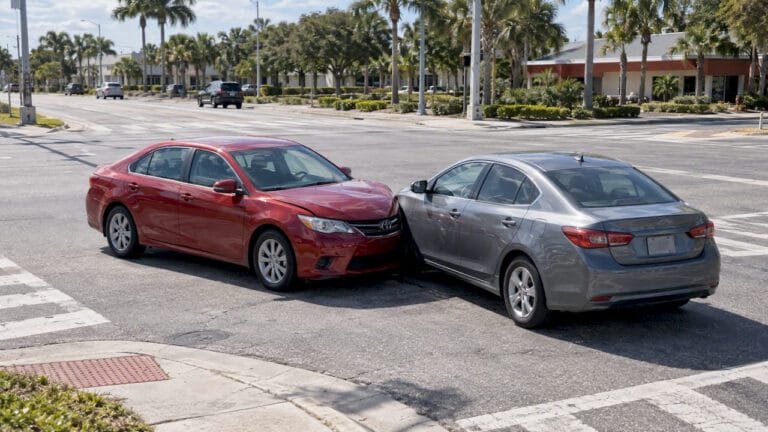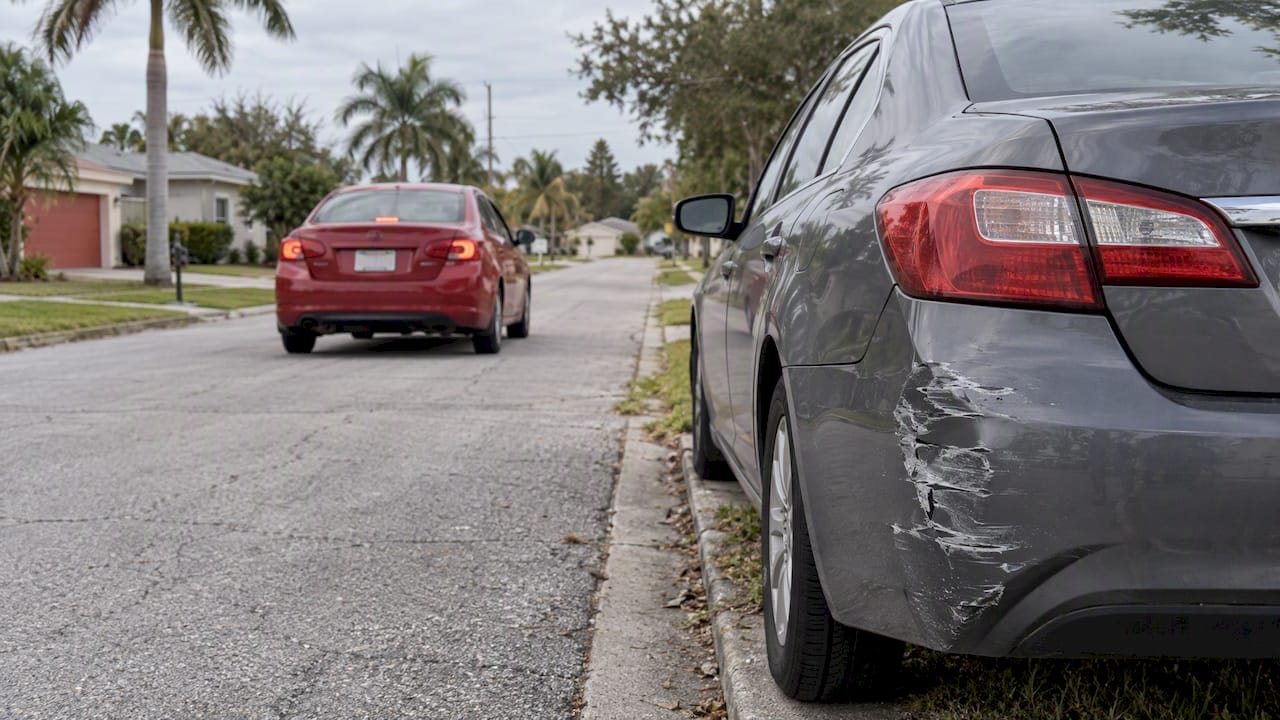
Florida punishes leaving the scene of a crash according to what the crash caused. Property damage alone is a second-degree misdemeanor, with up to 60 days in jail and a $500 fine. Injury makes it a felony. A death carries a mandatory minimum of four years in prison. A hit and run that involves injury or death also costs you your driver’s license for at least three years.
The rest of this guide explains each tier, what the court can add on top of jail and fines, what the state has to prove, and what to do if you are charged.
TL;DR
- Property damage only: second-degree misdemeanor, up to 60 days in jail and a $500 fine.
- Injury: third-degree felony. Serious bodily injury: second-degree felony. Death: first-degree felony with a four-year mandatory minimum prison term.
- Any conviction involving injury or death means a driver’s license revocation of at least three years.
- For injury and death cases, prosecutors must show you knew a person was hurt or killed, and that is often where a defense starts.
- If you were the one hit, the other driver’s charge does not replace your own civil claim.
Table of Contents
- Florida hit and run penalties at a glance
- Property damage only: the misdemeanor tier
- When a hit and run becomes a felony
- License revocation and what comes after
- What the state has to prove
- Why people leave, and why it backfires
- How long does a hit and run stay on your record?
- If you were the victim of a hit and run
- Our perspective
- Talk to a Brevard County defense attorney
- FAQ
- Sources
Florida hit and run penalties at a glance
Two statutes do the work. Section 316.061 covers crashes that damage only property. Section 316.027 covers crashes involving injury or death. The step up from one to the other is steep.
| What the crash caused | Charge | Maximum exposure | License |
|---|---|---|---|
| Property damage only | Second-degree misdemeanor | Up to 60 days in jail, $500 fine | Points and possible suspension through the DMV |
| Injury (not serious bodily injury) | Third-degree felony | Up to 5 years in prison, fine up to $5,000 | Revocation, at least 3 years |
| Serious bodily injury | Second-degree felony | Up to 15 years in prison, fine up to $10,000 | Revocation, at least 3 years |
| Death | First-degree felony | 4-year mandatory minimum, up to 30 years, fine up to $10,000 | Revocation, at least 3 years |
The misdemeanor figures come from the Florida Department of Highway Safety and Motor Vehicles. The felony degrees come from section 316.027. The maximum prison terms come from Florida’s general sentencing statute, and the fine caps from the statute on fines. Those are ceilings. Actual sentences depend on the scoring of your case, your record and the facts.
One wrinkle in the table: the license column for property damage is not a statutory revocation. We list it that way because a conviction can still affect your driving record, so ask your attorney how it applies to you.
Property damage only: the misdemeanor tier
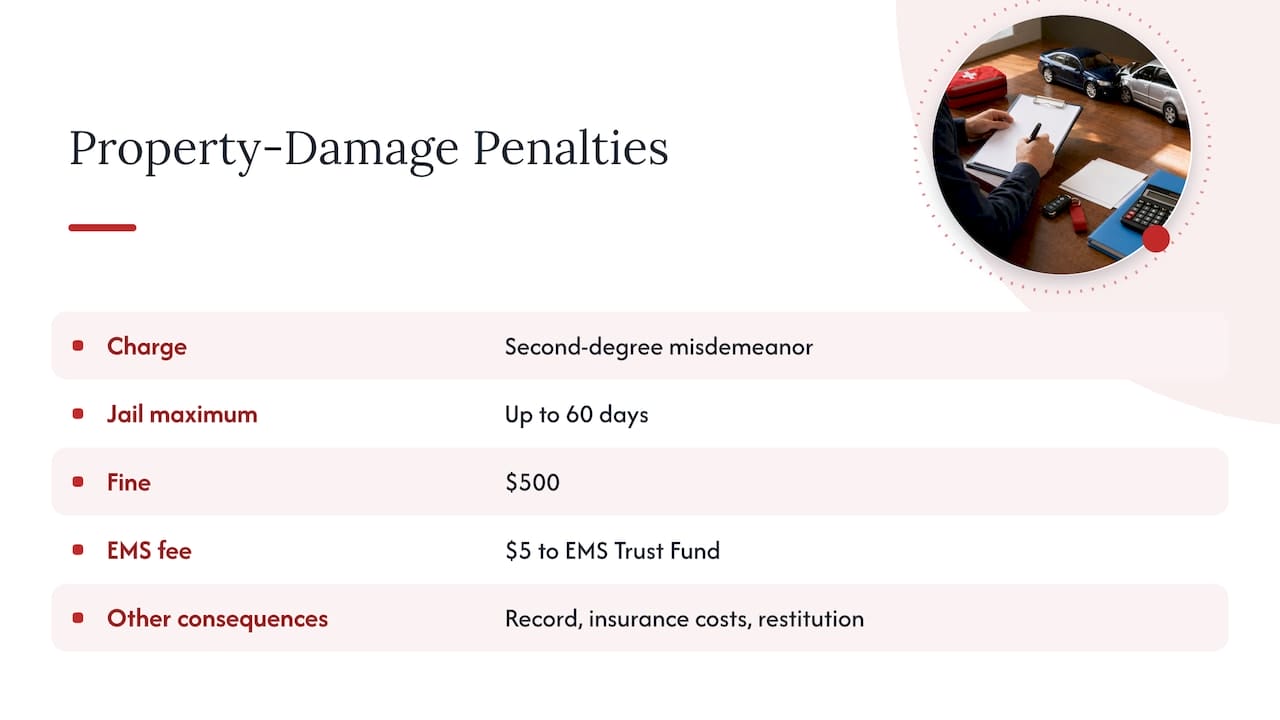
Hitting a parked car, a fence or a mailbox and driving away is a crime in Florida. The law expects you to stop, and where the owner is not there, to leave your information. Skipping that step is a second-degree misdemeanor, which means up to 60 days in jail and a $500 fine, according to the state highway safety agency.
There is also a $5 fee added to the fine in these cases, which goes to the Emergency Medical Services Trust Fund, per section 316.061.
A misdemeanor sounds minor, and in sentencing terms it is. In practice it can still mean a criminal record, higher insurance costs, and restitution to the owner of whatever you damaged. Many first-time property-damage cases resolve without jail, but that is a result to negotiate, not something to assume.
The Florida Supreme Court has pointed out that in property-damage-only cases the state does not have to prove you knew about the damage, while injury and death cases carry far more severe sanctions. That difference matters for defenses, covered below.
When a hit and run becomes a felony
The question “is hit and run a felony in Florida?” has a short answer: yes, the moment someone is hurt or killed.
Injury: third-degree felony
Leaving the scene of a crash that injured another person is a third-degree felony under section 316.027. The maximum is five years in prison under the general sentencing statute, with a fine of up to $5,000 under the fines statute. A felony conviction also carries consequences beyond the sentence: loss of firearm rights, trouble with employment and housing, and for some people, professional licenses.
Serious bodily injury: second-degree felony
When the injury is serious, the charge rises to a second-degree felony, with a maximum of 15 years. The legal definition of serious bodily injury is narrower than “anyone who went to the hospital,” and whether the injury meets it is a real point of dispute in many cases.
Death: first-degree felony and a four-year floor
A crash that kills someone makes leaving the scene a first-degree felony. Since July 1, 2014, when the Aaron Cohen Life Protection Act took effect, a four-year mandatory minimum prison term applies. The judge has little room to go below it. The ceiling is 30 years.
Note that this is a separate charge from any charge for causing the crash itself, such as vehicular homicide or DUI manslaughter. A prosecutor can bring both.
License revocation and what comes after
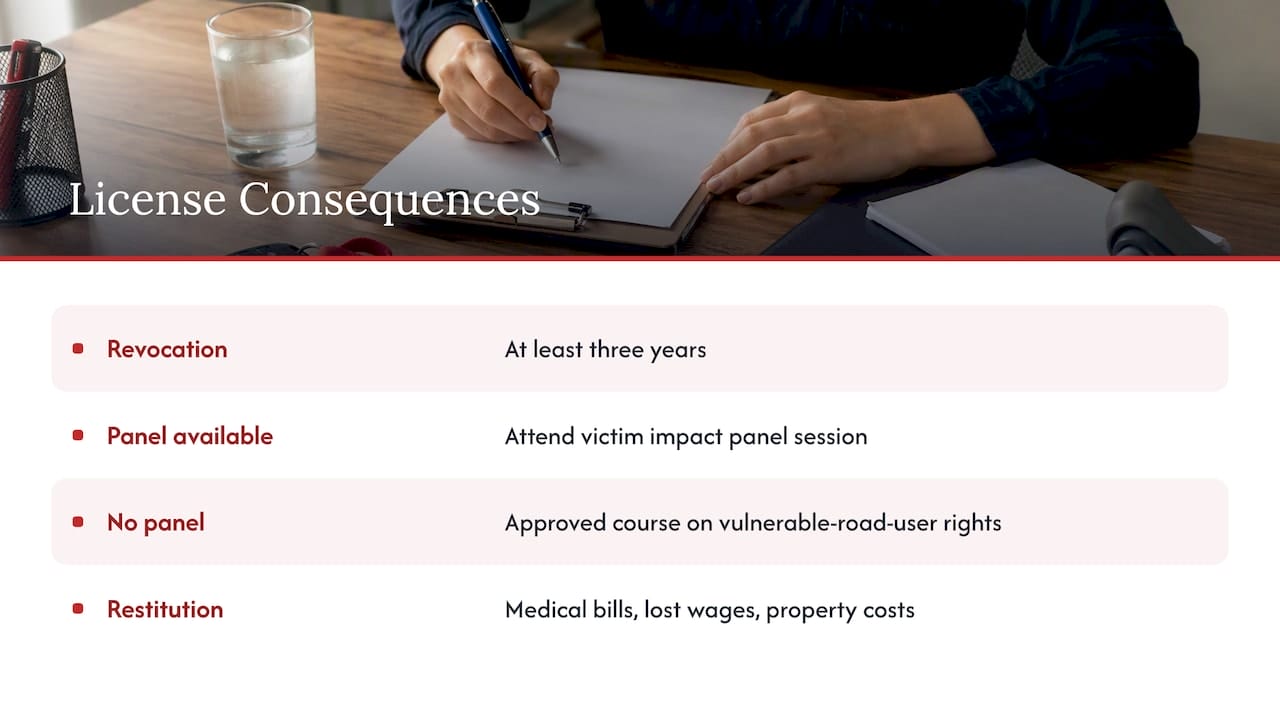
In injury and death cases, the court revokes your license for at least three years. That comes from section 316.027 and is repeated by the state highway safety agency.
Getting it back is not automatic when the time is up. Before reinstatement, the statute requires proof that you attended a victim’s impact panel session if one exists in your circuit. If none exists, you must complete a department-approved driver improvement course on the rights of vulnerable road users. The same statute spells this out.
The court can also order restitution to the victim. In practice that means medical bills, lost wages and property costs are on top of the criminal penalties, and a conviction can strengthen the victim’s civil case.
If you also face a license problem from another source, see our guides on driving while license suspended and reckless driving, since those charges often appear alongside a hit and run.
What the state has to prove
Florida does not convict people of hit and run just because a crash happened and they left. In injury and death cases, the Florida Supreme Court held in State v. Dumas that the state must prove the driver knew of the facts that created the duty to stop, specifically that an injury occurred. A driver who did not realize anyone was hurt is in a very different position from one who saw it and drove on.
That shapes the common defenses:
- Lack of knowledge. You did not feel an impact, or did not know a person, as opposed to a pothole or debris, was involved. This is weaker in property-damage cases, where knowledge of the damage is not an element.
- Misidentification. Many hit and runs are charged from partial plates, blurry video or a witness’s brief look. Whether you were the driver is often the central question.
- No duty arose. Whether the crash fits the statute’s terms, or whether you stopped and exchanged information in a way the police report omits.
- Injury classification. Whether the harm reached the level that makes the charge a felony, or a higher degree of felony.
- Emergency or inability to remain. Leaving to get help, or being unable to stay, can matter, though the law expects you to return or report promptly.
None of these is a guarantee. Each depends on evidence such as dashcam footage, repair estimates, phone records and witness statements. How that evidence is gathered and challenged is where an attorney earns the fee. Our page on why expert witnesses matter in criminal defense explains how accident reconstruction and similar specialists can change a case.
Why people leave, and why it backfires
The state’s own safety agency lists the usual reasons drivers flee: fear of arrest or license consequences, poor visibility, and impairment from drugs or alcohol. The impaired-driver scenario is the one that does most damage. Someone who might have faced a DUI charge ends up facing a DUI and a felony hit and run. For a breakdown of that first exposure, see our guide to DUI penalties in Florida.
The math for any other driver is similar. A fender bender that would cost a deductible and a ticket becomes a criminal case the moment you leave. Stopping, calling 911 when anyone may be hurt, and exchanging information is almost always the cheaper road, even when you were at fault.
How long does a hit and run stay on your record?
A conviction does not fall off on its own in Florida. A misdemeanor or felony conviction stays on your criminal history unless a court seals or expunges it, and that relief has strict eligibility rules, including a certificate of eligibility from the Florida Department of Law Enforcement. Many adjudicated convictions do not qualify. The outcome of the case matters a great deal: a dismissal, a not-guilty verdict or a case where adjudication was withheld is treated differently from a conviction.
This is one reason to fight the charge early rather than plead to “just a misdemeanor” without understanding the long-term record. Ask your attorney specifically about adjudication and later sealing before accepting any plea.
If you were the victim of a hit and run
The penalties above are the criminal side. If you were hit, you also have a civil side: medical bills, lost income, vehicle damage and pain and suffering. A criminal conviction of the other driver, if the police find them, does not pay those costs by itself.
Two practical points:
- Insurance may be your main source of recovery. When the driver is never identified, your own coverage often becomes the path to payment. Evidence you collect at the scene, such as photos, witness names and video, can change what you owe on a deductible, as this explanation of hit and run deductible evidence lays out.
- Do not wait on the police. Report the crash right away and start documenting injuries. Our guides to auto accident personal injury law in Florida and common personal injury case mistakes cover the missteps that weaken claims.
Our perspective
We see hit-and-run charges as cases about knowledge and identity far more often than cases about a driver who coldly chose to flee. People panic, assume the damage was trivial, or do not realize they struck anyone. The statute’s tiers are rigid, so a small difference in what the state can prove, such as whether an injury was known or whether it was serious, can move a client between a misdemeanor and a prison term.
Our approach in the Brevard County courts is to read the evidence before any decision about a plea: the video, the repair estimates, the medical records, how the driver was identified. We talk directly with clients about the realistic range of outcomes, including the license consequences, because the three-year revocation often hurts a family’s daily life as much as the sentence does. If you are charged, say as little as possible to police, keep every document about the crash, and call a criminal defense attorney before you give a statement.
— John
Talk to a Brevard County defense attorney
If you have been charged with leaving the scene of a crash, or you know police are looking for you, early advice matters. At The Law Office of John Vernon Moore, P.A., we handle criminal defense in Florida, and we offer a free 30-minute initial consultation. Before you call, it helps to read how the criminal defense process works and the questions to ask in a defense consultation.
FAQ
What is the sentence for a hit and run in Florida?
It depends on the harm. Property damage alone carries up to 60 days in jail and a $500 fine. Injury is a third-degree felony, serious bodily injury a second-degree felony, and a death a first-degree felony with a four-year mandatory minimum. Injury and death convictions also bring a license revocation of at least three years.
Is a hit and run a felony in Florida?
Yes, when someone was injured or killed. Leaving a crash with injury is a third-degree felony under section 316.027, and the degree rises with the seriousness of the harm. Only a property-damage-only hit and run is a misdemeanor.
Can you go to jail for a hit and run with only property damage?
Yes. It is a second-degree misdemeanor with up to 60 days in jail. Many first offenses end in probation, fines and restitution instead, but the jail exposure is real, and the outcome depends on your record and the facts.
Will I lose my license after a Florida hit and run?
If the crash involved injury or death, the revocation is at least three years, and reinstatement requires a victim’s impact panel or an approved course on vulnerable road user rights. Property-damage cases are handled differently, so ask an attorney how a conviction would affect your record and license.
Sources
- Hit-and-Run Awareness, Florida Department of Highway Safety and Motor Vehicles
- Florida Statutes 316.027, 2026
- Florida Statutes 316.061
- Florida Statutes 775.082, Penalties
- Florida Statutes 775.083, Fines
- State v. Dumas (Florida Supreme Court, 1997)
- Should I Stay or Should I Go? The Fear Factor Behind Hit-and-Run Crashes
- Hit and Run Deductibles: Evidence That Can Change What You Owe