
The questions that matter most in a personal injury consultation cover five areas: the lawyer’s experience with cases like yours, exactly how fees and costs work, an honest read on your case’s strengths and likely value, who will actually handle your file, and what happens next. Get any fee arrangement in writing, bring your medical records and accident evidence, and confirm beforehand whether the meeting is free, since most personal injury consultations are.
TL;DR:
- Ask how many similar cases the attorney handled recently, how many reached trial, and whether that attorney will manage your file day to day.
- Ask for a settlement range and its assumptions; shared fault, prior injuries, or treatment gaps can affect value, so distrust promises before care ends.
- Bring medical records, bills, accident photos, police reports, witness contacts, insurance letters, and a timeline documenting missed work or lost income.
- Before hiring, identify your primary contact, expected response times, update frequency, and how you can escalate urgent questions.
Table of Contents
- 1. Questions to bring to your first meeting
- 2. How to evaluate experience and track record during the consult
- 3. What to ask about fees, contingency percentages, and expense handling
- 4. Understanding case prospects, typical timeline, and value drivers
- 5. Who will handle the work and how the firm communicates with clients
- 6. Documents and evidence to bring to the consultation
- 7. Next steps if you decide to hire
- 8. How we run personal injury consultations at Jmoorelegal
- 9. What matters most when you walk into a consultation
- Schedule a free consultation with our office
- FAQ
- Sources
1. Questions to bring to your first meeting
A consultation usually runs 30 to 60 minutes, and the strongest use of that time is a short, organized list of questions rather than an open-ended conversation. Lead with the items that affect whether you hire this attorney at all, then move to logistics.
Experience and outcomes
- How many cases like mine have you handled in the past few years?
- How many of those went to trial versus settled?
- What was the outcome in a comparable case, and who on your team handled it?
- Do you personally try cases, or do you refer trial work elsewhere?
Fees and costs
5. What is your contingency fee percentage?
6. Does that percentage change if the case settles versus goes to trial?
7. Are case costs deducted before or after your fee is calculated?
8. Will I owe anything if we don’t win or if I decide not to hire you?
9. Can I get the fee agreement in writing before we proceed?
Case merits and timeline
10. Based on what I’ve shared, what are the strengths and weaknesses of my case?
11. What is a realistic range for settlement value, and what could change it?
12. How long do cases like mine typically take to resolve?
13. What milestones should I expect along the way?
Who handles the file and communication
14. Will you personally handle my case, or will an associate or paralegal manage it day to day?
15. Who should I contact with questions, and how fast can I expect a response?
16. Do you communicate by phone, email, or text, and how often will I get updates?
Logistics and next steps
17. Is this consultation free?
18. What do you need from me to get started today?
19. What’s the first thing that happens after I sign?
20. How do we handle it if we disagree about strategy or fees later?
Ask about fees and experience within the first ten minutes. If the answers feel vague or rehearsed, that tells you as much as a direct answer would.
2. How to evaluate experience and track record during the consult
Specific answers beat confident ones. A lawyer who has handled comparable cases should be able to describe fact patterns close to yours, not just cite a general number of years in practice.
- Ask how many cases similar to yours the attorney handled in the last few years and how many reached trial.
- Request examples of past outcomes, including who on the team actually worked the file.
- Ask what made a comparable case succeed or stall, not just how it ended.
- Be cautious of promises about what your case is “worth” before medical treatment is complete or liability is clear.
Pro Tip: Ask for a case with a similar injury type and similar fault situation to yours, then listen for specifics, not generalities.
3. What to ask about fees, contingency percentages, and expense handling
Contingency fees commonly fall within a range from around one-third to forty percent of your recovery, though there’s no single standard rate and the exact figure is negotiable and varies by state, according to the FTC’s consumer guidance on hiring a lawyer. Before you agree to anything, nail down the mechanics, not just the percentage.
- Ask the exact contingency percentage and whether it increases if the case goes to trial.
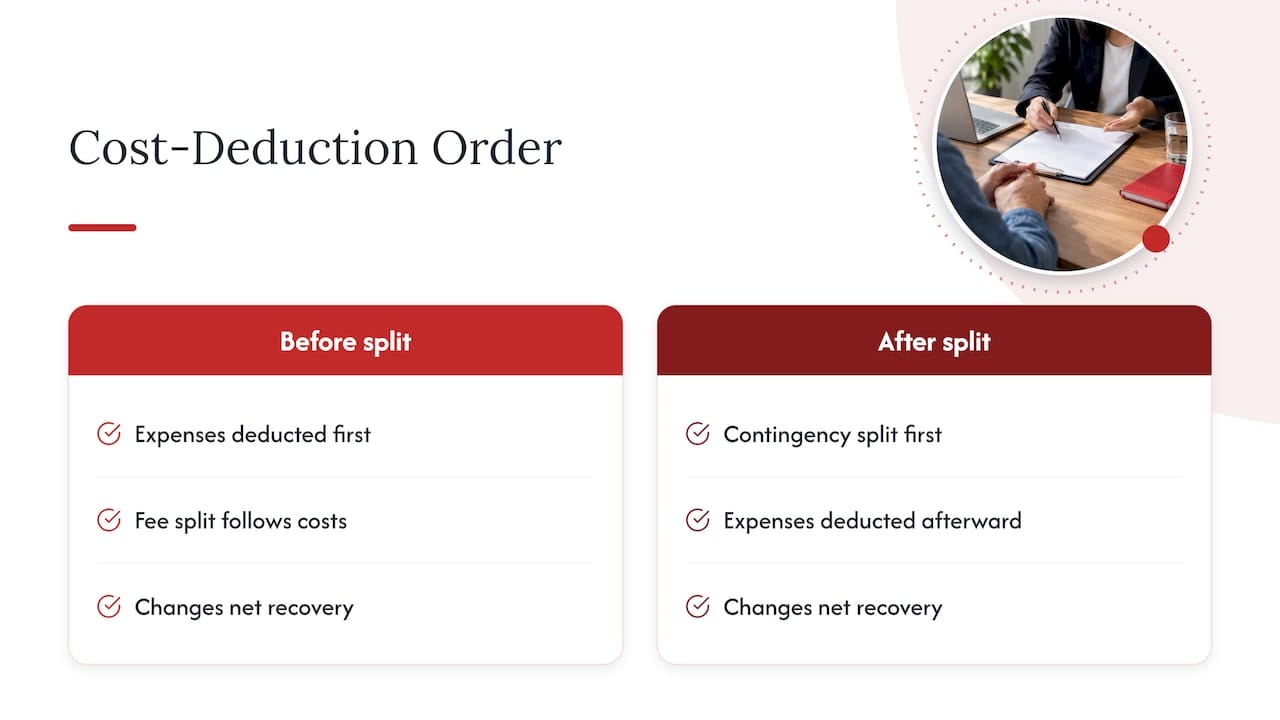
- Ask whether case costs, like filing fees and expert charges, get deducted before or after the contingency fee is calculated, since the order changes your net recovery, as Nolo’s guidance on hiring a personal injury lawyer points out.
- Ask whether the firm advances costs or expects you to pay them as they’re incurred.
- Request the fee agreement in writing and ask if you owe anything if you don’t hire the firm.
Contingency fees typically range from about one-third to forty percent of your recovery, and that split should be spelled out in a signed written agreement, per the FTC. You can also ask whether the percentage drops for an early settlement, since some firms will adjust the fee if a case resolves with less work, according to the American Bar Association’s guide to settling on a fee. Our guide to contingency fee arrangements walks through how these percentages and cost deductions typically work.
4. Understanding case prospects, typical timeline, and value drivers
A candid attorney will give you a range, not a single number, and will explain what could move that range up or down.
- Ask for a direct assessment of your case’s strengths and weaknesses, not just the positives.
- Ask for an estimated settlement range and what assumptions it’s based on.
- Ask for a timeline of major steps, from treatment completion to demand to possible litigation, and what could speed up or slow down each one.
- Ask how shared fault, prior injuries, or gaps in your medical treatment could affect value.
Settlement often happens faster than a trial verdict, and mediation is one path some cases take toward resolution without going before a jury. Our overview of mediation in personal injury cases explains how that option fits into the broader timeline.
5. Who will handle the work and how the firm communicates with clients
The person sitting across from you in the consultation is not always the person who manages your file day to day, and that’s worth clarifying up front.
- Ask who will be your primary point of contact: the lead attorney, an associate, or a paralegal.
- Ask expected response times for phone calls and emails, and whether texting is an option.
- Ask how you escalate if you need faster attention, and who that contact is.
Knowing who does the work and how fast they respond matters as much as the attorney’s resume, since this is also a compatibility check for how the relationship will run, according to the American Bar Association’s consumer questions guide.
6. Documents and evidence to bring to the consultation
Arriving prepared lets an attorney give you a sharper read on your case in the same meeting.
- Medical records and bills, or a list of treating providers plus any authorization forms you’ve received.
- A police report, photos of the scene and any property damage, witness names and contact information, and insurance correspondence.
- A written timeline of events and documentation of missed work or lost income.
Our breakdown of what your personal injury lawyer needs to know covers these details further, and our list of common case mistakes to avoid is worth reviewing before you say anything in writing to an insurer.
7. Next steps if you decide to hire
If you decide to move forward, expect the engagement to start with paperwork and a records request.
- You’ll sign a written agreement spelling out the contingency percentage, how costs are handled, and how the case will be managed.
- The firm will typically ask you to sign records releases and begin gathering facts, so ask what they need from you and by when.
- Confirm how disputes over fees or case decisions get resolved before you sign, since some firms specify arbitration or a state bar process, as outlined in the American Bar Association’s guidance on lawyer disagreements.
8. How we run personal injury consultations at Jmoorelegal
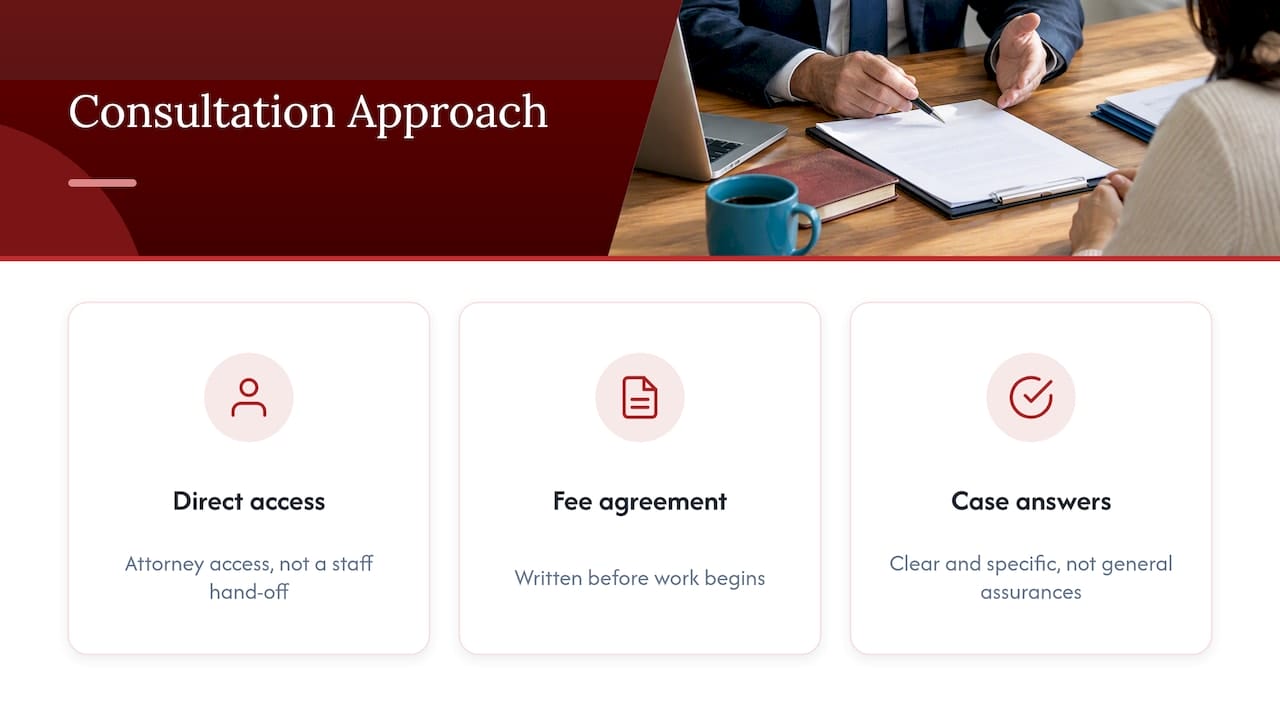
We offer an initial consultation, direct attorney access rather than a hand-off to staff, and a written fee agreement before work begins. Our personal injury practice focuses on clear, specific answers about your case rather than general assurances.
9. What matters most when you walk into a consultation
Most consultation checklists treat every question as equally important, and that’s where they fall short. The fee percentage gets asked constantly while the cost-deduction order, whether expenses come off the top before or after the contingency split, gets skipped almost every time, even though it can change what lands in your pocket more than the percentage itself.
The second gap is trial history. Plenty of attorneys will quote a settlement number with total confidence, but confidence isn’t the same as a track record. Ask what happened in cases that didn’t settle easily, not just the ones that did.
If you only have time for a handful of questions, prioritize fee mechanics and who will actually manage your file over polished descriptions of past wins. The answers to those two questions tell you more about how the next year of your case will go than anything else in the meeting.
— John
Schedule a free consultation with our office
If you’re ready to talk through your case, we offer consultations and handle personal injury claims directly, without passing you off between staff. Bring your medical records, accident report, and any correspondence from an insurer, and we’ll walk through your options together.

- Review our personal injury practice page for the types of claims we handle.
- Reach out through our main site to schedule your free consultation.
FAQ
What not to say to a personal injury lawyer?
Avoid guessing at facts you’re unsure of, such as speed or distance, and never exaggerate your injuries or omit prior medical history, since inconsistencies can hurt your case later. Stick to what you directly observed or experienced, and let your attorney know where your memory is uncertain.
What is the hardest injury to prove?
Injuries without clear objective evidence, such as soft tissue injuries, chronic pain, and some traumatic brain injuries, tend to be harder to prove because imaging and tests don’t always show visible damage. These cases typically rely more heavily on consistent medical documentation and treatment history.
What should I ask a divorce lawyer in an initial consultation?
While this article focuses on personal injury consultations, similar principles apply across family law meetings: ask about experience with cases like yours, fee structure, likely timeline, and who will handle your file day to day. Our family law practice page covers what to expect in that type of consultation.
What not to say in a demand letter?
A demand letter should avoid admitting fault, overstating damages, or including inconsistent details that contradict your medical records or accident report. Our guide to common personal injury case mistakes covers specific pitfalls to avoid before any written communication with an insurer.
Sources
- Hiring a Lawyer | Consumer Advice (FTC)
- What Should I Ask Before Hiring a Personal Injury Lawyer? (Nolo)