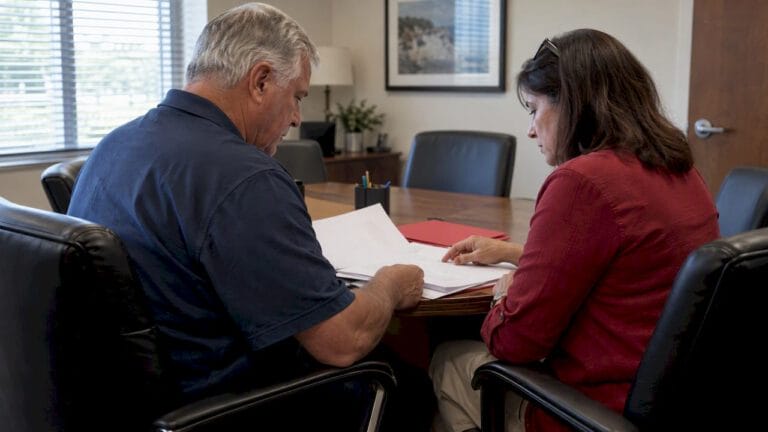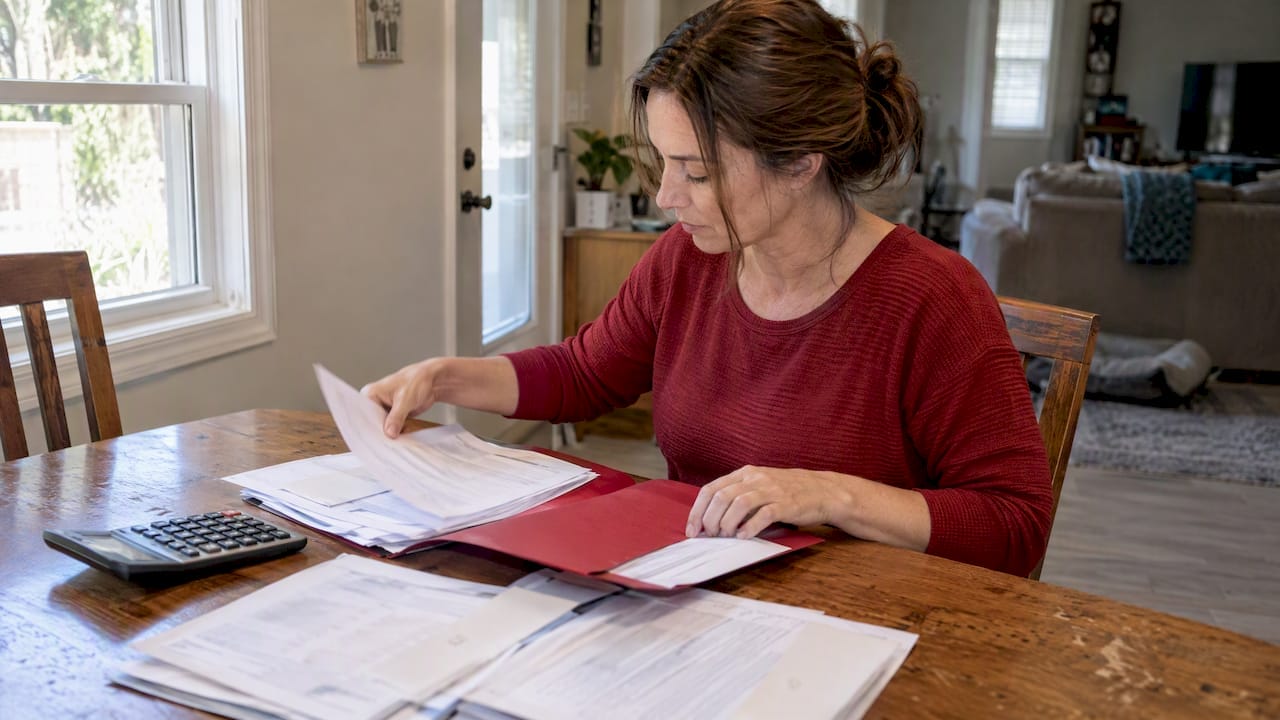
Florida starts every divorce case with a presumption that marital assets and debts split equally under Fla. Stat. §61.075. A judge first sets aside each spouse’s nonmarital property, then divides what remains from the marital estate. An unequal split is possible, but only when specific statutory factors support it and the court puts its reasoning in writing.
TL;DR:
- Premarital property, inheritances, and third party gifts can remain separate only when you preserve records and keep them out of joint accounts.
- A dissipation claim must show intentional waste or concealment within two years before filing, and bank records or other competent evidence matter more than suspicion.
- Both spouses generally must exchange sworn financial affidavits and supporting records within 45 days of filing, then update disclosures after material financial changes.
- You can seek an interim partial distribution by sworn motion for good cause, including legal fees or living expenses while the case remains pending.
- Many Florida circuits require mediation before contested financial issues reach trial, and complex business or pension divisions can add expert fees and extend the case.
Table of Contents
- What Fla. Stat. §61.075 says about the presumption of equality
- How to tell marital property from nonmarital property
- Which factors push a court toward an unequal division
- What disclosure and paperwork the process requires
- How courts structure awards and connect them to alimony
- Common examples: the home, retirement funds, businesses, and debt
- How the equitable distribution timeline unfolds from filing to decree
- What equitable distribution cases typically cost
- Why mediation often resolves equitable distribution disputes
- How military divorces change the equitable distribution analysis
- How narcissistic personality traits can complicate asset division
- What to gather before your first consultation
- How the Law Office of John Vernon Moore, P.A. helps with equitable distribution
- FAQ
- Sources
What Fla. Stat. §61.075 says about the presumption of equality
Florida’s equitable distribution statute begins from a straightforward premise: marital assets and liabilities are presumed to be distributed equally. Before any division happens, the court sets apart nonmarital property belonging to each spouse. When one party contests the division, the judge must support the final distribution with written findings tied to the facts of the case, as required under Fla. Stat. §61.075.
Recent changes have made interim partial distribution a more visible tool. Courts can now identify and distribute certain assets while the case is still pending, provided good cause exists.
- Equal distribution is the default, not a goal to argue for.
- Nonmarital property gets carved out before the marital pot is divided.
- Unequal awards require a written explanation grounded in evidence.
Equal distribution is the statutory starting point under Fla. Stat. §61.075, meaning a spouse who wants a bigger share carries the burden of proving why.
How to tell marital property from nonmarital property
Marital assets generally include anything acquired during the marriage, regardless of whose name is on the title. Nonmarital assets include property owned before the marriage, inheritances, gifts from third parties, and funds that can be clearly traced back to a nonmarital source.
- Identify the acquisition date: property bought before the wedding usually stays nonmarital.
- Check for commingling: nonmarital funds deposited into a joint account often lose their separate character.
- Gather documentation: bank statements, deeds, and gift letters help prove an asset’s origin.
- Note the valuation cutoff: courts typically use the earliest of a separation agreement date, a date the parties agree on, or the filing date, though a judge retains discretion to pick a different valuation date when fairness requires it.
Pro Tip: Keep inherited or premarital money in a separate account from day one. Once it mixes with marital funds, proving it back out becomes an uphill fight.
Our marital versus nonmarital property resource walks through more classification examples for readers sorting out complicated asset histories.
Which factors push a court toward an unequal division
When a spouse asks for more than half, the court weighs a defined set of factors rather than general fairness arguments. These include each spouse’s contribution to the marriage (including homemaking and child-rearing), the economic circumstances of each party, the duration of the marriage, the desirability of keeping the marital home for a dependent child, and whether either spouse intentionally wasted or hid marital assets within two years before the petition was filed, a concept known as dissipation.
- Contribution to the marriage, including nonfinancial roles like homemaking.
- Economic circumstances of each spouse at the time of division.
- Length of the marriage and any interruption in career or education it caused.
- Desirability of retaining the marital home for a minor child.
- Intentional dissipation of assets within two years of filing.
Courts apply a two-year lookback window for dissipation claims under Fla. Stat. §61.075, so spending patterns well before that window rarely factor into the analysis unless tied to an ongoing pattern.
Gambling losses, secret gifts to a third party, or draining a joint account shortly before filing can shift the division in the other spouse’s favor. The presumption of equality still governs, so the spouse alleging dissipation has to bring competent evidence, not suspicion. Our page on dissipation of marital assets covers how these claims get proven or defended in practice.
What disclosure and paperwork the process requires
Florida’s mandatory disclosure rule, Rule 12.285, requires both spouses to exchange a sworn financial affidavit (Form 12.902) along with supporting records. Missing a document or filing late creates friction that slows the whole case down.
- Complete Form 12.902, matched to income level, in full.
- Gather three years of tax returns, W-2s, 1099s, and K-1s.
- Collect recent pay stubs and all bank, retirement, and brokerage statements.
- Produce promissory notes, lease agreements, and any premarital or postmarital agreements.
- Supplement disclosure promptly whenever a material financial change occurs.
- Interim partial distribution can be requested by sworn motion showing good cause, such as a need to pay legal fees or cover living expenses before trial.
- Valuation dates are usually set near filing or trial, but a judge can select a different date when the facts call for it.
Our guide to financial affidavits in Florida divorce and our overview of mandatory disclosure break down these forms in more detail.
How courts structure awards and connect them to alimony
A judge can order a lump-sum payment, a series of installments, or an in-kind transfer of property to carry out equitable distribution. The choice often depends on liquidity: a business owner might pay out a spouse’s share over several years rather than selling the business outright.
- Lump-sum awards resolve the division cleanly but require available cash or financing.
- Installment plans spread the obligation but create an ongoing enforcement relationship.
- Distribution judgments vest immediately and can function like a legal conveyance of title.
Pro Tip: Equitable distribution is decided before alimony, because the property a spouse walks away with directly affects whether they need ongoing support.
Courts look at the distribution outcome first, then determine whether one spouse still needs alimony to meet their needs, a sequencing that the Florida Bar’s analysis of equitable distribution describes as central to how courts structure final judgments.
Common examples: the home, retirement funds, businesses, and debt
Every case has its own mix of assets, but a handful of categories come up constantly.
- The marital home: courts often order a sale and split of proceeds, award it to one spouse with an offsetting payment to the other, or let a parent stay temporarily when a dependent child’s stability matters.
- Retirement accounts: dividing a 401(k) or pension usually requires a Qualified Domestic Relations Order (QDRO), and timing the valuation incorrectly can create unexpected tax consequences for whoever ultimately withdraws the funds.
- Business interests: closely held businesses often need a forensic accountant or business valuator to establish a defensible value before the court can divide the interest fairly.
- Marital debt: credit cards, car loans, and medical debt incurred during the marriage are typically divided along with the assets, though a creditor can still pursue either spouse regardless of what the divorce judgment says.
Our resource on dividing marital debt explains the gap between what a judgment assigns and what a creditor can actually enforce.
How the equitable distribution timeline unfolds from filing to decree
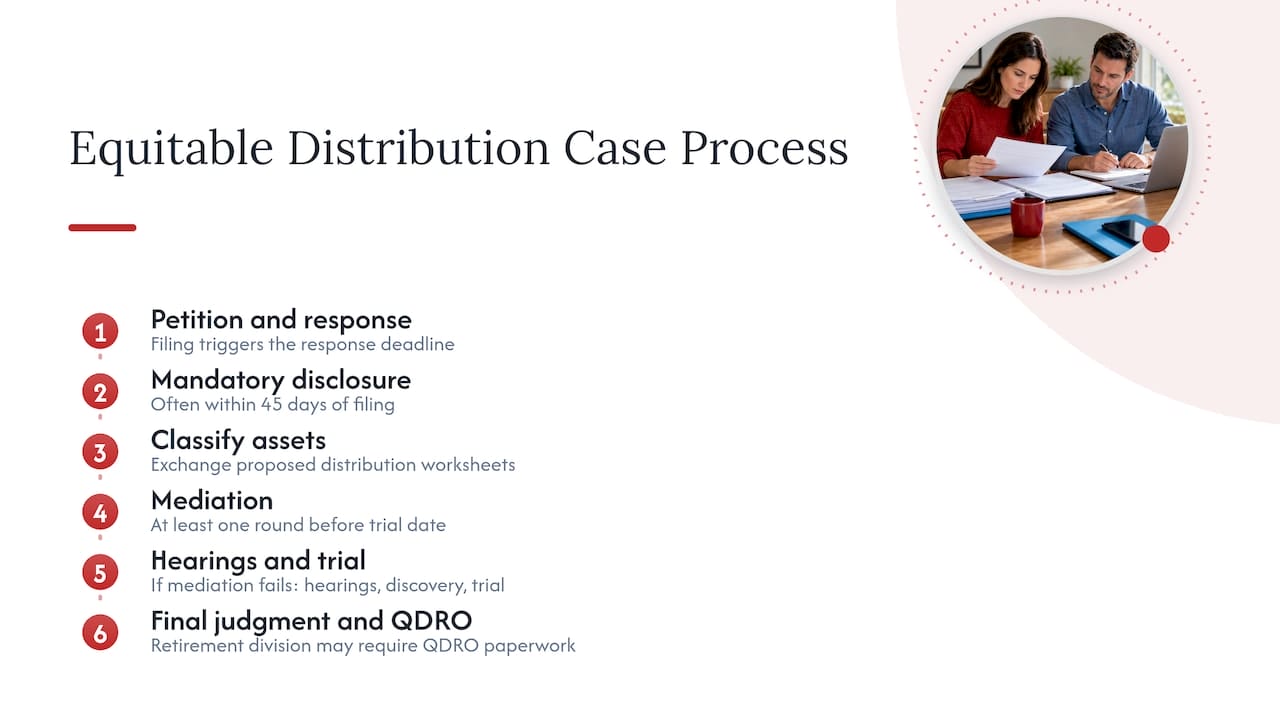
The process begins when one spouse files a petition for dissolution of marriage, which triggers the other spouse’s deadline to respond. Mandatory disclosure obligations kick in early, often within 45 days of filing, requiring both parties to exchange financial affidavits and supporting documents before much else can move forward.
Once disclosure is underway, the parties typically identify and classify assets, exchange proposed equitable distribution worksheets, and attend at least one round of mediation before a trial date is ever set. Many Florida circuits require mediation before a judge will hear a contested financial issue, which means the bulk of cases resolve well before trial.
If mediation does not resolve the property issues, the case proceeds to temporary hearings on interim relief, continued discovery, and eventually trial, where the judge classifies each asset, assigns values, and issues a written order explaining the distribution. After trial, a final judgment is entered, and the distribution of specific assets, such as retirement accounts, often requires additional paperwork like a QDRO before it can actually be executed.
The length of this process depends heavily on complexity. A case with a few bank accounts and no real estate can resolve in a matter of months, while a case involving a business, multiple retirement plans, and contested dissipation claims can take well over a year. Settling earlier through mediation generally shortens the path considerably compared to a fully litigated trial.
What equitable distribution cases typically cost
Costs in an equitable distribution case depend on how contested the financial issues are and how many assets require valuation. Filing fees, service of process, and basic court costs are the smallest part of the expense in most cases.
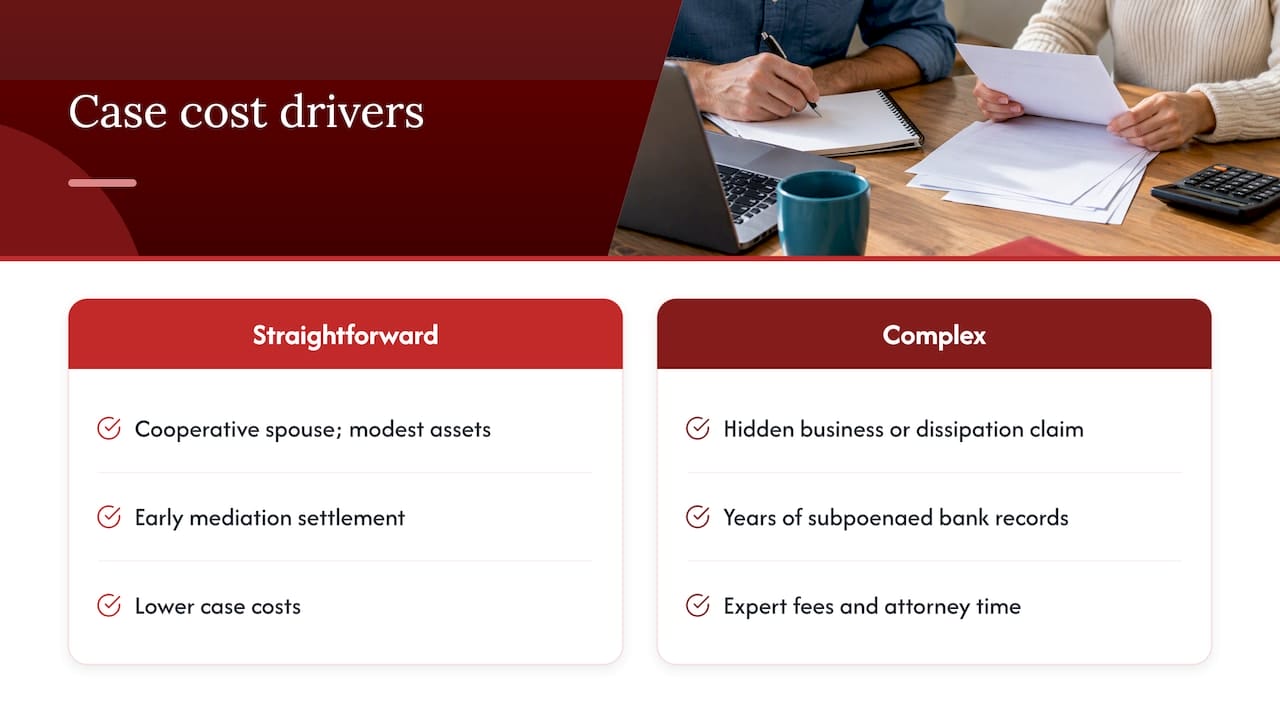
The larger costs come from discovery and expert work: forensic accountants for business valuations, appraisers for real estate, and actuaries for pension division all add professional fees on top of attorney time. A straightforward case with a cooperative spouse and modest assets costs far less than one involving a hidden business interest or a dissipation claim that requires subpoenaing bank records going back years.
Attorney fees typically track the complexity and length of the case rather than a flat number, since hourly litigation work scales with how many motions, depositions, and hearings the case requires. Cases that settle through mediation early generally cost a fraction of what a fully litigated trial runs, since expert discovery and courtroom time are the biggest cost drivers. We offer a free initial consultation so prospective clients can get a sense of what their specific situation might involve before committing to representation.
Why mediation often resolves equitable distribution disputes
Mediation gives both spouses a structured setting to negotiate asset division with a neutral third party, rather than leaving every decision to a judge who has never met them. Many Florida circuits require at least one mediation session before a contested financial matter can go to trial, which means most equitable distribution disputes get a real chance at settlement before litigation costs pile up.
A mediator does not decide the outcome. Instead, the mediator helps both spouses work through the equitable distribution worksheet, identify where they actually disagree, and test possible trade-offs, such as one spouse keeping the home in exchange for a larger share of a retirement account. When both sides come prepared with full financial disclosure, mediation sessions tend to move faster and produce agreements that hold up better than a rushed settlement reached outside that process.
We approach mediation sessions with an understanding of both the legal standards a judge would apply and the practical trade-offs that make a settlement durable. For couples who want to avoid a drawn-out trial, a well-prepared mediation session is often the fastest route to a final resolution. Our family mediation page covers how we structure that process for Brevard County clients.
How military divorces change the equitable distribution analysis
Military divorces in Florida involve an extra layer of federal rules on top of the state’s equitable distribution framework. Dividing military retirement pay requires careful attention to concurrent jurisdiction, residency requirements, and specific formulas for calculating a former spouse’s share, all of which sit alongside Florida’s standard classification of marital versus nonmarital property.
Deployment schedules, Survivor Benefit Plan elections, and the timing of military pension valuation all affect how a settlement or judgment gets structured. A service member’s pay statements and retirement point statements become essential disclosure documents, often in addition to the standard financial affidavit and tax records required under Rule 12.285.
Because military families often face frequent relocations and unpredictable schedules, getting documentation together early and understanding how federal and state rules interact matters more than in a typical civilian case. We handle cases involving military families, and our military divorces page covers the federal and state issues that come up most often.
How narcissistic personality traits can complicate asset division
A spouse with narcissistic personality traits can turn what should be a straightforward financial disclosure process into a prolonged fight. Common patterns include refusing to produce documents on time, minimizing or hiding assets, and using litigation itself as a form of control rather than a path to resolution.
These dynamics do not change the legal standard under Fla. Stat. §61.075, but they do change the practical strategy. A spouse facing this kind of obstruction often needs to lean harder on formal discovery tools, subpoenas, and, where justified, a dissipation claim to account for assets that were spent down or concealed before filing.
Mediation can be difficult in these cases because a narcissistic spouse may use the session to relitigate grievances instead of negotiating in good faith, which is part of why having an attorney who recognizes these patterns early matters. We have experience handling high-conflict cases involving narcissistic personality dynamics, which shapes how we prepare disclosure requests, document obstruction for the court, and set realistic expectations about timeline and cost from the start.
What to gather before your first consultation
Pull together tax returns, recent bank and retirement statements, and any prenuptial or postnuptial agreements before you meet with an attorney. Avoid spending down joint accounts, and take a dated snapshot of every balance now. These steps protect your position regardless of how contested the case becomes.
— John
How the Law Office of John Vernon Moore, P.A. helps with equitable distribution
We represent Brevard County clients through every stage of equitable distribution, from the first disclosure deadline through final judgment, including cases that require a QDRO, a business valuation, or a contested dissipation claim. Our mediation certification means we can represent you in direct negotiation or guide you through a formal mediation session with the same standards a judge would apply.

With decades of combined experience and specific work on military divorces and cases involving narcissistic personality dynamics, we focus on building a documented, defensible position from day one rather than reacting once a dispute escalates. We offer a free initial consultation to walk through your specific asset picture. Visit our family law practice page to schedule a conversation about your case.
This article is general information, not a substitute for advice from a qualified lawyer. Consult a qualified legal professional about your own circumstances before acting on anything here.
FAQ
Which states are equitable distribution states?
Most U.S. states, including Florida, use equitable distribution rather than community property to divide marital assets in divorce. Equitable distribution means a fair division based on statutory factors, with Florida’s statute starting from a presumption of equal distribution under Fla. Stat. §61.075.
Does a husband have to support his wife during separation in Florida?
Florida law does not require a fixed separation support obligation outside of a court order. A spouse can request temporary alimony or support while a divorce case is pending, and the court decides based on need and ability to pay rather than an automatic rule.
What assets cannot be touched in a divorce?
Property owned before the marriage, inheritances, and gifts from third parties generally stay nonmarital and outside the division, as long as they were not commingled with marital funds. Our page on marital versus nonmarital property covers the common exceptions and commingling pitfalls that can change that outcome.
What does equitable distribution mean in Florida?
Equitable distribution means Florida courts divide marital assets and debts fairly, starting from a presumption of an equal split under Fla. Stat. §61.075. A judge can order an unequal division only when statutory factors, such as dissipation or economic circumstances, support it and the court explains that reasoning in writing.
How does fault affect property division in a Florida divorce?
Moral fault, such as an affair, rarely changes how property gets divided on its own. Courts instead focus on economic consequences, like whether marital funds were spent on the affair, which the FindLaw overview of Florida marital property laws describes as the real factor judges weigh. Our page on divorce after infidelity explains what actually shifts an outcome in these cases.
Who claims the children on taxes after a divorce?
The right to claim a dependent child on taxes is typically addressed in the divorce judgment or a separate agreement, separate from how property is divided. The Tax Refinery’s guide to custody and claiming children walks through how that determination typically works and what documentation the IRS expects.
Sources
- Chapter 61 Section 075 – 2026 Florida Statutes – The Florida Senate
- RULE 12.285. MANDATORY DISCLOSURE (Florida Courts media)
- A Seven-Step Analysis of Equitable Distribution in Florida Part 2: Distributing Marital Property – The Florida Bar
- Florida marital property laws – FindLaw