
A contingency-fee attorney is paid only when you recover money. The lawyer takes a pre-agreed percentage of your settlement or judgment — and if you lose, you owe no attorney fees. According to the Cornell Law School Legal Information Institute, fees in personal-injury matters typically fall between 20% and 50% of the recovery, depending on case stage and complexity.
Two facts worth knowing before you read further:
- Typical percentage: commonly about one-third for pre-suit settlements, rising to a higher percentage if the case goes to trial
- Common case types: personal injury, workers’ compensation, and some civil money claims
The ABA Model Rule 1.5 requires the arrangement to be reasonable and documented in writing, and the Florida Bar requires the written agreement to spell out the percentage and how expenses are deducted.
Key Takeaways
A contingency-fee attorney is paid only from your recovery — but the deduction order and cost terms in your written agreement determine how much you actually take home.
| Point | Details |
|---|---|
| Pay only if you recover | No attorney fee is owed if the case is lost, but costs may still apply depending on the contract. |
| Typical fee range | Fees commonly run 33% pre-suit, rising to 40% or more at trial, within a national range of 20%–50%. |
| Deduction order matters | A 33% fee on gross vs. net recovery can shift thousands of dollars between attorney and client. |
| Get it in writing | Model Rule 1.5 and Florida Bar rules require a signed written agreement stating the percentage, cost allocation, and final accounting. |
| Jmoorelegal | Offers free consultations for personal-injury contingency cases in Brevard County with transparent, written fee agreements explained at intake. |
Table of Contents
- What is a contingency fee attorney and how does the arrangement work?
- When are contingency fees used, and when are they off the table?
- How are contingency fees calculated? Concrete examples
- Who pays litigation costs, and what happens if you lose?
- Pros and cons of hiring a contingency-fee attorney
- Questions to ask before you sign a contingency-fee agreement
- What do Model Rule 1.5 and state bar rules require?
- A perspective on contingency-fee representation in Brevard County
- Personal injury representation in Brevard County, Florida
- Sources
What is a contingency fee attorney and how does the arrangement work?
The core mechanic is simple: the attorney advances time and expertise; you advance nothing upfront. If the case resolves in your favor, the attorney’s fee comes out of the recovery before you receive your share. No recovery means no attorney fee, though costs are a separate matter covered below.
Percentage structures vary by stage. Most tiered agreements commonly reflect increasing percentages at each phase, starting lower in early settlement and rising for post-filing, trial, and sometimes appeal stages.
Why does the rate climb? Because the attorney’s risk and workload increase at each stage. A case that settles in six weeks costs the firm far less than one that goes to a two-week jury trial. The LegalClarity breakdown of tiered contingency arrangements notes that sliding-scale structures are common and that negotiating a cap or lower rate is entirely possible, particularly for cases with strong liability evidence.
The ABA’s guidance on fees and expenses frames the arrangement as a deliberate access-to-justice tool: by shifting financial risk to the attorney, contingency fees let claimants pursue meritorious cases they could never afford to litigate at hourly rates.
Pro Tip: Ask at the first meeting whether the fee percentage is calculated on the gross recovery (before costs are deducted) or the net recovery (after costs). That single question can change your take-home by thousands of dollars.
When are contingency fees used, and when are they off the table?
Contingency arrangements are built for cases where money is the goal. The ABA confirms they are used mainly in personal injury, workers’ compensation, and similar civil money claims. Common examples include:
- Car and truck accidents
- Slip-and-fall injuries
- Medical malpractice
- Product liability
- Workers’ compensation claims
- Some debt-collection and civil fraud matters
Two categories are effectively off-limits under ethics rules. Criminal defense cannot be handled on contingency — a fee tied to an acquittal would create obvious incentive problems and is prohibited under ABA Model Rule 1.5(d). Most domestic-relations matters — divorce, child custody, spousal support — are similarly prohibited in the majority of states, because tying a fee to the outcome of a custody dispute or property division raises serious conflict-of-interest concerns. Florida and most other states follow this prohibition. If you need help with family law matters in Florida, those cases are typically handled on an hourly or flat-fee basis instead.
Some civil matters sit in a gray zone. A breach-of-contract claim seeking money damages may qualify; a case seeking only an injunction or non-monetary relief usually does not, because there is no recovery from which to take a percentage.
How are contingency fees calculated? Concrete examples
The math matters more than most clients realize, and the order of deductions is where the real difference shows up.
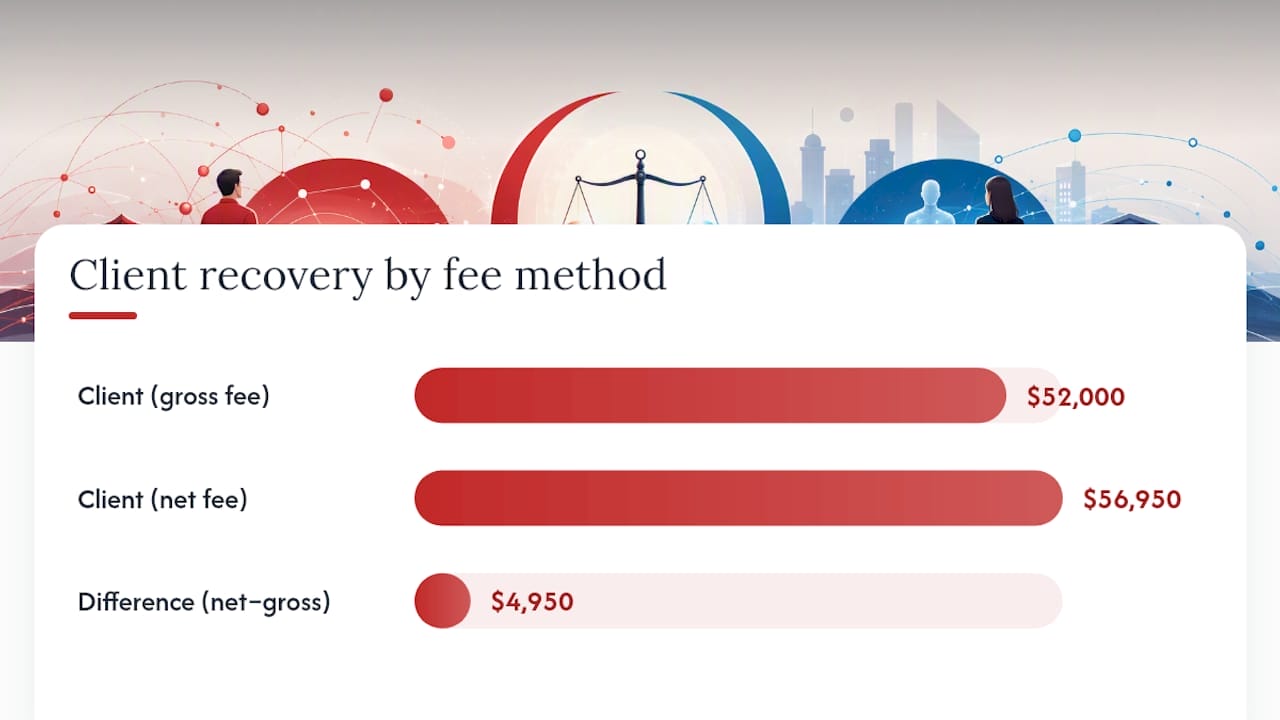
Assume a $100,000 settlement and $15,000 in litigation costs.
Scenario A: Fee calculated on gross recovery (before costs)
- Attorney fee: 33% × $100,000 = $33,000
- Costs deducted from client’s share: $15,000
- Client receives: $100,000 − $33,000 − $15,000 = $52,000
Scenario B: Fee calculated on net recovery (after costs)
- Net recovery: $100,000 − $15,000 = $85,000
- Attorney fee: 33% × $85,000 = $28,050
- Client receives: $100,000 − $28,050 − $15,000 = $56,950
The difference is nearly $5,000 to the client — on a single case. The Florida Bar’s consumer pamphlet specifically flags this distinction and requires the written agreement to state which method applies.
The table below summarizes commonly reported percentage ranges by stage:
| Case Stage | Typical Fee Range | Notes |
|---|---|---|
| Pre-suit settlement | around one-third | Typical starting rate |
| Post-filing (litigation) | higher than pre-suit | Rate rises after complaint is filed |
| Trial | higher still | Reflects full trial preparation and time |
These figures generally align with the broader range reported by the Cornell LII for personal-injury matters nationally.
Who pays litigation costs, and what happens if you lose?
Attorney fees and litigation costs are two different things. The fee is the lawyer’s compensation. Costs are the out-of-pocket expenses the case generates, and they include:
- Court filing fees
- Deposition and transcript costs
- Expert witness fees
- Medical record retrieval
- Subpoena and process-server fees
- Medical lien satisfaction at closing
The California State Bar’s billing guidance makes the critical point: even when a client loses, many contingency agreements require the client to remain liable for costs unless the contract explicitly states otherwise. Read that sentence twice before you sign anything.
Some agreements advance costs and recover them only from a successful settlement. Others require the client to pay costs regardless of outcome. Both are legal; the difference is entirely in the contract language.
Pro Tip: Before signing, ask the attorney for a written estimate of expected costs and confirm in writing whether you owe those costs if the case is dismissed or lost. At closing, request an itemized settlement statement showing every deduction.
Pros and cons of hiring a contingency-fee attorney
The arrangement has genuine advantages, but it is not the right fit for every situation.
Advantages:
- No upfront legal fees — you can pursue a claim without cash reserves
- The attorney’s financial interest aligns with yours: bigger recovery means bigger fee
- Attorneys screen cases before taking them, which filters out weak claims
- Access to experienced counsel that hourly billing would price out of reach
Disadvantages:
- The total fee paid can exceed what hourly billing would have cost on a straightforward case
- A potential conflict exists between settling quickly (lower risk for the attorney) and holding out for maximum recovery (better for the client)
- You may still owe costs if you lose, depending on the contract
- You give up some control: settlement authority and strategy decisions can create friction
Contingency representation makes the most sense when liability is reasonably clear, damages are significant, and you cannot afford hourly rates. When a case is simple, damages are modest, or the facts are genuinely contested, an hourly or flat-fee arrangement may produce a better net result. Reviewing common personal injury case mistakes before your first meeting can help you walk in with a clearer picture of your case’s strength.
Questions to ask before you sign a contingency-fee agreement
Walk into every intake meeting with this list. If an attorney cannot answer these clearly, that itself is useful information.
Must-have written contract terms:
- The exact percentage at each stage (pre-suit, post-filing, trial, appeal)
- Whether the fee is calculated on gross or net recovery
- Who pays costs if the case is lost or dismissed
- Whether costs are deducted before or after the attorney’s percentage
- How settlement authority works — can the attorney settle without your approval?
- What happens to the fee if you fire the attorney mid-case (quantum meruit)
Additional questions worth asking:
- What is your estimate of total litigation costs for this case?
- Will I receive an itemized settlement statement at closing?
- Are appeals covered under this agreement, or does a new fee apply?
- How often will you communicate case updates to me?
On the quantum meruit point: if you discharge an attorney before the case resolves, that attorney may still be entitled to reasonable compensation for work already done, even without a final recovery. The LegalClarity explanation of contingent fees notes that quantum meruit claims are a real possibility and that competent firms document time and expenses from day one. Ask how the firm handles this scenario before you sign.
What do Model Rule 1.5 and state bar rules require?
ABA Model Rule 1.5 sets the national ethical floor. Under Rule 1.5(d), a contingency-fee agreement must:
- Be in writing and signed by the client
- State the method by which the fee is determined
- Disclose whether litigation costs are deducted before or after the fee is calculated
- Specify what expenses the client owes if the case is lost
- Include a written statement at the conclusion of the matter showing the outcome, total recovery, attorney’s fee, and an itemized list of all costs deducted
State rules build on this floor and sometimes go further. Florida requires the written agreement to contain specific disclosures and caps fees in certain case types (medical malpractice, for example, has statutory limits). California’s State Bar similarly requires written fee agreements and a final accounting. If you are outside Florida, check your state bar’s website for local fee rules — most publish consumer pamphlets that are free and plain-language.
Pro Tip: Verify any attorney’s standing before you hire them. The Florida Bar’s attorney search tool lets you confirm licensure and check for discipline history in under two minutes.
A perspective on contingency-fee representation in Brevard County
Contingency fees work best when the facts support them — and that is not a universal condition. In my experience handling personal-injury cases in Brevard County, the arrangement makes the most sense when liability is reasonably clear, the injury is documented, and the client genuinely cannot front hourly fees. Those cases are where the alignment of interests is real: the attorney has every reason to build the strongest possible record because the fee depends on it.
What I see go wrong is when clients sign without understanding the cost-deduction order or without asking about their exposure if the case is dismissed. A $100,000 settlement sounds like a windfall until $33,000 in fees and $20,000 in costs come off the top. Walking clients through the actual math at intake, not at closing, is something I consider a basic obligation.
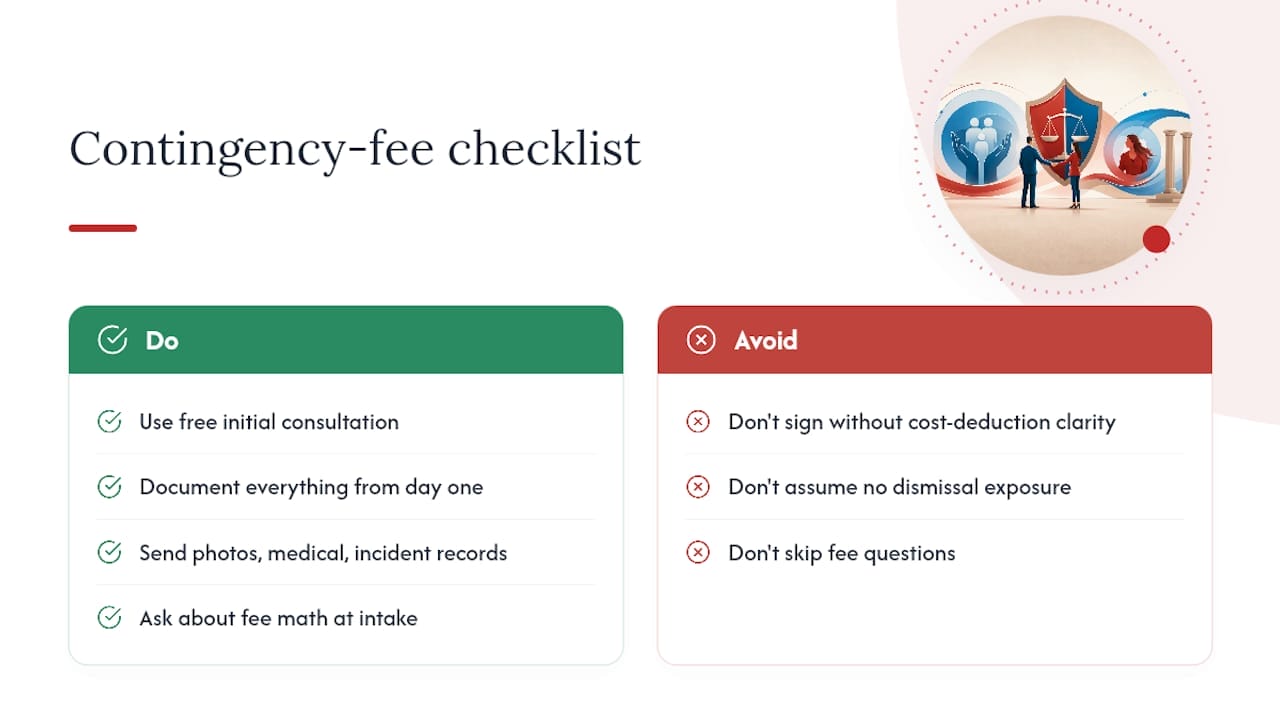
For local claimants, the practical advice is straightforward: document everything from day one. Photographs, medical records, incident reports, witness contact information. The information your personal injury lawyer needs to evaluate your case is the same information that drives the settlement value. The faster you can provide it, the faster the attorney can assess whether contingency representation is the right fit and what a realistic recovery looks like.
Free initial consultations exist precisely for this purpose. Use them.
Personal injury representation in Brevard County, Florida
If you have a personal-injury claim in Brevard County and want to understand whether a contingency-fee arrangement fits your situation, Jmoorelegal offers free initial consultations with direct attorney contact from the first meeting.

The firm’s personal injury practice covers auto accidents, slip-and-fall injuries, and other civil claims where contingency-fee representation is common. Every fee agreement is explained in plain language at intake, including the percentage, the cost-deduction order, and what you would owe if the case does not resolve in your favor. No surprises at closing.
The office is located in Brevard County, Florida. Call or schedule a free case evaluation to get a straight answer on whether your claim is a candidate for contingency representation and what the realistic numbers look like.
Sources
The sources below are the primary authorities used in this article. Each is free to access and worth reading directly if you want the full text of the rules.
- contingency fee | Wex | US Law | LII / Legal Information Institute
- What Is a Contingent Fee and How Does It Work? – LegalClarity
- What to Expect Regarding Fees and Billing | The State Bar of California
To check your state’s specific fee rules or verify an attorney’s license and discipline history, visit your state bar’s official website directly.
This article provides general legal information, not legal advice. Fee rules vary by state and case type. Confirm current requirements with your state bar or a licensed attorney in your jurisdiction.
This article is general information, not a substitute for advice from a qualified lawyer. Consult a qualified legal professional about your own circumstances before acting on anything here.