
If your proposed move is 50 miles or more from your residence at the time of the last order and will last at least 60 consecutive days, the relocation statute in Florida applies to you. You must either get a signed written agreement from everyone with time-sharing or file a petition to relocate. Anyone with court-ordered time-sharing must comply, an objection is due within 20 days, and the relocating parent carries the initial burden of proof.
TL;DR:
- Measure the 50 miles from the residence at the last time sharing order; temporary absences for vacation, education, or health care do not count.
- After service, objections are due within 20 days; any party’s written hearing request within 10 days can trigger a hearing on a signed agreement.
- The relocating parent must show by a preponderance of evidence that relocation serves the child’s best interest; then the burden shifts to the objecting parent.
- Document job or education offers, housing, school options, time sharing history, and travel costs; judges assess whether the plan protects the child’s relationships and needs.
Table of Contents
- What Florida Statute §61.13001 actually requires
- Relocation by agreement versus filing a petition
- The statutory factors courts weigh in contested relocation cases
- Hearings, burden of proof, temporary orders, and appellate review
- Possible orders and real-world consequences if relocation is approved or denied
- How to prepare your case, whether you are moving or objecting
- What judges prioritize and where parents slip: a Brevard County view
- How we help with Florida relocation disputes
- FAQ
- Sources
What Florida Statute §61.13001 actually requires
The law you are dealing with is Florida Statute 61.13001, titled “Parental relocation with a child.” It defines relocation as a change in the principal residence of a parent at least 50 miles from where that parent lived at the time of the last order establishing or modifying time-sharing, for at least 60 consecutive days. Temporary absences for vacation, education, or health care do not count.
Two details trip people up. First, the 50 miles is measured from your residence at the time of the last order, not from where you live today. If you already moved a short distance after the order and now plan a second move, the math starts at the original address. Second, the 60 days refers to consecutive days of a change in principal residence. A temporary absence for education or another purpose listed in the statute may fall within the exception, but the label you put on the move does not control. If the move is really a change of home, the statute treats it that way.
Who the statute covers
The statute is not limited to a parent who holds primary custody. It applies to any parent or other person with court-ordered time-sharing, so even a parent with a 50/50 schedule must follow the petition requirements for a qualifying move. Court-ordered access held by someone other than a parent is also covered. The statute addresses orders entered both before and after October 1, 2009, and you can read the structure of those applicability rules in the Justia version of the statute.
How the statute talks about “materially affecting” time-sharing
The statute is built around moves that change a child’s time with the other parent. A relocation petition must explain the proposed move and lay out a proposed long-distance schedule precisely because the move will usually affect the existing time-sharing arrangement. The court evaluates the relocation under the statutory best-interest framework. The court considers the child’s best interest, rather than treating either parent’s position as decisive on its own.
A quick checklist helps you decide whether the statute reaches your plans:
- Distance: Will your new principal residence be at least 50 miles from your residence at the time of the last order?
- Duration: Will the change last at least 60 consecutive days?
- Purpose: Is the stay a true temporary absence, such as vacation, education, or health care, or is it a change of home?
- Status: Do you have court-ordered time-sharing or access, whether as a parent or another person?
- Timing: Was your order entered before or after October 1, 2009? The statute addresses both.
If every answer points toward a move, assume the statute governs you and plan accordingly. Moving first and sorting out the paperwork later is the most expensive way to learn the rules.
Relocation by agreement versus filing a petition
Florida gives you two lawful routes. Both begin with the same question: can you and every other person entitled to time-sharing agree?
Relocation by agreement
When everyone entitled to access signs a written agreement, you use the Florida Supreme Court approved family law forms. The instructions for the Motion for Order Permitting Relocation by Agreement, Form 12.950(b)%20ADA.pdf), explain that if all persons entitled to access sign the agreement and no one timely requests a hearing, the court may ratify it without an evidentiary hearing. A timely written request for a hearing, within 10 days, triggers one. The agreement must include the proposed long-distance time-sharing schedule and transportation arrangements, and it should be specific enough that a judge could enforce it.
Petition to relocate
When there is no agreement, you file a petition. The Petition to Relocate with Minor Child(ren) packet explains that you must serve every person entitled to time-sharing, and that a response objecting to the petition must be filed within 20 days or the relocation may be allowed without a hearing. That 20-day clock is the single most consequential deadline in the process.
Here is the sequence most parents follow:
- Confirm the statute applies using the distance and duration tests above.
- Try for a written agreement with everyone entitled to time-sharing, using Form 12.950(a) as the framework.
- If agreement fails, prepare the Petition to Relocate, including the reason for the move, the new address and mailing details when known, the date of the move, and a proposed long-distance parenting plan.
- Attach the supporting paperwork the clerk and the form instructions call for, such as the proposed parenting plan and the UCCJEA affidavit.
- File in the court that entered your existing order and have the other parent served formally.
- Calendar the 20-day response window from the date of service, and watch for an objection.
- Submit a proposed final judgment when no one objects, using the court’s form language as your model.
Pro Tip: Draft your proposed long-distance schedule as if the judge will adopt it word for word. Specific pickup locations, named holidays, and who pays for each flight or drive leave far less room for dispute than “reasonable and liberal” contact.
Clerks in different circuits have their own filing habits, so check your circuit’s family division page for local packet instructions. If your case sits in Brevard County, we can walk you through the local filing routine. Our Florida child custody and time-sharing guide also covers how a parenting plan fits into this process.
The statutory factors courts weigh in contested relocation cases
When a parent objects, the judge turns to subsection (7) of the statute. The relocation factors are codified in 61.13001(7), as commentators note in a survey of professionals on relocation issues in custody evaluations. The controlling question is the child’s best interest, and the court weighs the listed factors without a presumption that the move is good or bad.
The factors in plain English
- Nature, quality, extent of involvement, and duration of the child’s relationship with each parent, siblings, and other significant people. A judge wants to know who has actually done the daily work of parenting.
- The child’s age, developmental stage, and needs, and how a move is likely to affect them physically, educationally, and emotionally. A teenager in the middle of high school is in a very different position than a toddler.
- Whether a long-distance schedule can preserve the child’s relationship with the nonrelocating parent. Judges look at feasibility: travel time, cost, the child’s school calendar, and the parents’ work schedules.
- The child’s preference, when the child is mature enough to express a reasoned one. It is a factor, not a vote.
- Whether the move will improve the general quality of life for the relocating parent and the child, financially, emotionally, and educationally.
- The reasons each parent is seeking or opposing the move, including whether either is acting in good faith or to frustrate the other parent’s relationship.
- The current employment and economic circumstances of each parent, and whether the relocation is necessary to improve them.
- Whether the relocating parent has complied with the time-sharing order and the statute in the past, and whether either parent has shown willingness to facilitate the child’s relationship with the other.
- Whether the relocation will enhance the child’s access to extended family support or reduce it.
- Any history of substance abuse or domestic violence and its effect on the child.
- Any other factor affecting the child’s best interest or the determination of whether to allow the move.
How facts help or hurt
Consider two illustrations, both hypothetical. A parent seeks to move a significant distance for a documented job offer at a higher salary, proposes extended time for the other parent, and has a history of facilitating exchanges. That parent presents a strong, well-supported plan. A different parent proposes a cross-country move with no confirmed job, offers only “visitation as agreed,” and has a record of withholding the child on holidays. That request will struggle, because the plan does not protect the relationship and the history suggests it will erode.
Facts that help a relocating parent: a verified job or education opportunity, a realistic travel budget, extended family waiting at the destination, a school already identified, and a track record of encouraging contact. Facts that help the objecting parent: consistent, hands-on involvement in school and medical routines, a stable local support network for the child, evidence that the move is driven by a desire to limit contact, and a long-distance plan that exists only on paper.
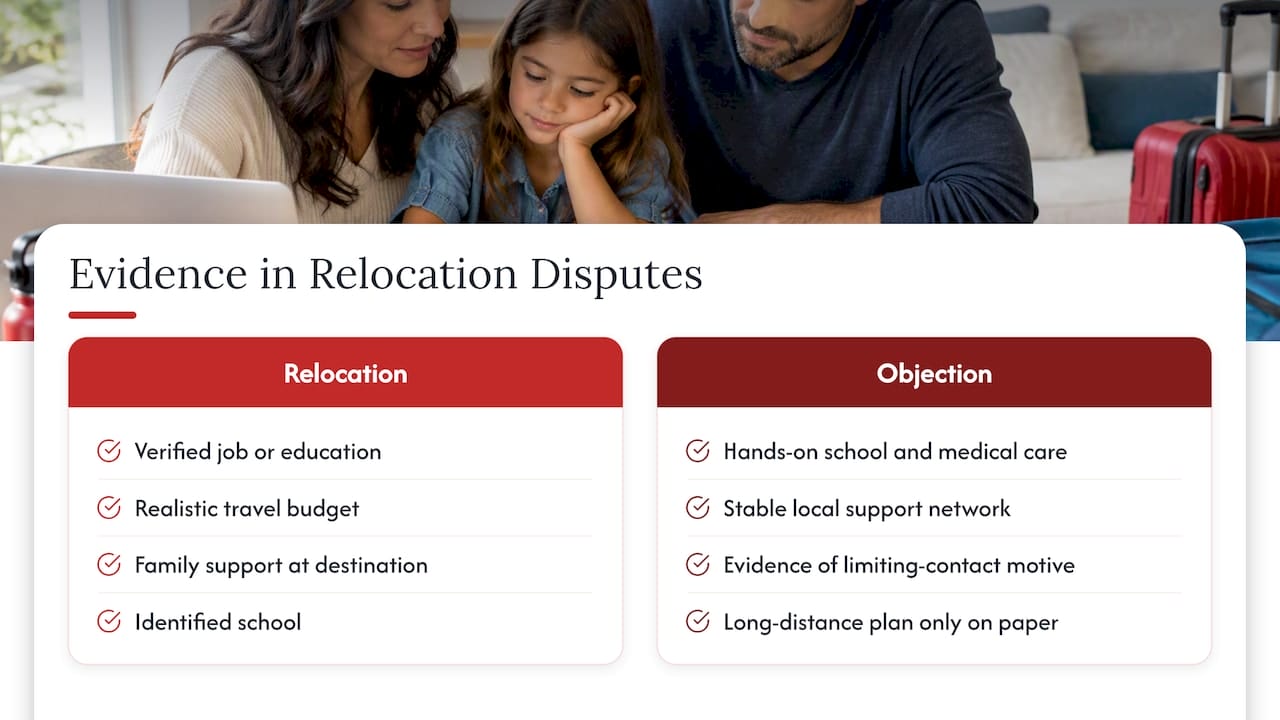
Remember that the child’s best interest is the controlling inquiry. The judge is not deciding which parent deserves the better life. For more on the Florida-specific best-interest analysis, see our page on the best interests of the child in Florida.
Hearings, burden of proof, temporary orders, and appellate review
Who has to prove what
Under the statute, the parent seeking to relocate must prove by a preponderance of the evidence that the relocation is in the child’s best interest. If that burden is met, it shifts to the nonrelocating parent to show that the proposed relocation is not in the child’s best interest. Statutory extracts confirming the burden-shifting rules appear in the Online Sunshine version of the statute.
Temporary orders
While a petition is pending, the statute allows a court to issue temporary orders. A parent worried that the other parent will move before the court rules can ask for an order restraining the relocation. A relocating parent with an urgent job start can ask for permission to move temporarily pending the final hearing. Courts can also order a child returned when a relocation has already happened without permission. If you seek temporary relief, assemble your core documents early.
What evidence matters
At a temporary hearing or trial, judges typically hear:
- Witness testimony from the parents and sometimes teachers, coaches, relatives, or caregivers who see the child’s daily life.
- Parenting calendars showing who actually handled school pickup, medical appointments, and activities.
- Financial records, including offer letters, pay stubs, budgets for travel, and cost-of-living comparisons.
- Evaluator or expert reports, such as a custody evaluation addressing the child’s relationships and the parents’ capacity to support contact.
- Communications between the parents that show cooperation or obstruction.
Credibility often decides the case. A parent who testifies accurately, concedes the other parent’s strengths, and presents a realistic plan usually fares better than one who overstates or minimizes.
Appellate review
A losing party sometimes appeals, but the odds are not generous. In Mignott v. Mignott, the Third District Court of Appeal reviewed a trial court’s relocation order for abuse of discretion and addressed whether the statutory findings were supported by competent, substantial evidence.
An appellate court reviews a relocation order for abuse of discretion and requires the trial court’s statutory findings to rest on competent, substantial evidence. In practice, the trial court is where your case is won or lost, so build the record there.
Possible orders and real-world consequences if relocation is approved or denied
When the court grants relocation
The Final Judgment / Supplemental Final Judgment Granting Relocation form, Form 12.950(i), shows what a grant can look like. The court can adopt the petition’s time-sharing schedule, order specific transportation arrangements, and address child-support modifications tied to the move. Where the petitioner’s plan is thin, the judge can instead draft a plan or require the parties to submit a more detailed one.
Expect an order to spell out:
- Regular long-distance time-sharing, often concentrated into summers, spring break, and alternating holidays.
- Transportation terms, including who accompanies a young child, who buys tickets, and where exchanges happen.
- Communication terms, such as scheduled video calls and reasonable phone contact.
- School and activity arrangements, including enrollment in the new school and how records are shared.
When the court denies relocation
A denial means the child stays in the existing arrangement. The parent who still wants to move can consider relocating alone or seek a modification of the arrangement if circumstances change. Before relocating with the child, seek the required agreement or court approval. Moving without permission can create serious legal problems.
Child support
Relocation may lead the court to consider a support recalculation. A new job changes income, a long-distance schedule changes the number of overnights, and travel costs can be allocated between the parents. The final judgment form contemplates child-support modification tied to the move, so ask for a recalculation or be prepared to respond to one.
Remedies that preserve contact
Even when a move is approved, courts work to protect the child’s bond with the other parent. As the Florida Bar Journal’s discussion of relocation emphasizes, judges focus on the child’s perspective, and the nonrelocating parent may receive more spring, summer, and holiday time to preserve meaningful contact. Common tools include:
- Extra holiday and summer time that substitutes for lost weekday contact.
- Makeup visits when a scheduled period is missed for travel or illness.
- Midpoint exchanges so neither parent bears the whole travel burden.
- Structured virtual contact on a predictable schedule.
For more on keeping a bond strong across distance, see our resource on long-distance parenting in Florida.
How to prepare your case, whether you are moving or objecting
Preparation is where parents in either seat gain the most ground. The work is the same in outline: document reality, tell the judge a believable story, and show you will protect the child’s other relationship.
Documents to gather
- Employment or education offers, in writing, with start dates and compensation.
- Housing documents, such as a lease or purchase contract at the destination. Logistics like selling a home are often part of the story, and a resource like this relocation home sale process guide helps you understand the timeline you may be presenting to the court.
- School information, including the new school, enrollment steps, and how it compares with the current one.
- A calendar of historical time-sharing, showing the real pattern of who does what.
- Financial affidavits and a travel-cost estimate for the proposed schedule.
- A proposed long-distance parenting plan, as detailed as you can make it.
An objecting parent should assemble parallel proof: school involvement, medical routines, activity schedules, and any evidence about why the proposed schedule will not work in practice.
Pro Tip: Build your calendar from records, not memory. Texts, school portals, and appointment confirmations show a judge what really happened and are much harder to dispute than recollection.
When to bring in experts
A custody evaluator or forensic psychologist can address the child’s attachments, developmental needs, and each parent’s capacity to support the other’s relationship. A vocational or education expert can speak to whether a job opportunity or school program is real and valuable. Their reports should answer the statutory questions directly rather than offer general opinions. Comparative research recommends that courts weigh advantages and disadvantages to the child across the available options and adopt harm-mitigation strategies, so ask any expert how the plan reduces harm to the child’s relationships.
Addressing parental gatekeeping
Gatekeeping allegations are common in relocation fights. A forensic model of parental gatekeeping describes facilitative, restrictive, and protective patterns and is used to assess whether a relocating parent will support the child’s relationship with the other parent. If you are accused of restricting contact, respond with evidence: records of offered make-up time, cooperative messages, and a structured contact plan with virtual-contact protocols. If you are raising the concern, document specific incidents rather than general frustration, and distinguish restriction from a legitimate protective reason.
Courtroom tactics that help
- Propose a phased relocation, such as finishing the school year before the move.
- Offer a detailed transportation plan, including costs and who travels with a young child.
- Include contingency language for missed flights, illness, or a changed work schedule.
- Anchor everything to the child’s continuity: school, medical care, and activities.
Military families face extra variables, including orders that can change quickly. Our military family law FAQs address those questions for families connected to Patrick SFB and Brevard County.
What judges prioritize and where parents slip: a Brevard County view
After years of watching these cases, I keep seeing the same pattern. Judges care less about which parent has the better reason to move and more about whether the child will still have two real parents afterward. Three things tend to carry weight: preserving meaningful contact, a detailed and realistic post-relocation schedule, and a track record of facilitating the other parent’s relationship. A parent who shows all three can lose some of the other arguments and still do well.
The mistakes are rarely exotic. Parents miss the 20-day objection window. They file without the required forms and attachments. They offer transportation plans that read like wishes. They under-document why the move helps the child, as if the judge would assume it.
My own strong opinion is that mediation deserves more respect than it gets. An agreed relocation plan avoids the cost of a contested hearing and tends to produce schedules both parents understand and will follow. A schedule you wrote together is one you are more likely to keep. Litigation should be the fallback, not the opening move.
— John
How we help with Florida relocation disputes
At The Law Office of John Vernon Moore, P.A., we represent parents on both sides of a relocation, whether you are planning a move or trying to stop one. Our family law practice covers custody and time-sharing, our attorney is mediation certified, and we have experience with military divorces and families whose orders change with a duty assignment.
[CTA_IMAGE]

Here is how we typically help:
- Draft and file petitions to relocate, or review one you were served with.
- Prepare relocation agreements and the supporting motion so the court can ratify them.
- Gather exhibits, build your calendar of historical time-sharing, and retain evaluators or other experts when the case calls for them.
- Negotiate or mediate toward an agreed long-distance plan, and advocate in court when agreement is out of reach.
Call us for a free initial consultation, and bring your current parenting plan and time-sharing order, any petition or response you have received, your proposed move details, recent financial documents, and a rough calendar of how time-sharing works today. To get started, visit our family law practice page or learn how family mediation can help you reach a plan without a trial. Reach out today and we will tell you where you stand.
This article is general information, not a substitute for advice from a qualified lawyer. Consult a qualified legal professional about your own circumstances before acting on anything here.
FAQ
What are the laws regarding child custody and relocation in Florida?
Florida’s relocation statute, section 61.13001, applies when a parent with court-ordered time-sharing plans to move at least 50 miles for at least 60 consecutive days. You must either obtain a signed written agreement or file a petition to relocate and serve everyone entitled to time-sharing. A court then decides the child’s best interest without presuming for or against the move.
How do I win a relocation case?
Build a concrete, child-centered plan that preserves the other parent’s relationship. As the relocating parent you carry the initial burden by a preponderance of the evidence, so document the job or school opportunity, offer a realistic long-distance schedule, and show a history of facilitating contact. An objecting parent should document real involvement and explain why the proposed schedule will not work.
What is the biggest mistake in a custody battle?
Missing a deadline or acting before the court rules is among the costliest errors. In a relocation, failing to object within 20 days of service can allow the move absent further notice, and moving without permission can create serious legal problems. Vague plans and poor documentation come next.
How do I prepare for a custody hearing without a lawyer?
Start with the Florida Supreme Court family law forms and your circuit’s self-help packets, then organize your evidence: calendars, school and medical records, financial documents, and a detailed proposed parenting plan. Practice presenting your story simply and focus on the child’s needs rather than conflict with the other parent. Because the stakes are high, many parents at least consult an attorney before the hearing.
Sources
- Chapter 61 Section 13001 – 2026 Florida Statutes – The Florida Senate
- Petition to Relocate with Minor Child(ren)