In Florida, an asset goes through probate when it is owned in the deceased person’s name alone, or co-owned with no automatic right of survivorship. An asset passes outside probate when something other than the will already says who gets it at death: a surviving co-owner, a named beneficiary, or a trust. The label comes from how the asset is titled, not from how valuable it is. It also does not depend on whether a will exists.
This guide shows how to sort a real estate into the two piles, why a will alone does not keep you out of court, and what to do about the gaps. We practice estate law in Brevard County, so we have seen how these rules play out for local families.
TL;DR
- Probate assets are those titled in the decedent’s sole name, or co-owned without a right of survivorship. Non-probate assets pass by contract, title or trust.
- A valid will does not avoid probate. The court admits the will and then supervises the transfer of probate assets.
- Joint accounts with survivorship, POD and TOD designations, and beneficiary-named policies and retirement accounts usually pass outside probate.
- A revocable trust can keep assets out of probate, but only the assets actually moved into it.
- Non-probate does not mean debt-free or tax-free. Creditors and a surviving spouse’s rights can still reach those assets in some situations.
Table of Contents
- What probate actually is
- Probate assets: no built-in answer
- Non-probate assets: the answer is already written
- Side-by-side comparison
- Does a will avoid probate in Florida?
- How to avoid probate in Florida, and the limits
- Non-probate does not mean free from claims
- When probate is needed: the main paths
- A worked example
- Selling property during probate
- Our perspective
- How we can help
- FAQ
- Sources
What probate actually is
Probate is the court-supervised process of identifying and gathering a deceased person’s assets, paying debts, and distributing what is left to the people entitled to it. The Florida Bar describes it in its consumer pamphlet Probate in Florida. A personal representative handles the work under the court’s oversight.
The process exists to answer three questions: who owned what, who is owed money, and who inherits. When the answers are not already built into how an asset is owned, a judge has to confirm them. When they are built in, the asset moves without that step.
That is the whole logic of probate versus non-probate. Every asset either already has an answer to “who gets this next?” or it does not.
Probate assets: no built-in answer
According to the Florida Bar, probate assets are those owned in the decedent’s sole name at death, or co-owned without a provision for automatic succession. Common examples include:
- Bank and investment accounts in the decedent’s name alone.
- Real estate titled in the decedent’s sole name, or held with another person as tenants in common. The Bar notes an exception for homestead property.
- Life insurance or retirement accounts that are payable to the estate rather than to a named person.
- Vehicles, personal belongings, and business interests with no transfer mechanism.
The tenants-in-common point surprises people. Two siblings who own a rental house together as tenants in common each hold a separate share. When one dies, that share does not slide to the other sibling. It belongs to the estate and goes through the court.
The homestead exception is where mistakes happen. Florida homestead has its own rules about who can inherit and how the property can be left, and they are strict. If the deceased lived in a house in Brevard County that they owned, talk to a lawyer before assuming anything about how it passes. Our page on Florida intestate succession covers what happens when there is no will and how a spouse’s share works.
Non-probate assets: the answer is already written
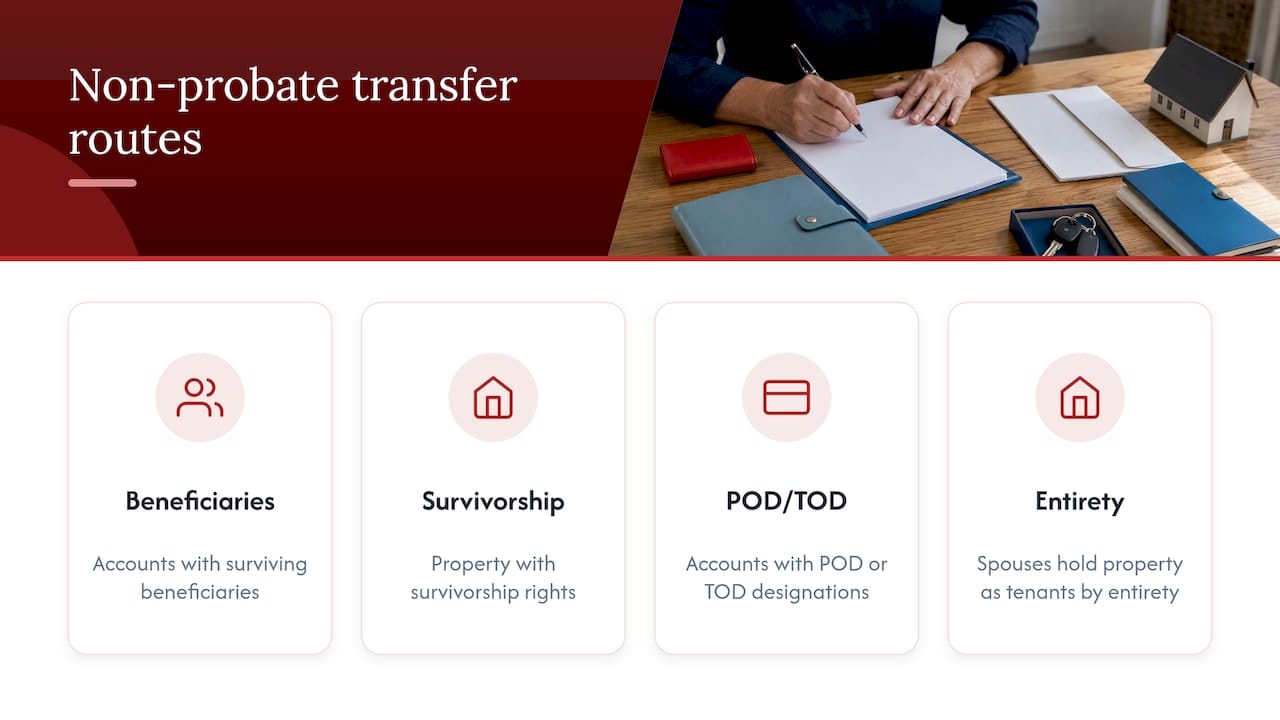
The Florida Bar explains that some assets do not require a probate proceeding to transfer ownership. These include accounts with surviving beneficiaries, property with survivorship rights, accounts with POD or TOD designations, and property held by spouses as tenants by the entirety.
Joint ownership with survivorship
If two people own an account or property as joint tenants with right of survivorship, the survivor owns it outright at the first death. A certified death certificate is typically what the bank or the county records office asks for. Spouses who hold real estate as tenants by the entirety get a similar result: the surviving spouse keeps the property.
POD and TOD designations
A payable-on-death (POD) bank account or transfer-on-death (TOD) brokerage account names who receives the money. The named person claims it directly from the institution. The will has no say over it, even if the will says something different.
Beneficiary designations
Life insurance policies and retirement accounts pay whoever is on the beneficiary form. Those forms control. A common and painful scenario is an ex-spouse still named on an old policy years after a divorce, while the will leaves everything to the children. The form wins unless it was updated or other law applies. If you are going through a divorce, updating beneficiary forms belongs on your checklist along with the settlement.
Assets held in a revocable trust
The Florida Bar’s pamphlet on the revocable trust explains that a revocable trust, survivorship ownership, or beneficiary designations can avoid probate for the assets they cover. We explain how trusts are set up and managed on our trusts and trust administration page.
Side-by-side comparison
| Asset | Typical result | Why |
|---|---|---|
| Bank account in one person’s name only | Probate | No survivor or beneficiary named |
| Bank account with a POD designation | Non-probate | Named beneficiary claims directly |
| Joint account with right of survivorship | Non-probate | Survivor owns it automatically |
| House in sole name | Probate (unless homestead rules apply) | Title passes through the estate |
| House owned by spouses as tenants by the entirety | Non-probate | Survivor keeps title |
| House owned as tenants in common | Decedent’s share goes through probate | No survivorship |
| Life insurance naming a person | Non-probate | Beneficiary form controls |
| Life insurance or retirement account payable to the estate | Probate | Estate is the payee |
| Assets properly titled in a revocable trust | Non-probate | Trust document controls |
Treat the table as a starting point. The paperwork behind each account, deed or policy decides the result, and that paperwork is sometimes different from what the family remembers.
Does a will avoid probate in Florida?
No. This is the most common misunderstanding we hear. The Florida Bar states that a will does not avoid probate. The court admits it, and probate is the way its instructions get carried out for probate assets.
What a will does is control who receives the probate assets. Without one, state law decides. A will can also name your personal representative and a guardian for minor children.
There is a related trap. Many people sign a “pour-over will” alongside a trust, thinking it keeps everything private and out of court. A pour-over will sends leftover assets into the trust at death, but those assets can still need probate first. Our article on pour-over wills in Florida walks through section 732.513 and why that matters.
The cleaner way to think about it: your will governs the assets that have no other answer. A will that covers a home and a sole-name savings account will trigger probate. A will in a family where everything is joint, beneficiary-named or in trust might never be filed in a meaningful way, though many people still need one as a safety net.
How to avoid probate in Florida, and the limits
Avoiding probate is a planning decision, not a goal in itself. The tools are straightforward:
- Revocable living trust. You keep control during your life and name successors. Assets titled in the trust pass under its terms. The Florida Bar warns that assets not properly transferred to a trust may still be subject to probate. A trust that sits unfunded in a drawer does little.
- Survivorship titling. Adding a spouse or another person to an account or deed can work, but it also exposes the asset to that person’s creditors, divorce or incapacity, and it can be hard to undo.
- POD and TOD designations. Easy and usually free to set up at the bank or brokerage. Name contingent beneficiaries, and avoid naming minors directly, since a child cannot manage the funds.
- Beneficiary forms. Review them after marriage, divorce, births, and deaths.
Our Florida probate avoidance page goes deeper into how these tools fit together. Which is right for you depends on your assets, your family, and how much control you want to keep.
Where avoiding probate backfires
A few examples we see in practice:
- Adding a child to the deed. It avoids probate on that house, but you may have given the child a share of ownership now. If the child is sued or divorced, your home is exposed.
- One child on the account. Naming one child as the joint owner of a savings account may mean the other children get nothing, even if the will says to split equally.
- Forgotten assets. A trust covers a house and brokerage account, yet a forgotten sole-name account or a vehicle still needs court action.
- Outdated forms. A beneficiary designation from twenty years ago can override your current wishes entirely.
Non-probate does not mean free from claims
People hear “outside probate” and assume the money is safe from debts and family claims. It is not always so. The Florida Bar notes that a revocable-trust trustee may be required in certain circumstances to pay estate administration expenses, enforceable creditor claims and federal estate taxes from trust assets. It also points out that a surviving spouse may have an elective-share right that includes non-probate assets.
In plain terms: if the probate estate is too small to cover legitimate debts and costs, assets that passed outside probate may have to contribute. And a spouse who is unhappy with what the plan leaves them may have a claim against assets that were never in the estate. Our intestate succession page discusses the elective share and related thresholds.
If you expect creditors, a blended family, or a spouse who may contest, plan with that in view rather than hoping the paperwork protects everything.
When probate is needed: the main paths
If at least one asset requires court action, Florida offers more than one route, and the right one depends on the size and nature of the estate.
Formal administration
This is the full process, used for larger or more complicated estates or where disputes are likely. We outline the typical timeline and checklist on our formal administration page.
Summary administration
According to the Flagler County Clerk, summary administration is generally available when the probate estate, less property exempt from creditors’ claims, is $75,000 or less and debts are paid or creditors do not object. It is also available when the decedent has been dead for more than two years with no prior administration. It is simpler and faster than formal administration, though it still involves a court order.
Disposition without administration
The same clerk’s page explains that this route applies only when assets consist solely of exempt property and limited non-exempt personal property, valued at no more than preferred funeral expenses plus reasonable and necessary medical and hospital expenses from the last 60 days of the final illness. It is a narrow option, often used for small estates.
For how these small-estate paths compare, see our page on Florida small estates. Someone who owned property in Florida but lived elsewhere may also need ancillary probate.
A worked example
Imagine a Melbourne widow, Dorothy. Her assets look like this:
- A home in her sole name.
- A checking account in her sole name.
- A savings account with her daughter as joint owner with survivorship.
- An IRA naming her son as beneficiary.
- A life insurance policy naming her estate.
She has a will leaving everything equally to her two children.
The daughter gets the savings account directly. The son gets the IRA directly. Neither is governed by the will. The house, the checking account and the life insurance are probate assets, and they go to the children equally under the will, after the court process. In this plan the children end up with unequal shares of the whole, because the savings account and IRA went to one child each. Dorothy may not have meant it that way.
Two fixes would help. She could name both children as beneficiaries on each account, and she could place the house in a revocable trust. A short meeting with an estate lawyer would have caught both problems.
Selling property during probate
Often the practical question is the house. Heirs who live out of state or do not want to manage a property tend to want to sell. Probate assets generally cannot be sold until the personal representative has authority from the court, and the timing depends on the case. If you are the executor, this overview of selling a house during probate explains how a sale can proceed without a court hearing in some situations. Ask your attorney whether that route fits your estate before you list or accept an offer.
Our perspective
After decades of handling Florida estates, we see the same pattern. Families rarely fight over the big decisions. They fight over a form nobody updated, a deed signed years ago “to make things easier,” or a will that did not match the accounts.
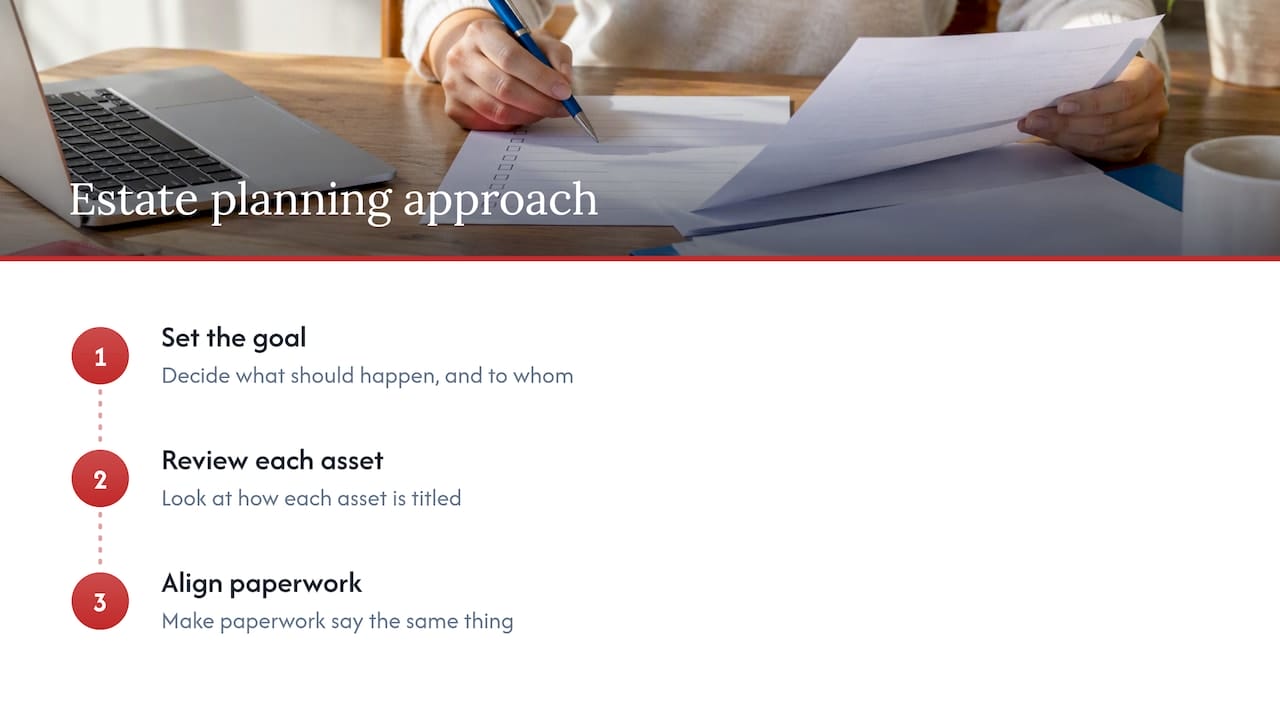
Our view is that the question “How do I avoid probate?” is often the wrong first question. Start with “What do I want to happen, and to whom?” Then look at how each asset is titled and make the paperwork say the same thing. Sometimes that means a trust. Sometimes a simple will and updated beneficiary forms are enough, and a trust would only add cost. Probate is not always the enemy: for some families, a supervised process is a clean way to settle debts and protect the personal representative.
We also see how family conflict shapes an estate plan. In high-conflict families, including those with a difficult ex-spouse or a controlling relative, we plan for challenges before they are filed. We also look at military families, whose assets often include federal benefits and beneficiary forms that sit outside any will.
What we ask every client is simple: bring every statement, deed and policy, and we will tell you which pile each one belongs in.
— John
How we can help
The Law Office of John Vernon Moore, P.A. serves clients across Brevard County with wills, trusts, powers of attorney, and probate and trust administration. We offer a free 30-minute consultation, and you speak directly with the attorney. Bring your deeds, account statements and beneficiary forms, and we will help you sort what passes outside probate from what does not. See our estate planning and probate services, or read our guide to what to ask at an estate planning consultation.

If you are already handling an estate, our probate and trust administration page describes how we guide personal representatives and trustees through the process.
FAQ
Is a house always a probate asset in Florida?
No. A house in the owner’s sole name is generally a probate asset, but one held by spouses as tenants by the entirety, or titled in a revocable trust, passes outside probate. Homestead property also follows its own rules. Check the deed and talk with a Florida attorney before assuming.
Do I need probate if everything has a beneficiary?
Possibly not. If every asset passes by survivorship, designation or trust, there may be nothing left for the court to administer. But some accounts or personal items often slip through, so confirm each one. A short review with an estate attorney can tell you whether anything remains.
Can a will override a beneficiary designation?
Generally no. A beneficiary form on a life insurance policy or retirement account controls who receives it, regardless of what the will says. That is why updating those forms after major life changes matters as much as updating the will.
Can creditors reach non-probate assets?
Sometimes. The Florida Bar notes that a trustee may have to use trust assets for administration expenses and enforceable creditor claims in certain circumstances. A surviving spouse’s elective share can also reach non-probate assets. Do not assume anything is untouchable.
Is there a faster option for a small estate?
Often yes. Florida offers summary administration and, in narrow cases, disposition without administration. The eligibility rules depend on estate size and the type of property, so confirm with an attorney or the probate clerk in your county.
Sources
- Probate in Florida, The Florida Bar
- The Revocable Trust in Florida, The Florida Bar
- Probate questions, Flagler County Clerk & Comptroller
- Selling a house during probate without a court hearing