If a car hit you while you were on foot in Florida, you have legal rights, even if the driver blames you. Drivers owe pedestrians a duty of care, your own no-fault (PIP) insurance may pay first, and you can still recover money from a negligent driver as long as you were not more than 50 percent at fault. What you do in the first days, and what the other side can prove about fault, shapes how much you recover.
This guide walks through the rules in plain language: who yields, how fault is divided, which insurance applies, what to do right after a crash, and where an attorney changes the outcome. It is general information, not advice on your particular case.
TL;DR
- Drivers must yield to pedestrians in crosswalks, and pedestrians must yield when crossing outside one. Both sides owe each other reasonable care.
- Florida uses comparative fault: your recovery shrinks by your share of blame, and you are barred only if you are more than 50 percent at fault.
- Florida is a no-fault state, so PIP coverage usually pays the first round of medical bills, but PIP is limited and is not the end of the claim.
- Get medical care quickly, document the scene, and do not give a recorded statement to an insurer before you understand your position.
- Florida’s filing deadline for injury lawsuits is short. Talk to an attorney early rather than waiting on the insurance company.
Table of Contents
- Who has the right of way: Florida’s pedestrian rules
- How fault is decided when a pedestrian is hit
- What to do after a pedestrian crash
- Insurance: who pays your medical bills
- What compensation can cover
- Deadlines and the clock on your claim
- Our perspective: what we see in pedestrian cases
- How we help pedestrians in Brevard County
- FAQ
- Sources
Who has the right of way: Florida’s pedestrian rules
People often assume pedestrians always win. They do not, and neither do drivers. Florida’s rules are a set of reciprocal duties.
According to the Florida Department of Highway Safety and Motor Vehicles, drivers should yield to pedestrians in marked and unmarked crosswalks, while pedestrians should use sidewalks where they exist and yield to vehicles when crossing mid-block. The same page says a driver who fails to yield to a pedestrian in a crosswalk faces a minimum citation of $164 and three points on their license.
The controlling law is Florida Statute 316.130. In practice it means:
- Traffic signals and signs apply to you. A pedestrian must obey official traffic control devices that apply to pedestrians, unless a police officer directs otherwise.
- Crosswalks. Where no signal is working or in place and no sign says otherwise, drivers must yield to a pedestrian crossing in a crosswalk under the conditions the statute spells out.
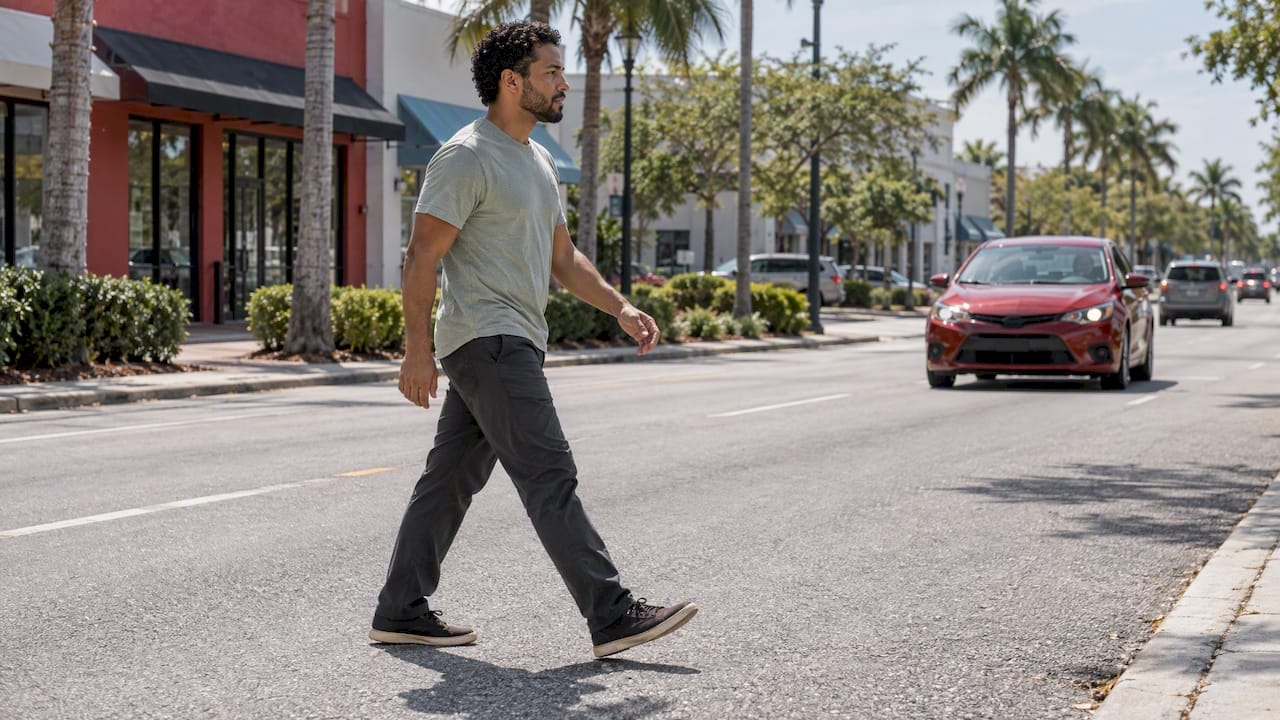
- Outside a crosswalk. A pedestrian crossing outside a marked crosswalk or an unmarked crosswalk at an intersection must yield to vehicles.
One detail matters more than most people realize: an unmarked crosswalk still counts. At most intersections, the law treats the space where sidewalks meet the street as a crosswalk even without painted lines.
The courts reinforce this balance. Florida’s standard civil jury instructions include an instruction, 401.10, on the equal and reciprocal rights of motorists and pedestrians, which is what jurors are told to apply when deciding whether someone was careless.
Why a driver can still be liable when you were outside a crosswalk
Crossing mid-block does not erase a driver’s duty. A driver who is speeding, texting, driving impaired, or not watching the road can still be negligent toward a pedestrian who was in the wrong place. That is where fault gets divided rather than assigned to one person, which is the next section.
How fault is decided when a pedestrian is hit
Nobody “wins” a pedestrian case just because a person was walking and a car was driving. To recover money, you generally need to show four things: the driver owed you a duty of care, the driver breached it, the breach caused your injury, and you suffered real damages.
The state’s own safety data shows why fault is argued so hard. The Florida DHSMV notes that pedestrian safety is a shared responsibility and that crash data shows fault is split fairly evenly between motorists and pedestrians. Its figures for 2023 are stark: 10,276 pedestrian crashes, 779 deaths and 1,431 serious bodily injuries in Florida.
Insurers know those numbers too. Expect the adjuster’s first question to be what you were doing in the seconds before impact: where you were crossing, whether you had a signal, whether you were looking at a phone, whether it was dark and what you were wearing.
The 50 percent rule
Florida applies modified comparative fault under Section 768.81 of the Florida Statutes. Judgment is entered against each liable party according to its percentage of fault, and any fault assigned to you reduces your damages. If you are found more than 50 percent at fault for your own harm, you recover nothing.
A simple example. Suppose a jury finds your total damages are $100,000, the driver 70 percent at fault and you 30 percent, because you crossed mid-block. Your recovery drops by your share, to $70,000. If the jury put 55 percent on you, the recovery would be zero. The numbers are illustrative, not a prediction, but they show why the percentage fight is often the whole case.
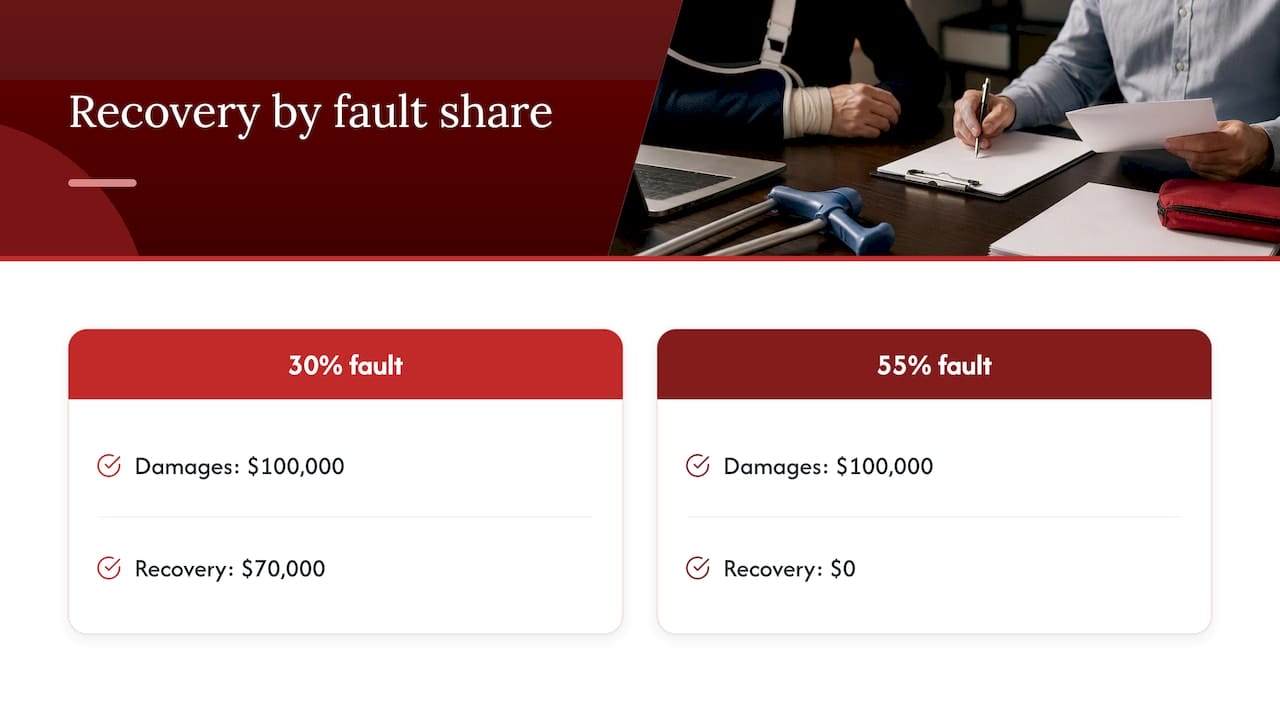
Because a few points of blame can change the result, the evidence about what really happened matters more than most people expect.
What to do after a pedestrian crash
The first hours and days affect both your health and your claim. The steps below track the general guidance from Nolo’s legal encyclopedia and the practical realities of Florida claims.
- Call 911 if you need medical attention. Do this even if you feel “mostly fine.” Adrenaline hides injuries, and head, spine and internal injuries can show up later.
- Report the crash to law enforcement. Ask the officer how to get the crash report number. Florida law requires drivers to stop and share their information, and a driver who leaves the scene creates a separate problem for themselves.
- Exchange information. Get the driver’s name, license plate, insurer and policy number, and phone number.
- Document everything. Photograph the vehicle, the road, crosswalk markings, signals, signs, skid marks, lighting and your injuries. Save your torn or bloody clothing and shoes rather than washing them.
- Collect witness contacts. A neutral witness who saw the driver run the signal can outweigh the driver’s version.
- Get medical care promptly and follow it. Nolo points out that adjusters and juries tend to assume delayed treatment means the injuries were minor. Keep every record, bill and discharge instruction.
- Be careful with insurers. Do not guess about speed, distance or your own fault, and do not accept a quick offer before you know the full extent of your injuries.
The kinds of proof that carry a claim are the same everywhere: photographs, the police report, witness details and medical records. A clear overview of what evidence an injury claim relies on can help you check you have gathered each type before you speak to anyone.
Mistakes made early are hard to undo. Our article on common personal injury case mistakes to avoid covers the ones we see most.
Insurance: who pays your medical bills
Florida is a no-fault state for auto insurance. Pedestrians are often surprised by what that means for them, so it helps to separate the layers of coverage.
Personal Injury Protection (PIP)
Florida’s PIP coverage pays regardless of who caused the crash. The state’s notice of PIP benefits explains that PIP pays 80 percent of reasonable, medically necessary medical expenses, provided you receive initial care within 14 days of the accident. It also provides disability benefits and a $5,000 death benefit.
The PIP statute, Section 627.736, sets a general benefit cap of $10,000 and limits benefits to $10,000 when a physician or similar provider has determined that you had an emergency medical condition. That money goes quickly after an ambulance ride, imaging and an orthopedic visit.
Whose PIP applies to a pedestrian? Generally the order runs like this, and an attorney or the insurer can confirm which fits you:
- Your own policy, if you own a vehicle with PIP, or if a resident relative in your household does. PIP generally follows you, including on foot.
- The striking vehicle’s policy, which can cover people hit by the insured vehicle when they are not occupants of a car, subject to the statute’s conditions.
- Neither, if no one involved has PIP. Then health insurance or other options become the main source for early bills.
The 14-day window is the part people miss. If you wait three weeks to see a doctor because you hoped the pain would fade, you risk losing PIP benefits. Get seen quickly.
Bodily injury liability: the driver’s insurance
PIP is only a starting point. The at-fault driver’s bodily injury (BI) liability coverage is what pays for serious injuries beyond it. According to the Florida Department of Financial Services, BI coverage pays for death or serious, permanent injury to others when the driver is legally liable.
Florida does not let you step outside the no-fault system for every injury. Under the state’s rules, claims for pain and suffering depend on meeting an injury threshold. We explain it in Avoid Losing Pain and Suffering Damages in Florida, and it is worth reading before you talk settlement.
When the driver is uninsured or underinsured
A pedestrian can be hit by a driver with no BI coverage or limits too low for the injuries. The Florida Department of Financial Services says uninsured motorist (UM) coverage pays for accidental bodily injury or death from an auto accident when the at-fault party lacks BI coverage or has insufficient limits.
If you own a car, your own UM policy may protect you as a pedestrian. Whether you chose “stacked” or “unstacked” coverage can change the amount available, and some drivers never realize they rejected stacking. Our guides on underinsured motorist coverage and stacked versus unstacked uninsured motorist coverage explain what to look for, and our practice page on uninsured and underinsured motor vehicle accidents shows how those claims work.
What compensation can cover
A pedestrian injury claim can include several categories of loss. Which ones you can reach depends on your injuries, the insurance available and Florida’s thresholds.
| Type of loss | Examples |
|---|---|
| Medical expenses | Emergency care, surgery, hospital stays, therapy, medication, future treatment |
| Lost income | Missed work, reduced earning capacity |
| Pain and suffering | Physical pain, emotional distress, loss of enjoyment of life, subject to Florida’s injury threshold |
| Property | Damaged phone, glasses, bicycle, clothing |
| Wrongful death | Funeral costs, loss of support, loss of companionship for surviving family |
If a pedestrian dies, the family has separate rights. Our wrongful death practice page describes how those claims are handled, and PIP’s $5,000 death benefit is only a small part of what may be at stake.
For a sense of how fault and PIP shape real numbers in car crash cases, see our article on Florida car accident settlements. Pedestrian cases follow similar logic, though serious injuries are common because there is no vehicle around the person.
Deadlines and the clock on your claim
Three clocks start running at once:
- 14 days to get initial medical care if you want to preserve PIP benefits.
- Prompt notice to insurers. PIP benefits are overdue if not paid within 30 days after the insurer has written notice of a covered loss and its amount, per Section 627.736, so send your documents in writing and keep copies.
- The lawsuit deadline. Florida changed its filing deadline for negligence claims in 2023 and shortened it to a period measured in a couple of years, not many. Never assume yours is the exception. Ask an attorney to confirm the exact date for your accident.
Evidence also decays faster than the law allows. Surveillance video is often overwritten within weeks, and witnesses move or forget. That is a reason to act early even when the lawsuit deadline feels far away.
Our perspective: what we see in pedestrian cases
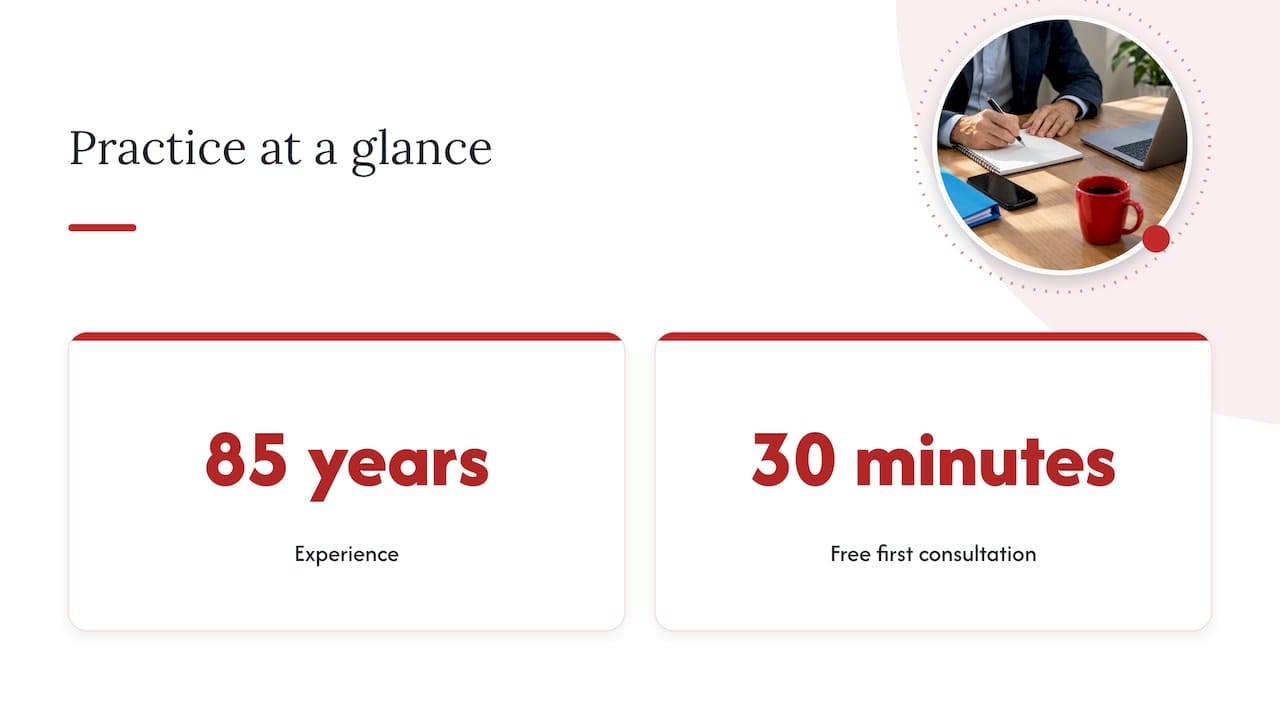
We handle personal injury claims for people across Brevard County, and with 85 years of experience behind our practice, we have seen how these cases unfold. A few patterns repeat.
The first is that people undervalue their own injuries. Someone walks away from a crash saying they are sore, skips follow-up care, and then learns three months later that a disc is damaged. By then the adjuster has a gap in the records to point at.
The second is that people over-explain fault. Telling an adjuster “I probably should have looked both ways” can become a percentage assigned to you under the 50 percent rule. Be honest, be brief, and let the evidence carry the story.
The third is that the real fight is almost never whether the driver hit you. It is how the blame gets divided, and which insurance policies are actually available. We start every case by mapping both: the facts that support the driver’s duty, and every PIP, BI and UM policy that could respond.
You deal directly with an attorney at our firm, not a call center. Your first 30-minute consultation is free, which gives you a chance to understand your options before you sign anything or accept an offer.
— John
How we help pedestrians in Brevard County
If you or a family member was hit while walking, jogging or crossing a street in Brevard County, our team can review the police report, identify the available insurance, and tell you honestly whether you have a claim worth pursuing. We do not publish fees for personal injury work, so ask about how a case would be handled when you call. You can read about our personal injury services or contact the firm to schedule a free 30-minute consultation.
For background before you call, our guide to what a personal injury claim involves and our list of what your personal injury lawyer needs to know will help you arrive prepared. Our broader page on auto accident personal injury law in Florida covers the insurance rules in more depth.
FAQ
Do pedestrians always have the right of way in Florida?
No. Drivers must yield to pedestrians in marked and unmarked crosswalks, but pedestrians crossing outside a crosswalk must yield to vehicles. Even a pedestrian who breaks a rule can still recover if the driver was also negligent, as long as the pedestrian is not more than 50 percent at fault.
Is Florida a no-fault state when a pedestrian is hit?
Yes, for auto insurance. Your own PIP, or in some cases the PIP of the vehicle that struck you, typically pays the first portion of medical bills regardless of fault. PIP has limits, so serious injuries often require a further claim against the driver’s liability coverage or your own uninsured motorist coverage.
What if I was partly at fault for the accident?
Your damages are reduced by your percentage of fault under Section 768.81. If a jury finds you more than 50 percent responsible, you cannot recover damages. That makes the evidence about where you were and what the driver was doing important to gather quickly.
What if the driver who hit me has no insurance?
You may still have options. Uninsured motorist coverage on your own policy, or on a household member’s policy, can pay when the at-fault driver has no liability coverage or too little. An attorney can check which policies apply to you.
Should I talk to the other driver’s insurance company?
You can give basic facts, but be cautious about recorded statements and early settlement offers. Adjusters work to limit what their company pays, so it is wise to speak with an attorney before agreeing to anything about fault or the value of your injuries.
Sources
- Pedestrian Safety, Florida Department of Highway Safety and Motor Vehicles
- Florida Statute 316.130 (2025)
- Florida Statute 768.81 (2026)
- Florida Standard Jury Instructions in Civil Cases
- Florida Statute 627.736 (2024)
- Notification of Personal Injury Protection Benefits, Florida Office of Insurance Regulation
- Personal Automobile Insurance Overview, Florida Department of Financial Services
- Hit By a Car as a Pedestrian, Nolo