

A pour-over will in Florida names your living trust as the recipient of any assets left in your individual name at death, but it does not itself avoid probate for those assets. The transfer happens under Fla. Stat. § 732.513, which lets a will devise property to a trustee. Anything routed this way still has to clear a Florida probate court first.
TL;DR:
- A pour-over will in Florida does not avoid probate and assets left in individual names must still go through court administration first.
- It functions as a backup to a trust, catching assets not retitled, especially useful for multi-state property owners or those with recent acquisitions.
- The devise to a trustee remains valid even if the trust is amended later or unfunded, but more assets then face longer probate processes.
- Proper execution requires a written, signed will with two witnesses and a notarized self-proving affidavit to prevent delays during probate.
- Funding a trust through retitling assets is essential; relying solely on a pour-over will increases probate costs and delays.
Table of Contents
- What a pour-over will is and how it pairs with a trust
- Who should consider a pour-over will in Florida
- How a pour-over will differs from a standard will in practice
- Florida probate and the statutory bridge in Section 732.513
- Execution formalities and the self-proving affidavit
- Trust funding and the limits of relying on a pour-over will
- Advantages and disadvantages of a pour-over will in Florida
- What Brevard County estate cases tend to get wrong
- Fund the trust first, use the will as backup
- How our firm helps with pour-over wills and trust funding
- Statutes and rules behind this guide
- Sources
- FAQ
What a pour-over will is and how it pairs with a trust
A pour-over will works as a companion document to a revocable living trust, not a replacement for one. The will names the trust as beneficiary of the “residue,” meaning whatever you own individually when you die that was never retitled into the trust during your lifetime. It functions as a backstop, catching accounts, vehicles, or property you forgot to transfer.
This differs from a standard will, which distributes assets directly to named people or organizations. A pour-over will has one job: send leftovers to the trust, where your existing distribution instructions take over.
Situations that commonly trigger a pour-over will include:
- Buying a new bank account or investment account and never retitling it in the trust’s name
- Inheriting property or receiving a gift after the trust was already signed
- Owning real estate in another state that was never deeded into the trust
- Simple oversight, which is the most common reason trusts end up partially funded
Who should consider a pour-over will in Florida
- Trust owners who suspect gaps in funding. If you signed a revocable living trust years ago and have not reviewed titling since, a pour-over will catch what slipped through.
- Frequent acquirers or multi-state property owners. People who regularly open new accounts or hold property outside Florida benefit from the safety net, since new assets rarely get retitled the same day they are acquired.
- Anyone with a fully funded trust and few outside assets. In this case, a pour-over will still belongs in the plan, but it will have little practical work to do since almost nothing sits outside the trust.
How a pour-over will differs from a standard will in practice
The distinction comes down to where assets end up and how they get there. A standard will sends property straight to heirs through the probate estate. A pour-over will sends the residue to a trustee, who then distributes according to the trust’s own terms, often without further court supervision once probate closes.
Two quick scenarios show the difference:
- Trust fully funded: The pour-over clause has almost nothing to catch. Probate, if needed at all, is minimal.
- Trust left mostly unfunded: The bulk of the estate flows through the will’s pour-over clause, meaning most assets face full probate before reaching the trust, which defeats much of the point of having one.
Florida probate and the statutory bridge in Section 732.513
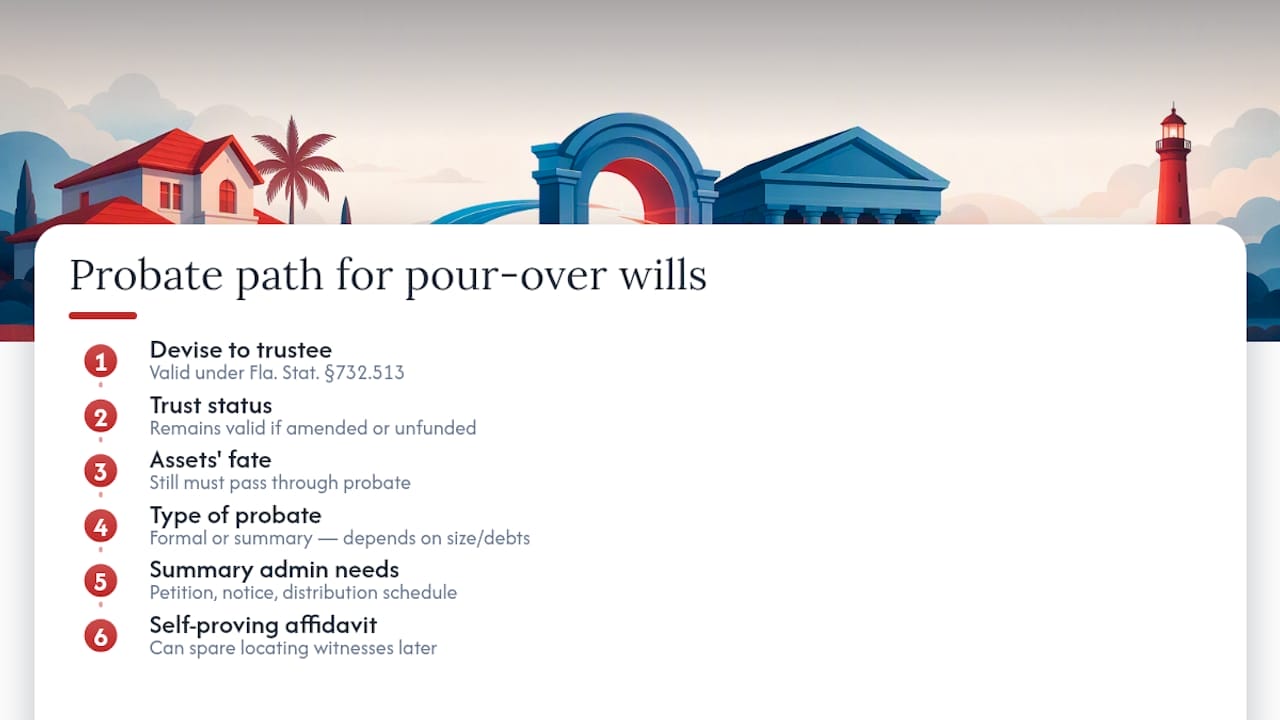
Fla. Stat. § 732.513 allows a will to devise property to the trustee of a trust that existed, or was signed at the same time as the will, and the devise remains valid even if the trust is amended afterward. That statutory bridge is what makes a pour-over will legally enforceable in Florida, but it does not exempt the poured-over assets from the probate process itself.
A devise to a trustee under this bridge stays valid even if the underlying trust is later amended, and even if the trust was never funded, but assets reaching the trust this way must still pass through probate administration.
Whether that probate is formal or summary depends on estate size and debts. The Florida Courts summary administration rule%20(revised%206-2-25%20crm)%20-%20Accessible.pdf) sets out the petition, notice, and distribution schedule requirements that determine whether a smaller poured-over estate qualifies for the faster path. A self-proving affidavit matters here too, since it can spare the estate from tracking down witnesses months or years after signing.
A pour-over devise survives even an unfunded trust, according to Fla. Stat. § 732.513, but relying on that allowance instead of funding the trust means more of the estate sits in probate longer.
Execution formalities and the self-proving affidavit
Florida sets specific rules for making a will valid, and a pour-over will is no exception.
- Put it in writing. Florida does not recognize oral wills.
- Sign at the end of the document, as required under Fla. Stat. § 732.502.
- Have two witnesses sign in your presence and each other’s presence, at the same time you sign.
- Add a self-proving affidavit under Fla. Stat. § 732.503, notarized alongside the witness signatures.
Skipping the self-proving affidavit is one of the most common local mistakes. Without it, the probate court may need live testimony from witnesses, who may have moved, died, or simply become impossible to locate years later. That single missing page can add weeks to an otherwise routine filing.
Pro Tip: Identify the trust by its exact name, execution date, and initial trustee in the pour-over clause, since a vague reference to “my trust” can invite unnecessary challenges during probate.
Trust funding and the limits of relying on a pour-over will
Funding a trust means retitling assets so the trust, not you individually, is the legal owner. That covers bank accounts, brokerage accounts, real estate deeds, and updating beneficiary designations on retirement accounts and life insurance where the trust is the intended recipient.
Section 732.513(2)© permits a devise to a trustee even if the trust was never funded, which sounds convenient, but it is a fallback, not a plan. Every dollar that reaches the trust this way costs time and, often, court filing fees that a fully funded trust would have skipped entirely.
A practical funding checklist:
- Retitle bank and brokerage accounts in the trust’s name
- Sign and record deeds transferring real estate into the trust
- Update transfer-on-death and payable-on-death designations where the trust should be the beneficiary
- Review retirement and insurance beneficiary forms yearly
Pro Tip: Set a recurring annual reminder to check titling on every account you open, since new accounts are the most common source of unintentional pour-over assets.
Advantages and disadvantages of a pour-over will in Florida
A pour-over will earn its place in most Florida estate plans, but it has real limits worth weighing.
- Advantage: safety net. It catches assets you forgot to retitle, keeping your overall plan intact.
- Advantage: single set of instructions. Once assets reach the trust, one document governs distribution instead of two conflicting ones.
- Disadvantage: probate still applies. Poured-over assets do not skip the court process.
- Disadvantage: delay and cost. Missing witnesses or a missing self-proving affidavit can slow things down, and an unfunded trust means more assets stuck in that queue.
- Alternative worth considering: transfer-on-death designations or a Florida transfer-on-death deed can move specific assets directly to beneficiaries, sometimes bypassing probate entirely for those items.
What Brevard County estate cases tend to get wrong
Experienced local attorneys have handled Florida estate matters with extensive combined experience and a client-centered approach. The recurring pattern locally: pour-over wills that reference a trust vaguely, trusts that were signed but never funded, and witnesses who cannot be located when the affidavit was skipped. Bring your existing trust document, a list of account and property titles, and any prior will to a review so gaps can be identified quickly.
Fund the trust first, use the will as backup
A pour-over will belongs in nearly every Florida trust-based plan, but only as insurance and not a primary strategy. If you are not funding the trust now, that is the priority, not the will itself. Add transfer-on-death options for accounts that support them, then audit every asset title, and schedule a review with an attorney before assuming the plan works as intended.
— John
How our firm helps with pour-over wills and trust funding
Getting the will and the trust to work together takes more than a signature. The Law Office of John Vernon Moore, P.A. handles revocable living trusts, pour-over wills, and probate and trust administration for clients across Brevard County.

Bring your current trust, a list of account titles, and any deeds to your consultation, and we will walk through what is funded, what is not, and what needs fixing. Start with our estate planning and probate services page to schedule a review.
Statutes and rules behind this guide
The statutory backbone of this article comes from Fla. Stat. § 732.513 on devises to trustees and Fla. Stat. § 732.502 on execution formalities. The Florida Bar’s revocable trust pamphlet explains why funding matters, and the Florida Courts summary administration rule details the faster probate path for smaller estates.
This article is general information, not a substitute for advice from a qualified lawyer. Consult a qualified legal professional about your own circumstances before acting on anything here.
Sources
- Fla. Stat. § 732.502 — Execution of wills
- Fla. Stat. § 732.513 — Devise to trustee of trust
- Florida Bar — Revocable Trusts consumer pamphlet
FAQ
In Florida, does a will automatically avoid probate?
No. A standard will, and a pour-over will alike, generally requires probate to transfer assets held in the deceased’s individual name. Only assets already titled in a trust or with valid beneficiary designations avoid probate.
Does a pour-over will avoid probate?
No, a pour-over will does not avoid probate for the assets it covers. It directs those assets into a trust, but under Fla. Stat. § 732.513, that transfer still happens through the probate process first.
How much can you inherit in Florida without paying taxes?
Florida has no state estate or inheritance tax, so beneficiaries generally owe nothing to the state on what they inherit. Federal estate tax may still apply to very large estates, and that threshold is set separately by federal law.
Can I write my own will in Florida without a lawyer?
Florida law does not require an attorney to draft a will, but it does require specific execution formalities under Fla. Stat. § 732.502, including two witnesses signing together with the testator. A pour-over will also needs to correctly identify an existing trust, which is where self-drafted documents most often run into trouble.


