
A personal injury claim is a civil legal demand for compensation filed by a person who suffered harm due to another party’s negligence or wrongful act. Under tort law, the injured person, called the claimant, seeks financial recovery for losses caused by someone else’s failure to act with reasonable care. This process is distinct from a criminal case. No government prosecutor is involved. The claimant drives the case, and the goal is compensation, not punishment. Understanding what a personal injury claim requires, what evidence supports it, and how the filing process works gives you a real advantage before you speak to an insurer or an attorney.
What is a personal injury claim and what does it cover?
A personal injury claim covers physical harm, psychological harm, or both, caused by another party’s negligence or intentional wrongdoing. Personal injury law recognizes a wide range of injuries, from broken bones after a car crash to anxiety disorders following a workplace assault. The law does not require visible physical damage. Documented psychological harm qualifies just as fully.

The legal framework rests on tort law, a branch of civil law governing wrongs between private parties. A tort claim asks one party to compensate another for harm caused by unreasonable conduct. The claimant bears the burden of proof, meaning you must show the other party was at fault. That burden is met by a “preponderance of the evidence,” which means your version of events must be more likely true than not.
One distinction matters early: a claim is not the same as a lawsuit. A claim is a formal demand, usually submitted to an insurance company first. A lawsuit is filed in court when a claim fails to produce a fair settlement. Most personal injury cases resolve at the claim stage, never reaching a courtroom.
What are the four essential elements of a valid personal injury claim?
A valid personal injury claim must satisfy all four pillars of tort law: duty of care, breach of duty, causation, and damages. Missing even one element gives an insurer or court grounds to reject the claim entirely. Each element carries equal weight.
- Duty of care means the at-fault party had a legal obligation to act reasonably toward you. A driver owes a duty of care to other road users. A property owner owes a duty to keep premises reasonably safe for visitors.
- Breach of duty means the at-fault party failed to meet that standard. Running a red light is a breach. Leaving a wet floor unmarked in a store is a breach.
- Causation means the breach directly caused your injury. You must show a clear link between the other party’s failure and the harm you suffered. This is where many claims face their toughest challenge.
- Damages means you suffered actual, measurable losses. These include medical bills, lost wages, pain, and reduced quality of life.
The burden of proving all four elements rests entirely on you as the claimant. Insurance adjusters look for gaps in any of these four areas to reduce or deny a payout. A weak causation argument, for example, gives an adjuster room to argue your injury existed before the accident.
Pro Tip: Document the sequence of events immediately after an accident. A written timeline created within 24 hours is far more credible than one reconstructed weeks later.
What are the common types of personal injury claims?
Personal injury law covers a broad set of situations where one party’s negligence causes harm to another. Knowing which category fits your situation helps you understand the legal standards and procedural steps that apply.
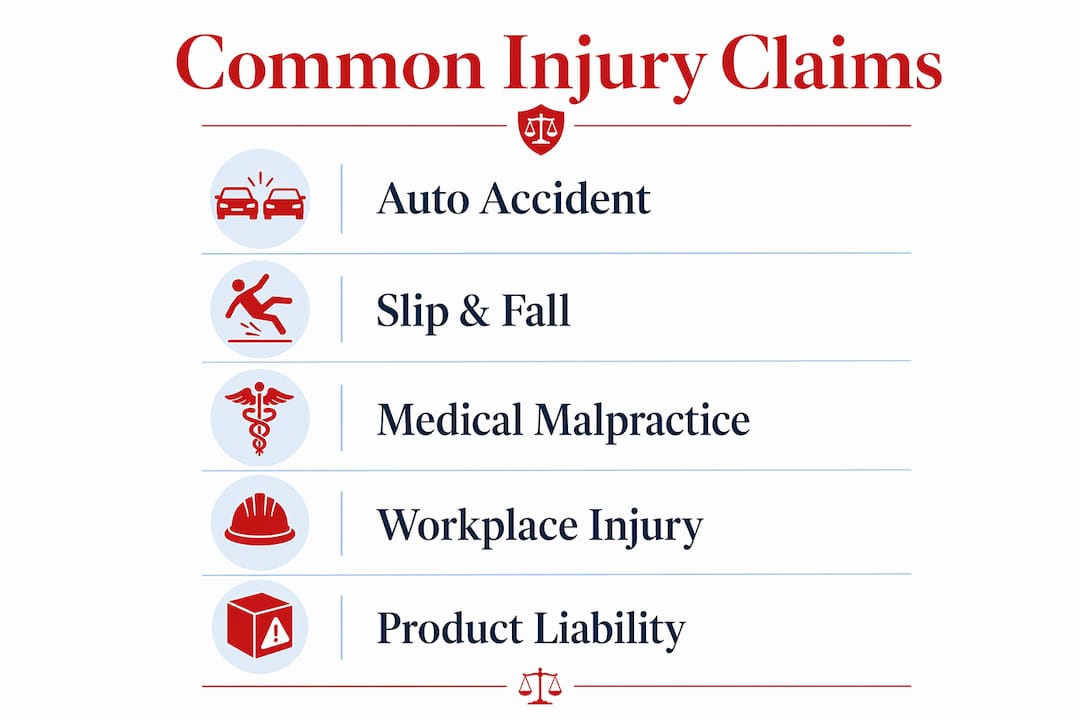
| Claim type | Common cause | Key legal consideration |
|---|---|---|
| Auto accident | Distracted or reckless driving | Florida no-fault insurance rules apply first |
| Slip and fall | Unsafe property conditions | Premises liability and notice of hazard |
| Medical malpractice | Provider error or negligence | Requires expert medical testimony |
| Workplace injury | Unsafe conditions or employer negligence | Workers’ compensation may run parallel |
| Product liability | Defective design or manufacturing | Manufacturer and retailer may share liability |
Each category carries its own procedural nuances. Medical malpractice claims, for instance, require an affidavit from a qualified medical expert before the case can proceed in Florida. Auto accident claims in Florida involve the state’s no-fault insurance system, which requires you to first seek benefits through your own Personal Injury Protection coverage before pursuing the at-fault driver.
One fact that surprises many claimants: immigration status does not affect your right to file a personal injury claim in the United States. The right to seek compensation for negligence-caused harm applies regardless of citizenship or residency status.
What types of evidence are most effective in a personal injury claim?
Strong evidence categories include liability proof, comprehensive medical records, financial documentation, expert reports, and documentation of daily impact. No single piece of evidence guarantees success. A multi-faceted approach is required.
-
Liability proof. Police reports, accident scene photographs, surveillance footage, and witness statements establish that the other party was at fault. Collect these as close to the incident as possible. Evidence degrades and memories fade quickly.
-
Medical records. Your treatment history is the backbone of your claim. The strongest claims rely on continuous, gap-free medical documentation connecting the injury to the accident from day one. Missed appointments or delayed treatment give adjusters grounds to argue your injury was not caused by the accident or was not serious.
-
Financial documentation. Medical bills, pay stubs showing lost wages, and receipts for out-of-pocket expenses quantify your economic losses. Keep every receipt and request itemized billing from every provider.
-
Expert reports. Accident reconstruction specialists, treating physicians, and vocational experts can testify about how the accident happened and how it affects your ability to work and function. Expert testimony carries significant weight in both negotiations and court.
-
Daily impact documentation. A pain diary and activity logs strengthen claims for non-economic damages like emotional distress and loss of enjoyment of life. Photos showing how your injury affects everyday tasks, such as difficulty climbing stairs or inability to lift your child, are harder for adjusters to dismiss than medical bills alone.
Pro Tip: Start a pain diary the day after the accident. Record your pain level, what activities you could not do, and how you felt emotionally. Entries made in real time carry far more credibility than reconstructed accounts.
Claimants who miss medical appointments create a specific vulnerability. Insurers argue that the gap in treatment means the injury healed or was never serious. Consistent care protects both your health and your claim value.
How do you file a personal injury claim?
Filing a personal injury claim follows a defined sequence, and the decisions you make at each stage directly affect your final compensation. Insurance companies prioritize minimizing payouts, so understanding the process before you engage with an adjuster is critical.
- Seek medical treatment immediately. Your first step after any accident is medical care, not paperwork. Treatment records establish the injury timeline and connect your harm to the incident.
- Notify the relevant insurer. Report the accident to the appropriate insurance company promptly. In Florida auto cases, that means your own PIP carrier first. In premises liability cases, it means the property owner’s liability insurer.
- Gather and organize your evidence. Compile police reports, medical records, photographs, witness contact information, and financial documents before submitting your claim.
- Submit the formal claim. A demand letter outlines your injuries, the at-fault party’s negligence, and the compensation you seek. This letter opens negotiations.
- Negotiate the settlement. Adjusters will respond with a lower offer. Settlement versus litigation involves weighing a guaranteed, quicker payment against a potentially higher jury award with a longer timeline. That choice is strategic, not just procedural.
- File a lawsuit if necessary. If negotiations fail, your attorney files a civil complaint in court. Florida’s statute of limitations sets a hard deadline for filing. Missing it ends your right to recover.
One critical warning: never give a recorded statement to the at-fault party’s insurer without legal counsel present. Adjusters are trained to ask questions that produce answers used to reduce your claim’s value. What you say in the first phone call can follow you through the entire case. Learn what your attorney needs to know before that conversation happens.
Key takeaways
A personal injury claim succeeds when you prove all four tort law elements and support them with continuous, well-organized evidence from the day of the accident forward.
| Point | Details |
|---|---|
| Four elements are non-negotiable | Duty, breach, causation, and damages must all be proven or the claim fails. |
| Evidence quality drives value | Gap-free medical records and daily impact logs protect against adjuster challenges. |
| Claims and lawsuits are different | Most cases settle at the claim stage before any court filing is needed. |
| Insurer interests are not yours | Adjusters work to minimize payouts; legal representation protects your position. |
| Act fast on deadlines | Florida’s statute of limitations is a hard cutoff with no exceptions for late filers. |
What I’ve seen claimants get wrong, and how to fix it
After years of handling personal injury cases in Brevard County, the pattern I see most often is not a weak case. It’s a well-founded case that gets undervalued because the claimant didn’t document it properly from the start.
People focus on getting better, which is exactly right. But they forget that the insurance adjuster reviewing their file three months later will look for any gap to justify a lower offer. A two-week delay in seeking treatment, a missed follow-up appointment, or a social media post showing you at a family event can all be used against you. The adjuster’s job is to find those gaps. Your job is to not give them any.
The second mistake I see is treating the insurer as a neutral party. Insurance companies are not neutral. They have a financial interest in paying you as little as possible. That doesn’t make them dishonest. It makes them adversarial. You need to approach every interaction with that reality in mind.
The third mistake is underestimating non-economic damages. Medical bills are easy to quantify. Pain, lost relationships, and the inability to do things you loved before the accident are harder to put a number on. But a well-documented narrative that links the incident to lasting changes in your daily life is more persuasive than a stack of bills. Write it down. Photograph it. Make the adjuster or jury feel what you lost.
Get legal counsel early. Not because you can’t understand the process, but because an experienced attorney knows the tactics adjusters use and how to counter them before they cost you money.
— John
Personal injury legal support in Brevard County
Jmoorelegal has represented personal injury claimants in Brevard County, Florida for decades, handling everything from auto accidents to complex premises liability cases. The firm’s approach centers on building the strongest possible evidentiary record from day one, guiding clients through insurer negotiations, and making the litigation decision based on what actually serves the client’s interests.

If you were hurt due to someone else’s negligence, a free initial consultation with Jmoorelegal gives you a clear picture of your claim’s strength before you say a word to any insurer. The firm’s personal injury legal services include case evaluation, evidence strategy, and settlement negotiation. You pay nothing unless you recover. Contact Jmoorelegal today to protect your claim from the start.
FAQ
What is the personal injury definition in legal terms?
A personal injury is any physical or psychological harm caused by another party’s negligence or intentional wrongdoing. The legal right to seek compensation for that harm is the foundation of tort law.
How long does a personal injury claim process take?
Timelines vary widely based on injury severity, insurer cooperation, and whether litigation is needed. Simple claims can resolve in a few months; complex cases involving serious injuries or disputed liability can take one to three years.
What are the best evidence types for a personal injury claim?
The most effective evidence combines liability proof, continuous medical records, financial documentation, expert reports, and a daily impact log. No single item is sufficient on its own.
Can I file a personal injury claim without an attorney?
You can file without an attorney, but legal representation significantly reduces the risk of accepting a low settlement or making damaging statements to insurers. Attorneys also handle procedural deadlines that, if missed, permanently bar recovery.
What types of personal injury claims are most common in Florida?
Auto accidents, slip and fall incidents, medical malpractice, and workplace injuries are the most common categories. Each type carries specific procedural requirements under Florida law, particularly auto claims governed by the state’s no-fault insurance system.
Recommended
- Personal Injury – The Law Office of John Vernon Moore, P.A.
- Important Things Your Personal Injury Lawyer Needs To Know About Your Claim – The Law Office of John Vernon Moore, P.A.
- If You Have An Accident In A Public Place, How Do You Claim Compensation? – The Law Office of John Vernon Moore, P.A.
- Auto Accident Personal Injury Law In Florida – The Law Office of John Vernon Moore, P.A.