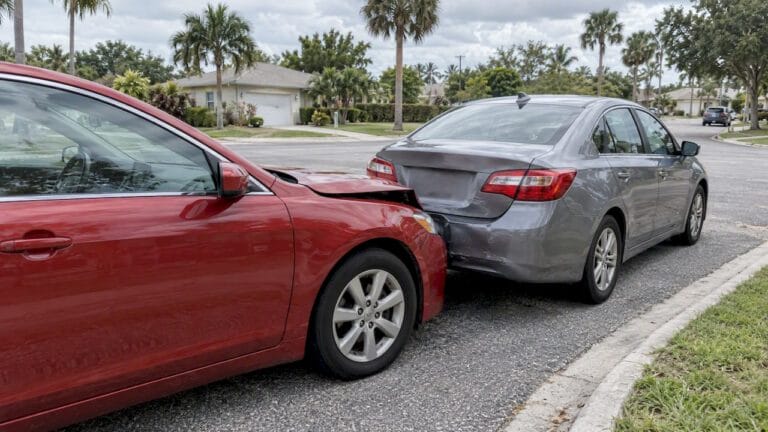
Underinsured motorist coverage (UIM) pays the gap between what an at-fault driver’s liability policy covers and the full amount of your compensable losses. The single most useful thing you can do right now: pull out your auto policy’s declarations page and confirm whether you have UIM listed, and at what limits. Many drivers](https://www.iii.org/fact-statistic/facts-statistics-uninsured-motorists) are uninsured, and many more carry only state-minimum liability limits that won’t come close to covering a serious injury.
Key Takeaways
Underinsured motorist coverage fills the gap your health insurance and collision coverage leave open when the at-fault driver’s liability limits are too low to cover your actual losses.
| Point | Details |
|---|---|
| Check your declarations page | Confirm UIM is listed on your policy and note the exact per-person and per-accident limits. |
| Match UIM to your BI limits | Setting UIM limits equal to your bodily injury liability limits gives you symmetric, meaningful protection. |
| Know your state’s rules | Roughly half of states require a written rejection to waive UM/UIM; stacking rules and offset options vary significantly by state. |
| Document everything after a crash | Medical records, police reports, and insurer correspondence are the foundation of any UIM claim. |
| Call an attorney for serious or disputed claims | Permanent injuries, low settlement offers, and bad-faith delays are clear signals to get legal representation. |
| Jmoorelegal for Florida UIM claims | Jmoorelegal offers free initial consultations for UIM and personal injury claims throughout Brevard County, Florida. |
Table of Contents
- What does underinsured motorist coverage actually pay for?
- Uninsured vs. underinsured motorist coverage: what’s the difference?
- When does UIM actually apply? Four real scenarios
- How state rules shape your UIM options
- How UIM works alongside your other coverages
- How much UIM coverage should you carry?
- Step-by-step: how to file a UIM claim after a crash
- When should you call a personal injury attorney about a UIM claim?
- What I see in practice with UIM claims
- Jmoorelegal helps Brevard County drivers protect their UIM rights
- Sources
What does underinsured motorist coverage actually pay for?
UIM and its companion coverages can cover a wide range of losses, though the exact list depends on your state and policy language:
- Medical expenses: Emergency care, surgery, hospitalization, physical therapy, and follow-up treatment.
- Lost wages: Income you couldn’t earn while recovering, including future earning capacity if the injury is permanent.
- Pain and suffering: Non-economic damages for physical pain, emotional distress, and reduced quality of life.
- Property damage (UMPD): Some states allow an uninsured motorist property damage add-on that covers vehicle repairs when the at-fault driver has no coverage. This is separate from UIM bodily injury (UIMBI).
The UIMBI vs. UMPD distinction matters. UIMBI covers injuries to you and your passengers. UMPD covers damage to your vehicle when the at-fault driver is uninsured. Collision coverage, by contrast, pays for your vehicle repairs regardless of fault, but it comes with a deductible and won’t touch your medical bills or lost wages. Common exclusions include intentional acts, vehicles not listed on your policy, and accidents involving drivers who are excluded from your policy by name.
Pro Tip: Check whether your state offers UMPD before assuming collision coverage handles everything. In some states, UMPD has a lower deductible than collision, making it the smarter choice when the other driver is uninsured.
For more on how property damage claims work alongside bodily injury claims, see property damage claim basics.
Uninsured vs. underinsured motorist coverage: what’s the difference?
People confuse these two constantly, and the confusion costs them. Cornell Law’s Wex defines the uninsured motorist clause as a policy provision covering bodily injury when the at-fault driver carries no liability insurance at all. UIM is a separate trigger: it applies when the at-fault driver has some insurance, but not enough.
Progressive puts it plainly: UM covers you when the other driver has zero coverage; UIM covers you when their limits fall short of your actual damages.
Here’s a concrete example. Say you suffer $80,000 in medical bills and lost wages after a crash. The at-fault driver carries the Florida minimum of $10,000 in bodily injury liability. Their insurer pays $10,000. Your UIM policy, set at $100,000 per person, then covers the remaining $70,000, up to your policy limit. Without UIM, that $70,000 gap comes out of your pocket or goes unpaid.
Stacking adds another layer. In states that allow it, stacking lets you multiply your UIM limits across multiple vehicles on the same policy (or across multiple policies). If you have two cars each with $50,000 UIM limits, a stacked policy gives you $100,000 in total UIM coverage for one accident. Non-stacked policies cap recovery at the single-vehicle limit. The difference in a serious crash can be substantial.
When does UIM actually apply? Four real scenarios
-
Hit-and-run with no identified driver. You’re rear-ended and the driver flees. Most states treat an unidentified hit-and-run driver as an uninsured motorist, so your UM coverage responds. Some states require physical contact between vehicles; others allow a witness statement. Check your state’s specific rule before assuming UM applies automatically.
-
At-fault driver with minimum limits. The other driver carries a minimum level of bodily injury liability, as required in many states. Your medical bills alone reach $60,000. Their insurer pays $25,000. Your UIM coverage picks up the remaining $35,000 (up to your limit). This is the most common UIM scenario.
-
Multi-vehicle crash where total damages exceed one driver’s limit. Three cars collide. The at-fault driver’s $50,000 per-accident limit gets split among multiple injured parties. Your share might be $20,000 even though your damages are $75,000. UIM covers the shortfall.
-
Pedestrian or cyclist struck by an underinsured driver. You don’t have to be in a car. If you’re hit while walking or cycling and the driver’s liability limits don’t cover your injuries, your own auto policy’s UIM coverage often extends to you as a named insured, even outside a vehicle. Confirm this with your insurer, as policy language varies.
Passengers in your vehicle are typically covered under your policy’s UIM limits as well, though they may also have claims under their own auto policies.
How state rules shape your UIM options
UIM laws vary more than most drivers realize. State Farm notes that UM and UIM are distinct coverages with different triggers, and state law determines whether each is required, optional, or subject to a written waiver.
Three common statutory approaches appear across the country:
- Mandatory offer with written waiver: The insurer must offer UM/UIM at limits matching your bodily injury liability. If you want less coverage or none, you must decline in writing. Texas follows this model; the Texas Department of Insurance notes that UM is generally offered and must be declined in writing if rejected.
- Match-or-waive with enhanced option: Some states add a third choice. Maryland’s consumer advisory describes three statutory options: (1) UM/UIM limits equal to your liability limits, (2) a waiver to lower limits, or (3) Enhanced UIM (EUIM) where the insurer cannot offset your total claim by the amount the at-fault driver’s insurer already paid. Insurers must provide written notice of all three options.
- State-specific minimums and DOI guidance: Arizona’s Department of Insurance notes that UIM/UM coverage includes state-specific minimums that consumers should verify directly with their DOI.
| State | Statutory approach | Key consumer note |
|---|---|---|
| Texas | Mandatory offer; written rejection required | Collision and MedPay don’t cover lost wages or long-term care |
| Maryland | Three options including EUIM; written notice required | EUIM eliminates the offset for at-fault driver’s payment |
| Arizona | UM/UIM required; state minimums apply | Check DIFI for current minimums and stacking rules |
| Florida | UM required to be offered; stacking permitted | Non-stacked policies sold at lower premium; written rejection needed |
To find your state’s exact rules, search “[your state] department of insurance uninsured motorist” or visit your state DOI’s consumer auto page directly.
How UIM works alongside your other coverages
Payment order matters. When you’re injured in a crash caused by an underinsured driver, multiple coverages may apply, and they don’t all pay at once.
Health insurance or PIP (personal injury protection) typically pays first for medical bills, subject to deductibles and copays. MedPay, if you carry it, covers medical expenses without a deductible and regardless of fault. UIM steps in after those primary sources are exhausted, covering remaining medical costs, lost wages, and pain and suffering up to your UIM limit. Collision handles vehicle repairs on its own track, independent of the bodily injury process.
| Coverage | What it typically covers | Pays when |
|---|---|---|
| Health insurance / PIP | Medical bills, some lost wages (PIP) | First, up to policy limits |
| MedPay | Medical bills only | First, regardless of fault |
| At-fault driver’s liability | Your damages up to their limit | After fault is established |
| UIM (bodily injury) | Gap between liability paid and your total damages | After at-fault driver’s limit is exhausted |
| Collision | Vehicle repair/replacement | Regardless of fault; deductible applies |
Subrogation is the wrinkle most people miss. If your UIM insurer pays your claim, it may pursue the at-fault driver’s insurer to recover what it paid. This generally happens in the background, but it can affect settlement timing. For a detailed breakdown of how subrogation works in injury cases, see subrogation in personal injury.
The Texas DOI makes a point worth repeating: collision and MedPay alone won’t cover long-term care or lost wages, which is exactly where UIM earns its premium.
How much UIM coverage should you carry?
The standard professional recommendation is to match your UIM limits to your bodily injury liability limits. If you carry $100,000/$300,000 in BI liability, set your UIM at the same level. The logic is symmetry: you’ve already decided those limits represent meaningful protection for others you might injure; you deserve the same protection for yourself.
A few practical steps to calibrate your limits:
- Review your assets. Higher net worth means more to protect if you’re seriously injured and face long-term income loss.
- Check your health insurance. A high-deductible health plan with a $6,000 out-of-pocket maximum leaves a real gap that UIM can fill.
- Consider your commute and driving exposure. More miles, more risk. A long daily commute on a busy Florida interstate justifies higher limits.
- Factor in household wage needs. If your income supports dependents, lost wages coverage becomes critical, not optional.
On cost: increasing UIM limits to a higher level typically adds a modest amount to your annual premium relative to the protection gained. The exact figure varies by insurer, state, and driving record, but the incremental cost of higher UIM limits is generally small compared to the gap it closes. Ask your insurer for a side-by-side quote at two or three limit levels before deciding.
Step-by-step: how to file a UIM claim after a crash
- Get medical care immediately. Your health comes first, and a documented treatment record is the foundation of any injury claim. Gaps in treatment are used by insurers to minimize payouts.
- Call the police. A police report establishes the facts of the crash, identifies the other driver, and documents their insurance information. For hit-and-run claims, a report is often required to trigger UM coverage.
- Document the scene. Photograph vehicle damage, road conditions, skid marks, and injuries. Collect the other driver’s name, license, plate number, and insurance carrier.
- Notify your insurer promptly. Most policies require timely notice of a potential UIM claim. Delay can give the insurer grounds to deny coverage. Report the accident even if you’re unsure whether UIM will apply.
- Gather and preserve records. Medical bills, treatment notes, pay stubs showing lost wages, and any written communications with the at-fault driver’s insurer all support your claim.
- Do not sign a release prematurely. Accepting a settlement from the at-fault driver’s insurer without your own insurer’s consent can waive your UIM rights. Confirm the process with your insurer or an attorney before signing anything.
- File the UIM claim formally. Once the at-fault driver’s limits are confirmed as insufficient, submit your UIM claim with supporting documentation. Your insurer will evaluate damages and may request an independent medical examination.
- Watch the statute of limitations. In Florida, the statute of limitations for personal injury claims is generally two years from the date of the accident. Missing this deadline can bar your claim entirely. Deadlines vary by state, so confirm yours early.
Avoiding common procedural errors matters as much as the claim itself. See personal injury case mistakes to avoid for a fuller list of what can derail a claim.
When should you call a personal injury attorney about a UIM claim?
Some UIM claims resolve straightforwardly. Many don’t. Call an attorney when:
- Injuries are serious or permanent. Spinal injuries, traumatic brain injuries, or any condition requiring long-term care involve future damages that insurers routinely undervalue. An attorney can retain medical experts to document those future costs.
- The insurer disputes fault or your damages. Insurers have adjusters and lawyers. You should too.
- The settlement offer doesn’t cover future care. A quick offer that closes out your claim before you know the full extent of your injuries is a common tactic. Once you sign, there’s no going back.
- The insurer denies the claim or delays unreasonably. Bad-faith insurance practices are actionable in most states. An attorney can pursue extra-contractual remedies beyond the policy limits in egregious cases.
- Stacking or offset disputes arise. Policy language around stacking and offsets is technical. A misread clause can cost tens of thousands of dollars.
What a lawyer actually does in a UIM case: reviews the full policy language, preserves evidence and medical records, negotiates directly with adjusters, and files suit if necessary. For Florida drivers specifically, Florida auto accident law involves specific procedural deadlines and PIP coordination rules that an experienced attorney navigates routinely. A Brevard County attorney familiar with local courts and Florida’s UIM statutes can make a material difference in complex claims.
What I see in practice with UIM claims
The pattern I see most often is this: a driver gets hurt, assumes their health insurance will handle it, and signs a release from the at-fault driver’s insurer for the policy minimum without ever checking whether they had UIM coverage. By the time the full medical picture is clear, the release has already waived their rights.
The fix is straightforward but requires discipline. Document everything from the moment of the crash. Do not sign any release until you know the total scope of your injuries and have confirmed your own policy’s UIM limits. Keep every medical record, every bill, and every piece of correspondence with any insurer. These documents are your leverage.
The other mistake I see is people who have UIM but set their limits at $25,000 because it was the cheapest option. That limit disappears fast in a serious crash. Matching your UIM to your bodily injury liability limits costs relatively little and closes a gap that can otherwise be financially devastating.
Jmoorelegal helps Brevard County drivers protect their UIM rights
If you’ve been injured by an underinsured driver in Brevard County or anywhere in Florida, the gap between what the other driver’s insurer offers and what you’re actually owed can be significant. Jmoorelegal handles personal injury and UIM claims for clients throughout Brevard County, with direct attorney involvement from the first conversation.

A free initial consultation covers your policy limits, the at-fault driver’s coverage, and whether your claim warrants legal representation. You’ll get a straight answer about your options, not a sales pitch. Contact Jmoorelegal to schedule your consultation and get a clear picture of what your UIM claim is actually worth.
Sources
- uninsured motorist clause | Wex | US Law – LII – Cornell University
- UM/UIM: What Is Uninsured Motorist Coverage? | Progressive
- What is uninsured motorist coverage, and do I really need it? (Texas Department of Insurance)
This article provides general information about underinsured motorist coverage and is not a substitute for legal advice. Coverage rules, deadlines, and statutory requirements vary by state. Confirm current rules with your state’s department of insurance or a qualified attorney.
Recommended
- Underinsured and Uninsured Motor Vehicle Accidents – The Law Office of John Vernon Moore, P.A.
- Property Damage Claims: What You Need to Know – The Law Office of John Vernon Moore, P.A.
- Important Things Your Personal Injury Lawyer Needs To Know About Your Claim – The Law Office of John Vernon Moore, P.A.
- Common Personal Injury Case Mistakes to Avoid – The Law Office of John Vernon Moore, P.A.