If the other parent has accused you of abuse, neglect or domestic violence and the claim is false, the most important thing you can do is respond early, calmly and with documents. Florida courts must weigh evidence of abuse, and they must also weigh evidence that a parent knowingly gave the court false information. A false claim can cost the person who made it. It can also do real damage to your time-sharing if you ignore it. A family law attorney who handles high-conflict cases can help you build the record. At the Law Office of John Vernon Moore, P.A., we handle family law matters in Brevard County and offer a free 30-minute consultation.
TL;DR
- Florida law tells judges to consider evidence of abuse or domestic violence, and separately to consider whether a parent knowingly gave the court false information about it.
- Knowingly making a false report of child abuse to the Florida abuse hotline is a third-degree felony, with an administrative fine of up to $10,000 per violation.
- A report that DCF closes with no indicators is not automatically a “false report.” The law requires the report to have been made maliciously or knowingly untrue.
- If DCF contacts you, you may have an attorney present, ask to record your interview, and later request a copy of the closed investigation.
- Do not respond by moving the child, hiding the child or cutting off contact. That can create a criminal problem of your own.
Table of Contents
- What counts as a false allegation in a Florida custody case
- How Florida courts treat these claims
- When the claim goes through DCF
- What the law says about making a false report
- Can a parent lose custody for making false accusations?
- Your first steps if you are falsely accused
- Why an attorney changes the outcome
- Perspective: what we tell parents who walk in angry
- Talk to us about your case
- FAQ
- Sources
What counts as a false allegation in a Florida custody case
In a custody fight, a false allegation is a claim of abuse, neglect, domestic violence, substance abuse or unfitness that is not true, made to the court, to law enforcement or to the Department of Children and Families (DCF). In Florida, custody is called parental responsibility and time-sharing. Time-sharing is the schedule that decides when the child is with each parent.
There are two different things people mean by “false”:
- An unproven or mistaken claim. A parent honestly believed something happened, or misread a situation. The report was made in good faith, and the law does not treat a good-faith report as a false report. Chapter 39 of the Florida Statutes defines a false report as one made maliciously to harass, embarrass or harm another person, for financial gain, to acquire custody of a child, or for personal benefit in any other private dispute involving a child.
- A knowingly untrue or exaggerated claim. The accuser knows it is not true, or inflates a minor event, to gain an advantage in the case. This is what the criminal penalties and the court’s credibility findings are aimed at.
The difference matters for strategy. You will usually not win by proving the other parent is a bad person. You win by showing, with records, that the claim does not match the facts.
How Florida courts treat these claims
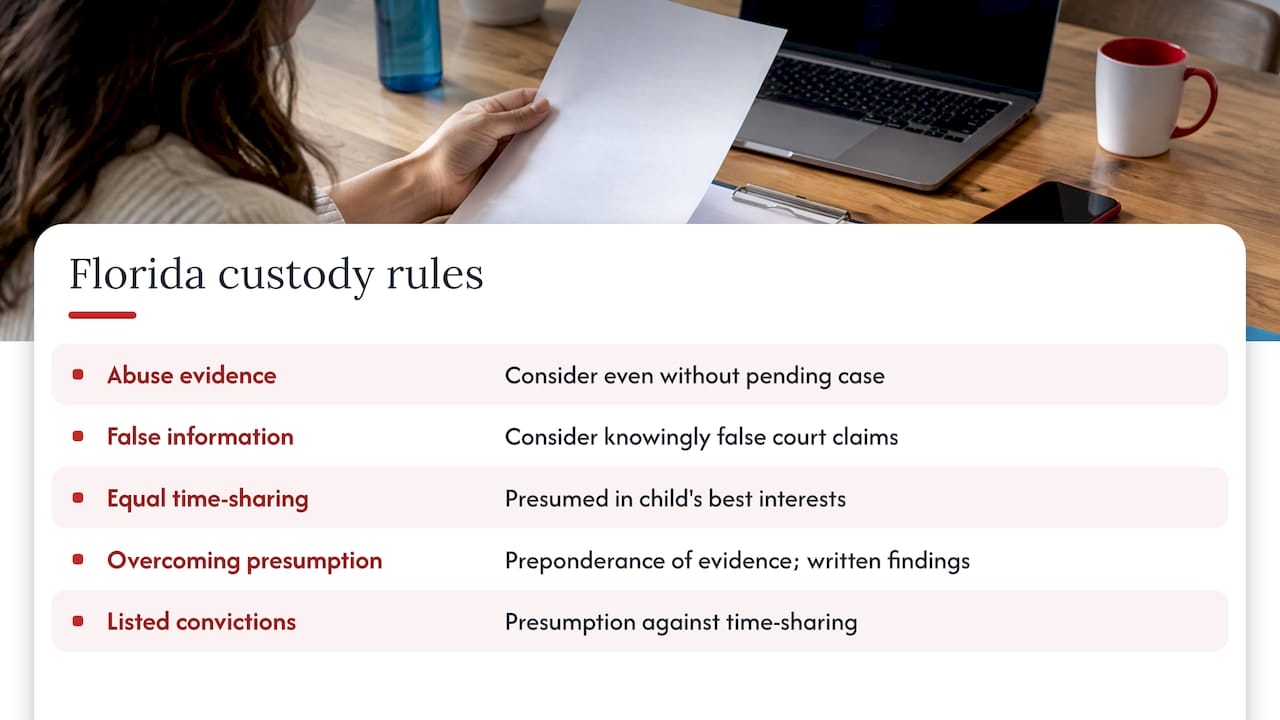
Florida Statute 61.13 governs parenting plans and time-sharing. As amended by House Bill 1301 (effective July 1, 2023), it does two things that matter here.
First, the court must consider evidence of domestic violence, child abuse or neglect, whether or not another case on the subject is pending. A judge cannot wave a serious allegation away just because no criminal charge exists.
Second, the court must also consider evidence that either parent knowingly provided false information to the court about such an action. That is the hook for a falsely accused parent: if you can show a claim was knowingly false, the judge is directed to take that into account.
The same 2023 law also created a rebuttable presumption that equal time-sharing is in a child’s best interests. It can be overcome only by a preponderance of the evidence, and judges must make specific written findings when they create or modify a schedule. A parent who wants to defeat equal time-sharing often does it by alleging danger. That is why false allegations are so tempting in contested cases, and why your response needs to be documented. Our page on equal time-sharing in Florida explains the presumption in more detail.
Two cautions about how fresh this law is. The Florida Bar Journal noted in early 2026 that it is not immediately clear whether courts must apply the equal-time presumption when modifying a parenting plan created before the 2023 amendment. And a 2026 bill, HB 971, proposed giving certain time-sharing matters priority on the court calendar. Check the current status of the statute with your attorney before you rely on either point.
A convicted-offense presumption also exists: a conviction for certain listed offenses creates a rebuttable presumption against granting time-sharing. This is another reason a false criminal complaint can be so damaging, and why a pending criminal charge needs its own defense.
When the claim goes through DCF
Many false allegations reach you as a call from DCF rather than as a court filing. Knowing how the process works takes some of the fear out of it.
According to Florida DCF’s Child Protective Services page, a hotline report is reviewed by a trained counselor. If it meets the legal requirements, it is assigned to a Child Protective Investigator (CPI), who contacts the child and family to assess safety. DCF says parents may:
- have an attorney present,
- ask to record their interview,
- accept or decline services, and
- request the investigation file once it is closed.
If a child is removed from the home, a court hearing takes place within 24 hours.
Getting the file and challenging a finding
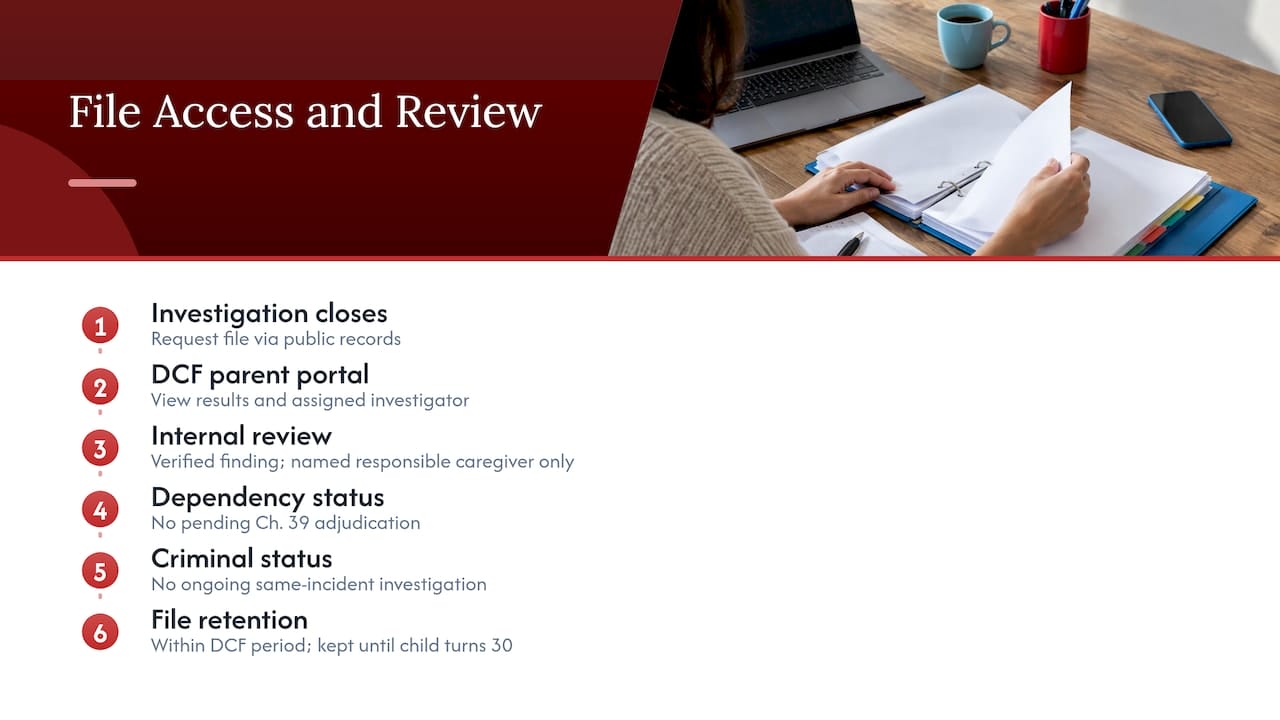
After an investigation closes, DCF says the parents and the accused person can request a copy through its public-records process, and can see the results and the assigned investigator at the DCF parent portal. A verified finding can be challenged through internal review if you are named as the responsible caregiver, there is no pending Chapter 39 dependency adjudication, there is no ongoing criminal investigation for the same incident, and the file is within DCF’s retention period. DCF says records are kept until the child turns 30.
That file is often the best single exhibit in the family court case. It shows what was alleged, who was interviewed and what the investigator concluded.
The other parent and DCF
A March 2025 DCF memo on interviewing the non-maltreating caregiver requires investigators to make diligent efforts to contact the non-maltreating parent in separate-household cases. Wherever possible they should interview both parents separately and give them the “Child Protection: Your Rights and Responsibilities” pamphlet. Before notifying the other parent, the investigator must check whether an injunction under section 39.504 or 741.30 is in place. If so, the person it is against is not notified of the investigation.
“No indicators” is not the same as “false”
Parents are often disappointed when DCF closes a case with no indicators of abuse and the accuser faces no consequence. DCF explains the distinction: a false report is one determined to have been made knowingly and intentionally untrue. In that case DCF may stop its investigative activity and must refer the report to local law enforcement for prosecution if sufficient evidence exists, with the consent of the person accused. A closed case alone does not prove your accuser lied. Your job is to gather the evidence that does.
What the law says about making a false report
Florida treats a knowingly false hotline report seriously. According to DCF’s False Reporting Guidelines, a person who knowingly and willfully makes a false report of child abuse, neglect or abandonment to the central abuse hotline commits a third-degree felony, punishable by up to five years in prison, plus a Department fine of up to $10,000 per violation. The same guidelines say a report made to acquire custody of a child falls within the definition. DCF’s Child Protective Services page adds that advising someone else to make a false report is also a third-degree felony, citing sections 39.205(9) and 39.206(1) of the Florida Statutes.
In practice, prosecutors decide whether to charge, and many parents never see that outcome. Do not build your case around the hope that the accuser will be prosecuted. Build it around what the family court judge needs to see.
Can a parent lose custody for making false accusations?
There is no automatic rule that a false accusation costs a parent time-sharing. What the statute gives you is this: the judge must consider evidence that a parent knowingly provided false information to the court, and the best-interests analysis looks at each parent’s willingness to support the child’s relationship with the other parent. A pattern of fabricated or exaggerated claims aimed at cutting you out can weigh heavily in that analysis, especially when it is documented. Our guide to evidence Florida courts want in parental alienation cases covers how repeated interference with a parent-child relationship is shown.
Your first steps if you are falsely accused
- Stay calm and stay civil in writing. Every text, email and social media post can end up as an exhibit. Write as if the judge is reading over your shoulder.
- Do not retaliate with your own allegations. A counter-accusation that you cannot support damages your credibility, which is your most valuable asset.
- Keep the child’s routine steady. Keep exchanges on schedule, keep attending school and medical appointments, and keep the child out of the dispute.
- Preserve the record. Save messages, call logs, calendars, photos, school and medical records, and the names of neutral people who see you parent. Keep originals and back them up.
- Talk to an attorney before you talk to an investigator or an officer about the substance. If DCF or law enforcement is involved, the rights listed above, including having an attorney present, are yours to use.
- Request the DCF file once the investigation closes, and review it for inconsistencies with other evidence.
- Respond within the court case. Deadlines apply to responses and motions. Missing one can let an unanswered claim stand.
Do not take or hide the child
It can feel protective to keep the child away until things calm down. Under Florida Statute 787.03, knowingly or recklessly taking or enticing a minor from a lawful custodian without lawful authority is a third-degree felony. Where there is no custody order, a parent who takes, detains, conceals or entices away a child with malicious intent to deprive the other of custody rights also commits a third-degree felony. The statute includes defenses for a person who reasonably believes the action was necessary to protect the child from danger or to escape domestic violence, but a parent who relies on them must report to the sheriff’s or state attorney’s office within 10 days and start a qualifying custody proceeding within a reasonable time. That is a narrow path, and one to walk with legal advice, not alone.
Why an attorney changes the outcome
False allegations are not just a factual dispute. They run on several tracks at once: the family court case, a possible DCF investigation, sometimes an injunction petition or a criminal complaint. Each has different deadlines, different standards and different consequences, and what you say in one can be used in the others.
An attorney can:
- tell you what to say, and what not to say, to an investigator or officer,
- organize your evidence into a timeline that matches the accusation point by point,
- file the right motions in the time-sharing case and ask the court to make findings on the credibility of the claims,
- coordinate with criminal defense when a charge or investigation is open, and
- keep you from the mistakes that hand the accuser a story, such as angry messages or unilateral changes to the schedule.
This is also where our experience matters. The firm’s family law work includes high-conflict divorces and cases involving narcissistic personality disorder, where false or exaggerated claims are often part of a pattern of control. Our pages on false abuse allegations in Florida custody cases and false allegations of domestic violence go deeper on those two situations.
Military parents face added complications, such as deployments and relocation, that can make a time-sharing schedule harder to defend. We handle military divorces and have a military family law FAQ for Patrick SFB and Brevard County families.
Perspective: what we tell parents who walk in angry
Most parents come to us in the first week after the accusation. They are furious, scared and sure that the truth will speak for itself. It rarely does, not without work.
What we see as the right approach is the opposite of what the anger tells you to do. We slow the case down, take the allegation apart one sentence at a time, and match each piece to a document, a witness or a timeline. We keep our client looking like the steady parent, because the judge is deciding who the child is safest and best supported with.
Because you deal directly with your attorney here, the person who learns your case is the person who stands next to you in court. We are also mediation certified, so when a resolution is realistic and safe for the child, we can pursue it. When it is not, we are prepared to put the evidence in front of the judge.
If you are accused, do not wait for the other side to set the story. Bring us what you have, even if it feels messy.
John
Talk to us about your case
If you are facing a false abuse, neglect or domestic violence claim in a custody case in Brevard County, the Law Office of John Vernon Moore, P.A. offers a free 30-minute consultation. Bring your messages, the court papers and any DCF paperwork you have received. You will talk directly with an attorney about your next step.

See our family law practice area for the services we offer, including divorce, child custody and visitation, child support and parenting plans. You can also read our Florida child custody and time-sharing guide and our guide to Florida parenting plans first.
FAQ
Can a parent lose custody for false accusations?
Not automatically. Florida law directs the court to consider evidence that a parent knowingly gave false information about abuse or domestic violence, and that finding can weigh against the accuser in the best-interests analysis. Judges make these decisions case by case, so the strength of your documentation matters.
Is a false report to the DCF hotline a crime?
Yes, when it is knowingly and willfully false. DCF states it is a third-degree felony punishable by up to five years in prison, with a possible administrative fine of up to $10,000 per violation. A report made in good faith is not a false report, even if DCF closes it with no indicators.
Can I have a lawyer with me when DCF interviews me?
Yes. DCF says parents may have an attorney present and may ask to record their interview. Talk to an attorney before the interview so you know how to handle questions that touch on an open family court case or a criminal matter.
How do I get a copy of a closed DCF investigation?
DCF says parents and the accused person can request a copy of a closed investigation through its public-records process, by phone at (850) 488-2381 or by email. You can also see the results and the assigned investigator through the DCF parent portal. The file can be a key exhibit in your custody case.
Sources
- Committee Substitute for House Bill No. 1301 (2023), Florida Laws
- Child Protective Services, Florida DCF
- False Reporting Guidelines, Florida DCF
- Chapter 39, Florida Statutes
- Florida DCF memo, CFOP 170-5 Chapter 16, March 10, 2025
- Florida Statute 787.03 (2025)
- Florida HB 971 (2026), filed text
- Retroactivity (or Not) of the Equal Timesharing Presumption, The Florida Bar Journal