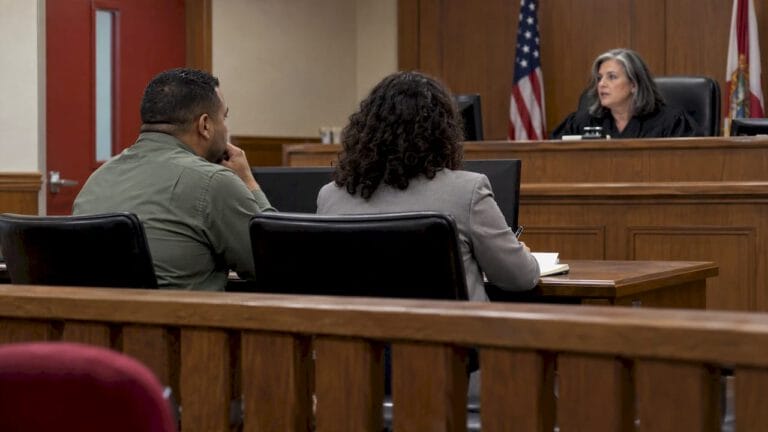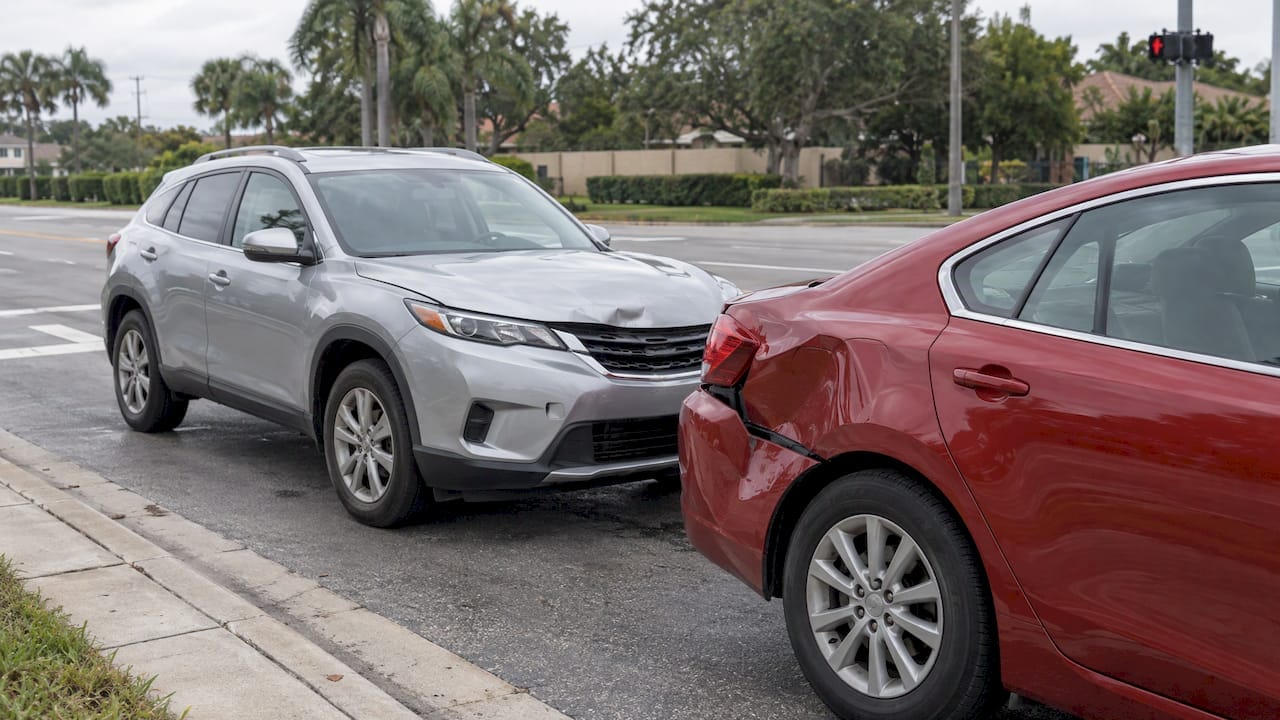
In a Florida Uber or Lyft crash, the insurance that pays depends on what the driver’s app was doing at the moment of impact, and a claim can involve the driver, the rideshare company and a second driver’s insurer all at once. Florida law sets minimum coverage for each app status, gives you a short window to get medical care, and gives you a limited time to file suit. Knowing those rules early protects your claim. A Brevard County injury attorney can sort out who owes what before you speak to an adjuster.
This guide is for people injured as a rider, as a driver in another car, or as a pedestrian or cyclist. It explains the rules in plain terms. It is general information, not advice on your specific case.
TL;DR
- Coverage turns on the driver’s app status: logged on and waiting, or accepted a ride and carrying a rider. The higher limits apply once a ride is accepted.
- Florida’s statute for rideshare companies (called transportation network companies, or TNCs) requires $1 million in primary liability coverage during a prearranged ride, and lower minimums while the driver is logged on and waiting.
- You must start medical care within 14 days of the crash to use Personal Injury Protection (PIP), and the general deadline to sue for negligence is two years.
- If a jury finds you more than 50% at fault for your own harm, Florida bars recovery. Anything less reduces your award proportionately.
- Preserve evidence early and talk to an attorney before giving a recorded statement. We offer free 30-minute consultations.
Table of Contents
- Why rideshare crashes are different from ordinary car accidents
- Which insurance applies: the three app statuses
- Who can be held responsible
- What to do after a rideshare accident in Florida
- Compensation: PIP first, then the liability claim
- The 51% rule and how it affects you
- Deadlines you should not miss
- Why a local attorney helps in a rideshare case
- Our perspective
- Talk to us about your rideshare accident
- FAQ
- Sources
Why rideshare crashes are different from ordinary car accidents
In an ordinary two-car crash, you usually deal with one at-fault driver and that driver’s auto insurer. A rideshare crash adds layers. The driver has a personal policy, the company carries its own commercial coverage, and which one responds depends on a status the app records. Another driver, a vehicle owner or a property owner can also share fault.
Florida’s rules for these companies sit in Florida Statute § 627.748. It defines a prearranged ride as beginning when the driver accepts a ride request through the app and continuing while the driver transports the rider, ending when the last rider exits. That definition matters because it sets the line between the two main coverage tiers.
Which insurance applies: the three app statuses
Think of every rideshare crash as falling into one of three situations.
| App status | What it means | Coverage that applies |
|---|---|---|
| App off | Driver is using the car personally | The driver’s personal auto policy. Lyft states it has no policy that applies when the app is off. |
| Logged on, no ride accepted | Driver is waiting for a request | At least $50,000 per person and $100,000 per incident for death and bodily injury, $25,000 for property damage, plus PIP and uninsured/underinsured motorist (UM/UIM) coverage |
| Prearranged ride | Driver accepted a request, heading to pickup or carrying the rider | At least $1 million in primary liability for death, bodily injury and property damage, plus PIP and UM/UIM coverage |
The figures for the second and third rows come from Florida Statute § 627.748(7). The statute allows the required coverage to be provided by the driver or vehicle owner, by the company, or by a combination of them.
What the companies say about their own policies
Both major companies publish coverage descriptions consistent with those tiers. Uber’s insurance page says that while a driver is online and available for a trip, Uber maintains third-party liability insurance of at least $50,000 per person and $100,000 per accident for injuries and $25,000 per accident for property damage. En route or on a trip, it lists at least $1,000,000 for property damage and injuries to riders and third parties. Lyft’s help page describes a similar structure, with at least $1 million in third-party auto liability when picking up a rider or during a ride in most markets.
These are the companies’ own descriptions of their programs. The binding minimums for Florida are the ones in the statute.
When the driver’s own insurance has lapsed
Sometimes the driver’s personal policy does not respond. Under § 627.748(7)(d) and (e), if the driver’s insurance has lapsed or does not provide the required coverage, the company’s insurance must provide it beginning with the first dollar of a claim, and it has a duty to defend. The company’s coverage cannot depend on a personal insurer first denying the claim. That is a useful rule when an adjuster tells you to wait for another carrier.
A rule that has been under legislative review
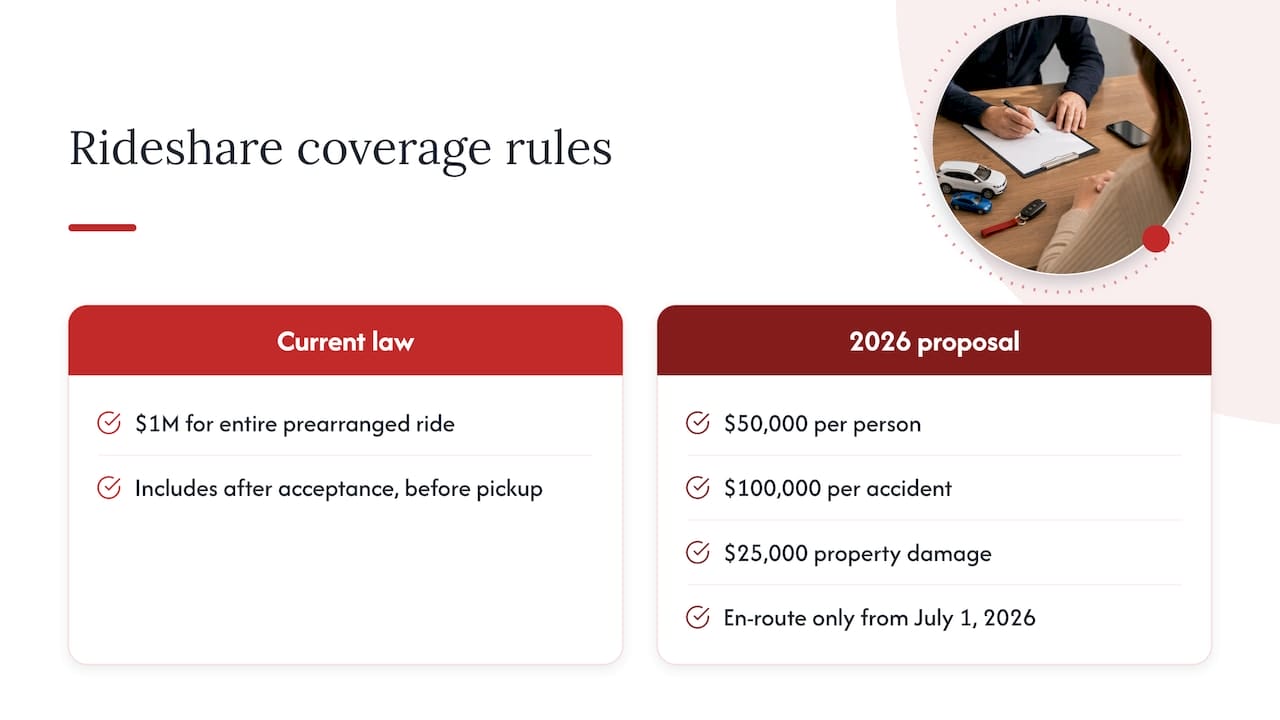
Current law, as explained in a Florida Senate bill analysis, requires the $1 million coverage for the entire prearranged ride. That includes the stretch after the driver accepts but before the rider is in the car. A 2026 Senate bill analysis describes a proposal to lower the limits for the en-route-only period to $50,000, $100,000 and $25,000 starting July 1, 2026. Because insurance rules change, confirm the text in force on the date of your crash. An attorney will check that for you.
Who can be held responsible
Fault is not limited to the rideshare driver. Depending on the facts, responsibility can sit with one or several of these:
- The rideshare driver. If the driver was speeding, distracted or ran a light, the driver’s negligence is the starting point. Coverage then comes from the tier that matches the app status.
- The other driver. Many rideshare crashes are caused by someone outside the rideshare car. That driver’s liability policy is often the first source of payment for injured riders and the rideshare driver alike.
- The rideshare company. Under the statute, the company’s insurance can be the source of the required coverage, and it must step in when the driver’s coverage has lapsed. Whether a company carries any broader liability depends on the facts and is a question for an attorney.
- A vehicle owner. If the driver does not own the car, the owner’s coverage may enter the picture, because the statute allows the driver or the vehicle owner to meet the requirements.
- A property owner or government entity. Poor road design, a missing sign or a hazardous driveway can add a defendant. Claims against a government body follow special rules: Florida Statute § 768.28 requires pre-suit written notice and caps recovery at $200,000 per person and $300,000 per incident.
Florida generally assigns each liable party its own percentage of fault rather than making them jointly responsible for the whole. Under § 768.81(3), the court enters judgment against each party based on that party’s share, and a defendant can assign fault to someone not in the case only if it pleads that and proves it. This is one reason to identify every responsible party early, before the evidence is gone.
What to do after a rideshare accident in Florida
What you do in the first hours and days shapes the claim. Here is a practical order.
- Get safe and call 911. Florida law requires a driver involved in a crash with injury or death, or with at least $500 in estimated property damage, to immediately contact local law enforcement. A police report also creates an official record of the scene.
- Get medical care right away. Even if you feel fine, go to an emergency room, urgent care or doctor. Florida’s PIP system sets a deadline of 14 days, covered below, and early records link your injuries to the crash.
- Capture the app status. Take screenshots of your ride receipt, the driver’s name, photo, license plate and vehicle. If you were the rideshare driver, screenshot your app status at the time of the crash. Under § 627.748(7)(h), a driver must provide insurance information after a crash and, on request, disclose whether they were logged on or on a prearranged ride.
- Collect names and contact details. Get the other driver’s insurance information, plus names and numbers for witnesses.
- Photograph everything. Take pictures of vehicle damage, skid marks, traffic signals, road conditions and your injuries. Save dashcam footage if there is any.
- Keep records. Save medical bills, pharmacy receipts, pay stubs showing missed work and a short daily note on pain and limits.
- Be careful with insurers. Give basic facts to your own insurer. Before giving a recorded statement to any other insurer, or accepting a quick settlement offer, talk to an attorney. Early offers are often made before the full extent of an injury is known.
- Do not post about the crash. Social media posts can be used to dispute your account.
Our article on common personal injury case mistakes expands on how small early missteps can weaken a claim.
Compensation: PIP first, then the liability claim
Florida is a no-fault state for the first layer of medical costs. According to the Florida Department of Financial Services, PIP pays 80% of necessary and reasonable medical expenses regardless of who caused the crash, 60% of work loss and a $5,000 death benefit. Payment is based on initial services and care received within 14 days after the accident. Follow-up care depends on an emergency medical condition diagnosis.
Because the statute requires rideshare coverage to include PIP, a rider or driver hurt in a rideshare vehicle is not left without a first source for medical bills. PIP does not pay for everything, though. Pain and suffering and the rest of your losses come from a claim against the at-fault party’s liability coverage, and that is where the rideshare tiers matter.
A liability claim can include:
- medical expenses beyond PIP
- lost income and reduced earning ability
- pain and suffering
- property damage
- in a fatal crash, a wrongful death claim by the family
For a sense of how fault and PIP interact in dollars, see our guide to Florida car accident settlements. Every case turns on its own injuries and facts, so no figure predicts your result.
When the at-fault driver has too little insurance
If the person who hit you carries minimal coverage or none, your own uninsured or underinsured motorist coverage may help. Read our explanation of underinsured motorist coverage, and see how we handle uninsured and underinsured motor vehicle accidents. Rideshare coverage also includes UM/UIM under the statute, which can matter for riders.
The 51% rule and how it affects you
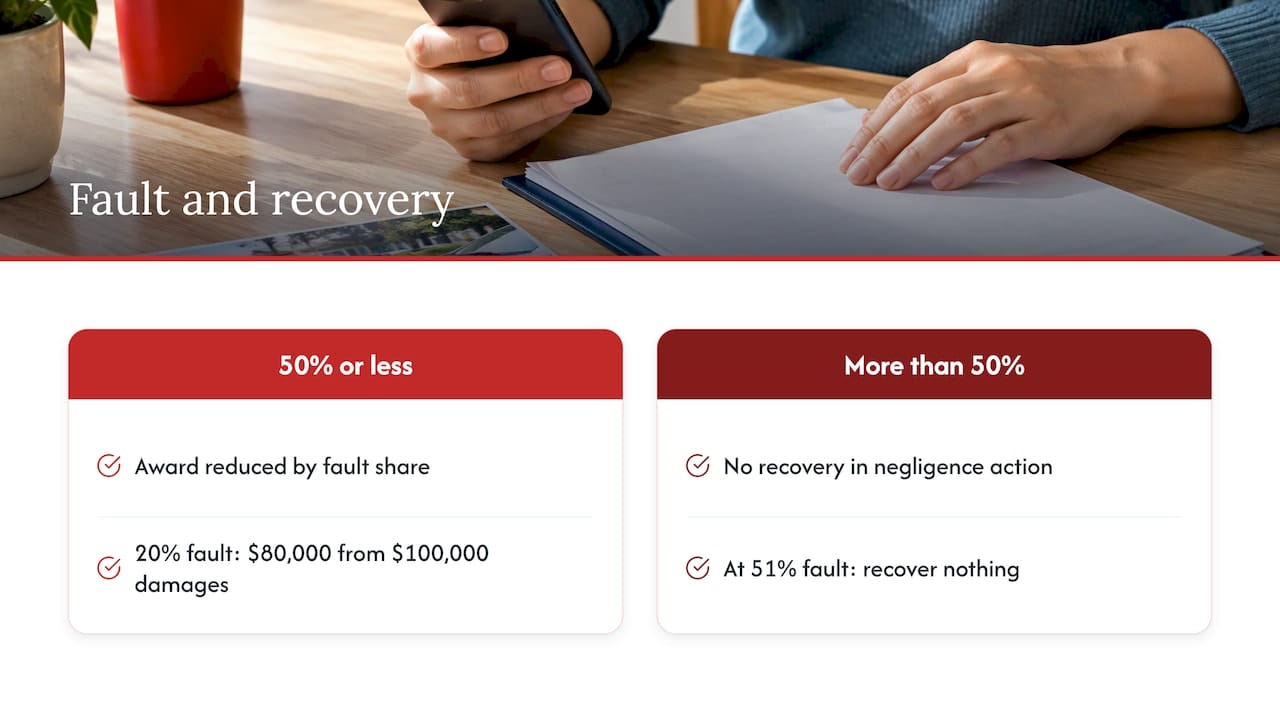
Florida uses modified comparative negligence. Under § 768.81(6), a party found more than 50% at fault for their own harm may not recover damages in a negligence action. If you are 50% or less at fault, your award is reduced by your share.
Here is a worked example. Suppose a jury values your damages at $100,000 and finds you 20% at fault, for instance because you were not wearing a seat belt. You could recover $80,000. At 51% fault, you recover nothing.
Riders are rarely blamed for a crash, but passengers can be assigned some fault in unusual cases, and a pedestrian or cyclist hit by a rideshare car often faces fault arguments. Insurers use this rule to push percentages upward, so how the facts are presented matters. Our guide to comparative negligence in Florida goes deeper.
Deadlines you should not miss
| Deadline | Rule | Source |
|---|---|---|
| 14 days | Start initial medical care to qualify for PIP benefits | Florida Dept. of Financial Services |
| 2 years | General limit to file a negligence lawsuit | Fla. Stat. § 95.11(5)(a) |
| Pre-suit notice | Required before suing a government entity | Fla. Stat. § 768.28 |
The two-year period is the rule for negligence actions. Some cases, such as wrongful death or claims against a government body, can follow different rules, so do not assume two years applies to you. We explain the change in our post on the two-year statute of limitations in Florida. Evidence also fades fast: video is overwritten, and the app data that proves the driver’s status is easier to request early.
Why a local attorney helps in a rideshare case
The hard part of a rideshare claim is not the law alone. It is the sequence: working out the driver’s app status, putting the right insurer on notice, preserving evidence before it disappears, and keeping the claim from being undervalued under the fault rules. Each carrier has its own adjusters, and each can point to another policy.
An attorney who handles the whole claim keeps those threads together and speaks to insurers for you. Our Florida auto accidents page describes how we approach crash claims, and our overview of auto accident personal injury law in Florida covers the broader framework. If you were visiting Florida when the crash happened, see our page on Florida tourism accidents.
Our perspective
We hear the same worry from people hurt in rideshare crashes: who do I even call first? The answer is that you should not have to work that out while you are recovering.
The Law Office of John Vernon Moore, P.A. represents injury clients in Brevard County, and our approach is built on direct attorney interaction. You talk to the attorney handling your case, not a layer of intake staff. We look at the facts that decide a rideshare claim: the driver’s app status, the insurance tier it triggers, who else shares fault, and how the 51% rule could be used against you.
We also know that a crash does not stop other parts of life. Our practice covers family law, estate planning and criminal defense as well as personal injury, so if an injury changes your family or financial situation, you can get help in one place.
John
Talk to us about your rideshare accident
If you were hurt in an Uber or Lyft crash in or around Brevard County, our personal injury team offers a free 30-minute consultation. Bring your ride receipt or app screenshots, the police report number, your medical records and any insurer letters. We will explain which coverage is likely to apply and what your deadlines are. See our personal injury practice area for car accidents, slip and fall and wrongful death.

FAQ
Do you get compensation if your Uber or Lyft crashes in Florida?
You may. PIP from the vehicle’s coverage can pay 80% of necessary medical expenses and 60% of lost work income regardless of fault, if you start care within 14 days. A liability claim against the at-fault driver’s insurer, and in some cases the rideshare coverage, can cover further losses such as pain and suffering. The amount depends on your injuries and on fault.
What is the 51% rule in Florida?
It is the comparative negligence bar in Fla. Stat. § 768.81(6). If a jury finds you more than 50% at fault for your own harm, you cannot recover damages. If you are 50% or less at fault, your award is reduced by your percentage.
Does the rideshare company’s $1 million coverage always apply?
No. Florida’s statute ties the $1 million primary liability requirement to a prearranged ride, which starts when the driver accepts a request. When the driver is only logged on and waiting, the minimum is $50,000 per person and $100,000 per incident for bodily injury, plus $25,000 for property damage. Legislative proposals have addressed these tiers, so check the current statute.
How long do I have to file a claim after a rideshare crash in Florida?
The general limit for a negligence lawsuit is two years under Fla. Stat. § 95.11(5)(a). PIP requires you to start medical care within 14 days of the crash. Claims against government bodies and wrongful death cases have their own rules, so speak with an attorney promptly.
Should I give the rideshare company’s insurer a statement?
Talk to an attorney first. Insurers often ask for recorded statements early, before your injuries are fully understood, and what you say can be used to assign fault to you. Give your own insurer the basic facts and let your attorney handle the rest.
Sources
- Florida Statute § 627.748, Transportation network companies (2025)
- Florida Statute § 627.748, full text with subsections
- Uber insurance for rideshare drivers
- Lyft insurance coverage help page
- Florida Senate 2025 bill analysis on TNC coverage
- Florida Senate 2026 bill analysis, SB 632
- Florida Statute § 768.28 and Chapter 768 (2025)
- Florida Statute § 768.81 (2025)
- Florida Statute § 768.81, Online Sunshine
- Florida Statute § 95.11 (2025)
- Florida Department of Financial Services, personal automobile insurance overview
- Florida Highway Safety and Motor Vehicles, involved in a crash