There is no fixed answer to how long a Florida car accident settlement takes, because the biggest stage, your medical treatment, ends when your doctors say it does. Florida law does fix some clocks: your PIP benefits are due within 30 days of proper written notice, the insurer must pay a signed settlement within 20 days, and you generally have two years to sue. Knowing those dates lets you see where a claim is moving and where it has stalled. If you were hurt in Brevard County, our personal injury team can walk you through where your claim stands in a free 30-minute consultation.
TL;DR
- A Florida car accident claim runs through reporting, treatment, investigation, a demand, negotiation and payment. Treatment is usually the longest and least predictable stage.
- PIP (personal injury protection, Florida’s no-fault coverage) payment is due within 30 days of proper written notice, according to the state’s Department of Financial Services.
- Once a settlement is agreed, Florida law requires the insurer to tender payment within 20 days unless the agreement sets another date. Late payment carries 12% annual interest.
- Florida’s statute of limitations for negligence actions is two years, so a slow negotiation never replaces the need to watch the filing deadline.
- Prompt reporting, complete records and a clear damages figure are what move a claim along.
Table of Contents
- The short version: a timeline in six stages
- Stage 1: Reporting and notifying the insurer (days)
- Stage 2: PIP benefits and medical treatment (weeks to many months)
- Stage 3: Investigation (one to three months, overlapping treatment)
- Stage 4: The demand (when your damages are known)
- Stage 5: Negotiation and mediation (weeks to months)
- Stage 6: Getting paid after you agree (20 days by statute)
- The deadline that overrides everything: two years
- If a lawsuit becomes necessary
- Three worked examples
- Why having a lawyer helps your timeline
- Talk to us about your claim
- Our perspective
- FAQ
- Sources
The short version: a timeline in six stages
No official body publishes an average settlement time, and any single number you see online mixes together a fender-bender with a spinal surgery. What you can rely on is the order of events and the legal deadlines attached to some of them.
| Stage | What happens | What controls the length |
|---|---|---|
| 1. Report and notify | Crash is reported, insurer is told, vehicle damage is documented | How fast you act |
| 2. Treatment | You see doctors and keep treating until you recover or your condition stabilizes | Your injuries |
| 3. Investigation | Fault, damage and injuries are examined | Clear or disputed fault, available records |
| 4. Demand | A written demand states what you are asking for | When your damages are known |
| 5. Negotiation | Offers and counteroffers, possibly mediation | The gap between the two sides |
| 6. Payment | Release is signed and funds are tendered | A 20-day statutory clock |
If negotiation fails, a seventh stage, a lawsuit, begins, and it runs on the court’s calendar rather than the insurer’s.
Stage 1: Reporting and notifying the insurer (days)
This is the only stage fully in your hands, and it sets the tone for the rest. Florida’s Department of Financial Services (DFS) lists the basics in its Automobile Insurance Toolkit: report the crash, record witness details, tell your insurer promptly, and document and have your vehicle damage inspected before repairs.
Why this matters for timing: witnesses move, memories fade and repair shops fix evidence out of existence. A claim that starts with names, photos and a prompt notice spends less time later arguing about what happened.
Where it goes wrong: waiting to see whether you feel better before calling anyone, or giving a recorded statement to the other driver’s insurer before you understand your injuries. Early statements are read back later.
Vehicle damage runs on its own track. If you are also dealing with repair costs, a property damage claim is separate from your injury claim, and the repair estimate and inspection can move forward while you are still treating.
Stage 2: PIP benefits and medical treatment (weeks to many months)
Florida is a no-fault state, so your own PIP coverage is usually the first source of payment for medical bills and lost income, whoever caused the crash. DFS states that PIP payment is due within 30 days of proper written notice, and that interest can be payable if it is overdue. If your PIP is late, that is a concrete deadline you can point to.
The settlement of your injury claim against the at-fault driver, however, generally waits for your treatment to reach a point where your damages can be described. Settling early is the most common way people shortchange themselves: once you sign a release, you cannot reopen the claim if your back pain turns out to need surgery.
This is why one claimant settles in a few months and another takes years. The injury sets the pace, not the paperwork.
Florida also limits when you can recover non-economic damages such as pain and suffering, which depends on the severity of the injury. Our guide to avoiding the loss of pain and suffering damages under §627.737 explains the rule, and it is one more reason to have your treatment records in order before any demand goes out.
Stage 3: Investigation (one to three months, overlapping treatment)
While you treat, the insurer investigates. It looks at the crash report, photographs, statements, repair estimates and your medical records. DFS flags prompt reporting, witness information, insurer inspection, repair estimates, supplemental damage and disagreement over the amount of damage as the practical points that shape how a claim is handled.
Fault is the question that stretches this stage the most. When both drivers tell different stories, the insurer takes longer, asks for more and offers less. Our overview of how liability is determined after a car accident shows what evidence carries weight.
Supplemental damage is a good example of a quiet delay. A shop opens the bumper and finds more broken than the first estimate showed. The insurer then re-inspects, and the clock keeps running. Ask the shop to tell you the moment it finds hidden damage.

Stage 4: The demand (when your damages are known)
A demand is a written statement of what you are asking the insurer to pay, backed by medical records, bills and proof of lost wages. It is normally sent once your doctors can describe your condition and your future care. Sending it too early means asking for too little. Sending it incomplete means the insurer writes back asking for the missing pieces and the review starts over.
Two habits shorten this stage:
- Collect bills and records as you go, not at the end.
- Keep a simple log of missed work and daily limits while you recover.
Stage 5: Negotiation and mediation (weeks to months)
After the demand, the insurer responds, usually with a lower figure, and the two sides trade offers. Each round can take days or weeks, and the process is slower when fault or the value of the injury is disputed.
If the claim stalls, DFS notes that eligible disputes can be submitted to nonbinding insurance mediation before settlement, suit or appraisal. The eligible claims it lists include bodily injury claims under $10,000 and property damage claims of any amount. Mediation is a meeting with a neutral third party, and because it is nonbinding, you decide whether to accept what comes out of it. Our firm is mediation certified, which matters when a negotiation needs a structured way to close the gap.
If your claim is taking too long: DFS advises contacting the insurer promptly, keeping a record of witness information, asking for an explanation if a claim is denied, and considering mediation where you are eligible. Keep a written log of every call and letter, with dates. If an insurer is not dealing fairly with a claim, see our explanation of insurance bad faith in Florida.
What speeds a claim up, and what slows it down
| Tends to speed it up | Tends to slow it down |
|---|---|
| Prompt report to police and insurer | Late notice to the insurer |
| Witness names recorded at the scene | Disputed fault, no witnesses |
| Treatment that reaches a clear end point | Ongoing or changing diagnoses |
| Complete records sent with the demand | Missing bills or gaps in treatment |
| Damage inspected and documented before repairs | Supplemental damage found later |
Stage 6: Getting paid after you agree (20 days by statute)
People are often surprised by how this part works. You do not receive a check the moment you agree on a number. You sign a release, a document ending your claim, and then payment is processed.
Florida Statutes section 627.4265 requires the insurer to tender payment no later than 20 days after the settlement, unless the agreement sets another date. The insurer may condition payment on a mutually agreeable release. If payment is late, the statute sets interest at 12% a year. When payment depends on a release, interest starts when you deliver the executed release to the insurer, so sign and return it promptly.
If your case has an attorney, the funds typically arrive at the attorney’s trust account first, where liens and bills are settled before you receive your share. That step is part of why the final distribution can take a little longer than the insurer’s 20 days.
The deadline that overrides everything: two years
Negotiation can feel open-ended, but the court clock is not. Florida’s 2025 statute, section 95.11, sets a two-year limitations period for an action founded on negligence, and the same two years for wrongful death actions. Car accident injury claims against a negligent driver are negligence actions.
That has a practical consequence for the timeline: if talks are still going at month 18, you are close to the point where a lawsuit needs to be filed to protect your rights. An insurer that drags its feet gains nothing when you file. Our article on the two-year limit and HB 837 explains the 2023 change that shortened the old period.
If the crash killed a family member, the same two-year period applies to a wrongful death claim, and the family should speak with an attorney quickly.
If a lawsuit becomes necessary
Filing suit does not mean you are going to trial. Most cases still settle, often after the other side has to answer in court and exchange evidence. But once a case is in the court system, the timeline depends on the judge’s calendar, the discovery process and the number of parties, so it is measured in many months rather than weeks. A trial is the longest path, which is why preparing a well-documented claim at the beginning is the best way to avoid it.
Three worked examples
These are illustrations of how the stages combine, not predictions or averages.
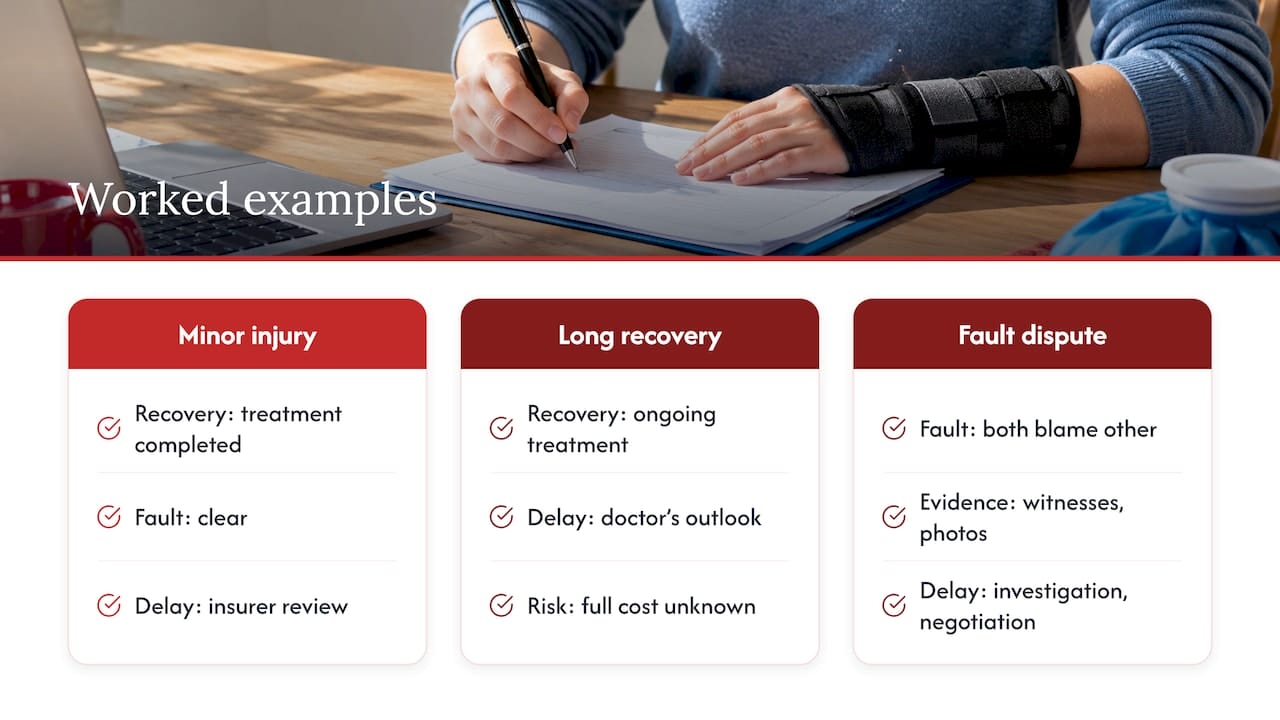
A minor injury, clear fault. A driver is rear-ended, sees a doctor within days, completes treatment and has complete records. Notice, PIP and the demand all move quickly, and the main wait is the insurer’s review. The 20-day payment rule then applies once a release is signed.
A longer recovery. A driver has ongoing treatment and an injection plan. The demand cannot go out until the doctor can describe the outlook, so the claim waits on treatment. Rushing here risks settling before the full cost is known.
A fault dispute. Both drivers say the other ran the light. Witnesses and photographs decide the case. Investigation and negotiation take longer, and the two-year deadline is a real planning date.
Why having a lawyer helps your timeline
A claim stalls mostly for ordinary reasons: a missing record, a late notice, a demand sent before the damages are clear, or an insurer waiting for the claimant to blink. Our firm handles Florida auto accident claims with direct attorney interaction, which means you speak with the lawyer handling your case about what is happening and what comes next. For a broader look at how payouts are shaped, read our guide to Florida car accident settlements.
If your car needs repairs while the injury claim is open, keeping the vehicle repaired is part of the timeline too. This guide to auto claim steps for keeping repairs moving covers practical moves that affect how quickly your vehicle gets back on the road.
Talk to us about your claim
If you were injured in a car accident in Brevard County, the Law Office of John Vernon Moore, P.A. represents clients in personal injury cases, including car accidents. The first 30-minute consultation is free, and it is the quickest way to find out which stage your claim is in and what deadline matters most.

Bring the crash report, your insurance information, photos and any medical bills you have so far. We will tell you what the next step is.
Our perspective
Most people come to us asking one question: how long will this take? We understand why. Bills do not wait, and an open claim hangs over everything.
What 85 years of experience at our firm has taught us is that the honest answer begins with your treatment, not with the insurer. A claim is built on what your records show, so the best thing you can do for your timeline is to treat consistently, keep every record and speak to a lawyer before you talk to an adjuster about anything that matters.
We work with clients directly, not through layers of staff, and we plan each case around the person in front of us. That means setting a realistic path with you at the start, watching the statutory deadlines, and making a decision with you about when a demand is ready and when mediation could help close a gap. Our firm is mediation certified, and we think a well-prepared case often resolves faster because both sides can see what it is worth.
If you have been hurt in a crash, you do not have to guess where you stand. Call us.
John
FAQ
How long after a car accident can you sue in Florida?
Florida’s 2025 statute, section 95.11, sets a two-year limitations period for actions founded on negligence, which covers most car accident injury claims. A wrongful death action also has a two-year period. Talk to an attorney well before the second anniversary of the crash so there is time to prepare a filing.
How long does it take to get paid after a settlement is signed?
Under Florida Statutes section 627.4265, the insurer must tender payment no later than 20 days after settlement unless the agreement provides another date. Payment may be conditioned on a release. Late payment bears 12% annual interest.
What can I do if my insurance claim is taking too long?
Contact the insurer promptly, keep notes of every conversation and ask for a written explanation if a claim is denied. For PIP, payment is due within 30 days of proper written notice. Eligible disputes can go to nonbinding mediation through the state’s program, and you can ask an attorney to review the delay.
Why can’t I settle right away?
Because a release ends your claim permanently. Until your doctors can say how you have recovered and what future care you may need, neither you nor the insurer can put a fair figure on the claim. Settling before then risks leaving future medical costs uncovered.
Sources
- Automobile Insurance Toolkit, Florida Department of Financial Services
- Florida Statutes section 627.4265 (2026), Online Sunshine
- Chapter 95, Section 11, 2025 Florida Statutes, The Florida Senate