
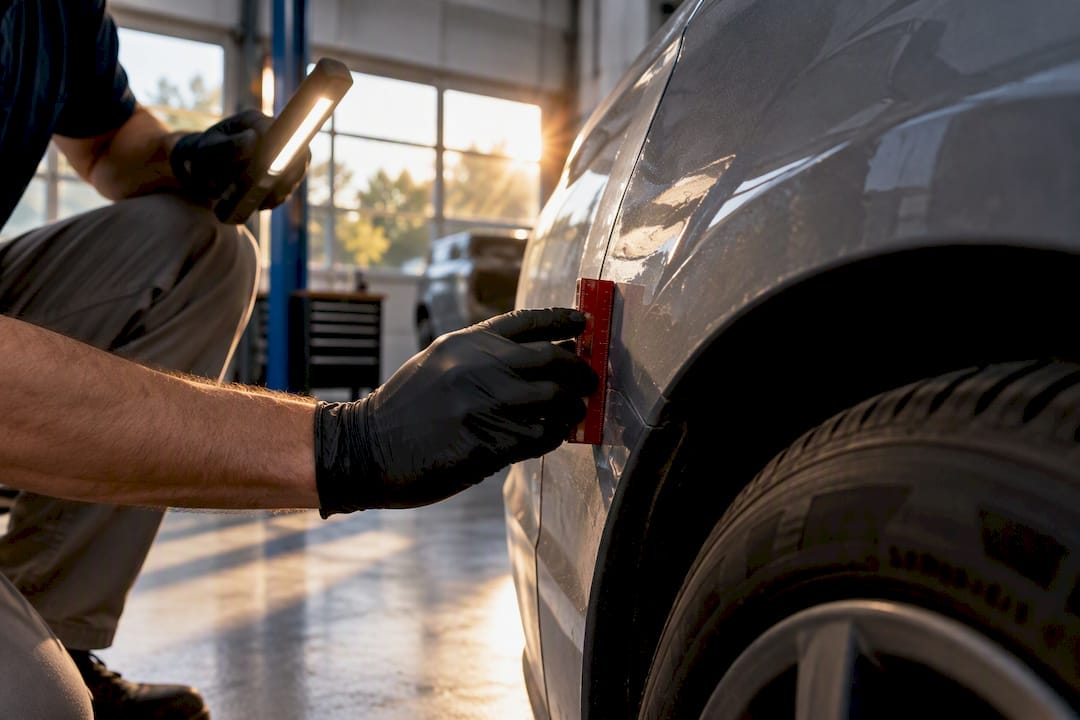
Yes, you can file a diminished value claim in Florida against an at-fault driver’s insurer once your car is repaired but still worth less than it was before the crash. Your own first-party policy may work differently, so check the wording before you assume the same right applies. Before you sign anything or accept a settlement, preserve your repair records and get an independent appraisal.
TL;DR:
- Diminished value claims in Florida are most successful when filed against the at-fault driver’s liability insurer, especially for market-value loss that repairs don’t restore.
- You should obtain a USPAP-compliant appraisal from a credentialed appraiser before settling, focusing on comparable sales and a clear methodology.
- Collect all relevant documentation early, including police reports, repair bills, photos, and receipts, and log all insurer contacts in writing to preserve leverage.
- Insurers often rely on formulas or claim the vehicle was fully restored, which can be rebutted with solid appraisals and detailed repair records.
- The typical effective window to pursue diminished value is within four years of the accident, with third-party claims being the most straightforward recovery path.
Table of Contents
- Immediate action checklist: what to do in the first 30 days after repairs
- What diminished value means in Florida and the legal framework
- Who can file, which insurer to pursue, and timing
- Evidence you need and what makes an appraisal credible in Florida
- How to submit a diminished value demand and negotiate
- Common insurer defenses and practical ways to rebut them
- Dispute resolution options in Florida: DFS mediation, small claims, and lawsuits
- How diminished value affects resale and trade-in values in Florida’s used car market
- Typical settlement amounts or ranges and factors influencing compensation
- Impact of pre-existing damage or vehicle history on diminished value claims
- Role of expert witnesses and appraisal professionals in litigation
- Recent Florida case law updates shaping diminished value claims
- Differences in diminished value claims between private passenger vehicles and commercial vehicles
- Practical perspective from a Florida personal-injury attorney
- How the Law Office of John Vernon Moore, P.A. can help
- Sources
- FAQ
Immediate action checklist: what to do in the first 30 days after repairs
The weeks right after your car comes out of the body shop matter more than any other stretch of the claim. Insurers move fast to close files, and once you sign a release, your leverage is gone.
- Confirm the at-fault driver’s insurer and policy details, and get the claim number in writing.
- Pull the police report and keep a copy with your file.
- Collect repair bills, pre- and post-accident photos, a vehicle history report, and every receipt tied to the repair.
- Order an independent, USPAP-grade diminished value appraisal from an ASA or IARA credentialed appraiser before you sign a release or cash an offer.
- Log every insurer contact: date, name, and a one-line summary of what was said.
Beyond the numbered steps, a few habits protect the claim over the long run:
- Ask the insurer in writing for the exact valuation method it used.
- Never accept a verbal settlement figure without a written breakdown.
- Keep a separate folder (digital or paper) exclusively for this claim.
Pro Tip: Request the insurer’s valuation worksheet before you counter. It tells you which comparable sales or formula they relied on, and that document becomes your best rebuttal material.
What diminished value means in Florida and the legal framework
Diminished value is the gap between what your car was worth right before the crash and what it’s worth after a proper repair. It isn’t the same as the repair bill. A shop can restore the frame, repaint the panels, and replace every part, and the car can still carry a lower resale price simply because it now has an accident on its record.
Florida law recognizes this gap as a real, compensable loss when repairs don’t fully restore pre-loss market value, a principle reflected in Florida appellate and Supreme Court materials addressing insurer duties after a covered loss. Whether you can collect, and from whom, depends heavily on the type of claim:
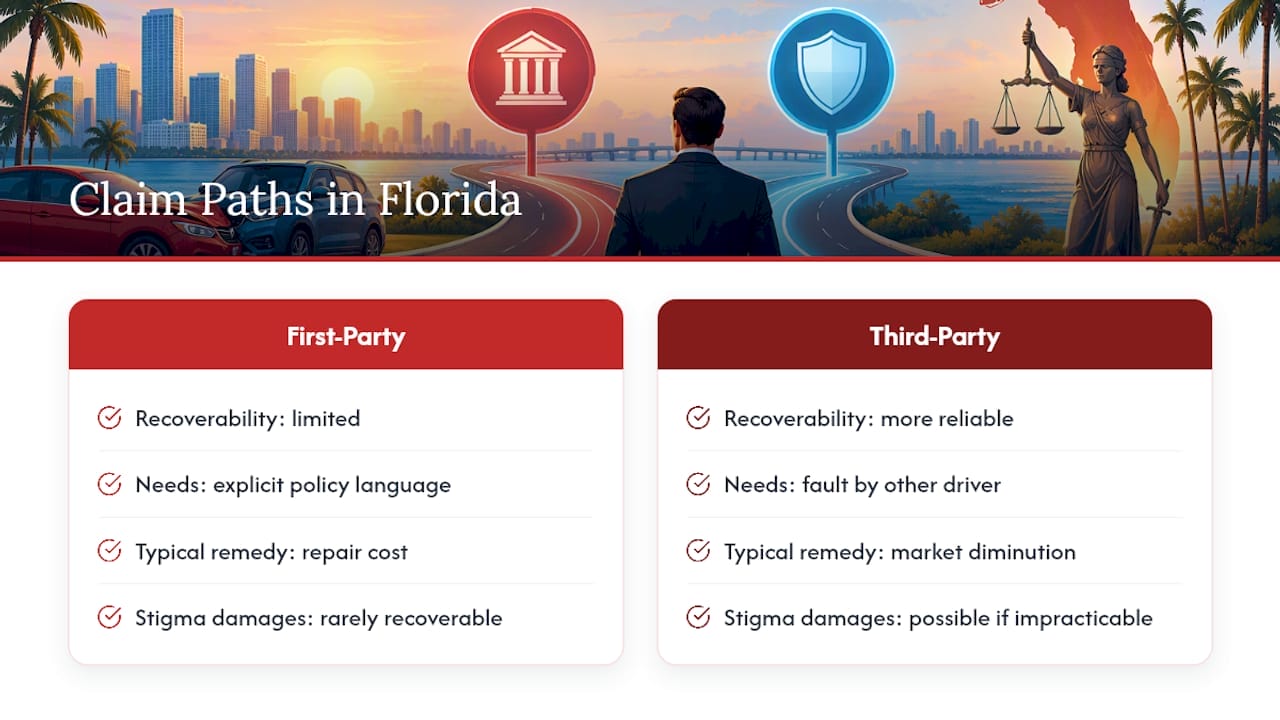
- A third-party claim against the at-fault driver’s liability carrier is the standard route to diminished value.
- A first-party claim under your own collision policy may not include inherent diminished value at all, since many repair-or-replace policies are written to cover restoration, not market stigma.
Regulatory guidance also shapes insurer behavior here: Florida Statutes section 626.9743 sets out how insurers must document valuation and deductions in motor vehicle claims, particularly for total losses, and that documentation duty carries over into how insurers should explain any diminished value offer.
Who can file, which insurer to pursue, and timing
The person who owned the vehicle at the time of the crash is the one with standing to claim diminished value, and the target is almost always the at-fault driver’s liability insurer rather than your own.
- If another driver caused the crash, file the diminished value claim against their liability carrier: this is the cleanest path since Florida recognizes market-loss damages in third-party claims.
- If you’re relying on your own collision coverage, read the policy closely. Many first-party policies promise repair or replacement, not compensation for lingering resale stigma.
- Florida’s statute of limitations for property damage claims runs generally four years from the date of the accident, but don’t wait that long. Insurer silence or delay tactics eat into your practical window to gather fresh evidence.
- If the at-fault driver is uninsured, your options narrow to your own collision coverage or uninsured motorist property damage coverage, and neither typically includes diminished value as a matter of course.
Evidence you need and what makes an appraisal credible in Florida
An appraisal only helps if it can survive scrutiny from an adjuster, a mediator, or a judge. That means demanding real credentials and a defensible process, not a quick drive-by estimate.
- Confirm the appraiser follows Uniform Standards of Professional Appraisal Practice (USPAP) and holds an American Society of Appraisers (ASA) or International Automotive Appraisers Association (IARA) credential.
- Ask for a written methodology section: how they pulled comparable sales, what adjustments they made, and why.
- Require dated photos of the vehicle, a signed report, and a clear final number tied to the comparables cited.
Pair that appraisal with your own paperwork: complete repair invoices listing every part used, pre-accident photos if you have them, service records, the vehicle history report, and the police report. Together, these tie the appraiser’s market comparison back to a documented, verifiable repair.
Pro Tip: Order the appraisal before you accept any settlement offer. An appraisal completed after you’ve signed a release is often treated as worthless in negotiation or in court, according to consumer guidance on diminished value claims.
How to submit a diminished value demand and negotiate
Once you have the appraisal and supporting documents, the demand letter is the formal ask that starts the clock on a response.
- Open with a short incident summary: date, location, vehicles involved, and fault determination.
- Attach the appraiser’s full report along with the repair invoice and any photos.
- State your requested dollar figure clearly, tied directly to the appraisal.
- Set a firm response deadline, typically 14 to 30 days.
- Note your next steps if the insurer doesn’t respond: mediation through the Florida Department of Financial Services, a small claims filing, or litigation.
Keep every piece of correspondence, and if the insurer counters with a lower figure, ask for the itemized deductions in writing. That request alone forces many insurers to justify a number they’d rather leave vague. If negotiation stalls, an attorney can help you weigh whether pursuing the claim further is worth the cost of litigation.
Common insurer defenses and practical ways to rebut them
Insurers rely on a fairly predictable playbook to minimize diminished value payouts, and each defense has a documented counter.
- The 17c formula defense, borrowed from an old class-action settlement formula, caps diminished value using a flat percentage regardless of your car’s actual market loss.
- “The repair restored full value” claim, asserting the vehicle is functionally and cosmetically identical to its pre-accident condition.
- “No comparable sales exist”, used to dismiss your appraiser’s market comparison as speculative.
Rebut the 17c approach with a USPAP-compliant appraisal built on real local comparables rather than a formula. Counter the “fully restored” claim with a line-by-line comparison of repair invoices against manufacturer specifications, and if structural or frame damage is involved, note that buyers and dealers routinely price that history into resale even after a competent repair. A sworn declaration from your appraiser often settles disputes over comparable sales. When insurers won’t budge past these points, litigation becomes the more realistic path.
Dispute resolution options in Florida: DFS mediation, small claims, and lawsuits
When negotiation stalls, Florida gives you three practical escalation routes, each with different costs and timelines.
- DFS mediation is voluntary and nonbinding, and it’s available for property damage disputes of any amount, with the insurer typically covering the mediation cost.
- Small claims court works for smaller diminished value amounts and moves faster than a full civil suit, though you’ll want to confirm your county’s current filing threshold before you file.
- A civil lawsuit is the route for larger, contested claims, particularly when the insurer disputes fault or the appraisal itself.
Whichever path you choose, keep tracking deadlines and documentation. Mediation doesn’t pause your statute of limitations, so don’t let a scheduled session become an excuse to stop watching the calendar.
How diminished value affects resale and trade-in values in Florida’s used car market
A vehicle with an accident on its record sells for less in Florida’s used car market, full stop. Dealers pull vehicle history reports before making a trade-in offer, and once a Carfax or similar report shows a reported accident, the offer drops regardless of how well the repair was done.
This is where diminished value claims connect directly to your wallet outside of the insurance process. If you plan to sell or trade in the vehicle within a year or two of the accident, the resale discount you’ll absorb is essentially the same market loss your diminished value claim is meant to compensate. Buyers and dealers price in accident history as a risk factor: uncertainty about hidden structural issues, paint match, and frame alignment, even when a shop’s work meets every standard.
Private buyers behave the same way. Listings that disclose accident history routinely sell for less than comparable clean-title vehicles, and Florida’s high used-car turnover, driven by relocation, leasing turnover, and a large private-sale market, means most owners will face this gap eventually rather than hypothetically. That’s the practical argument for pursuing a diminished value claim promptly rather than treating it as optional paperwork. The claim exists specifically to offset the resale hit you’ll otherwise absorb alone.
Typical settlement amounts or ranges and factors influencing compensation
There’s no fixed dollar figure for diminished value in Florida because the amount depends entirely on your specific vehicle, the extent of the damage, and the quality of your evidence. What drives the number up or down is fairly consistent across claims.
Vehicle age and mileage matter: a newer car with low mileage tends to show a larger dollar loss because buyers expect a clean history at that price point. The severity of the damage matters even more. Cosmetic bumper damage repaired to factory spec creates a smaller gap than frame or structural damage, which buyers and appraisers treat as a much larger red flag regardless of repair quality.
The strength of your appraisal is the factor you actually control. A USPAP-compliant report built on solid local comparable sales carries far more weight with an insurer or a mediator than a generic online calculator estimate, and insurers know the difference. Documentation quality, repair invoice completeness, and how quickly you moved before signing a release all influence where you land in negotiation. Because these variables shift so much from case to case, the honest answer for any individual owner is to get a professional appraisal rather than rely on a rule of thumb pulled from someone else’s claim.
Impact of pre-existing damage or vehicle history on diminished value claims
Pre-existing damage complicates a diminished value claim, but it doesn’t automatically kill it. Insurers routinely pull vehicle history reports and prior claim records to look for any damage that predates the accident you’re claiming for, and if they find it, expect them to argue that some or all of the value loss existed before the crash.
The fix is documentation you ideally gathered before this happened: past repair records, prior appraisals, or even photos showing the vehicle’s condition before the incident. Without that baseline, the burden falls on your current appraiser to distinguish new damage from old, which is harder but not impossible when the new damage is in a clearly different location or of a clearly different type.
A vehicle with a genuinely clean history before the accident makes for the strongest diminished value claim, since there’s no prior stigma to separate out. A vehicle with multiple prior claims on its history report will see a smaller diminished value award, because the market has already priced in some of that risk regardless of this latest accident. Either way, an appraiser who can point to a specific, well-documented history report and explain how they isolated the new damage gives your claim far more credibility than a vague assertion that “the car was fine before.”
Role of expert witnesses and appraisal professionals in litigation
When a diminished value dispute goes to mediation or court, the appraiser stops being a background document and becomes the centerpiece of the case. A written report is useful in negotiation, but a credentialed appraiser who can testify, explain methodology under questioning, and defend comparable sales choices carries far more weight in front of a mediator or a judge.
ASA and IARA credentialed appraisers are trained specifically to withstand this kind of scrutiny, which is part of why insurers push back harder against reports from credentialed professionals than against consumer-generated estimates. A sworn declaration or live testimony from the appraiser addresses the insurer’s favorite defense: that the comparable sales used weren’t truly comparable, or that the methodology was arbitrary.
If your case reaches litigation, expect the appraiser’s qualifications to be litigated almost as heavily as the number itself. Courts want to see a documented, repeatable process, not a one-off guess, which is exactly why choosing a USPAP-compliant, credentialed appraiser at the start of the claim, rather than after a dispute escalates, pays off later. An attorney handling the case will typically coordinate directly with the appraiser to make sure the report anticipates the insurer’s likely objections before they’re raised.
Recent Florida case law updates shaping diminished value claims
Florida’s approach to diminished value has developed largely through appellate rulings addressing how insurers must handle claims where repairs don’t fully restore pre-loss market value. Materials tied to cases like Auto-Owners Insurance Co. v. Green have helped define the boundary between what a first-party policy covers and what remains recoverable through a third-party claim against an at-fault driver’s insurer.
The core takeaway from this line of authority is consistent: recovery depends heavily on claim type and the specific policy language involved. Courts have generally been reluctant to read inherent diminished value into first-party repair-or-replace policies unless the language clearly supports it, which pushes most successful diminished value recoveries toward third-party claims against the at-fault driver’s liability carrier.
For everyday claimants, this means the practical strategy hasn’t shifted even as case law refines the edges. Third-party claims remain the more reliable path, first-party claims require a careful read of your policy’s actual promises, and the Florida Bar’s own analysis of property-loss damages confirms that Florida generally limits recovery to the lesser of repair cost or market-value diminution, with stigma damages reserved for cases where restoration proves impracticable. That framework, rather than any single new ruling, still governs most claims filed in 2026.
Differences in diminished value claims between private passenger vehicles and commercial vehicles
A private passenger vehicle and a commercial vehicle follow the same basic diminished value theory, but the practical claim looks different once you dig into valuation and evidence.
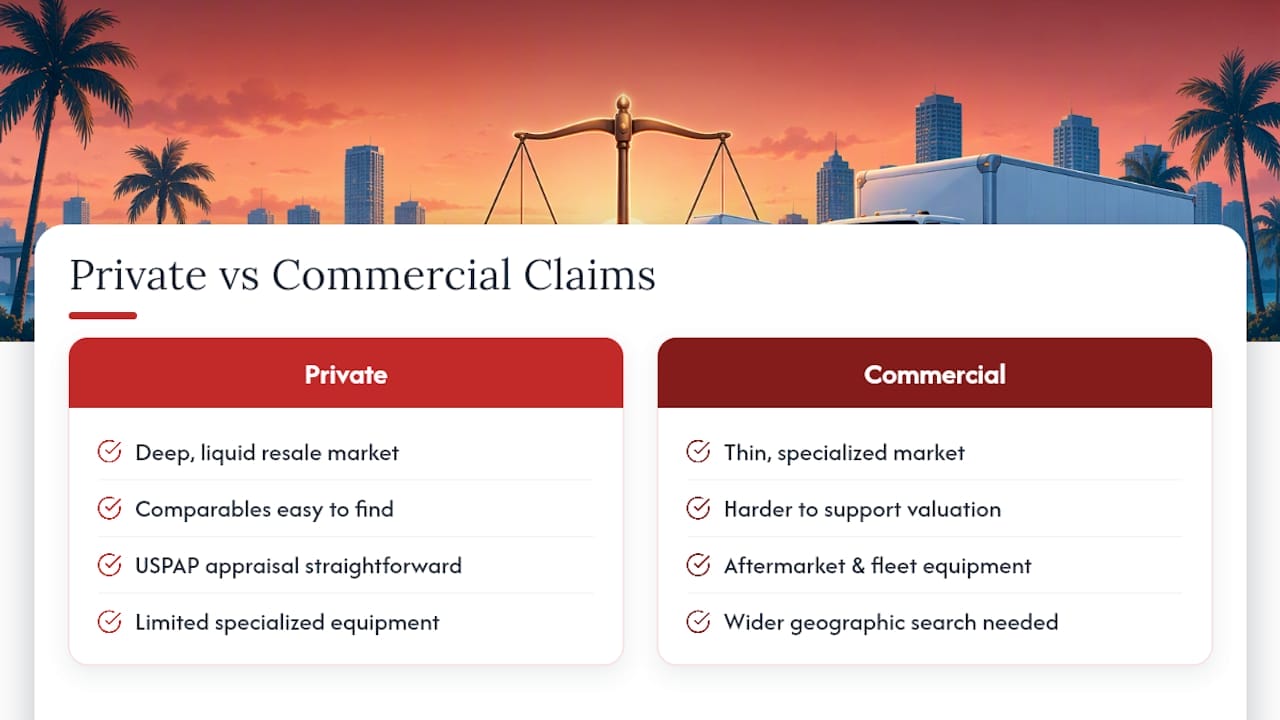
Private vehicles benefit from a deep, liquid resale market. Comparable sales are easy to find, whether through dealer listings, private sale platforms, or trade-in data, which makes a USPAP-compliant appraisal relatively straightforward to support with solid comparables.
Commercial vehicles, delivery vans, box trucks, work trucks with specialized equipment, are harder to appraise because the comparable sales pool is thinner and more specialized. An appraiser valuing a commercial vehicle often has to widen the geographic search for comparables or account for aftermarket equipment and fleet-specific wear patterns that don’t apply to a standard passenger car.
Commercial claims also tend to involve larger dollar amounts and higher insurer scrutiny, since fleet vehicles represent a bigger loss exposure and insurers know a diminished value claim on a commercial vehicle sets a costlier precedent than a single passenger car claim. Business owners pursuing these claims should expect to lean more heavily on a credentialed appraiser’s testimony and less on informal negotiation, since the stakes and the insurer’s resistance both tend to scale up together.
Practical perspective from a Florida personal-injury attorney
Most diminished value disputes resolve without a lawsuit, but a few situations call for one: disputed fault, an insurer that won’t explain its valuation method, or a rebuttal appraisal the adjuster simply ignores. Set realistic expectations early. Recovery depends on your documentation, not on hope, and Florida law won’t let you collect twice for the same loss. A firm with direct attorney contact and mediation-certified staff can move a stalled claim forward without the delay of a revolving cast of case handlers.
— John
How the Law Office of John Vernon Moore, P.A. can help
The firm offers an initial consultation and attorney contact throughout diminished value disputes.
- Bring your appraisal report, repair invoices, and the police report to your first meeting.
- We can review the insurer’s valuation, negotiate on your behalf, or represent you through mediation and litigation if needed.

Contact our personal injury team to schedule your free case review before you sign any settlement offer.
This article is general information, not a substitute for advice from a qualified lawyer. Consult a qualified legal professional about your own circumstances before acting on anything here.
Sources
- Florida Supreme Court docket / opinion materials (Auto-Owners v. Green / related briefing)
- Florida Statutes §626.9743 — Claim settlement practices relating to motor vehicle insurance
- Florida Department of Financial Services — Mediation and consumer guidance
- Florida Bar Journal — Measure of damages in property-loss cases
- MoneyGeek — Diminished value claim Florida (practical steps and state-specific notes)
FAQ
Can you make a diminished value claim in Florida?
Yes, Florida drivers can pursue a diminished value claim, most reliably against the at-fault driver’s liability insurer rather than through their own first-party policy. Courts recognize compensable market loss when a repair doesn’t fully restore the vehicle’s pre-accident value, based on Florida appellate authority.
What is the average payout for a diminished value claim?
There’s no fixed payout figure, since the amount depends on the vehicle’s age, mileage, damage severity, and the strength of the appraisal used to support the claim. A USPAP-compliant appraisal built on solid comparable sales generally produces a more defensible number than a generic estimate.
What states allow diminished value claims?
Diminished value claims are recognized in some form across most states, though the rules for who can claim, and against which policy, vary significantly by jurisdiction. Florida allows third-party claims against an at-fault driver’s insurer, while first-party recovery depends on the specific policy language, as outlined in Florida statute 626.9743.
What is the 51% rule in Florida?
The 51% rule generally refers to Florida’s comparative negligence standard, which affects whether an injured party can recover damages when they’re partly at fault for an accident. It’s a separate legal concept from diminished value, which focuses on measuring the vehicle’s market-value loss rather than allocating fault between drivers.


