A first domestic battery conviction in Florida is usually a first-degree misdemeanor, with up to one year in jail and a fine of up to $1,000. The court must also impose at least 10 days in county jail when bodily harm was intentionally caused, at least one year of probation and a batterers’ intervention program. A prior battery conviction, strangulation or serious injury can turn the charge into a felony. If you have been arrested in Brevard County, the penalties are only part of the picture. The charge can also reach your gun rights, your criminal record, your divorce and your custody case. Our criminal defense and family law practice handles both sides of that problem.
TL;DR
- Domestic battery is generally charged as a first-degree misdemeanor: up to one year in jail or probation and a fine of up to $1,000.
- A conviction for intentionally causing bodily harm carries a mandatory minimum of 10 days in county jail for a first offense, 15 for a second and 20 for a third or later, with higher minimums if a child under 16 was present.
- A second battery after a prior battery conviction, or battery by strangulation, is a third-degree felony: up to five years in prison and a $5,000 fine.
- Even a withheld adjudication or a no contest plea triggers probation, a 29-week program, firearm limits and a record that cannot be sealed.
- The state, not the alleged victim, decides whether to prosecute, so the case does not end because the other person changes their mind.
Table of Contents
- What counts as domestic battery in Florida
- The base penalty: a first-degree misdemeanor
- Will you go to jail? The mandatory minimums
- Probation and the batterers’ intervention program
- When domestic battery becomes a felony
- Consequences beyond jail and fines
- Why the alleged victim cannot simply drop the charge
- What to do in the first days after an arrest
- How we approach these cases
- Our perspective
- FAQ
- Sources
What counts as domestic battery in Florida
Florida has no separate crime called “domestic battery.” It is the ordinary crime of battery, charged against a family or household member. Under Chapter 784 of the Florida Statutes, battery means intentionally touching or striking another person against their will, or intentionally causing bodily harm. No injury is required. A shove, a grab or a slap can qualify.
The “domestic” label comes from section 741.28, which defines domestic violence to include battery and several related crimes, committed by one family or household member against another. That label brings extra rules that an ordinary bar-fight battery does not: mandatory jail time, mandatory probation, a required program and bail restrictions. For a plain-language overview of what these charges involve, see our guide to domestic violence charges.
The base penalty: a first-degree misdemeanor
Simple battery under section 784.03(1) is a first-degree misdemeanor. Florida’s general sentencing statute, section 775.082, sets the maximum jail term for that level at one year. The fine ceiling under section 775.083 is $1,000. Court costs are assessed on top of any fine.
Those are maximums. What actually happens depends on the facts, your history and how the case is resolved. But the domestic violence statutes set floors that the judge cannot ignore.
Will you go to jail? The mandatory minimums
Many people assume a first misdemeanor means probation only. In domestic cases that is often wrong. Under section 741.283, a person adjudicated guilty of a domestic violence crime who intentionally caused bodily harm must serve a minimum county jail term, unless sentenced to a nonsuspended state prison term:
| Offense | Minimum county jail | If a child under 16 was present |
|---|---|---|
| First offense | 10 days | 15 days |
| Second offense | 15 days | 20 days |
| Third or later offense | 20 days | 30 days |
The judge may add probation, community control or more jail on top. The minimum applies to a person adjudicated guilty, which is one reason the way a case is resolved matters so much. Whether a given outcome keeps you under that statute depends on the exact charge, the facts and the plea, and it should be reviewed by a defense attorney before you agree to anything.
Probation and the batterers’ intervention program
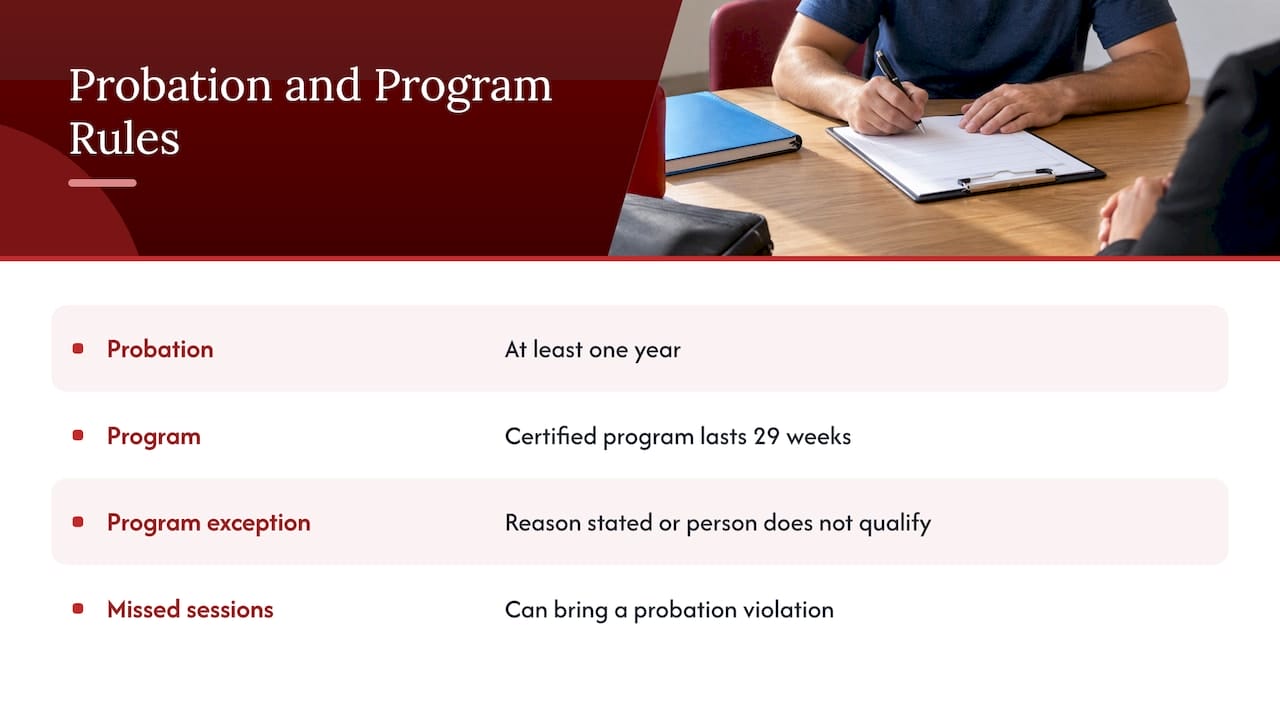
Under section 741.281, anyone found guilty of, given a withheld adjudication for, or pleading no contest to a domestic violence crime must be ordered to at least one year of probation and must complete a batterers’ intervention program. The court can skip the program only if it states on the record why it is inappropriate, or finds the person does not qualify under section 741.325. Probation does not prevent a separate jail sentence.
The program is not a weekend class. Florida’s administrative code defines a certified program as 29 weeks long and aimed at intimate-partner violence. You pay for it, you must attend consistently, and missing sessions can bring a probation violation. If you work shifts, travel for the military or share childcare, build the schedule before you start.
When domestic battery becomes a felony
Three situations push the charge above a misdemeanor.
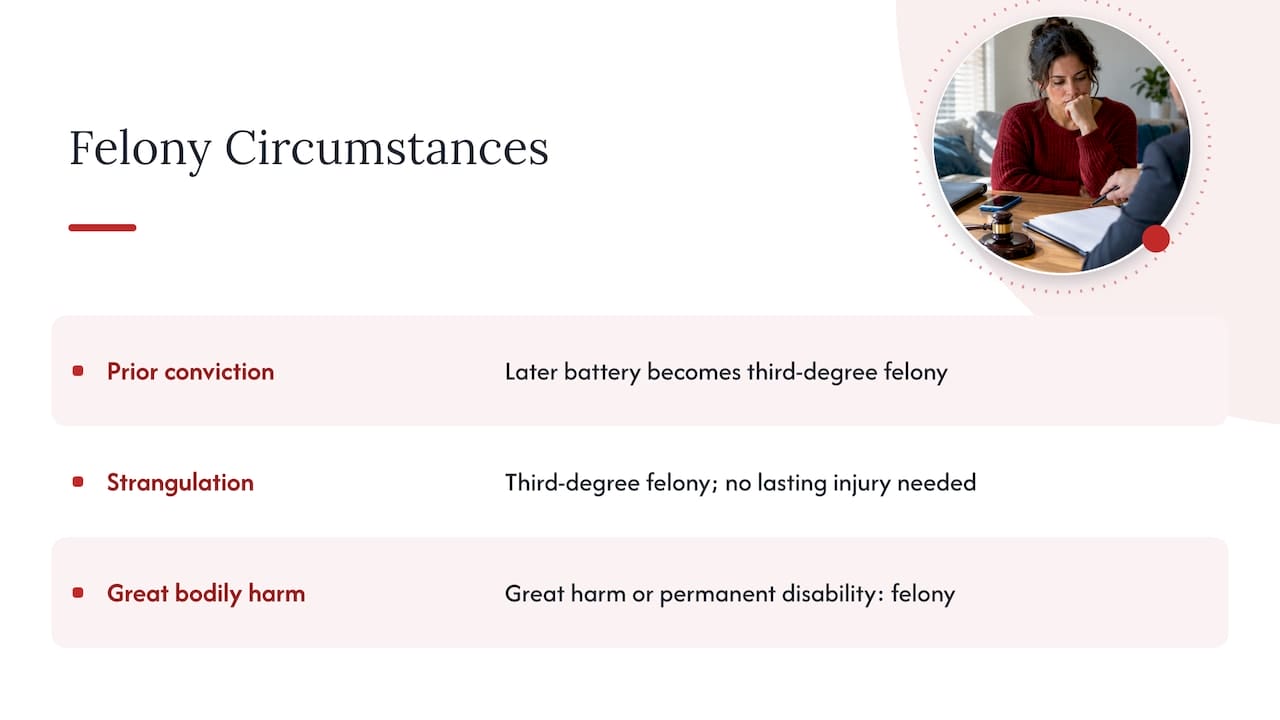
A prior battery conviction. Under section 784.03(2), a person with one prior conviction for battery, aggravated battery, felony battery or resisting an officer with violence who commits a second or subsequent battery commits a third-degree felony. “Conviction” here includes a withheld adjudication and a no contest plea, so an old case that “went away” can still count.
Strangulation. Section 784.041 makes domestic battery by strangulation a third-degree felony. It covers knowingly impeding the breathing or blood circulation of a family or household member or dating partner by pressure on the throat or neck, or by blocking the nose or mouth. No lasting injury is needed.
Great bodily harm. The same section makes felony battery, which causes great bodily harm, permanent disability or permanent disfigurement, a third-degree felony.
A third-degree felony carries up to five years in prison and a fine of up to $5,000, per the state’s fine statute and sentencing statute cited above. Aggravated battery, which involves a deadly weapon or great bodily harm, is a more serious offense with its own penalties and is not covered here.
The 2026 reclassification law
Florida’s 2026 House Bill 277 took effect July 1, 2026. It reclassifies listed domestic violence offenses to a higher degree when the offender has a prior domestic violence conviction, in a ladder that runs up to a life felony at the top. Felony battery under section 784.03(2) is excluded. If you have any earlier domestic violence case, even an old one, tell your attorney at the first meeting, because it can change which tier your new charge falls into.
Consequences beyond jail and fines
Your firearm rights
Under section 790.065, the state’s purchase check blocks firearm sales to anyone convicted of a misdemeanor crime of domestic violence. It also blocks people with a withheld adjudication or suspended sentence on a domestic violence crime, unless three years have passed since probation or other court conditions were completed or the record was expunged. For military members and law enforcement, a firearm restriction can affect a career, not just a hobby.
A record you cannot clear
Under section 943.0584, a conviction for assault or battery of a family or household member is ineligible for sealing or expunction. “Conviction” there includes a guilty or no contest plea even if adjudication is withheld. Domestic battery by strangulation, felony battery and aggravated battery are on the same list. A local public defender’s office says the same about a withhold of adjudication on a domestic violence offense. In practice, the plea you accept on day one is the record you carry for life, and that is the strongest reason to resolve the case with a lawyer’s advice rather than to get it over with.
Bail and the no-contact period
Under section 741.2901, a person arrested for domestic violence is held until brought before a judge for bail, and the judge must weigh the safety of the victim, the victim’s children and anyone else in danger. Bail conditions commonly bar contact with the alleged victim and can bar you from the shared home. Breaking those conditions creates new problems on top of the original charge.
Divorce and custody
A criminal case and a family case run side by side. A domestic battery arrest can shape a protective injunction, parenting time and the way a judge views both parents. We explain how in our pages on domestic violence and divorce and domestic violence and child custody. If an injunction has been filed against you or by you, our injunction FAQs answer the common questions.
Why the alleged victim cannot simply drop the charge
A frequent misunderstanding is that the case ends if the other person says they want it dismissed. Florida’s legislative intent in section 741.2901 treats domestic violence as a crime rather than a private matter and favors prosecution. The state attorney’s specialized prosecutors decide whether to file or divert charges, even over the alleged victim’s objection when necessary. A request to drop the case is something the prosecutor may weigh, not something the prosecutor must follow. Never contact the other person to ask them to withdraw; that can be treated as a violation of bail conditions or as tampering.
What to do in the first days after an arrest
- Follow the release conditions exactly. Stay away from the home and the person if ordered, and do not text or call through friends.
- Say nothing about the facts to police, the other person or on social media. Statements are used later.
- Write down your own account privately, with times, witnesses and any injuries, and give it only to your attorney.
- List your priors. Any earlier battery, even with a withheld adjudication, may count as a conviction under the felony upgrade.
- Do not accept a plea before understanding its side effects. Probation, the 29-week program, firearm limits and the permanent record all follow from a plea that looks small.
- Meet a Brevard County criminal defense attorney early. Early review of the arrest report and the charging decision gives you the most options.
The military adds another layer. Service members may face command consequences in addition to civil charges. Our military family law FAQs address how family cases work for service families around Patrick Space Force Base and across Brevard.
How we approach these cases
We represent individuals charged with crimes and families in conflict in Brevard County. You deal directly with your attorney, and we offer a free 30-minute consultation. Because we practice both criminal defense and family law, the strategy in the criminal case is built with the divorce, injunction or custody case in mind. Our criminal defense practice covers charges like this one.

If you or someone close to you is facing a domestic battery charge in Brevard County, contact our office for a free 30-minute consultation before you decide how to plead.
Our perspective
Domestic battery cases are rarely about one afternoon. They sit on top of a marriage, children, a home, a career and sometimes a military duty station. The statute lists the penalties, but the real cost is how one plea ripples into custody, firearms and a record that cannot be sealed.
That is why we start with the whole picture. We have 85 years of combined experience across criminal and family law, and we are mediation certified. We deal regularly with high-conflict divorces and with military families, and we look at the criminal charge and the family case together so that a decision in one does not quietly damage the other.
Talk to us before you talk to anyone else about the case. You will speak with your attorney directly, and the first consultation is free.
John
FAQ
Is domestic battery a felony or a misdemeanor in Florida?
A first domestic battery is generally a first-degree misdemeanor. It becomes a third-degree felony when the person has a prior battery-type conviction, or when the act is battery by strangulation or causes great bodily harm. Under the 2026 reclassification law, a prior domestic violence conviction can raise the degree further.
Will I go to jail for a first-offense misdemeanor domestic battery?
Often, yes. If the offense involved intentionally causing bodily harm and you are adjudicated guilty, the law sets a minimum of 10 days in county jail for a first offense, or 15 days if a child under 16 was present. The result depends on the charge and how the case is resolved, so get legal advice before pleading.
Can a domestic battery charge be sealed or expunged?
Not if it results in a conviction, and that includes a guilty or no contest plea with adjudication withheld. Domestic battery convictions are on Florida’s list of offenses ineligible for sealing or expunction.
Can the alleged victim drop the charges?
No. The state attorney decides whether to file, pursue or divert the charge, and may do so even over the alleged victim’s objection. The alleged victim’s wishes can be considered but do not control the outcome.
How long does the batterers’ intervention program last?
Florida’s certified program is defined as 29 weeks. It is a required condition of the minimum one-year probation after a guilty finding, withheld adjudication or no contest plea, unless the court states on the record that it is inappropriate.
Sources
- Chapter 784, 2026 Florida Statutes
- Section 741.283, 2026 Florida Statutes
- Section 741.281, 2026 Florida Statutes
- Section 790.065, 2026 Florida Statutes
- Section 943.0584, 2026 Florida Statutes
- Florida Statutes chapter 741, Online Sunshine
- Section 775.082, 2026 Florida Statutes
- Section 775.083, 2026 Florida Statutes
- 2026 House Bill 277, enrolled text
- Fla. Admin. Code R. 65H-2.014
- FAQs on sealing and expunging criminal history records