DUI checkpoints are legal in Florida, and if an officer directs you to stop, you have to stop. You must hand over your license and registration when asked. You do not have to perform roadside field sobriety exercises. Refusing a breath or urine test after a lawful arrest, though, triggers an automatic license suspension. This guide covers what police must do to run a checkpoint, what you can and cannot decline, whether you can turn around, and what to do in the first 10 days after an arrest.
TL;DR
- Checkpoints are lawful in Florida when they follow a written plan with uniform vehicle-selection rules. Officers cannot simply pick cars at random.
- When directed to stop, you must stop and provide your license and registration. Answering extra questions and field sobriety exercises are voluntary.
- After a lawful DUI arrest, refusing a breath or urine test means a one-year license suspension for a first refusal, or 18 months after a prior refusal. A refusal is also admissible in court.
- You have 10 days from the notice of suspension to request an administrative review of your license suspension. Do not let that window close.
- A checkpoint arrest can often be challenged on how the checkpoint was set up and run. Speak with a Florida criminal defense lawyer early.
Table of Contents
- Are DUI checkpoints legal in Florida?
- What a properly run checkpoint looks like
- What you must do when you reach a checkpoint
- Do you have to answer questions or do field sobriety exercises?
- Breath, urine and blood tests: what a refusal costs
- Can you turn around to avoid a checkpoint?
- After a checkpoint arrest: the first 10 days
- How a checkpoint arrest can be challenged
- Our perspective on checkpoint cases
- Talk to a Brevard County DUI defense lawyer
- FAQ
- Sources
Are DUI checkpoints legal in Florida?
Yes. Sobriety checkpoints, sometimes called roadblocks, are a lawful tool for Florida law enforcement. Their legality depends on the way they are organized. A checkpoint is not an excuse to stop any driver an officer feels like stopping. It is a planned operation with written rules meant to limit what individual officers can decide on the spot.
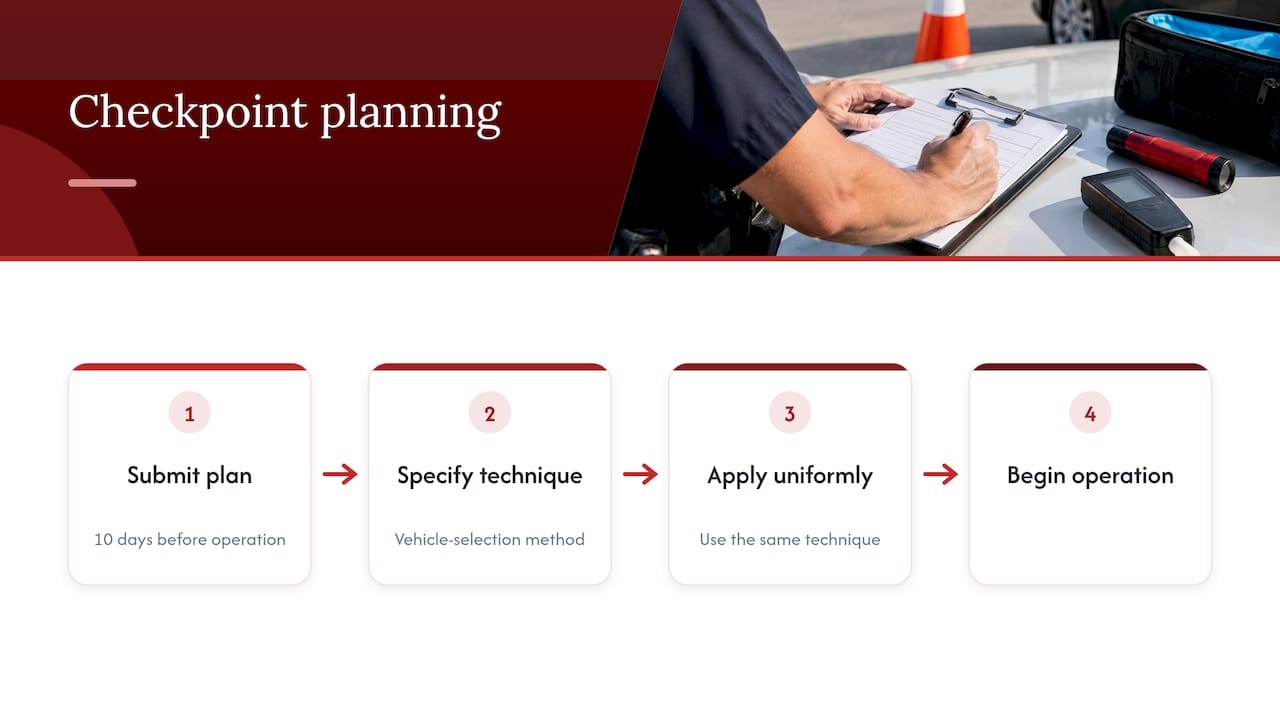
The Florida Highway Patrol’s own policy shows what that looks like. Under FHP policy 17.08, the operational plan for a comprehensive roadside safety checkpoint has to be completed and submitted to the Troop Commander no less than 10 days before the operation begins. The same policy requires the plan to specify the vehicle-selection technique, and that technique must be applied uniformly. City police departments and sheriff’s offices run their own checkpoints under their own written procedures, but the principle is the same: a plan first, then the stop.
That structure matters for you as a driver. If a checkpoint was not set up according to a written plan, or officers departed from the plan in the field, that can become the basis for a legal challenge. We come back to that below.
What a properly run checkpoint looks like
You cannot inspect an operational plan from your driver’s seat, but you can notice how an operation is run. A lawful checkpoint generally shows these features:
- A planned location and time. The site is chosen ahead of time, not improvised by an officer on patrol.
- A supervisor. Someone in charge is responsible for making sure the plan is followed and for deciding what happens if traffic backs up.
- A fixed pattern for stopping cars. For example, every vehicle or every third vehicle, applied the same way to everyone.
- Visible law enforcement presence. Marked vehicles, uniformed officers and warning signs or lighting so drivers can see what is ahead.
- Officers with defined jobs. Some make the initial contact, others handle field exercises or testing.
If you are stopped and later charged, it is worth writing down what you remember as soon as you can: where the checkpoint was, whether there was any warning, how cars were being selected, and how long you waited. Those details can help your attorney compare what happened with what a lawful plan requires.
What you must do when you reach a checkpoint
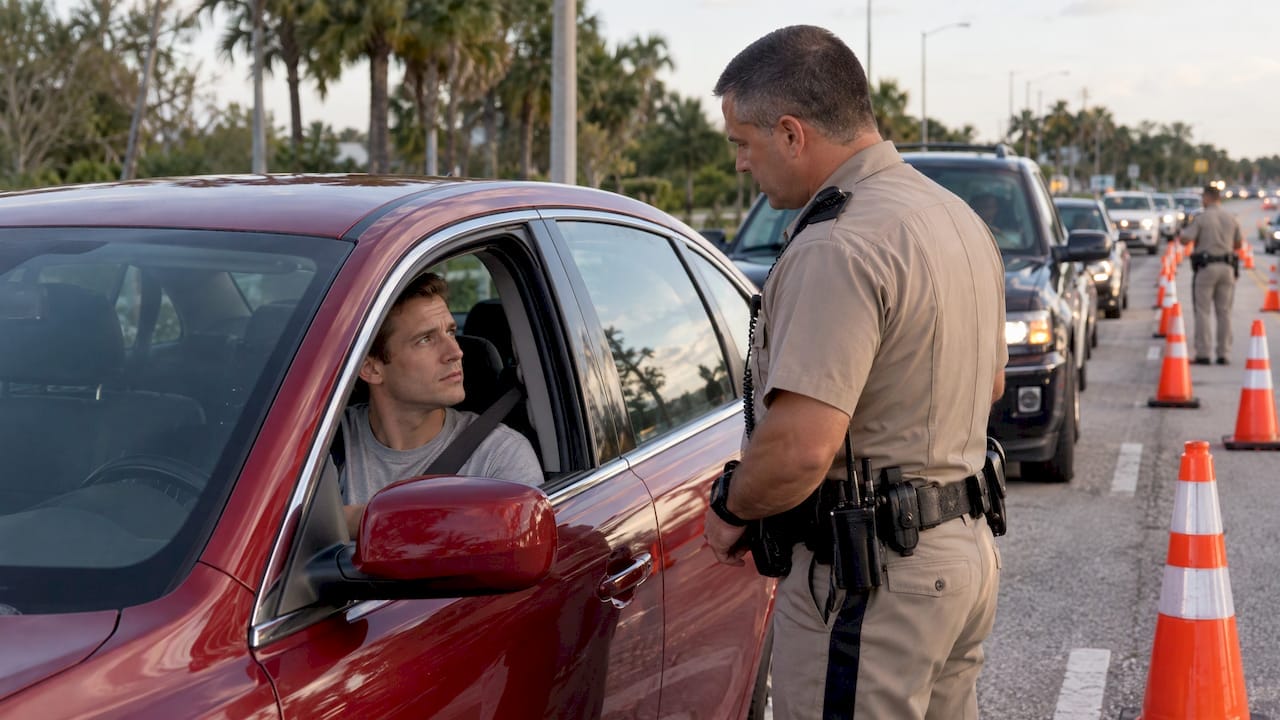
The core obligation is simple. According to the Miami Herald’s explanation of Florida checkpoint rules, a driver who is directed to stop must stop and provide a requested license and registration, which is the same duty that applies in any ordinary vehicle stop.
In practice:
- Slow down, follow the officers’ directions and stop where you are told.
- Keep your hands visible and stay calm.
- Roll your window down enough to communicate and hand over your license and registration when asked.
- Be polite. Being courteous is not the same as agreeing to everything you are asked.
Driving through a checkpoint without stopping when directed is a separate problem entirely. It turns a routine stop into a traffic offense and can give officers a reason to pursue you. Do not do it.
Do you have to answer questions or do field sobriety exercises?
Officers at a checkpoint often start with a casual question such as where you are coming from or whether you have had anything to drink. You are required to provide your documents. Beyond that, you can politely decline to discuss your evening. Many people feel pressure to explain themselves, and what they say can become part of the case against them later.
Field sobriety exercises, the walk-and-turn, one-leg stand and similar roadside tasks, are voluntary. The Miami Herald report states that field sobriety tests are not required in Florida. Declining them is allowed. It does not mean the officer will simply wave you on, though. Officers may still decide they have grounds to continue the investigation, including asking you to take a chemical test. Plan on that possibility and know your rights going in.
A few practical points:
- You can say, calmly and clearly, that you do not wish to perform the exercises. Arguing or explaining adds nothing.
- The exercises are scored subjectively, outdoors, often at night, on uneven ground and in poor light. Many sober people struggle with them, which is one reason attorneys regularly examine them closely in court.
- Declining the exercises is different from refusing a breath or urine test after an arrest. The consequences are not the same.
Breath, urine and blood tests: what a refusal costs
This is where drivers get hurt most often, so the details deserve care.
Under Florida Statutes section 316.1932, a driver is deemed to consent to an approved breath test after a lawful arrest for an alcohol-related offense, and to a urine test after a lawful arrest for impairment by chemical or controlled substances. For a breath test, the statute requires a lawful arrest and reasonable cause to believe the person drove, or was in actual physical control of a vehicle, while impaired.
What happens if you refuse that lawful test:
| Situation | License consequence | Criminal consequence |
|---|---|---|
| First refusal of a lawful breath or urine test | One-year suspension | Second-degree misdemeanor |
| Refusal after a prior refusal suspension or fine | 18-month suspension | First-degree misdemeanor |
The statute’s own breakdown is on the Florida Senate’s page for section 316.1932. Refusal of a lawful breath test is also admissible in a criminal proceeding, so the prosecution can raise it at trial. Blood-test refusal has its own separate statutory conditions, so do not assume the rules for breath and blood are identical.
There is a second track as well. Under section 322.2615, an officer suspends the driving privilege when a driver has an unlawful alcohol level of 0.08 or higher, or refuses a qualifying chemical test. The administrative suspension is six months for a first unlawful-level offense, one year if there was a prior such suspension, one year for a first refusal, and 18 months if there was a prior refusal suspension.
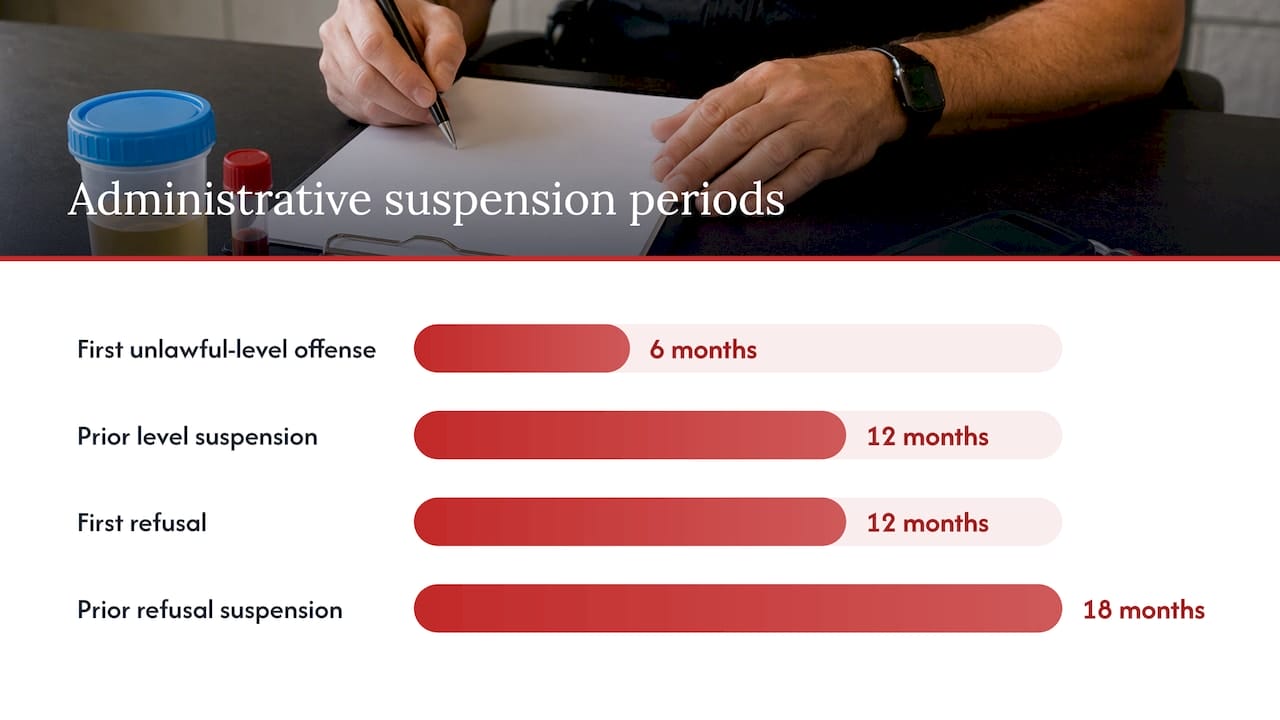
This administrative suspension is separate from whatever happens in criminal court. You can face both. For a closer look at refusal specifically, see our page on breath test refusal in Florida.
Can you turn around to avoid a checkpoint?
This is one of the most common questions drivers ask. The Miami Herald reports that you may turn around to avoid a DUI checkpoint if the maneuver is legal and safe. The risk is what the turn looks like. A sudden U-turn near a roadblock can arouse suspicion, and an officer may pull you over, particularly if the maneuver breaks a traffic law.
If you are thinking about doing it, keep these points in mind:
- A legal turn at an intersection or a place where U-turns are permitted is very different from crossing a double yellow line or cutting across a median.
- An illegal maneuver gives officers an independent reason to stop you, with or without a checkpoint.
- Once you are pulled over for the turn, you are in an ordinary traffic stop, and the same investigation can follow.
- If you have not been drinking, the simplest option is usually to go through the checkpoint, provide your documents and move on.
After a checkpoint arrest: the first 10 days
If you are arrested and your license is taken, the clock starts immediately. Under section 322.2615, an eligible driver whose license is taken receives a 10-day temporary permit. The driver must request a formal or informal administrative review within 10 days after the notice of suspension. The permit expires at midnight on the 10th day.
This is the so-called 10-day rule, and it is not the same thing as a checkpoint requirement. It is a deadline that begins after an arrest, and it exists whether the arrest came at a checkpoint, a traffic stop or anywhere else. Missing it can mean losing the chance to challenge the administrative suspension at all.
A sensible sequence after an arrest:
- Note the date on the notice of suspension and count 10 days from it.
- Do not discuss the details of the night with anyone but your attorney.
- Contact a criminal defense lawyer who handles DUI cases right away so the review request is filed in time.
- Write down everything you remember about the checkpoint, the officers and the testing.
- Hold on to every document you were given.
If you hold a commercial license, the stakes are higher still. Our guide on keeping your CDL after a DUI explains why the 10-day deadline matters so much for professional drivers. And for the penalty side of a conviction, see our overview of Florida DUI penalties and fines.
An arrest also raises the immediate question of getting released. Bail rules and bond services vary by state, and some providers explain how DUI bail bonds work after an arrest. Your attorney can tell you what to expect in the county where you were booked.
How a checkpoint arrest can be challenged
Because a checkpoint must be run according to a written plan, many checkpoint cases turn on whether it actually was. A defense lawyer will typically look at questions such as:
- Was there a written operational plan, and was it approved before the checkpoint started?
- Did officers follow the vehicle-selection method the plan laid out, or did they pick out cars on their own?
- Was there a supervisor, and what happened when traffic backed up?
- Was the arrest itself lawful, with reasonable cause to believe you were impaired?
- Were the breath test and any field exercises administered correctly?
Evidence gathered at an improperly run checkpoint may be challenged through a motion to suppress. Whether that works depends on the facts of your case, and no one can promise an outcome. What you can do is give your attorney as much accurate detail as possible, as early as possible.
Our perspective on checkpoint cases
At our firm, we see the same pattern again and again. A person goes through what feels like a routine stop, answers a few more questions than they needed to, and then the case is already moving. The people who come out best are usually the ones who stayed polite, handed over their documents, and called a lawyer quickly.
We approach every DUI case as an individual case, not a template. We read the arrest report, look at how the stop was conducted, and think about what the driver’s license, job and family depend on. For someone who drives for a living or serves in the military, a suspension can be as serious as the criminal charge, so the 10-day deadline gets our attention first.
You deal directly with the attorney handling your case, and the first 30 minutes with us are a free consultation. If you were stopped in Brevard County or anywhere nearby, bring everything you were given, and tell us everything you remember about the stop. We would rather hear too much than too little.
John
Talk to a Brevard County DUI defense lawyer
If you were arrested after a checkpoint, or you received a notice of license suspension, do not wait to find out where you stand. The Law Office of John Vernon Moore, P.A. represents clients charged with DUI and other criminal offenses in Brevard County, Florida. We review how the stop was run, what tests were requested and how your license is affected, and we explain your options in plain language. Your first consultation of 30 minutes is free.

Learn more about our DUI defense and criminal law services or contact the firm to schedule your consultation.
FAQ
Can police stop every car at a Florida DUI checkpoint?
They can stop vehicles according to the selection method in the written plan, which may mean every car or a fixed pattern such as every third car. For the Florida Highway Patrol, the plan must specify the technique and apply it uniformly. Officers are not supposed to substitute their own picks.
Do I have to take a breathalyzer at a checkpoint?
You are not required to take roadside field sobriety exercises. A breath test after a lawful arrest is different, because Florida’s implied consent law applies at that point. Refusing it brings a one-year suspension for a first refusal, or 18 months after a prior refusal suspension or fine, according to section 316.1932.
What is the 10-day rule for DUI in Florida?
If your license is taken at arrest, you get a 10-day temporary permit and must request an administrative review within 10 days of the notice of suspension. The permit expires at midnight on the 10th day, per section 322.2615. It applies after any DUI arrest, not only at checkpoints.
Can I turn around to avoid a DUI checkpoint?
You may, if the turn is legal and safe. The risk is that it can draw attention, and an officer who sees an illegal maneuver can pull you over for it, as the Miami Herald notes.
Sources
- Florida Highway Patrol Policy 17.08, Checkpoints
- Do you have to stop at a DUI checkpoint in Florida? Miami Herald
- Florida Statutes section 316.1932, 2026
- Florida Statutes section 322.2615