If you weren’t wearing a seat belt when another driver hit you, you can still bring an injury claim in Florida. The seat belt defense is an argument the at-fault driver’s side may raise to reduce what you recover. It is not a bar to your case, and the defense has to prove several specific things before it counts for anything.
This guide explains what the defense is, what the defendant must prove, how it interacts with Florida’s fault rules, and how an injured person can respond.
TL;DR
- Florida treats not wearing a seat belt as possible evidence of comparative negligence. It is not negligence automatically and it does not end your claim.
- The defendant must show an available, working belt went unused, that skipping it was unreasonable, and that this caused or substantially contributed to some of your damages.
- If the defense succeeds, a jury reduces your compensation by your percentage of fault. It can only reduce the part of the harm the missing belt caused.
- Evidence about the crash, your injuries and the belt itself decides these disputes, so act early to preserve it.
- We offer free 30-minute consultations for Brevard County car accident cases.
Table of Contents
- What the seat belt defense is
- What Florida’s seat belt law says
- What the defendant must prove
- How it interacts with comparative negligence
- Can you recover damages without a seat belt?
- Where seat belt evidence comes from
- How to respond when the defense is raised
- Our perspective
- Talk with our Brevard County car accident team
- FAQ
- Sources
What the seat belt defense is
The seat belt defense is a way for a defendant in a car accident case to argue that you share responsibility for your own injuries because you weren’t buckled. Florida courts have long treated it as a comparative negligence issue. In Ridley v. Safety Kleen Corp., the Florida Supreme Court held that the seat belt issue should ordinarily be raised as an affirmative defense of comparative negligence.
An affirmative defense means the defendant carries the burden. You do not have to prove you were buckled, and the defense does not get to assume the missing belt mattered. They must prove it.
Note what the defense is not. It does not say the crash was your fault. A driver who ran a red light and hit you is still the driver who ran the red light. The seat belt argument is only about whether your injuries were worse than they would have been with a belt on.
What Florida’s seat belt law says
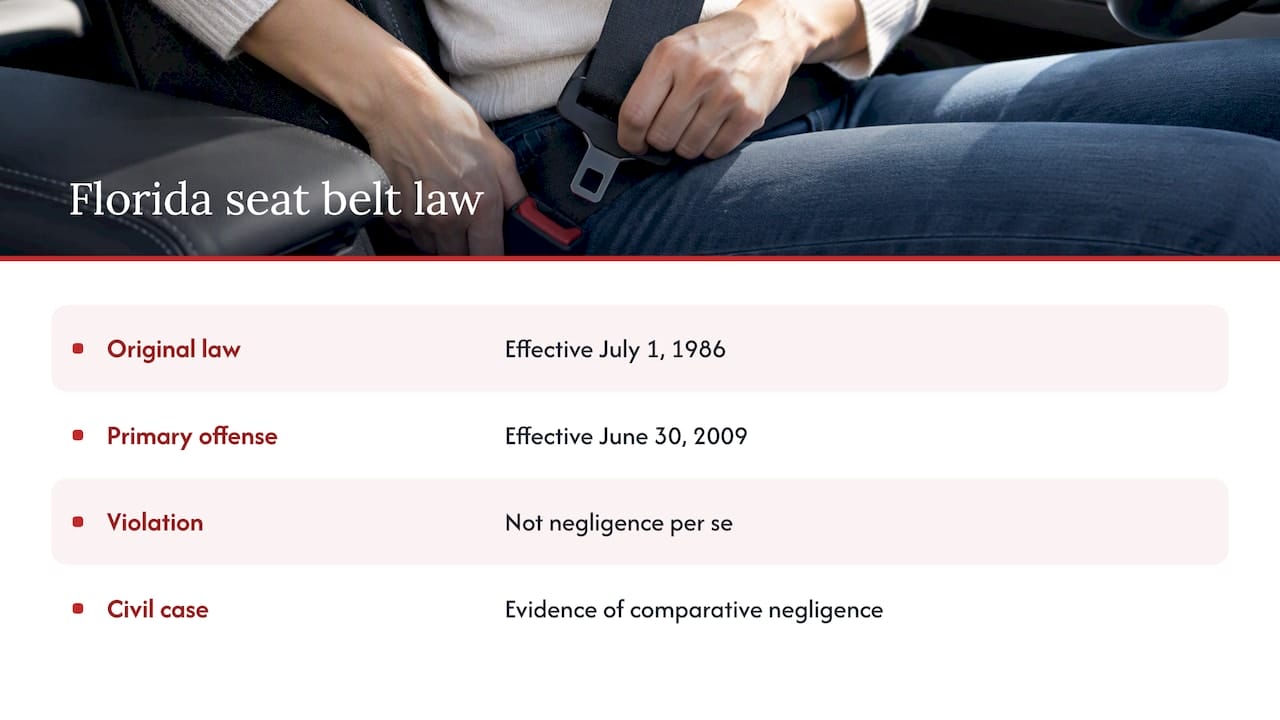
Florida’s safety belt statute, section 316.614, generally requires drivers and front-seat passengers to be restrained. Enforcement is primary, meaning an officer can stop a vehicle for a belt violation alone. The Florida Department of Highway Safety and Motor Vehicles says seat belt use became a primary offense under the Dori Slosberg and Katie Marchetti Safety Belt Law, effective June 30, 2009. The state’s original safety belt law took effect earlier: the U.S. Bureau of Transportation Statistics lists Florida’s law as effective July 1, 1986.
The same statute limits how a violation can be used in a lawsuit. As the court in Ridley summarized it, a violation of the belt requirement is not negligence per se and not prima facie evidence of negligence. It cannot be used to mitigate damages as such, but it may be considered as evidence of comparative negligence in a civil action.
That wording is why the defense is a fault-sharing argument and not an automatic deduction. A traffic citation for no belt does not decide the civil case either.
Who is exempt from the belt requirement
The statute lists exceptions. Under the 2025 Florida Statutes, they include a person with a physician-certified medical condition, rural letter carriers on designated routes, employees collecting solid waste or recyclables on designated routes, living quarters of recreational vehicles, and vehicles that federal law does not require to have seat belts. If you fit an exception, the defense’s argument that skipping the belt was unreasonable gets much harder.
Children and back-seat passengers have their own rules, including child restraint requirements. The FLHSMV page on Florida’s occupant protection laws is the place to check the current requirements for a specific child’s age and size.
What the defendant must prove
The leading case is Insurance Co. of North America v. Pasakarnis, decided by the Florida Supreme Court in 1984. To prevail, the defendant must prove three things, according to the court’s opinion:
- Availability. You did not use an available and operational seat belt.
- Unreasonableness. Your failure to use it was unreasonable under the circumstances.
- Causation. The failure caused or contributed substantially to at least a portion of your damages.
The third element does the most work. Your fault in a seat belt dispute is not about the crash. It is about the injuries. If the defense cannot show that a belt would have prevented or reduced the harm you are claiming, the jury should not consider the lack of a belt at all. The same opinion and the later case Henry v. Hoelke (2011) make this point: when the defendant fails to prove that non-use caused or substantially contributed to the injuries, the jury should not weigh it in apportioning fault.
Why “available and operational” matters
A belt that was broken, missing, or that the vehicle was never required to have fails the first element. So does a situation where a passenger was seated in a spot without a working belt. Photographs of the vehicle interior, repair records and the vehicle’s own data can all bear on this.
Why “unreasonable” is a real question
Reasonableness is judged on the facts. A medical condition that kept you from wearing a belt, a belt that would not latch, or a belt you removed in the seconds before impact for a legitimate reason are all different from a driver who simply never buckled up. Each situation puts a different story in front of the jury.
How it interacts with comparative negligence
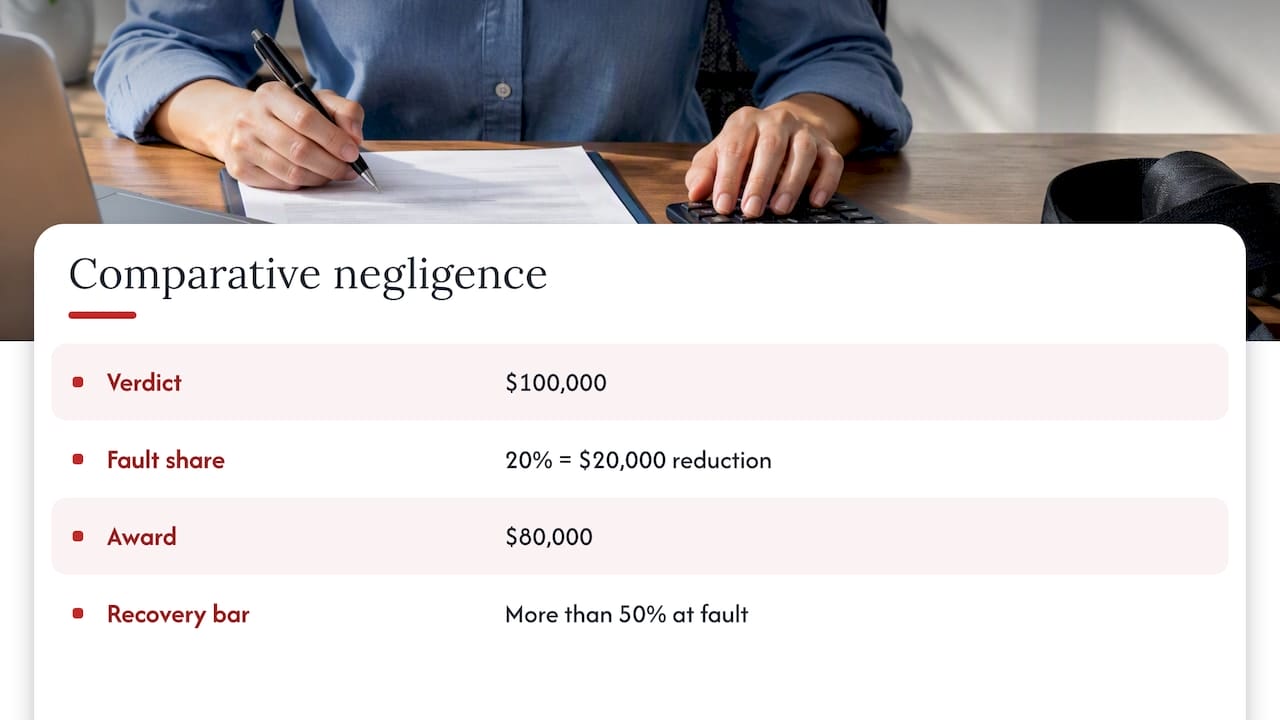
Florida’s comparative negligence rules decide what the jury does with a seat belt finding. If the jury finds you partly at fault because a missing belt made your injuries worse, your award is reduced in proportion to your percentage of fault. A $100,000 verdict with a 20% fault share on the injured person becomes $80,000.
Since 2023, Florida has used a modified comparative negligence system that can bar recovery entirely when the injured person is found more than 50% at fault. Our own explainer on how the 51% rule works covers the details. For seat belt cases, that makes it important to keep the percentage assigned to non-use as small as the evidence honestly supports. In practice, the missing belt usually accounts for a fraction of the total fault, since the other driver caused the crash. But it is why a defense lawyer raises the issue: it is a lever to move the percentage.
To see how fault is decided more broadly, read how liability is determined after a car accident.
A worked example
Imagine a driver stopped at a light in Brevard County is rear-ended at speed. The other driver admits looking at a phone. The injured driver was not wearing a belt and suffered a facial laceration and a broken wrist from striking the steering wheel.
The defense argues the belt would have kept the driver off the wheel. The injured driver’s side responds that the wrist injury came from bracing on the wheel, that the neck and back injuries would have occurred with or without a belt, and that the defense has no expert tying each injury to the missing belt. A jury that accepts part of the defense might attribute some fault to the injury-specific harm, not to the crash itself. The rest of the claim stands.
This is a hypothetical, not a prediction. Real outcomes depend on the evidence.
Can you recover damages without a seat belt?
Yes. Not wearing a belt does not disqualify an injury claim. In most cases the effect is a discount on damages, and only for the part of your injuries the defense can tie to non-use. Florida’s courts frame the issue as comparative negligence, not as a complete defense, which is why the claim itself continues.
Other parts of your case are unaffected by the argument, including who caused the crash, your medical treatment, and your insurance coverage. If you want a broader view of how compensation is built, our guide to Florida car accident settlements and PIP explains the pieces, and Florida’s rules on pain and suffering damages cover what injuries may qualify.
Where seat belt evidence comes from
Both sides build the issue from the same raw material:
- The police report and officer observations, including whether a citation was written and what witnesses said.
- Photos of the vehicle interior, belt hardware, and any spooled or stretched belt webbing.
- Vehicle data, which in many modern cars records belt status and speed before a crash.
- Medical records and injury patterns, such as where on the body you were hurt.
- Expert opinions, usually from accident reconstruction or biomechanical engineers, about whether a belt would have changed a specific injury.
- Witness and EMS statements about how you were found in the vehicle.
Because the defense needs causation and not just non-use, the expert evidence often decides the matter. A defendant who offers no expert link between the missing belt and your specific injuries has a weak position under the Pasakarnis standard.
How to respond when the defense is raised
If an insurer or defense attorney raises the seat belt, the response is practical:
- Do not guess about it. Do not say you were or were not buckled to an adjuster before you’ve spoken with an attorney. Offhand remarks get quoted back.
- Preserve the vehicle. Ask that the car, its belts and its data recorder not be repaired, sold or scrapped until they have been documented.
- Get complete medical records. Doctors’ notes describing the mechanism of injury matter more than most people expect.
- Hold the defense to its burden. Each of the three elements has to be proven, and the causation link has to be tied to specific injuries.
- Check whether an exception applies. A medical exemption or an inoperable belt changes the analysis.
- Watch the clock. Florida now gives most negligence claims a shorter filing window, which we explain in our guide to the Florida statute of limitations after HB 837.
The defense can also be misapplied in unusual settings. In Cybroski v. Wright, the Fourth District Court of Appeal held in 2006 that the safety belt statute did not eliminate a common-law claim based on a parent’s duty to protect a child, even with evidence about the child’s belt use. Cases involving children and passengers can turn on different rules from a standard driver claim.
Our perspective
We see the seat belt defense used as a pressure tactic more often than as a real answer to a claim. An adjuster hears “no seat belt” and hopes the injured person will accept a lower number out of embarrassment or fear.
Florida law does not support that reaction. The defense has to prove an available belt, an unreasonable choice, and a real link between the missing belt and specific injuries. We take that burden seriously and hold the other side to it.
In every car accident case we handle, the attorney you meet is the attorney who works your file. That matters here because seat belt disputes depend on details: the vehicle, the medical timeline, and the way an injury happened. A lawyer who has reviewed those facts personally can tell you honestly where your case is strong and what the other side will argue.
If you were hurt in Brevard County and are worried that a missing belt will sink your claim, bring us what you have. We will tell you how Florida law treats it.
John
Talk with our Brevard County car accident team
If an insurer is using the seat belt argument to lower your claim, we can review the crash, the injuries and the evidence with you. We handle car accident and other personal injury claims for Brevard County clients, and our initial 30-minute consultation is free.

For an overview of how these claims work from start to finish, see our guide to Florida auto accident injury law.
FAQ
Can I still sue if I wasn’t wearing a seat belt in Florida?
Yes. Florida law says a belt violation is not negligence per se, and the issue is treated as comparative negligence. The defense must prove that non-use was unreasonable and that it caused or substantially contributed to your damages. If it does, your award is reduced, not eliminated.
What must a defendant prove to use the seat belt defense?
Under Insurance Co. of North America v. Pasakarnis, the defendant must show that you did not use an available, operational belt, that the failure was unreasonable, and that it caused or contributed substantially to at least part of your damages. Without the causation element, the jury should not consider non-use.
Does Florida’s seat belt law apply to back-seat passengers?
The statute’s general requirement covers drivers and front-seat passengers, and children are covered by separate child restraint rules. Because the answer depends on the passenger’s age and seat position, check the current rules on the FLHSMV’s occupant protection page or ask an attorney how they apply to your accident.
Does the seat belt defense apply in every kind of crash?
No. It matters most when the injuries could plausibly have been reduced by a belt, such as ejection or striking the interior. Injuries that would have happened regardless of a belt fall outside the defense, and the statutory exceptions, such as a physician-certified medical condition, can also change the analysis.
Sources
- Insurance Co. of North America v. Pasakarnis (Fla. 1984)
- Ridley v. Safety Kleen Corp. (Fla. 1997)
- Chapter 316, Section 614, 2025 Florida Statutes
- Buckle Up Florida, It’s the Law! (Florida Department of Highway Safety and Motor Vehicles)
- Key Provisions of Safety Belt Use Laws (Bureau of Transportation Statistics)
- Cybroski v. Wright (Fla. 4th DCA 2006)