Bring a short written summary of what happened, the names and contact details of everyone involved, and every document tied to your issue, sorted by date. That is the core of a good first meeting, and Illinois Legal Aid Online gives the same basic advice. What else goes in the folder depends on the kind of case: divorce needs financial records, a criminal matter needs arrest paperwork, an injury claim needs medical bills, and estate planning needs a list of what you own.
This guide covers each, so you can walk into the meeting prepared and use your time on strategy instead of hunting for paperwork.
TL;DR
- Bring a one-page timeline, a list of names and contact details, and every document connected to your problem.
- Sort papers by category, then by date, with the newest on top.
- Divorce means financial records and marriage details. Criminal means police and court papers. Injury means bills, photos, and insurance letters. Estate planning means an inventory of assets.
- Write your questions down and be honest about the facts that do not help you.
- Missing a document is fine. Bring what you have and say what you are missing.
Table of Contents
- The core kit for any legal consultation
- How to organize what you bring
- What to bring to a divorce consultation
- What to bring to a custody consultation
- What to bring if you are facing criminal charges
- What to bring to a personal injury consultation
- What to bring to an estate planning consultation
- Questions worth writing down
- Perspective: what we see in the first meeting
- Talk to us before you assemble everything
- FAQ
- Sources
The core kit for any legal consultation
No matter what brings you to a lawyer, start with these items.
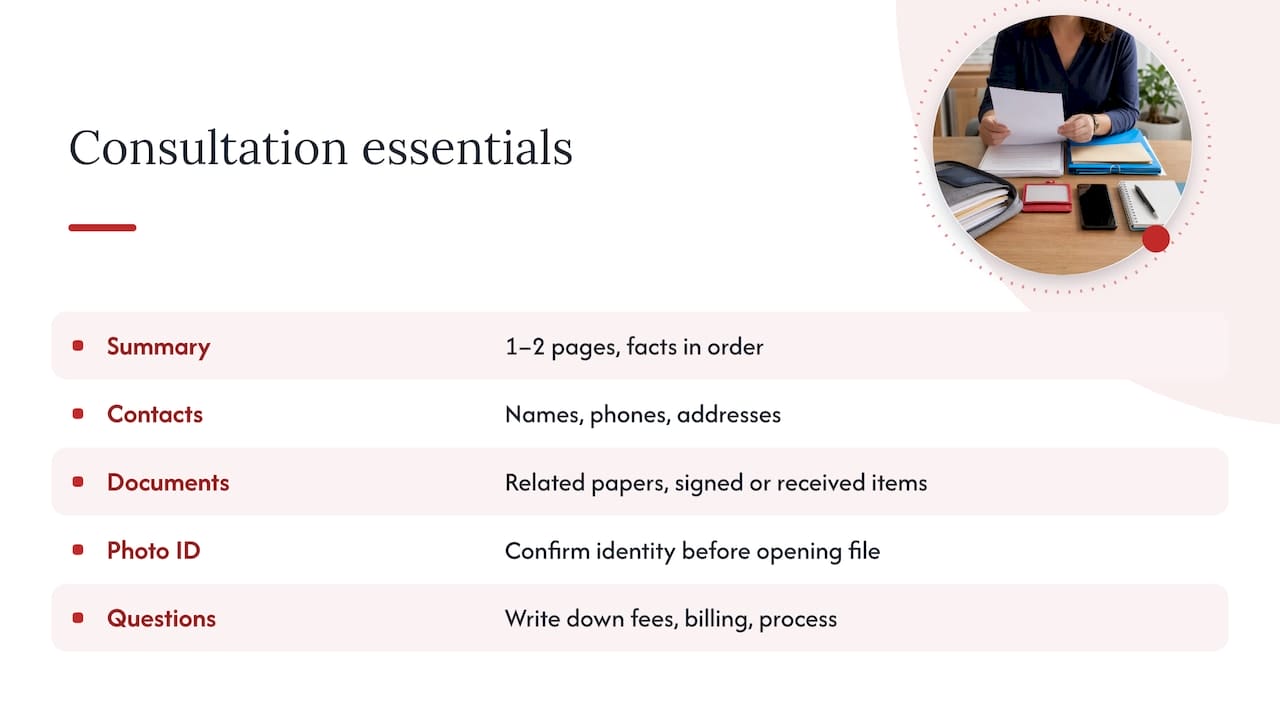
A written summary. One to two pages telling the story in order: what happened, when, and where. Facts, not arguments. Illinois Legal Aid Online recommends this because it keeps you from forgetting details under pressure, and it lets the attorney grasp your situation in minutes.
Names and contact information. List everyone involved: the other party, witnesses, insurance adjusters, employers, police officers, and anyone who has already helped you. Include phone numbers and addresses where you have them.
Every related document. Depending on your matter, that can mean communications, contracts, bills, receipts, court papers, police or arrest records, photos, and videos. When in doubt, bring it. The attorney can decide what matters.
Photo ID. Most offices need to confirm who you are before opening a file.
Your questions. Written, not remembered. San Antonio Law Help suggests writing them down in advance, and asking about fees, billing, and the legal process in particular.
Anything you have already signed or received. Court notices, settlement offers, letters from the other side’s lawyer, and agreements all belong in the folder, even if they look unimportant.
How to organize what you bring
A stack of loose paper wastes the first half of the meeting. A little structure fixes that. Washington LawHelp recommends using folders or paper clips, grouping papers by category, and arranging each group by date, with older records beneath newer ones.
A simple system:
- One folder per category. For example: court papers, financial records, communications, and photos.
- Chronological order inside each folder. Newest on top.
- A cover sheet. List what is in each folder in one line.
- Copies, not originals. Legal Services of New Jersey advises making copies and keeping originals safe. Hand over copies unless the attorney asks to see an original.
- Digital backups. Phone photos, texts, and emails can go on a flash drive or in a shared folder, with printouts of the key ones.
For assets, Washington LawHelp suggests separate tabs for bank, retirement, and investment accounts, real property, and personal property. That layout works well for any money-related matter.
What to bring to a divorce consultation
Divorce is the case where preparation pays off the most, because so much of it turns on money and children. Based on the Washington LawHelp checklist, gather:
- Financial records: tax returns from the past several years, pay stubs, bank statements, credit-card statements, and current bills.
- Property records: deeds, mortgages, loan papers, and vehicle titles with identifying details.
- Retirement and investment statements: pension, retirement, brokerage, and investment accounts.
- Agreements: premarital or community-property agreements, and any marital agreements.
- Court papers: anything filed or served, including prior orders.
- Insurance records: health, life, auto, and home policies.
- Family documents: your marriage certificate and your children’s birth certificates.
- Safety records: if relevant, school, daycare, or domestic-violence records.
The American Bar Association’s 2026 client guide adds that your attorney needs a picture of assets and liabilities: bank accounts, retirement plans, real estate, mortgages, credit-card and other debt, monthly expenses, which banks each spouse uses, and tax returns.
Details to write down
Washington LawHelp also recommends writing out a few facts so you are not guessing in the room: the date and county of your marriage, the date you separated, everyone’s birth dates and addresses, where the children have lived for the last five years, and case numbers from any other proceedings involving the children. Legal Services of New Jersey notes you may also need your children’s Social Security numbers.
Why dates and values matter
For property issues, LawHelp explains that documentation should show when property was acquired, who acquired it, and what it is worth. A house bought before the marriage is a different conversation from one bought after. If you can find the purchase date and an approximate value, bring them.
If you are in Florida, our Florida divorce checklist goes deeper on documents and steps, and our page on the financial affidavit in Florida divorce explains the sworn financial disclosure you will need to complete. For a fuller first-meeting walkthrough, see our divorce attorney consultation prep guide. If you suspect hidden income or assets, say so at the meeting. We explain how forensic accountants help in divorce when finances are complicated.
Military divorce
If you or your spouse serves, tell the attorney at the start and bring anything that shows military status, service dates, and pay, along with the usual financial records. Military cases carry their own questions about where to file and how benefits are handled. Our military divorce process page and military family law FAQs outline what to expect near Patrick SFB and across Brevard County.
What to bring to a custody consultation
Custody conversations are about your child’s daily life and each parent’s role in it. Bring:
- Existing custody orders, temporary orders, restraining orders, and divorce decrees.
- Court case numbers for any prior proceedings involving the children.
- A description of the child’s routine: school, activities, doctors, who handles pickups, meals, and bedtime.
- School records, report cards, and medical records. LawHelp defines evidence as information used to prove a case, and lists written documents like these along with testimony from witnesses such as friends, relatives, or teachers.
- Names of people who have seen you parent: teachers, coaches, relatives.
- Income records, if child support is part of the question.
- Messages with the other parent, printed in date order.
If safety is a concern, bring any records you already have, and read our guide on documenting abuse for court. If you are a father trying to understand your standing, see our page on fathers’ rights in Florida.
A practical point about proof: the LawHelp guidance treats evidence as material that connects facts to the result you want. So do not just bring a mountain of texts. Pick the ones that show your involvement and the specific issues in dispute.
What to bring if you are facing criminal charges
The sooner a defense attorney sees your paperwork, the sooner they can look for problems in the case. Illinois Legal Aid Online lists police statements, arrest photos or videos, arrest documents, court papers, and officers’ names and badge numbers as useful materials.
Put together:
- The citation, arrest report, or booking paperwork.
- Your bond or release paperwork, and the next court date and courtroom.
- Any summons, notice, or charging document.
- Names of witnesses and their contact information.
- Photos, video, or messages from the day of the incident.
- Notes on how the stop or arrest happened, written while you still remember.
- Your prior record, if any, including old case numbers.
Write your account for the attorney only. Do not post it online or share it with friends. For background on what you are entitled to when taken into custody, this overview of your rights during an arrest describes the rules in California; Florida procedures differ, so ask your attorney how they apply to you.
Be candid about the facts that hurt. A defense attorney who hears the bad parts on day one can plan around them. Surprises later in the case are what cause trouble. If your charge is a DUI, theft, drug, or white-collar offense, our criminal defense page outlines how we approach those cases.
What to bring to a personal injury consultation
An injury claim is built on documents, so bring everything that shows what happened and what it cost you:
- Accident or incident reports, including police reports and any property-owner incident forms.
- Photos and videos of the scene, vehicles, hazards, and injuries.
- Medical records, bills, and the names of every provider you have seen.
- Insurance cards and any letters or emails from adjusters, plus your own policy information.
- Receipts for out-of-pocket costs.
- Proof of missed work and lost income.
- Witness names and contact details.
Do not give recorded statements to an insurance company before you have spoken with counsel. Our pages on common personal injury mistakes to avoid and what your injury lawyer needs to know cover what to share and what to hold back. Before you sign with any firm, our personal injury consultation questions give you a list to ask.
What to bring to an estate planning consultation
Estate planning is less about a dispute and more about an inventory. Bring:
- A list of assets: bank, investment, and retirement accounts, real estate, vehicles, business interests, and life insurance.
- Approximate values and how each asset is titled.
- Existing wills, trusts, powers of attorney, and beneficiary designations.
- Names, ages, and contact details of family members, and who you would want as guardian, executor, or agent.
- Your wishes in plain language: who gets what, and what should happen if someone cannot manage their own affairs.
We lay this out in more detail in our guide to estate planning consultation questions and what to bring. If you are dealing with a death in the family, our probate law and process page explains the court steps, and you should bring the death certificate and any will you can find.
Questions worth writing down
The consultation goes both ways. You are also deciding whether this attorney is the right fit. San Antonio Law Help recommends asking about fees, billing, and the legal process. Good questions include:
- Who will handle my case day to day, and how often will I hear from them?
- How are fees structured, and what costs are billed separately?
- What are the realistic paths for my situation, and roughly how long does each take?
- What do you need from me next, and by when?
- What could make this harder or more expensive?
For divorce specifically, our guide to questions to ask a divorce lawyer focuses on avoiding surprise fees.
Perspective: what we see in the first meeting
Clients often apologize for showing up with a shoebox, a phone full of screenshots, or nothing at all. Please don’t. We would always rather meet you early than wait until everything is perfect. The shoebox is a fine start, and we will help you sort it.
What does change the quality of the meeting is a timeline and a clear sense of what you want to happen. In high-conflict divorces, including those involving a spouse with narcissistic traits, a dated list of events and saved messages gives us something solid to work from. In military divorces, knowing service dates and duty stations early helps us plan the filing correctly. In every case, a direct conversation with the attorney who will actually handle your matter is worth more than a perfect folder.
We built our practice around that direct contact and a tailored strategy for each client, backed by decades of experience and mediation certification. Come as you are, bring what you can, and tell us the whole story.
John
Talk to us before you assemble everything
If you are in Brevard County and weighing a family, criminal, injury, or estate matter, we offer free 30-minute consultations with direct attorney interaction. Use this article as your checklist, bring what you have, and we will work out the rest together. See our practice areas or go straight to family law.

If you would rather resolve a family dispute without a courtroom, ask us about family mediation.
FAQ
What if I do not have all the documents?
Bring what you have and write down what is missing. An attorney can often request records from courts, banks, or insurers, and the first meeting is about understanding your situation, not completing the file. Do not delay the consultation just to track down every page.
Should I bring originals or copies?
Bring copies and keep originals safe, as Legal Services of New Jersey advises. The exception is when the attorney specifically asks to see an original, such as a certified marriage certificate or a will.
Should I tell the attorney about facts that hurt my case?
Yes. The San Antonio Law Help guidance encourages being candid about unfavorable facts. Conversations with a prospective attorney are meant to let you speak openly, and the attorney can only plan around problems they know about.
How should I prepare questions for the lawyer?
Write them down before you go and rank the top three. Ask about fees, billing, who will handle your case, and what the process looks like. Leave space on the page for notes, since you will hear a lot in a short time.
Sources
- Hiring a lawyer, Illinois Legal Aid Online
- Get ready for a family law appointment, Washington LawHelp
- Divorce in New Jersey: A Self-Help Guide, Legal Services of New Jersey
- Getting Ready for Court: Frequently Asked Questions, LawHelp
- Preparing for Divorce: A Guide for Clients, American Bar Association
- Preparing for a Consultation with an Attorney, San Antonio Law Help
- Your rights during an arrest in California