
A personal representative in Florida is the person, bank or trust company a probate judge appoints to administer a deceased person’s estate. Florida uses this term in place of executor, executrix, administrator or administratrix, according to The Florida Bar’s probate guide. If you were named in a will, or you are the closest family member of someone who died, this guide covers what the job involves, who qualifies, what the court gives you to prove your authority, and how you are paid.
TL;DR
- A personal representative is the court-appointed fiduciary who gathers the estate’s assets, pays valid debts and taxes, and distributes what remains. It is the Florida name for an executor.
- You generally must be 18 or older, mentally and physically able to serve, and either a Florida resident or a qualifying close relative of the decedent. A felony conviction disqualifies you.
- Letters of administration are your proof of authority. Under Probate Rule 5.235 as amended in 2025, they expire 12 months after issuance unless a court extends them.
- Ordinary compensation is set by a statutory percentage of the estate, starting at 3 percent of the first $1 million.
- Most personal representatives need a Florida probate attorney, because the court requires one unless you are an attorney or the only person receiving estate assets.
Table of Contents
- What a personal representative is, and how it compares with an executor
- Who can serve as a personal representative
- How the appointment works
- Letters of administration: your proof of authority
- What a personal representative must do
- How a personal representative is paid
- Mistakes that cost personal representatives
- When the estate includes a house you do not want
- Our perspective
- Talk to a Brevard County probate attorney
- FAQ
- Sources
What a personal representative is, and how it compares with an executor
In everyday speech, people say “executor” for the person who handles a will. In a Florida courtroom, the title is personal representative. The Florida Bar describes it as the person or institution the judge appoints to administer the probate estate, and it applies the same title whether or not there is a will.
The difference that matters is how you get the job:
- With a valid will, the will names the person it wants. The judge appoints that person if he or she is qualified.
- Without a will, the court chooses from the family according to a statutory order (covered below). Other states would call this person an administrator.
Either way, the personal representative has no authority until the judge signs an order and the clerk issues letters. Before that point, a named executor is only a nominee.
The role is a fiduciary one. Under Chapter 733 of the Florida Statutes, a personal representative must observe the standards of care that apply to trustees while settling and distributing the estate. That is a higher bar than “doing your best,” and it shapes every decision on the list below.
Who can serve as a personal representative
Individual qualifications
Per The Florida Bar, an individual must be:
- at least 18 years old,
- mentally and physically able to perform the duties,
- a Florida resident, or a qualifying close relative of the decedent who lives elsewhere, and
- free of felony convictions.
The relative exception matters for families spread across the country. A daughter in Ohio can serve in her father’s Florida estate, while a longtime friend in Ohio generally cannot.
Banks and trust companies
An institution can serve too. Section 733.305 makes trust companies, state banking corporations and national banking associations authorized to exercise fiduciary powers in Florida qualified to act. Families sometimes choose this route when the estate is large, contested, or when no relative wants the work.
Who gets priority
When more than one person wants the job, Section 733.301 sets the order of preference.
| Situation | First choice | Second choice | Third choice |
|---|---|---|---|
| There is a will | The person the will nominates | A person selected by a majority in interest of those entitled to the estate | A devisee |
| There is no will | The surviving spouse | A person selected by a majority in interest of the heirs | The heir nearest in degree |
Legal scholarship has long noted that when a valid will exists, the court’s priority stays centered on the decedent’s own choice, as discussed in a University of Florida law review article. That is a good reason to name your representative deliberately, and to name a backup, while you are alive.
If there is no will, the heirs are determined by statute. Our guide to Florida intestate succession explains how the estate is divided and who counts as an heir.
How the appointment works
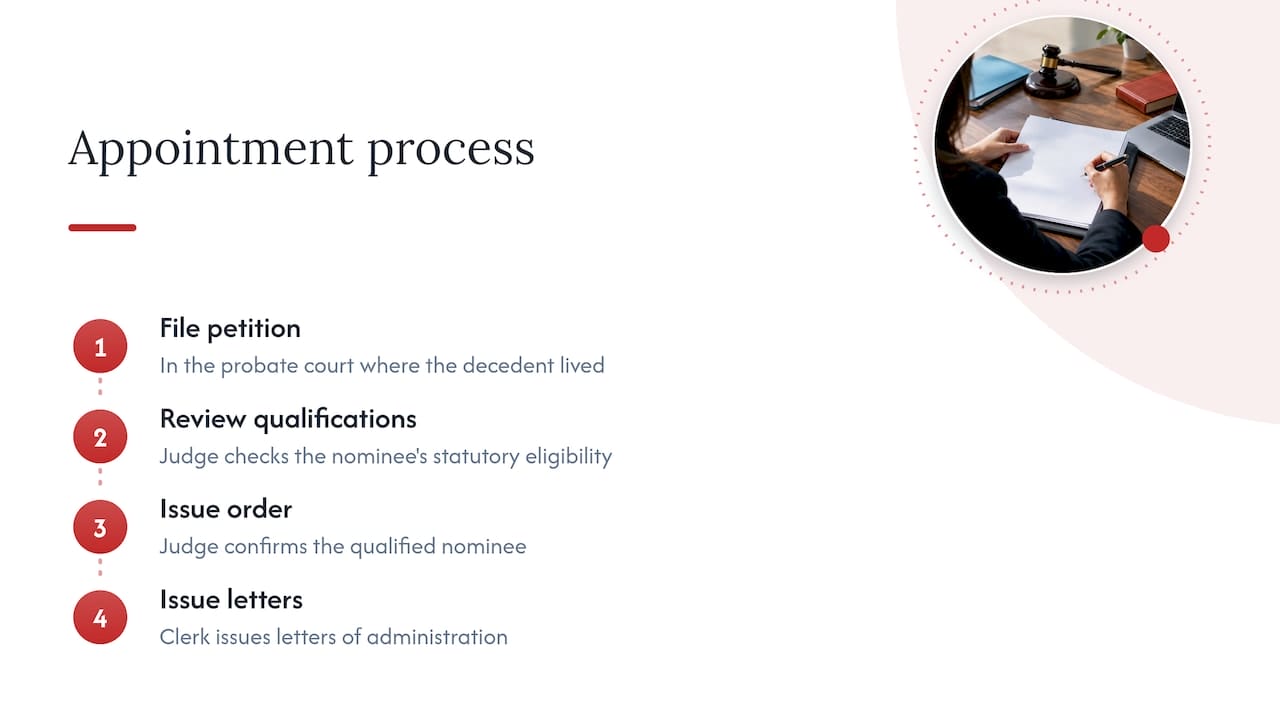
Appointment starts with a petition filed in the probate court of the county where the decedent lived. The judge reviews whether the nominated person meets the statutory qualifications. When the answer is yes, the judge issues an order and the clerk issues letters of administration. The Florida Bar’s guide says letters are issued when the judge determines that the nominee is qualified, so there is no fixed waiting period written into that guidance. Timing depends on the county, the completeness of your paperwork and whether anyone objects.
One rule catches many families off guard. According to the St. Lucie County Clerk’s probate FAQ, a personal representative seeking appointment must be represented by an attorney, unless the representative is an attorney or the sole person who will receive assets from the estate. Florida Probate Rule 5.030 is the rule behind this requirement. In practice, nearly everyone hires a probate lawyer before filing.
If you want to see what the whole case looks like from filing to closing, read our overview of probate law and the process in Florida.
Letters of administration: your proof of authority
Letters of administration are the document that proves you are who you say you are. The Personal Representatives Handbook from Florida’s 17th Judicial Circuit says they are evidence that the named person has authority to deal with and manage the decedent’s property.
In practice, you will show certified copies to:
- banks, to retitle or close the decedent’s accounts,
- brokerages and insurers,
- the county, when handling real estate in the estate,
- anyone who holds assets that belong to the estate.
Order several certified copies from the clerk. Institutions often keep the copy you hand over.
The 12-month expiration
The Florida Supreme Court amended Rule 5.235 in 2025. Letters now expire twelve months after the date of issuance unless a court order extends them. The court’s stated aim was to encourage the expeditious administration of estates.
What this means for you:
- Put the one-year anniversary of your letters on your calendar the day they are issued.
- If the estate will not be finished by then, because of real estate sales, litigation or tax matters, ask your attorney to seek an extension well before the date.
- Do not wait until a bank refuses your letters to learn they have lapsed.
Our breakdown of formal administration in Florida walks through why a typical case runs six to twelve months, and why that makes this deadline real.
What a personal representative must do
The Florida Bar summarizes the work as identifying, gathering, valuing and safeguarding assets; notifying creditors; paying valid claims and taxes; employing professionals; and distributing what remains to the beneficiaries. You do all of it under court rules until the estate is closed.
In order, the work usually looks like this:
- Secure the estate. Locate the original will and file it with the court. Protect the home, vehicles and accounts.
- Get appointed. Petition the court, take the oath, and receive letters.
- Take inventory. List and value what the decedent owned. Keep estate funds in an estate account, separate from your own money.
- Notify creditors and beneficiaries. Creditors get a defined window to file claims.
- Pay what is owed. Valid claims, administration expenses and taxes come before beneficiaries.
- Distribute and close. Once debts are settled, assets go to the beneficiaries and the estate is closed with the court.
Not every asset goes through this process. Life insurance with a named beneficiary, jointly owned accounts and trust assets often pass outside it. Our page on probate versus non-probate assets in Florida helps you sort which is which before you start inventorying. If the decedent owned property only in Florida while living elsewhere, see how ancillary probate in Florida can apply. And for modest estates there may be a shorter route, covered in our guide to small estates in Florida.
Personal responsibility
According to the 17th Circuit handbook, a personal representative is personally accountable to creditors and beneficiaries for proper administration, but is not personally liable for estate debts when the estate is managed correctly. The practical lesson: keep clean records, do not mix funds, do not distribute early, and do not pay yourself without authority.
How a personal representative is paid
A personal representative is entitled to reasonable compensation for ordinary services. Chapter 733 sets the commission as a percentage of the estate’s compensable value: 3 percent of the first $1 million, with lower percentages above that, within a range of 1.5 to 3 percent. The statute also allows added pay for extraordinary services, such as litigation, selling a business or handling complex tax matters.
A worked example using only the first tier: on a compensable estate of $400,000, a 3 percent commission comes to $12,000. Estates above $1 million use the lower statutory percentages for the portion above that line, so check the current statute or ask your attorney for the exact figure.
Some practical points:
- Many family members serving as personal representatives waive the fee, especially when they are also the main beneficiary. Commissions are taxable income to the recipient, while an inheritance generally is not treated the same way, so ask a tax professional before deciding.
- Attorney fees and other costs are separate from your commission and are paid from the estate.
- Keep a log of the time and tasks if you plan to claim extraordinary compensation.
Mistakes that cost personal representatives
- Acting before appointment. Selling or moving estate property without letters invites disputes.
- Letting letters expire. See the 12-month rule above.
- Mixing funds. A separate estate account is the simplest protection you have.
- Paying beneficiaries first. Creditors and taxes rank ahead.
- Going silent. Beneficiaries who are kept informed rarely become adversaries.
- Doing it without counsel. Given the attorney requirement and the fiduciary standard, hiring a lawyer early is usually cheaper than fixing mistakes later.
When the estate includes a house you do not want
Inherited real estate is often the hardest asset to settle. It may need repairs, carry a mortgage, or sit vacant while beneficiaries disagree. Before you list it, learn the process, the tax questions and the alternatives. This overview of selling inherited property lays out the typical steps and options. In a Florida estate, you generally need your letters in hand, and the sale must respect the court’s rules and the will’s terms, so involve your attorney before signing a contract.
Our perspective
We meet personal representatives at a hard moment. They are grieving, they have been handed a stack of forms, and they have just learned that the job comes with legal duties and personal accountability.
Our view is simple: the best estates are the ones where the representative asks questions early. Whether you need to open formal administration, figure out which assets skip probate, or plan ahead so your own family faces less of this, a short conversation with a lawyer who handles probate every week saves months of guesswork.
We work with families across Brevard County, and we think clients are best served when they speak directly with the attorney handling their matter, not a rotating cast. That is how we run our probate and trust administration practice, and it is why we explain the process in plain terms before you commit to anything.
If you are planning your own estate, consider naming a backup personal representative and reviewing whether a trust could reduce what has to go through court at all.
John
Talk to a Brevard County probate attorney
If you have been named personal representative, or you are the person who needs to be appointed, our probate and trust administration team can walk you through the petition, the letters, creditor notices and closing. We offer free 30-minute consultations, so you can ask your questions before deciding anything. You can also read about Florida probate avoidance if you are planning for your own family.

To start, visit our estate planning and probate page and request your consultation.
FAQ
Is a personal representative the same as an executor in Florida?
Functionally, yes. Florida uses “personal representative” for anyone who administers a probate estate, whether named in a will or appointed by the court. The older words executor and administrator describe how the person got the role, not a different job.
Can someone who lives outside Florida serve?
Only if the person is a qualifying close relative of the decedent. The Florida Bar’s guidance requires an individual to be either a Florida resident or such a relative. A friend or distant acquaintance who lives out of state generally cannot be appointed.
Do I need a lawyer to be a personal representative?
Usually, yes. A personal representative seeking appointment must be represented by an attorney unless he or she is an attorney or the sole person receiving assets from the estate. Even in those exceptions, the fiduciary duties and the court deadlines make advice worthwhile.
How long do letters of administration last?
Under Probate Rule 5.235, as amended in 2025, letters expire twelve months after issuance unless the court extends them. If your estate may take longer, ask your attorney about requesting an extension before the anniversary.
What can a personal representative be paid?
The statute allows reasonable compensation for ordinary services, calculated as a percentage of the estate. The first tier is 3 percent of the first $1 million, with lower percentages above it. Extraordinary services can justify additional pay, and family members often waive the fee altogether.
Sources
- Probate in Florida, The Florida Bar
- Chapter 733, 2026 Florida Statutes, The Florida Senate
- Chapter 733, 2025 Florida Statutes, The Florida Senate
- Section 733.301, 2025 Florida Statutes
- The Potential Personal Representative, University of Florida Law Review
- Personal Representatives Handbook, 17th Judicial Circuit of Florida
- Probate FAQs, St. Lucie County Clerk
- Rule 5.235, Issuance of Letters, Florida Supreme Court