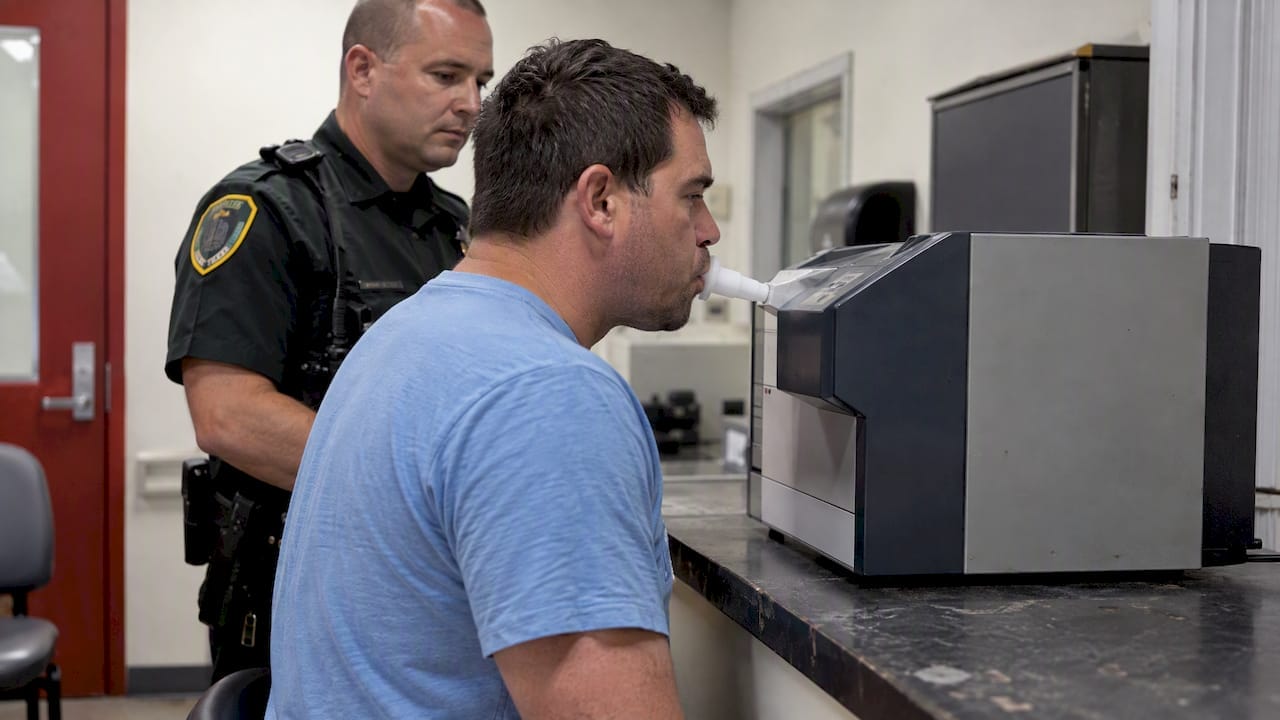
If you drive in Florida, you have already agreed to a chemical test. Under Florida’s implied consent law, anyone operating a motor vehicle in the state is deemed to have consented to breath, blood or urine testing if they are lawfully arrested for DUI. Refusing carries a license suspension of its own, whether or not you are ever convicted of DUI, and a first refusal can now also be charged as a crime. This guide explains what the law says, what changed in October 2025, and what to do in the first days after an arrest.
TL;DR
- Driving in Florida means you consent to a breath, blood or urine test after a lawful DUI arrest (Fla. Stat. 316.1932). It applies to out-of-state drivers too.
- Refusing means a 1-year license suspension for a first refusal and 18 months for a later one, separate from any DUI charge.
- Refusing a breath or urine test can be a second-degree misdemeanor on a first refusal if your license was previously suspended for refusal, the offense rises to a first-degree misdemeanor, as section 316.1939 describes.
- You generally have 10 days to request a hearing with the state licensing agency. The hearing is separate from your criminal case.
- An officer needs probable cause and a lawful arrest first. If either is missing, the refusal penalties can be challenged.
Table of Contents
- What implied consent means in Florida
- The conditions that must be met first
- What changed on October 1, 2025
- What refusing costs you
- Why the 10-day deadline matters most
- What happens in the days after an arrest
- Should you take the test or refuse?
- Our perspective
- Get help with a DUI or refusal arrest in Brevard County
- Implied consent outside of DUI: a quick note on recording
- FAQ
- Sources
What implied consent means in Florida
The idea is simple. Driving on public roads is a privilege, and the state attaches a condition to it: if you are lawfully arrested for driving under the influence, you must submit to testing. You never sign anything. Having a license, or simply driving in the state, is treated as your agreement.
The core text is section 316.1932 of the Florida Statutes. It covers tests for alcohol, chemical substances and controlled substances. The statute also says a person who is unconscious or otherwise incapable of refusing is deemed not to have withdrawn consent.
Two points surprise people:
- It is not limited to Florida license holders. A visitor from Georgia or Ohio is covered the moment they drive here.
- It is not unique to Florida. According to NHTSA, implied consent laws exist in all 50 states. What differs is the penalty. Florida pairs an administrative license sanction with criminal exposure for certain refusals, while other states handle refusal differently.
The conditions that must be met first
Implied consent is not a blank check. The officer cannot demand a breath test at a roadside stop just because you look tired.
According to the state’s DUI uniform traffic citation materials, the officer must have probable cause to believe you were driving or in actual physical control of a vehicle while impaired. A lawful arrest has to come before the request for a breath, blood or urine test. When those conditions are not met, the refusal penalties, including the suspension, can be challenged at an administrative hearing.
That is where many cases are won or lost. Questions worth asking about any arrest:
- Why was the car stopped in the first place?
- What did the officer observe that supported probable cause?
- Were you actually under arrest when the test was requested?
- Was the implied consent warning read to you, and in the way the statute requires?
Roadside field sobriety exercises and a handheld breath device at the roadside are a different matter from the evidentiary breath test at the station. The implied consent warning and the penalties discussed here attach to the post-arrest request.
Jurisdiction questions
Some drivers hope that being transported across a city line voids the test request. The Florida Supreme Court addressed this in a case where a Maitland officer arrested a driver in Maitland and took him to a breath test facility outside the city. The court held that a municipal officer may request a breath test outside the officer’s geographic jurisdiction when the request is incidental to a lawful DUI arrest that began inside it (Supreme Court of Florida opinion). In practice, that argument is largely closed.
What changed on October 1, 2025
The Florida Law Enforcement Liaison Program reports that Florida’s implied consent statutes were updated effective October 1, 2025, affecting sections 316.1932 and 316.1939. The main changes:
- Officers must now advise motorists that refusing a breath or urine test is a second-degree misdemeanor on a first refusal, and a first-degree misdemeanor if the license was previously suspended for refusal.
- The language in the breath and urine subsections of 316.1932 was revised to match.
- New statewide implied consent forms and refusal affidavits were created for law enforcement, including a version for commercial drivers.
- License suspensions stayed the same: 1 year for a first refusal, 18 months for subsequent refusals.
If you were arrested before that date, the older warning language may apply to your case. If your arrest came after it, the new warning should have been given. Whether it was read correctly is one of the details worth checking in the arrest paperwork.
What refusing costs you
A refusal triggers two separate tracks. They run on different clocks, in different forums.
| Administrative track | Criminal track | |
|---|---|---|
| Who acts | Florida Department of Highway Safety and Motor Vehicles (FLHSMV) | The State Attorney, in county court |
| Penalty for refusal | 1-year suspension (first), 18 months (later) | Misdemeanor charge in the circumstances section 316.1939 describes |
| Deadline to contest | 10 days, in writing | Set by the court process after charges are filed |
| Standard question | Was the arrest lawful and the refusal proper? | Is there proof beyond a reasonable doubt? |
The statute sets the suspension at one year for a first refusal and 18 months for later ones. Under section 316.1939, refusing a lawful breath or urine test is a second-degree misdemeanor for a first refusal and a first-degree misdemeanor for a later one, under the conditions the statute lays out. Read the exact conditions in your own case with a lawyer, because the statute ties them to probable cause and to your prior record.
We walk through the practical details on our page about what to do within 10 days of a breath test refusal in Florida.
Refusal as evidence
A refusal can be used against you. It is treated as evidence that a driver may have been conscious of guilt. But prosecutors have limits. The Third District Court of Appeal has found it improper for the state to argue that by refusing a test, a defendant gave up the chance to prove innocence, because that shifts the burden of proof onto the defendant (Third DCA opinion). The burden stays with the state.
There is also an active line of cases about whether evidence of a refusal can be suppressed in particular circumstances. In one Sixth District appeal, the State challenged an order suppressing a driver’s breath test refusal (Sixth DCA opinion). This area of law keeps moving, which is one reason to have someone track it for you.
Why the 10-day deadline matters most
The single most expensive mistake after a refusal arrest is doing nothing for a week and a half. A hearing with FLHSMV must be requested in writing within 10 days, according to a state Bureau of Administrative Reviews document. Miss it, and you give up the best chance to challenge the suspension.
Two things to understand about that hearing:
- It is separate from criminal court. Winning one does not automatically win the other, and a criminal result does not automatically reverse an administrative suspension.
- It is narrow. The questions are usually whether there was probable cause, whether the arrest was lawful, and whether you actually refused after being properly warned.
If you drive for a living, the stakes are higher. Commercial license holders face their own disqualification rules after a refusal, covered on our CDL and DUI deadline page.
What happens in the days after an arrest
A realistic timeline helps you plan.
- Day 0: arrest and release. You are booked, asked to take a test, and, if you refuse, handed paperwork that acts as your temporary driving permit. Read it. It states the suspension and the right to a hearing.
- Days 1 to 3: gather records. Keep the citation, any bond paperwork, and the name of the arresting agency.
- By day 10: file the written request. Do this with a lawyer if you can. A late request is the one error you cannot repair.
- After release: watch your court dates. Missing one can add a new problem on top of the first. For a general explanation of how skipped dates after posting bond play out, see this guide to what happens if you miss a court date after bail. It is written about California practice, so check the rules for your own Florida case.
- Weeks later: the criminal case proceeds. Arraignment, discovery, and possible negotiation.
If your license is suspended, driving can create further charges. Our guide to driving while license suspended in Florida explains the rules and defenses. Some drivers may qualify for limited driving privileges, and our page on the Florida hardship license covers the form and process.
Should you take the test or refuse?
We cannot tell you what to do in a car at night with an officer in front of you, and a blog post is not a substitute for advice on your own facts. But we can set out how the trade-off works.
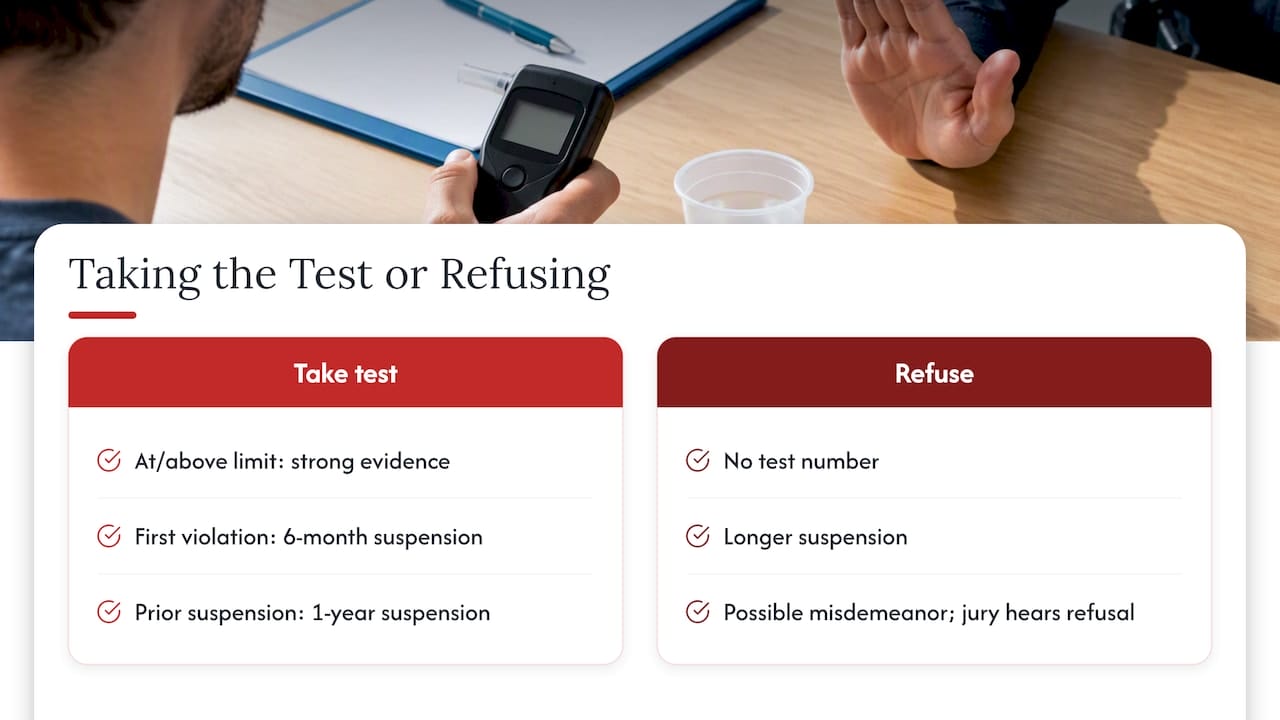
If you take the test: a result at or above the legal limit hands the state strong evidence and can lead to a separate suspension. The DUI citation materials from the state describe a six-month administrative suspension for a first violation of an unlawful blood or breath alcohol level, and one year for a driver previously suspended for it (FLHSMV citation form).
If you refuse: the state has no number, but you face a longer suspension, possible misdemeanor exposure, and a jury may hear about the refusal.
Because the consequences of refusal are longer and can include a crime, many people are surprised that a one-year suspension can be harsher than the penalty for a failed test. That is by design. Whatever you chose, the next step is the same: protect the 10-day window.
Our perspective
Most people who call us after a refusal arrest tell us the same thing: nobody explained that two cases had started. One is a license case with a short fuse. The other is a criminal case that moves slowly. We handle DUI defense in Brevard County, and our first job is to separate those tracks and put the deadline on the calendar.
We also look hard at the stop. Implied consent only applies after a lawful arrest, so the early questions are about why the officer pulled you over and what supported probable cause. We read the video, the affidavit and the warning that was given, and we compare them. A refusal that looked simple at 2 a.m. often looks different on paper.
You will speak with the attorney who handles your case, not a call center. We offer a free 30-minute consultation, which is a good time to bring your citation and tell us what happened. If your case involves a military member, a commercial license or a prior suspension, say so early, because each changes the strategy.
— John
Get help with a DUI or refusal arrest in Brevard County
If you were arrested for DUI in Brevard County and you refused, or you are not sure whether you did, call us before the 10 days run out. Our DUI and criminal defense practice can review your paperwork, request the administrative hearing and begin building your defense. You can also read how a first-offense DUI conviction can play out and what to expect from Florida DUI penalties and fines.
Implied consent outside of DUI: a quick note on recording
Searchers often confuse implied consent on the road with consent to be recorded. They are unrelated. Florida is generally a two-party consent state: it is unlawful to intentionally record an oral communication without the consent of all parties, subject to narrow exceptions, under section 934.03. The exceptions include certain situations involving minors at risk of violence or sexual abuse and people protected by specific court-ordered injunctions.
FAQ
What is Florida’s implied consent rule?
By driving in Florida, you are deemed to have agreed to a breath, blood or urine test if you are lawfully arrested for DUI. The rule is in section 316.1932 of the Florida Statutes. Refusing triggers a license suspension and, in some cases, a misdemeanor charge.
Do all 50 states have implied consent laws?
Yes. NHTSA reports that implied consent laws exist in every state. The penalties and procedures differ from state to state, so what happens in Florida may not match what happens elsewhere.
Does implied consent apply to out-of-state drivers?
Yes. It applies to anyone operating a motor vehicle in Florida, not just people holding a Florida license. An out-of-state driver who refuses can still face the Florida consequences.
Can I fight a license suspension after refusing a breath test?
Often you can contest it, but the deadline is short. The request for an administrative hearing must be in writing within 10 days. The hearing is separate from your criminal case, so a lawyer should handle both tracks.
Can someone record me without my consent in Florida?
Generally no. Florida requires the consent of all parties to record an oral communication, with limited exceptions. This is a different law from implied consent for DUI testing.
Sources
- Florida Statutes, section 316.1932
- Florida Statutes, section 316.1939
- Florida Statutes, section 934.03
- NHTSA report on implied consent laws
- FLHSMV DUI uniform traffic citation
- FLHSMV Bureau of Administrative Reviews document
- Florida Law Enforcement Liaison Program: implied consent update
- Supreme Court of Florida opinion on out-of-jurisdiction breath tests
- Third District Court of Appeal opinion on refusal arguments
- Sixth District Court of Appeal opinion on suppressing refusal evidence