A Florida hardship license restores limited driving privileges for work or business travel while your license is suspended or revoked, but only if your suspension type qualifies and you follow the Bureau of Administrative Review’s process. Your first moves are enrolling in the required course (ADI or a licensed DUI program), completing form HSMV 78306, and attaching proof of that enrollment. Child support suspensions don’t qualify for this remedy at all.
TL;DR:
- Only certain suspensions, such as point violations or most DUI-related cases, qualify for a hardship license, while child support suspensions do not.
- Enrollment in a state-licensed DUI or ADI course must be verified in writing before applying, and the course must be completed within 90 days of enrollment.
- Waiting periods before petitioning vary: 90 days for first DUI, up to 12 months for refusal or second DUI, and 12 months or more for revocations.
- The application requires a detailed employer letter, proof of course enrollment, and must be filed correctly with the HSMV form HSMV 78306 to avoid delays.
- Approved restricted licenses typically limit driving to business purposes or employment, with strict boundaries, and additional fees, insurance, or ignition interlock devices are usually required afterwards.
Table of Contents
- Who Qualifies for a Hardship License in Florida?
- Enrolling in ADI or a DUI Program: The 90-Day Rule
- How to Apply: Form HSMV 78306 and the BAR Hearing
- What a Hardship License Actually Lets You Do
- How Long Do You Have to Wait?
- Building an Evidence Packet That Actually Works
- After Approval: Fees, Insurance, and Ignition Interlock
- Why Applications Get Denied and What to Do Next
- What I’ve Learned Handling Hardship Cases in Brevard County
- How Jmoorelegal Helps You Get Back on the Road
- Sources
Who Qualifies for a Hardship License in Florida?
Eligibility depends entirely on why the state suspended your license, not how badly you need to drive. Point-based suspensions (too many violations in a set period) and most DUI-related administrative suspensions generally allow a hardship petition. Revocations, including those tied to habitual traffic offender status, involve a longer road and sometimes a mandatory waiting period before you can even file.
Some suspensions are flatly off the table. Florida Statute 322.271 gives the Department of Highway Safety and Motor Vehicles authority to restore driving privileges for business or employment purposes, but FLHSMV guidance confirms that child support delinquency suspensions don’t qualify. Parents facing that situation usually need a different fix, such as a modification after job loss or resolving the underlying child support enforcement matter directly.
Before you do anything else, pull your suspension notice and check:
- The specific statute cited for your suspension (it tells you which track you’re on)
- Whether the notice mentions a mandatory waiting period before you can petition
- Whether it references child support enforcement (if so, hardship licensing won’t help)
- Whether it’s a suspension or a revocation, since revocations carry stricter rules
Enrolling in ADI or a DUI Program: The 90-Day Rule
The course you need depends on why you lost your license. Point suspensions and most non-fatal moving violation suspensions require the 12-hour Advanced Driver Improvement course. DUI-related suspensions require enrollment in a state-licensed DUI program instead, which involves evaluation and sometimes substance abuse education beyond the basic course.
You enroll first, then apply. BAR wants proof of enrollment attached to your hardship application, not a promise that you’ll sign up eventually.
Pro Tip: Request written enrollment verification the same day you sign up. BAR offices see incomplete files constantly, and a missing enrollment letter is one of the most common reasons applications sit for weeks instead of days.
Miss the follow-through and you lose the license anyway. A licensed DUI program or ADI course typically costs somewhere in the range of $60 to $65, though DUI program evaluation fees run higher. Whichever course applies to your case, the 90-day clock matters:
- Enrollment must happen before or alongside your application
- You generally have 90 days from enrollment to finish the course
- Failing to complete it in that window cancels your restricted license, even after BAR approved it
How to Apply: Form HSMV 78306 and the BAR Hearing
Form HSMV 78306 is the actual application, and getting it right the first time saves you a second trip to the Bureau of Administrative Review office. Here’s the sequence that works:
- Gather your enrollment verification, a government-issued ID, and a letter from your employer describing your job duties and work schedule.
- Complete HSMV 78306 in full, including the section asking whether you’re requesting a hearing waiver.
- Include the filing fee. Many county BAR offices reference roughly $12 for the hearing application itself, separate from reinstatement fees due later.
- File the packet at your county’s BAR office, either by mail or in person. Check office hours through FLHSMV’s MyDMV portal before you drive over.
- Wait for BAR to determine whether your case qualifies for a waived hearing or requires an in-person appearance.
BAR sometimes waives the hearing when your documentation is clean and your case is straightforward, such as a first-time point suspension with a clear employer letter. When a hearing is required, expect a hearing officer to ask direct questions about your job, your driving history, and why restricted privileges matter to your income. Bring the same documents you submitted, plus anything that reinforces your case.
What a Hardship License Actually Lets You Do
Florida issues two main flavors of restricted privileges under this process: business-purpose restrictions and employment-only (H) restrictions. The hearing officer sets the exact boundaries, so two people with similar cases can end up with different limits.
Business-purpose restrictions tend to be broader, covering driving that’s reasonably necessary to operate a business or conduct its affairs. Employment restrictions are narrower and typically limit you to commuting directly between home and work, plus job-related errands your employer can document.
Trips that usually fall inside these restrictions:
- Driving to and from your job on a fixed schedule
- Work-related errands (deliveries, client visits, supply runs) tied to your documented duties
- Medical appointments and, in many cases, authorized school or church trips
Driving outside those lines isn’t a paperwork problem. It’s a new violation, and it can mean immediate revocation of the restricted license plus fresh criminal exposure if it happens during a DUI-related restriction.
How Long Do You Have to Wait?
Waiting periods vary sharply by suspension type, and this is where a lot of applicants get tripped up assuming they can file immediately.
| Suspension Type | Typical Wait Before Petitioning |
|---|---|
| First-offense DUI | 90 days hard suspension |
| Test refusal or second DUI offense | Up to 12 months |
| Revocation (shorter-term) | 12 months before petition eligible |
| Revocation (longer-term or habitual offender) | varies by suspension type |
These figures reflect typical statutory ranges and can shift based on prior history, so confirm your exact window against your suspension notice. Once you file a complete packet, BAR processing itself often moves faster than the waiting period that got you there. A hearing, when required, adds time to the front end but rarely stretches the process for more than a few additional weeks.
Building an Evidence Packet That Actually Works
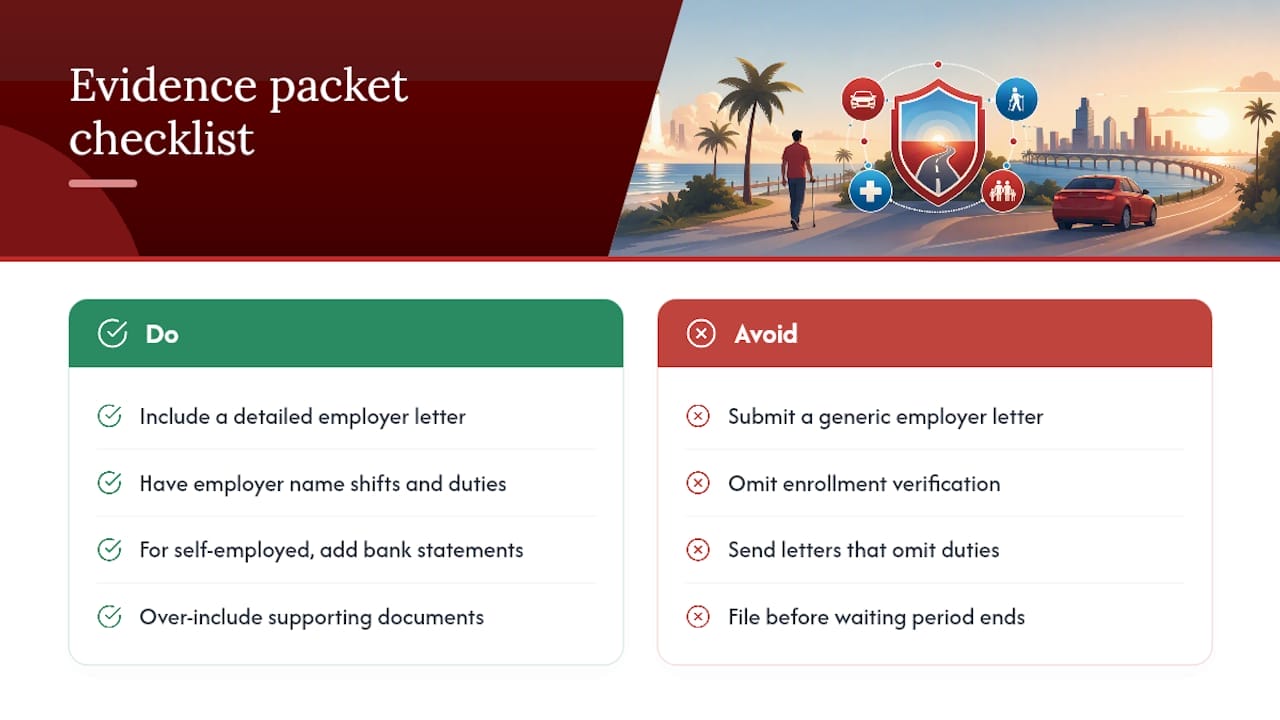
BAR hearing officers weigh two things: your paperwork and your credibility. A generic “please help me keep my job” letter from an employer does little. A letter that names your shift hours, lists specific duties that require driving, and states plainly that the job cannot be performed without a valid license carries far more weight.
Self-employed applicants face a harder lift because there’s no employer to vouch for them. Bank statements, client contracts, and a signed personal statement describing daily operations can fill that gap, similar to the documentation standards used in personal injury case preparation.
Pro Tip: Over-include rather than under-include. A packet with more supporting documents than strictly required often gets a hearing waived; a thin packet almost always triggers a live hearing or a request for more paperwork.
Common mistakes that slow everything down: missing enrollment verification, employer letters that don’t mention specific duties, and applications submitted before the mandatory waiting period expires.
After Approval: Fees, Insurance, and Ignition Interlock
Approval isn’t the finish line. You still need to take BAR’s authorization to your local FLHSMV office, pay reinstatement fees, and square away insurance before the restricted license is actually valid.
- Reinstatement fees vary by suspension type and get paid at the FLHSMV office, not at BAR
- DUI-related cases typically require FR-44 insurance, which carries higher liability minimums than standard coverage and usually runs for three years
- Many DUI cases also require an ignition interlock device installed at the driver’s expense before the restricted license activates
- Budget for all three together. FR-44 coverage and an IID can cost more over time than the application itself
Why Applications Get Denied and What to Do Next
Most denials trace back to documentation gaps or credibility issues at the hearing, not some hidden disqualifier. An employer letter that’s vague, a missing enrollment certificate, or inconsistent testimony about your driving needs are the usual culprits.
If BAR denies you, you generally have the option to supplement the record with better documentation and request reconsideration, or reapply once you’ve fixed the gap. In DUI cases tied to a criminal charge, a first-offense DUI conviction can complicate a pending hardship petition, which is exactly when an attorney’s involvement stops being optional and starts being practical, both at BAR and in the underlying criminal case.
What I’ve Learned Handling Hardship Cases in Brevard County
Across decades of combined experience in this office, the pattern repeats: people lose their license, panic about their job, and file a rushed application that gets bounced for something fixable. The cases that succeed are the ones where the employer letter is specific, the course enrollment happened on day one, and someone checked the waiting period before filing anything.
I’ve represented clients through everything from first-offense point suspensions to revocations tangled up with military reassignment timelines. A mediation-certified, client-centered approach means we build your packet to survive scrutiny, not just to check a box. If your license is suspended and your job depends on driving, talk to us before you file.
— John
How Jmoorelegal Helps You Get Back on the Road
Jmoorelegal handles the parts of this process that trip up most applicants on their own: building an employer letter that actually persuades a hearing officer, timing your filing against the correct waiting period, and representing you if BAR schedules a live hearing instead of waiving it.
Filing HSMV 78306 correctly the first time matters more than most people realize, since a bounced application means starting the waiting-period clock over in some cases. If your suspension is tangled up with a pending DUI charge or a criminal matter, our criminal law practice handles both sides of that problem at once, so your hardship petition and your criminal defense aren’t working against each other. Call our Brevard County office for a free consultation, and bring your suspension notice so we can tell you exactly where you stand before you file anything.
This article is general information, not a substitute for advice from a qualified lawyer. Consult a qualified legal professional about your own circumstances before acting on anything here.
Sources
- 2025 Statutes 0322.271 | Florida House of Representatives
- Other Common Suspensions and Revocations | FLHSMV
- How to Apply for a Hardship License in Florida – LegalClarity