
A child custody agreement is a legally binding document that specifies how parents share time, decision-making, and responsibilities for their children after separation or divorce. Courts call this document a parenting plan, and the two terms are used interchangeably across most states. Getting it right from the start protects your child’s stability and saves you from costly return trips to court. This child custody agreement guide walks you through every stage: what to include, how to draft it, how to file it, and what mistakes to avoid.
What should a child custody agreement include?
A parenting plan covers two distinct types of custody. Legal custody defines decision-making rights over education, healthcare, and religion, while physical custody defines where the child lives and sleeps. Most agreements today grant joint legal custody to both parents, with physical custody split according to a detailed schedule. Few agreements include tie-breakers for decision deadlocks, and that gap causes serious problems when parents disagree on major choices.

Core provisions every agreement needs
A complete parenting plan addresses all of the following:
- Legal custody and decision-making. State whether decisions require mutual consent or whether one parent has final say in specific categories.
- Physical custody schedule. Specify weekday and weekend arrangements down to pickup and drop-off times, not just general percentages.
- Holiday and school break rotations. Alternate Thanksgiving, winter break, spring break, and summer vacation on a clear yearly cycle.
- Exchange logistics. Name the location, time, and which parent provides transportation for every regular exchange.
- Communication protocols. Set rules for how parents contact each other and how children reach the non-custodial parent by phone or video.
- Dispute resolution steps. Require mediation or a parenting coordinator before either parent can file a court motion.
- Relocation notice. Require written notice at least 30 to 60 days before any move that affects the schedule.
- Expense sharing. Reference child support and address uncovered medical, educational, and extracurricular costs.
- Modification procedures. Describe the process for requesting changes as the child grows.
Detailed provisions covering exchange logistics, holiday rotations, and relocation notice reduce later disputes substantially. Vague plans leave room for interpretation, and interpretation leads to conflict.
Pro Tip: Build a shared digital calendar using a co-parenting app to track exchanges, appointments, and schedule changes. A written record of every deviation from the plan protects you if disputes escalate.
A strong custody agreement also accounts for the child’s developmental changes. A successful parenting plan adjusts schedules and provisions as the child’s needs evolve from toddlerhood through high school. What works for a five-year-old will not work for a teenager with after-school activities and a social life.
How do you draft and negotiate a custody agreement?
Start by learning your state’s specific requirements. Florida, for example, requires parents to submit a detailed parenting plan to the court, and the plan must address every element listed in Florida Statute 61.13. Other states have their own checklists. Skipping this step produces a plan the court will send back for revision.
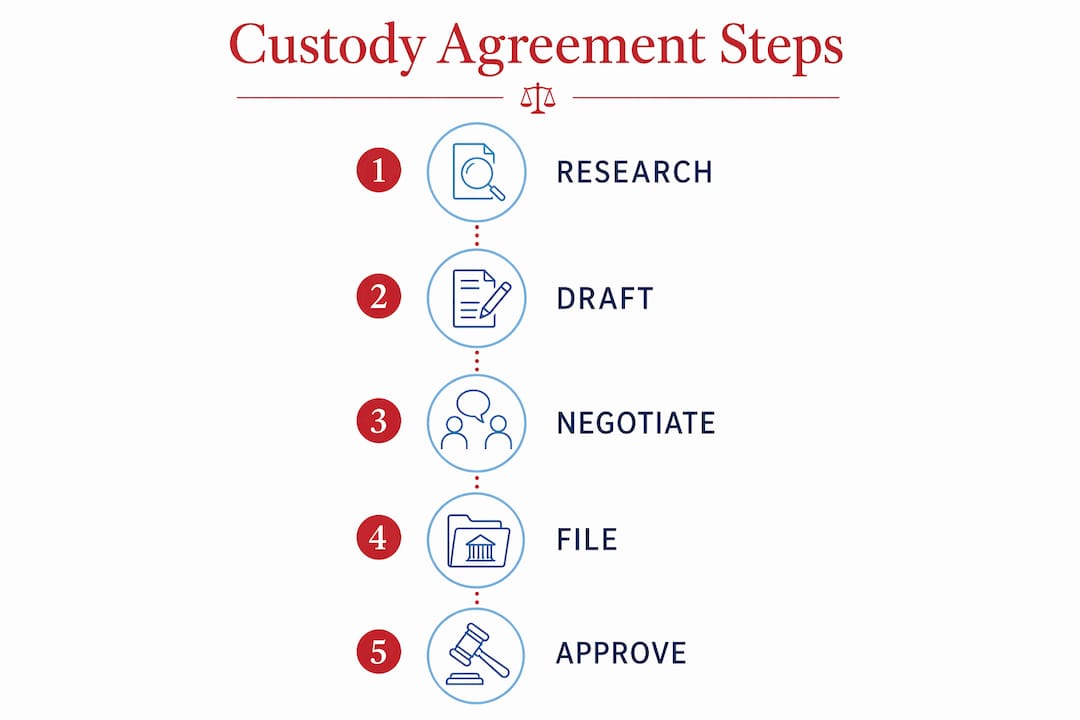
Most states require parents to attend at least one mediation session before a contested custody hearing. Mediation is not a sign of failure. It is a structured process where a neutral third party helps both parents reach agreement without a judge deciding for them. Understanding the role of a mediator in family court before you walk into that session gives you a real advantage.
Follow these steps to draft an agreement that holds up:
- List every scenario you can imagine. Think through birthdays, school plays, sick days, snow days, and what happens when one parent travels for work.
- Write in specific terms. “Every other weekend” is not specific. “Every other Friday at 6:00 PM through Sunday at 6:00 PM” is specific.
- Add a tie-break mechanism. Adding a tie-break mechanism in joint legal custody avoids deadlocks in major decisions while preserving cooperative co-parenting. A common approach names a parenting coordinator as the final decision-maker.
- Use a parenting plan template as a starting point, not a finish line. Templates miss jurisdictional nuances. Self-help templates often miss local requirements; professional legal review is strongly recommended for enforceability.
- Address joint custody and sole custody differently. Joint custody arrangements require more detailed communication and decision-making protocols. Sole custody agreements must still define visitation rights and communication rules for the non-custodial parent.
- Plan for the future. Build in a review clause that triggers a formal review when the child reaches a new school stage, such as starting middle school or high school.
Pro Tip: Never use the word “reasonable” to describe visitation or communication. Courts cannot enforce “reasonable” because it means something different to every parent. Replace it with exact days, times, and conditions every time.
Negotiation works best when both parents focus on the child’s routine rather than on winning. Parents who treat the process as a problem to solve together reach agreements faster and return to court less often.
How do you file a custody agreement with the court?
A signed custody agreement is not legally enforceable until a judge approves it. A custody agreement signed by parents remains a private contract until filed and approved by a court order. That distinction matters enormously. Without court approval, you have no legal mechanism to enforce the terms if the other parent stops following them.
The filing process follows these steps:
- Prepare the documents. Submit the signed parenting plan along with a petition or motion to your family court. Some courts require additional child custody forms, such as a financial affidavit or a proposed order.
- Pay the filing fee. Filing fees for custody petitions range from $50 to $400 depending on the state and case type. Budget for this cost upfront.
- Attend or waive the hearing. When both parents agree and the plan is thorough, courts often waive the hearing and approve the plan on paper. Contested plans require a hearing.
- Understand what the judge reviews. Judges evaluate the best interests of the child by examining the parent-child relationship, home stability, health history, any abuse history, and each parent’s willingness to cooperate. A plan that clearly serves the child’s interests moves through review faster.
Once approved, the parenting plan becomes a court order. Court orders carry enforcement powers such as contempt proceedings. A private agreement carries no such power. If you need to understand how the family court process works before filing, reviewing that process in advance prevents costly procedural errors.
What mistakes should you avoid in a custody agreement?
The most expensive mistake parents make is using vague language. Vague terms like “reasonable visitation” invite conflict; specifying exact schedule days and times is the best practice. Courts cannot enforce ambiguous terms, which means every disagreement becomes a new legal battle.
Specific, enforceable schedules minimize court involvement. Vague language invites repeated litigation and conflict, turning a one-time agreement into an ongoing legal expense that drains both parents financially and emotionally.
Other common mistakes include:
- Ignoring exchange logistics. Not naming a pickup location or time creates a daily source of conflict. Specify the school, a neutral public location, or one parent’s home for every exchange.
- Skipping dispute resolution steps. Experts recommend including mediation or parenting coordinator steps before any court filing. Parents who skip this step pay far more in litigation costs.
- Failing to address relocation. Not addressing relocation or calendar edge cases like birthdays and school breaks is a frequent source of conflict. A relocation clause with a required notice period prevents one parent from moving the child without warning.
- Assuming the signed document is enforceable. Many parents discover too late that their signed agreement has no legal force. File it with the court immediately after signing.
- Failing to document violations. Keep a dated log of every missed exchange, late pickup, or communication breach. That record supports a modification request or enforcement motion if needed.
Pro Tip: If the other parent violates the court order, do not retaliate by withholding visitation. That puts you in violation too. Document the breach, consult your attorney, and file the appropriate motion.
When circumstances change significantly, such as a job relocation, a change in the child’s school, or a shift in a parent’s work schedule, you can request a modification of child custody through the court. Courts approve modifications when the change serves the child’s best interests and reflects a genuine shift in circumstances.
Key Takeaways
A well-drafted parenting plan, filed and approved by a court, is the single most effective tool for reducing conflict and protecting your child’s stability after separation.
| Point | Details |
|---|---|
| Define both custody types | Specify legal custody for decisions and physical custody for living arrangements separately. |
| Use exact language | Replace vague terms like “reasonable visitation” with specific days, times, and locations. |
| File for court approval | A signed agreement has no legal force until a judge converts it into a court order. |
| Include dispute resolution | Require mediation before court filings to cut litigation costs and preserve co-parenting. |
| Plan for change | Build in a review clause so the plan adapts as your child grows through new life stages. |
What I’ve learned after years of custody cases
After handling custody matters in Brevard County for years, the pattern I see most often is this: parents spend enormous energy fighting over who gets more time, and almost no energy making sure the agreement actually works day to day. The parents who come back to court least are the ones who treated the drafting process like a logistics project, not a competition.
The agreements that hold up are specific to the point of feeling excessive. They name the exact gas station where exchanges happen. They specify which parent buys the Halloween costume. They state what happens if a holiday falls on a school day. That level of detail feels unnecessary until the first time you need it, and then it feels like the most important thing you ever wrote.
I also tell every client that mediation is not a concession. It is the most cost-effective tool available in family law. Parents who reach their own agreement through family mediation keep control of the outcome. Parents who let a judge decide hand that control to a stranger who has read a file for twenty minutes.
The hardest part of my job is watching parents use their children as leverage in a dispute that is really about adult grievances. The best custody agreements I have seen were written by parents who genuinely asked, “What does my child need?” and built the plan from that answer outward.
— John
Jmoorelegal: custody agreement support in Brevard County
Drafting a parenting plan that holds up in court takes more than a downloaded template. The Law Office of John Vernon Moore, P.A. provides direct attorney guidance through every stage of the custody process, from initial drafting through court filing and, when needed, modification.

Jmoorelegal’s family law services cover joint custody arrangements, sole custody plans, mediation, and post-judgment modifications. The firm is mediation certified and has deep experience with high-conflict cases, including those involving narcissistic personality dynamics and military family schedules. Every client receives a free initial consultation and direct access to the attorney handling their case. Contact Jmoorelegal to schedule your consultation and get a custody plan built for your family’s specific situation.
FAQ
What is the difference between legal and physical custody?
Legal custody covers the right to make decisions about education, healthcare, and religion. Physical custody determines where the child lives and the day-to-day parenting schedule.
Does a custody agreement need court approval to be enforceable?
A signed custody agreement is not legally enforceable until a judge approves it and converts it into a court order. Without that approval, it remains a private contract with no enforcement mechanism.
How much does it cost to file a custody agreement?
Filing fees for custody petitions range from $50 to $400 depending on the state and case type. Courts sometimes waive the hearing when both parents have signed a mutual agreement.
When can a custody agreement be modified?
A court will approve a modification when there is a substantial change in circumstances, such as a relocation, a change in the child’s needs, or a significant shift in a parent’s schedule, and the change serves the child’s best interests.
Do both parents need a lawyer to create a custody agreement?
Both parents do not legally need an attorney, but professional legal review is strongly recommended. Templates often miss jurisdictional requirements, and errors in the agreement can create enforcement problems later.
Recommended
- How Domestic Violence Affects Custody: 2026 Guide – The Law Office of John Vernon Moore, P.A.
- Modification of Child Custody – The Law Office of John Vernon Moore, P.A.
- Child Custody & Visitation – The Law Office of John Vernon Moore, P.A.
- Role of Mediator in Family Court: A Parent’s Guide – The Law Office of John Vernon Moore, P.A.