
A domestic violence charge defense strategy is defined as a structured legal approach to challenging the prosecution’s evidence, exposing procedural violations, and presenting lawful justifications for a defendant’s conduct. Charges under domestic violence statutes carry consequences far beyond a criminal record. A misdemeanor conviction alone triggers a permanent federal firearm ban under the Lautenberg Amendment, affecting careers in law enforcement and the military. The prosecution must prove guilt beyond a reasonable doubt, and that standard creates real openings for a skilled defense. Jmoorelegal has spent decades building case-specific strategies for defendants in Brevard County, Florida, and the approach always starts the same way: challenge the evidence before trial, not during it.
What are the primary defense strategies in domestic violence cases?
Effective defenses target three core weaknesses in the prosecution’s case: insufficient proof, procedural errors, and justified conduct. Each of these angles requires a different set of facts, and the strongest cases often combine more than one.
Self-defense
Self-defense is the most frequently raised justification in domestic violence cases. To succeed, you must show that you reasonably believed you faced imminent physical harm and that your response was proportionate to that threat. Physical evidence of injury, medical records, and witness accounts all support this claim. Courts look closely at who was the primary aggressor, so documentation of prior incidents matters.

False allegations
False allegations are more common in domestic violence cases than in most other criminal categories, often surfacing during contentious divorces or custody disputes. The defense here focuses on motive. An attorney examines the accuser’s timeline, prior statements, text messages, and any history of making similar claims. Inconsistencies between the initial 911 call and later testimony are particularly damaging to the prosecution’s credibility.
Lack of evidence
The prosecution carries the burden of proof. When physical evidence is absent and the case rests entirely on accuser testimony, the “beyond a reasonable doubt” standard becomes very difficult to meet. Domestic violence law is circuit-specific, and what qualifies as sufficient proof varies by jurisdiction. An attorney who knows the local courts understands exactly where that threshold sits.
- Self-defense: Requires proof of reasonable fear and proportionate response.
- False allegations: Targets motive, timeline inconsistencies, and prior statement contradictions.
- Lack of evidence: Exploits the prosecution’s burden when physical proof is absent.
- Mutual combat: Argues both parties participated, complicating the aggressor determination.
- Procedural violations: Challenges evidence obtained through unlawful searches or Miranda breaches.
Pro Tip: Stop posting on social media the moment you are charged. Prosecutors treat your posts as evidence, and a single comment can contradict your entire defense.
How to gather and use evidence effectively in your defense
The legal victim in a domestic violence case is the State, not the accuser. That distinction matters because pretrial investigation is the primary tool for identifying inconsistencies that force case reduction or outright dismissal. Evidence collection is not passive. You and your attorney must actively pursue every available record.
Critical evidence types
| Evidence Type | Why It Matters |
|---|---|
| 911 call transcripts | Captures the accuser’s first account, often before a narrative is shaped |
| Bodycam footage | Shows officer observations at the scene, including visible injuries and demeanor |
| Medical records | Documents the presence or absence of injuries consistent with the allegation |
| Text and email records | Reveals communication patterns, threats, or recantations |
| Witness statements | Provides third-party accounts that corroborate or contradict the accusation |
Steps for building your evidence file
- Request all law enforcement records immediately. Bodycam footage and incident reports are time-sensitive. Agencies have retention schedules, and footage can be deleted.
- Obtain medical records from both parties. Your injuries matter as much as the accuser’s. Records showing your own injuries support a self-defense claim.
- Preserve all digital communications. Screenshot and back up every relevant text, email, and social media message before accounts are deleted or altered.
- Identify and interview witnesses early. Neighbors, family members, and bystanders have the clearest memories immediately after an incident.
- Request a psychological evaluation voluntarily. Voluntary psychological evaluations after charges demonstrate non-threat status and strengthen bond hearing arguments.
Pro Tip: Ask your attorney about evidence admissibility standards before submitting anything to the court. Not all evidence you collect will be usable, and the wrong submission can backfire.
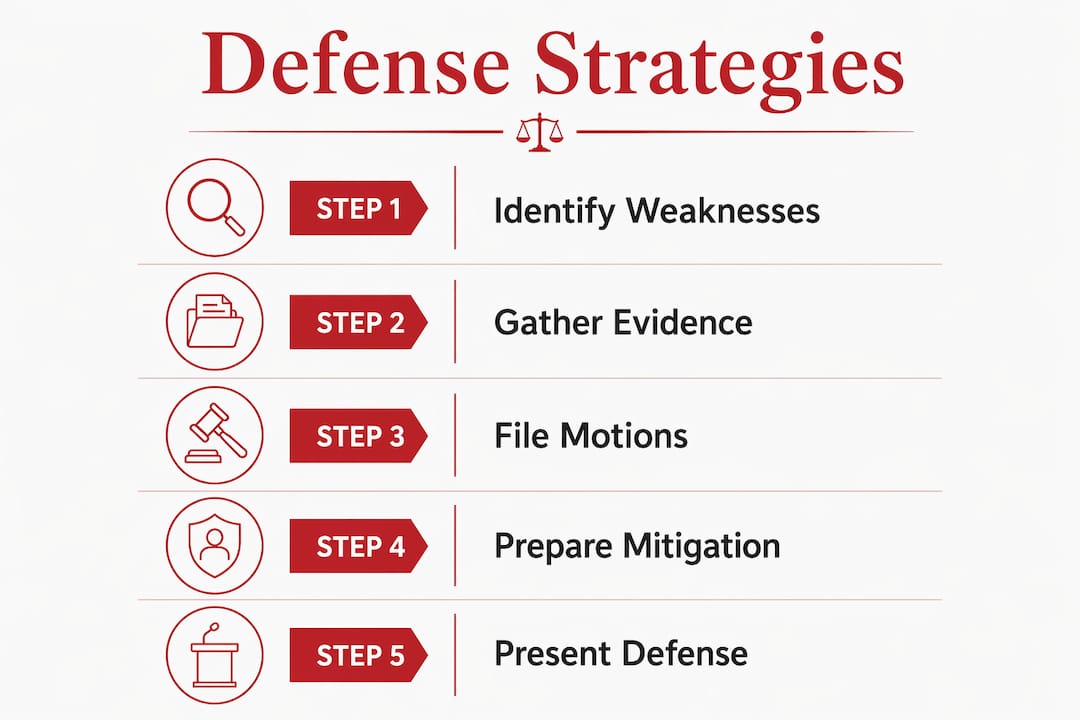
Step-by-step approach to mounting a domestic violence defense
A domestic violence case defense does not begin at trial. The most consequential decisions happen in the first days after arrest. Missing early windows closes options that cannot be reopened.
-
Retain legal counsel within 24 hours of arrest. The first 24–48 hours determine bond conditions, no-contact orders, and the tone of the prosecution’s early investigation. An attorney present at this stage can intervene before the case hardens.
-
Avoid all contact with the alleged victim. Violating a no-contact order, even at the victim’s invitation, creates a separate criminal charge and destroys your credibility with the court. Learn how violation of probation conditions can compound your legal exposure.
-
Submit a mitigation packet during the pre-filing window. In Florida, submitting a mitigation packet within a 21-day window after arrest can persuade prosecutors to issue a “No Action” status, preventing formal charges entirely. This packet includes contradictory bodycam footage, character references, and medical records.
-
File pretrial motions to suppress or dismiss. If law enforcement violated your Fourth Amendment rights during the search or failed to read Miranda rights, your attorney files motions to exclude that evidence. Excluded evidence frequently collapses the prosecution’s case.
-
Evaluate pretrial diversion and counseling programs. Many jurisdictions offer diversion programs for first-time defendants. Completing a certified batterers’ intervention program or anger management course signals accountability and often results in reduced or dropped charges.
-
Prepare for trial with full witness and evidence review. If the case proceeds, your attorney challenges every piece of prosecution evidence, prepares witnesses for cross-examination, and files motions in limine to exclude prejudicial material before the jury hears it.
A clear understanding of how the criminal defense process works at each stage prevents costly mistakes and keeps your options open at every decision point.
How do constitutional rights affect your domestic violence defense?
Constitutional protections are not formalities. They are the most powerful tools in criminal defense for domestic violence, and violations by law enforcement create grounds for dismissal or evidence suppression that prosecutors cannot easily overcome.
The Fourth Amendment prohibits unlawful searches and seizures. If police entered your home without a warrant and without valid consent, any evidence they collected is subject to suppression. The Fifth Amendment protects against self-incrimination. Statements made before Miranda rights are read are inadmissible. The Sixth Amendment guarantees the right to confront your accuser, which becomes critical when the prosecution tries to introduce prior statements without live testimony.
No-drop prosecution policies mean victim cooperation is often irrelevant. The State proceeds using 911 calls, officer observations, and medical records even when the victim refuses to testify. That reality makes constitutional challenges more important, not less, because the prosecution has built-in tools to work around an uncooperative accuser.
- Fourth Amendment violations: Unlawful entry or search without a warrant leads to evidence suppression.
- Miranda violations: Statements taken before rights are read are excluded from trial.
- Confrontation Clause: Prosecutors cannot simply read prior statements into evidence without giving you the right to cross-examine.
- Due process: Prosecutors must disclose all exculpatory evidence under the Brady doctrine. Failure to do so is grounds for dismissal.
Certain domestic violence convictions also carry immigration consequences including deportation under federal law. That collateral risk makes precision in the defense strategy non-negotiable for non-citizen defendants.
Key Takeaways
A domestic violence charge defense requires immediate legal action, aggressive evidence collection, and targeted constitutional challenges to give defendants the best chance of dismissal or acquittal.
| Point | Details |
|---|---|
| Challenge evidence early | Pretrial investigation and mitigation packets can stop charges before they are formally filed. |
| Know the collateral stakes | A misdemeanor conviction triggers a permanent federal firearm ban and potential immigration consequences. |
| Constitutional violations matter | Unlawful searches and Miranda breaches can suppress key prosecution evidence entirely. |
| No-drop policies change the game | Victim recantation does not stop prosecution; defense must build an independent evidence strategy. |
| Self-defense requires documentation | Medical records, injury photos, and prior incident reports are the foundation of a justified-conduct defense. |
What I have learned after years of domestic violence defense work
After handling domestic violence cases across Brevard County for years, the pattern I see most often is this: defendants wait too long to act. They assume the accuser will recant, the charges will fade, or the truth will speak for itself. None of those things happen reliably.
The cases I have seen resolved most favorably share one trait. The defendant’s attorney was involved before formal charges were filed. That 21-day pre-filing window is real, and it is the single most underused opportunity in domestic violence defense. A well-constructed mitigation packet, delivered to the right prosecutor at the right time, can end a case before it begins.
I also want to be direct about something most articles skip. The emotional weight of these charges is enormous. Defendants often make their worst decisions in the first 48 hours, contacting the alleged victim, posting on social media, or speaking to police without counsel. Those decisions are almost impossible to undo. The courtroom is not where domestic violence cases are won or lost. They are won or lost in the days immediately following arrest, in the evidence your attorney collects, and in the motions filed before a jury is ever seated.
The impact on custody is another dimension defendants rarely consider early enough. A domestic violence charge, even without a conviction, reshapes custody proceedings. Addressing it strategically from day one protects both your criminal case and your parental rights.
— John
Facing charges? Jmoorelegal builds your defense from day one
Domestic violence charges move fast, and the decisions made in the first week determine the entire trajectory of your case. Jmoorelegal, The Law Office of John Vernon Moore, P.A., provides direct attorney access from the first consultation, with no hand-off to paralegals on critical decisions.

The firm’s criminal law practice covers the full defense process: evidence review, pretrial motions, mitigation packet preparation, and trial representation. For cases with family law dimensions, the domestic violence defense team coordinates across both practice areas to protect your rights in criminal court and in custody proceedings simultaneously. Call today for a free initial consultation and get a defense strategy built around your specific facts.
FAQ
What is the strongest defense against a domestic violence charge?
Self-defense, false allegations, and lack of credible evidence are the three most effective defenses. The strongest approach depends on the specific facts, available evidence, and the prosecution’s proof.
Can domestic violence charges be dropped if the victim recants?
Recantation does not automatically stop prosecution. No-drop policies allow the State to proceed using 911 calls, officer observations, and medical records without victim testimony.
How does a domestic violence conviction affect gun rights?
A misdemeanor domestic violence conviction triggers a permanent federal firearm possession ban under the Lautenberg Amendment, affecting careers in law enforcement, the military, and any firearm-related profession.
What is a mitigation packet and when should it be filed?
A mitigation packet is a document submitted to prosecutors before formal charges are filed, typically within a 21-day window after arrest in Florida. It includes character references, bodycam footage, and medical records to argue for a “No Action” outcome.
Does domestic violence affect immigration status?
Federal law categorizes certain domestic violence convictions as grounds for removal. Non-citizen defendants face deportation risk and must treat charge precision as a top priority in their defense strategy.
Recommended
- Domestic Violence – The Law Office of John Vernon Moore, P.A.
- How Domestic Violence Affects Custody: 2026 Guide – The Law Office of John Vernon Moore, P.A.
- Domestic Violence Injunction Guide for Florida Victims – The Law Office of John Vernon Moore, P.A.
- Assault and Battery – The Law Office of John Vernon Moore, P.A.