
A contested divorce is defined as a divorce in which spouses cannot agree on at least one significant legal issue, requiring a judge to make the final decision. Approximately 40%–50% of all divorces involve at least one contested issue. That figure means millions of people each year face court involvement they did not plan for. The most common disputes involve child custody, property division, spousal support, and debt allocation. Understanding what is contested divorce, how it differs from an uncontested case, and what the process actually looks like gives you a real advantage before you ever walk into a courtroom.
What is a contested divorce, exactly?
A contested divorce occurs when one or both spouses disagree on at least one material issue that the court must resolve. The formal legal term used in most jurisdictions is “contested dissolution of marriage.” Under modern no-fault divorce laws, the legal status of the marriage itself is rarely what gets contested. What actually gets fought over is money, children, and property.
The contrast with an uncontested divorce is sharp. In an uncontested case, both spouses agree on every issue before filing, and the court simply approves the agreement. In a contested case, the court becomes the decision-maker on whatever the spouses cannot resolve themselves. Even one unresolved issue, such as who keeps the family home, makes the entire divorce contested.
The contested vs. uncontested divorce comparison matters most when you are planning your finances and your timeline. Contested cases cost more, take longer, and carry greater emotional weight. Knowing which category your situation falls into early helps you prepare for what is ahead.
What common issues make a divorce contested?
The most frequent sources of dispute in contested divorces fall into five categories. Each one can independently push a case from uncontested to contested territory.
- Child custody and visitation: Who the children live with, how parenting time is divided, and who makes major decisions about education and healthcare.
- Child support: The amount, duration, and method of payment, particularly when one parent’s income is disputed or variable.
- Division of marital property and debts: Real estate, retirement accounts, business interests, and joint debts all require valuation and allocation.
- Spousal support (alimony): Whether support is owed, how much, and for how long, especially in long marriages or when one spouse left the workforce.
- Legal grounds: Rare under no-fault laws, but fault-based claims can still affect property division or alimony in some states.
Asset valuation disputes are particularly common and expensive. Two spouses may hire competing appraisers for a business or a piece of real estate and arrive at wildly different numbers. A parenting time conflict can be just as contentious, especially when one parent wants to relocate. Emotional factors often drive contestation more than the actual dollar value of what is being disputed. That dynamic inflates legal fees without improving outcomes.
Pro Tip: Before you decide to fight over a specific asset, ask your attorney to estimate the legal cost of winning that fight. If the cost of litigation exceeds the value of the asset, negotiating a trade-off is almost always the better financial decision.

How does the contested divorce process work?
The contested divorce process follows a defined sequence of legal stages. Most cases do not reach the final stage, but you should understand all of them.
- Filing and service: One spouse files a petition for dissolution of marriage. The other spouse is served and files a response, which may include counterclaims disputing the petitioner’s requests.
- Temporary orders: Either spouse can request temporary court orders covering child custody, support, or use of the marital home while the case is pending. These orders can last months.
- Discovery: Both sides exchange financial documents, answer written questions called interrogatories, and may conduct depositions. This stage is invasive and time-consuming.
- Mediation: Florida courts require mediation before trial in most family law cases. A neutral mediator helps both parties negotiate a settlement. Mediation resolves about 70% of cases that attempt it.
- Pre-trial motions and hearings: Attorneys argue procedural and evidentiary issues before the judge. These hearings can resolve some disputes without a full trial.
- Trial: If no settlement is reached, a judge hears testimony, reviews evidence, and issues binding rulings on every unresolved issue.
- Final judgment: The court enters a final decree of dissolution, incorporating all rulings and any agreements reached during the process.
Only about 5% of contested divorces actually reach a full trial. The rest settle at some point during the process, often during or after mediation. That statistic does not mean the process is short. It means negotiation eventually works, but only after significant time and expense.
Pro Tip: Start gathering financial documents the moment you believe your divorce will be contested. Bank statements, tax returns, retirement account statements, and property records from the past three to five years are the foundation of your case. Waiting until discovery begins costs you time and money.
What are the typical timelines and costs of a contested divorce?
Contested divorces take significantly longer and cost far more than most people expect. Planning around realistic numbers protects you from financial shock mid-process.
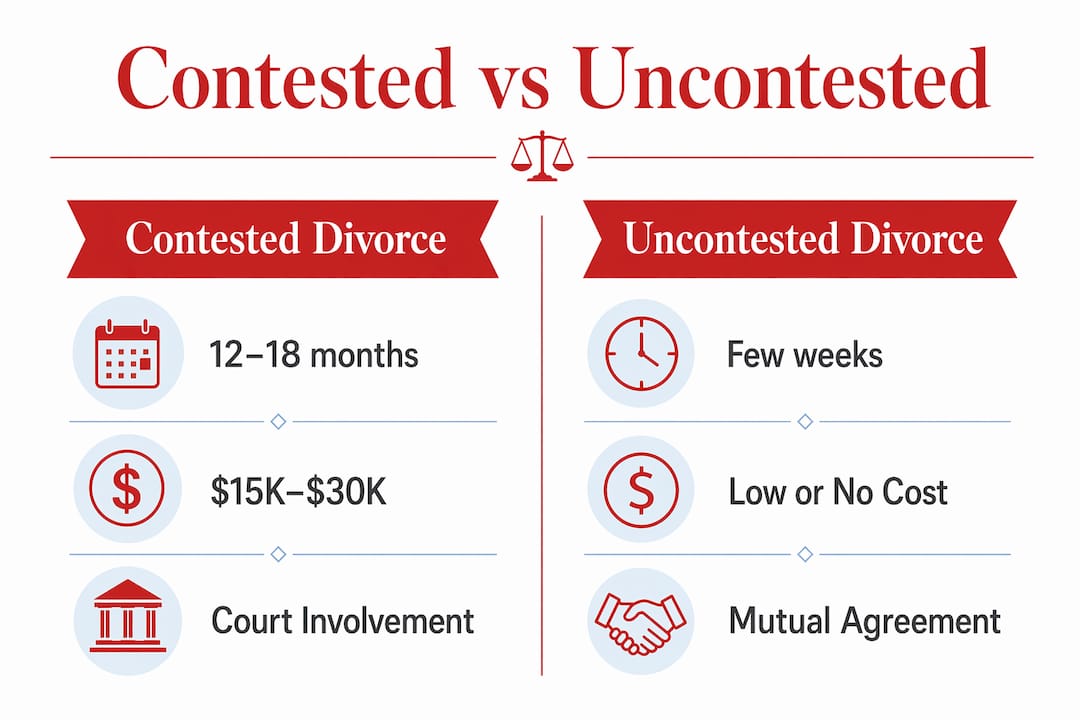
Contested divorces generally take 12–18 months to resolve, with complex cases involving custody battles or business valuations sometimes exceeding two years. Uncontested divorces, by contrast, typically resolve in 2–6 months. That difference in timeline directly translates to a difference in legal fees.
| Factor | Contested divorce | Uncontested divorce |
|---|---|---|
| Typical duration | 12–18 months (up to 2+ years) | 2–6 months |
| Average cost per spouse | $15,000–$30,000 | $1,500–$5,000 total |
| Complex case cost | $50,000+ per spouse | Rarely applicable |
| Court involvement | Mandatory | Minimal |
| Trial likelihood | ~5% | None |
Average contested divorce costs run $15,000–$30,000 per spouse, and cases involving custody disputes or significant assets can exceed $50,000 per spouse. Those figures cover attorney fees, court costs, expert witness fees, and mediation costs. Emotional conflict, not asset complexity alone, drives many of those expenses higher. Clients who fight over items of modest value because of anger or principle often spend more in legal fees than the disputed item is worth.
The financial implications of contested divorce extend beyond legal bills. You may need to maintain two households during the process, fund temporary support payments, and absorb the cost of financial experts. Building a cash reserve before filing is not optional. It is a practical necessity.
Can a contested divorce become uncontested?
A contested divorce can convert to an uncontested one at any stage, including during trial. Cases convert to uncontested when both parties reach a written agreement on all remaining issues. That possibility should shape how you approach every stage of the process.
The most effective resolution strategies include:
- Early mediation: Starting mediation before discovery is complete reduces legal fees and preserves more goodwill between parties. The role of a mediator in family court is to facilitate agreement, not impose one.
- Collaborative divorce: Both spouses and their attorneys commit to resolving disputes without litigation. The benefits of collaborative divorce include lower costs, faster resolution, and greater control over the outcome.
- Cost-benefit negotiation: Evaluate each disputed issue against its litigation cost. Settling a $20,000 asset dispute for $10,000 less than you wanted beats spending $15,000 in attorney fees to win it.
- Partial agreements: Resolving some issues by agreement narrows the scope of trial and reduces overall cost, even if full settlement is not yet possible.
- Financial documentation: Organizing your own records thoroughly gives your attorney better tools to negotiate from a position of strength.
Mediation successfully resolves about 70% of cases that attempt it. That rate holds even in high-conflict situations. The key is entering mediation with realistic expectations and a clear sense of your priorities.
Pro Tip: Rank your contested issues by importance before mediation. Decide in advance which ones you will fight for and which ones you will trade away. Walking into mediation without that clarity leads to reactive decisions that cost you money.
Key Takeaways
A contested divorce requires court intervention on at least one unresolved issue, costs significantly more than an uncontested case, and takes 12–18 months on average, but most cases settle before trial through mediation or negotiation.
| Point | Details |
|---|---|
| Definition of contested divorce | A divorce where spouses disagree on at least one issue, requiring a judge to decide. |
| Most common disputes | Child custody, property division, spousal support, and debt allocation drive most contested cases. |
| Timeline and cost | Expect 12–18 months and $15,000–$30,000 per spouse; complex cases cost $50,000 or more. |
| Trial is rare | Only about 5% of contested divorces reach a full trial; most settle during mediation. |
| Conversion is possible | A contested case can become uncontested at any stage once both parties reach full agreement. |
What I’ve learned after years of contested divorce cases
Litigation is the last resort, not the first move. I have watched clients spend $40,000 fighting over furniture and retirement accounts that a skilled negotiator could have split in a single afternoon. The emotional weight of a contested divorce is real, and it distorts financial judgment in ways that are hard to see from the inside.
The clients who fare best come in prepared. They have their financial records organized. They have already opened individual bank accounts and established their own credit. They understand that the process will take longer than they want and cost more than they planned. That preparation does not eliminate the pain, but it prevents the kind of reactive spending that turns a manageable case into a financial disaster.
The other thing I tell every client is this: your attorney’s job is to protect your legal interests, not to win every argument. Knowing when to settle is a skill. Knowing when to fight is equally important. The difference between those two decisions, made at the right moment, often determines whether you come out of this process in a stable position or a depleted one. Experienced legal counsel does not just argue in court. It helps you make better decisions at every stage.
— John
Jmoorelegal’s approach to contested divorce in Brevard County
Contested divorce cases require more than legal knowledge. They require a strategy built around your specific situation, your financial reality, and your goals for life after the process ends.

Jmoorelegal has represented clients through contested divorces in Brevard County, Florida for decades, including high-conflict cases involving custody disputes, military divorces, and complex asset division. The firm’s family law services cover every stage of the contested divorce process, from temporary orders and discovery through mediation and trial. Jmoorelegal is mediation certified and offers free initial consultations so you can understand your options before committing to a path. If you are facing a contested divorce, getting clear legal guidance early is the single most effective way to protect your interests and manage your costs.
FAQ
What is the main difference between contested and uncontested divorce?
In an uncontested divorce, both spouses agree on every issue before filing, and the court approves the agreement. In a contested divorce, at least one issue remains unresolved, and a judge makes the final decision.
How long does a contested divorce typically take?
Contested divorces take 12–18 months on average, with complex cases sometimes exceeding two years. Uncontested divorces typically resolve in 2–6 months.
Does a contested divorce always go to trial?
No. Only about 5% of contested divorces reach a full trial. The vast majority settle through mediation or negotiation before the trial date.
What does a contested divorce cost?
Average costs run $15,000–$30,000 per spouse for a contested divorce. Cases involving custody battles or significant assets can exceed $50,000 per spouse.
Can I switch from a contested to an uncontested divorce?
Yes. A contested divorce can convert to an uncontested one at any point, including during trial, once both spouses reach a written agreement on all remaining issues.
Recommended
- Divorce Procedure in Florida: Complete Legal Guide – The Law Office of John Vernon Moore, P.A.
- Benefits of a Collaborative Divorce – The Law Office of John Vernon Moore, P.A.
- Navigating the Complexities of Narcissism in Divorce – The Law Office of John Vernon Moore, P.A.
- Tips and Information on Military Divorces in Florida – The Law Office of John Vernon Moore, P.A.