
Medical records are defined as the primary evidence in any personal injury case, providing objective, clinical proof of injuries, treatments, and recovery that no other document can replicate. When you file a personal injury claim, your attorney and the opposing insurer both turn to these records first. A comprehensive medical history produces an accurate diagnosis in about 74% of clinical visits. That figure tells you exactly how much weight courts and insurers place on documented clinical findings versus verbal accounts alone. Understanding the role of medical records in an injury case is not optional. It is the foundation of every successful claim.
What types of medical records are essential in a personal injury case?
Medical documentation in personal injury falls into several distinct categories, and each one serves a specific evidentiary purpose. Missing even one category can leave a gap that defense counsel will exploit.
The core documents you need to collect include:
- Emergency room and ambulance reports. These capture your clinical condition within hours of the accident. They are the hardest evidence to dispute because they predate any recovery or memory bias.
- Physician and specialist notes. These detail diagnoses, treatment plans, and your reported symptoms at each visit. Inconsistencies between visits can hurt your case, so review them carefully.
- Diagnostic imaging reports. X-rays, MRIs, and CT scans show structural damage that words alone cannot convey. A radiologist’s written report carries significant weight with insurers and juries.
- Surgical and procedure reports. If you underwent surgery, these documents quantify the severity of your injuries in clinical terms.
- Physical therapy and rehabilitation records. These show the ongoing functional impact of your injuries and the effort required to recover.
- Medical billing records. Bills and explanation-of-benefits statements translate your injuries into economic damages, a required element in any tort claim.
- Records predating the accident. Pre-existing condition documentation lets your attorney argue what changed because of the accident, not what existed before it.
Pro Tip: Request records from every provider you saw, including urgent care clinics, chiropractors, and mental health professionals. Gaps in your provider list create gaps in your story.
The legal value of medical records in a personal injury claim depends on completeness. One missing imaging report or a single undocumented follow-up visit can reduce your settlement offer significantly.

How do medical records establish causation and injury severity?
Causation is the legal requirement that your injuries resulted directly from the defendant’s actions. Medical records are the primary tool for proving it. Medical records verify five critical elements in personal injury litigation: injury nature and severity, causation, treatment timeline, economic damages, and pre-existing conditions. Each element maps directly to what a court or insurer needs to evaluate your claim.
Here is how records build that proof step by step:
- Establish the timeline. The date and time stamps on emergency room and ambulance reports connect your injuries to the accident date. A clinical note written two hours after a car crash carries far more weight than one written two weeks later.
- Document injury severity. Physician notes and imaging reports describe injuries in clinical language that courts recognize. A diagnosis of “herniated disc at L4-L5” is more persuasive than a claimant’s description of back pain.
- Show functional impact. Therapy notes and follow-up records document how your injuries affected your daily life, your ability to work, and your quality of life over time.
- Confirm treatment necessity. Surgical reports and specialist referrals show that your treatment was medically required, not elective, which strengthens the economic damages portion of your claim.
- Address pre-existing conditions. Records from before the accident let your attorney argue the “aggravation” doctrine, meaning the defendant worsened a condition you already had.
Immediate post-injury documentation carries the most weight because it captures clinical status before recovery or memory bias sets in. This is why going to the emergency room immediately after an accident is not just a health decision. It is a legal one.
Key insight: The closer in time a medical record is to the accident, the harder it is for the defense to argue that your injuries came from a different source.
How to obtain and review your medical records effectively
Obtaining your records is a legal right, not a favor from your provider. The HIPAA Privacy Rule requires healthcare providers to give patients access to their records within 30 days of a written request, under 45 C.F.R. § 164.524(b)(2). That 30-day window matters when your attorney is building a demand package under a settlement deadline.
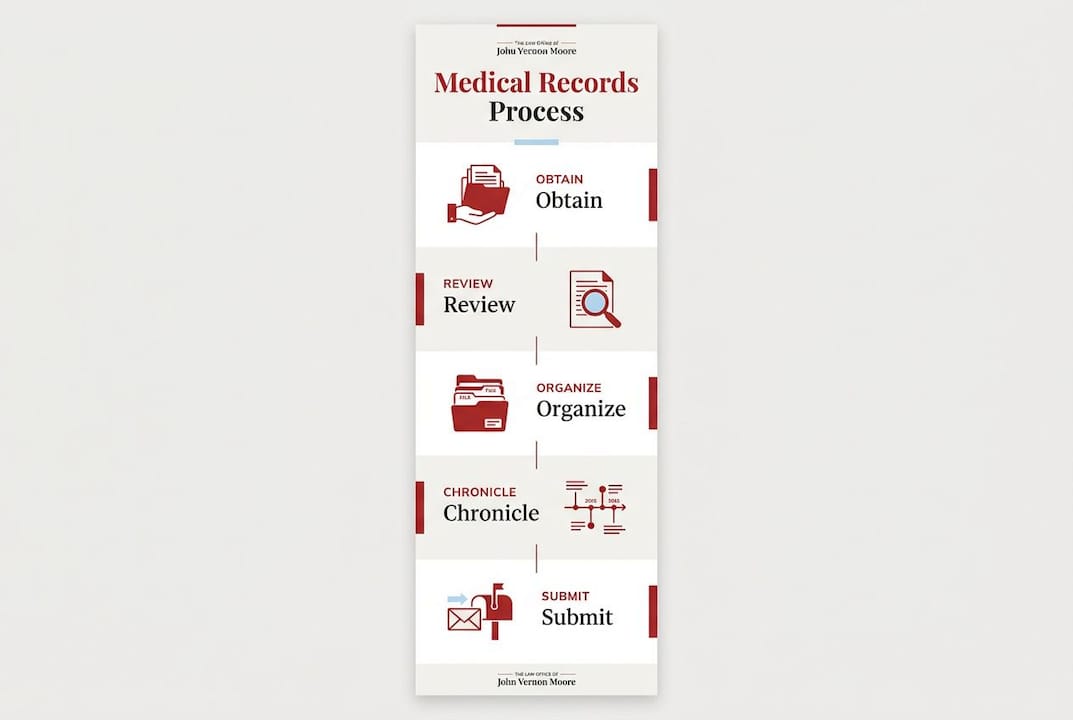
A faster and cheaper method exists. A HITECH Act-compliant request specifies electronic format delivery and pre-authorizes fees, which can reduce costs and accelerate processing compared to a standard HIPAA request. Ask your attorney to use this format from the start.
Once you have the records, review them with these priorities:
- Check for completeness. Confirm that every provider visit has a corresponding note. A visit with no documentation is a gap the defense will notice.
- Verify dates and diagnoses. Dates must align with the accident timeline. Diagnoses must be consistent across providers.
- Flag treatment gaps. A two-week break in treatment with no explanation gives defense counsel room to argue your injuries resolved or were unrelated to the accident.
- Review billing for accuracy. Billing records must match the services documented in clinical notes. Discrepancies invite challenges to your economic damages.
- Collect pre-accident records. Records from the two to three years before the accident establish your baseline health and support an aggravation argument.
Pro Tip: Build a medical chronology, a time-ordered summary of every significant medical event, before your attorney files a demand letter. It gives insurers, experts, and judges a clear narrative of your injuries and recovery.
A medical chronology is critical for lawyers, experts, and evaluators to grasp the full case story and identify strengths or weaknesses. Without one, raw records are just a stack of paper. With one, they become a persuasive account of what happened to you.
| Review task | Why it matters |
|---|---|
| Confirm all provider visits are documented | Undocumented visits create evidentiary gaps |
| Verify diagnosis consistency across providers | Inconsistencies invite credibility challenges |
| Identify and explain treatment gaps | Unexplained gaps reduce settlement value |
| Match billing records to clinical notes | Discrepancies undermine economic damage claims |
| Collect pre-accident baseline records | Supports aggravation doctrine arguments |
What are the most common misconceptions about medical records in injury claims?
The biggest misconception claimants hold is that collecting records is the finish line. Collecting records alone is insufficient. They must be reviewed for completeness and organized into a chronological narrative to provide strong evidentiary support. Raw records handed to an insurer without context rarely produce fair offers.
Defense attorneys are trained to find weaknesses in medical documentation. The most common vulnerabilities include:
- Unexplained treatment gaps. Short gaps in treatment can be exploited by the defense to argue injuries are less severe or unrelated to the accident. Even a two-week gap with no documented reason can reduce a settlement offer.
- Undocumented symptoms. Pain, fatigue, anxiety, and sleep disruption are real consequences of serious injuries. If your doctor never wrote them down, they effectively did not happen in the eyes of the insurer.
- Inconsistent histories. If you told the ER nurse your neck hurt but told your primary care physician three days later that you felt fine, that inconsistency will appear in the records and will be used against you.
- Missing imaging. An MRI ordered but never retrieved from the imaging center is a gap in your evidence file. Always confirm that reports, not just the images, are in your possession.
- Outdated records. If your treatment is ongoing, your records must be updated regularly. Submitting a demand package before your treatment concludes understates your damages.
“Medical files speak on behalf of patients when they are not present, making thorough documentation and record keeping critical to case success.”
Avoiding common personal injury mistakes starts with treating your medical record file as a living document, not a one-time collection task.
How do medical records impact settlement negotiations and trial outcomes?
Well-organized medical evidence directly determines the dollar value of your claim. Insurers calculate settlement offers based on documented injury severity, treatment duration, and economic losses. Records that tell a clear, consistent story produce higher offers. Records with gaps, inconsistencies, or missing documents produce lower ones.
Medical records act as the patient’s voice in legal proceedings long after the accident, when memories fade and witnesses become unavailable. A case that goes to trial two years after an accident relies almost entirely on contemporaneous clinical documentation.
The practical impact on your case includes:
- Stronger demand letters. A demand letter backed by organized records, a medical chronology, and itemized billing is harder to dispute than one with vague references to “ongoing pain.”
- Expert witness support. Medical experts base their testimony on your records. Incomplete records limit what an expert can say on your behalf.
- Faster resolution. Clear, complete records reduce back-and-forth with insurers and can shorten the time to settlement. Disputes arise most often when records are ambiguous or incomplete.
- Credibility at trial. Juries respond to clinical documentation. A physician’s note describing your limitations carries more weight than your own testimony about the same facts.
Pro Tip: If your case involves personal injury mediation, bring a printed medical chronology to the session. Mediators use it to evaluate claim value quickly, and it signals that your case is well-prepared.
The admissibility of medical evidence follows specific rules, and records that are incomplete, improperly authenticated, or obtained outside HIPAA procedures can be challenged or excluded entirely.
Key Takeaways
Medical records are the single most important evidence category in a personal injury case, and their completeness, consistency, and organization directly determine claim value and outcome.
| Point | Details |
|---|---|
| Collect all record types | Gather ER reports, physician notes, imaging, billing, and pre-accident records without exception. |
| Act immediately after the accident | Early documentation is the hardest evidence to dispute and establishes causation most effectively. |
| Use HITECH requests | A HITECH Act-compliant letter speeds up delivery and reduces record request costs. |
| Build a medical chronology | A time-ordered summary turns raw records into a persuasive narrative for insurers and courts. |
| Update records continuously | Submit demand packages only after treatment concludes to avoid understating your damages. |
What I have learned after years of injury cases
After handling personal injury cases in Brevard County for years, the pattern I see most often is this: claimants focus entirely on their physical recovery and assume their attorney will handle the records. That assumption costs people money.
The claimants who receive the best outcomes treat their medical file like a second job. They attend every follow-up appointment, they tell their doctors about every symptom, and they follow up to confirm that every visit is documented. They do not skip appointments because they feel slightly better. They understand that a two-week gap in treatment, even a reasonable one, will be used against them.
The other mistake I see regularly is waiting too long to start collecting records. Providers archive or destroy records after a set period. Imaging centers may not retain films indefinitely. The earlier you begin the collection process, the more complete your file will be.
A medical chronology is not just a legal tool. It is the clearest way for you to understand your own case. When you can see your entire treatment history laid out in order, you understand what you went through, what it cost, and what it is worth. That clarity makes you a better witness and a more confident participant in your own claim.
Treat medical record management as a core part of your case preparation from day one. Not as an afterthought.
— John
Jmoorelegal is ready to help you build your case
Personal injury claims in Florida depend on evidence, and evidence starts with your medical records. Jmoorelegal has spent decades helping clients in Brevard County access, organize, and present medical documentation that supports fair compensation.

Whether you were injured in a car accident, a slip and fall, or another incident, the team at Jmoorelegal works directly with you to identify every record that matters, close gaps in your documentation, and build a case that holds up under scrutiny. You get direct attorney access, a free initial consultation, and a legal strategy built around your specific situation. Visit the personal injury practice page to learn how Jmoorelegal can help you move forward with confidence.
FAQ
What is the role of medical records in an injury case?
Medical records provide objective clinical proof of injuries, causation, treatment history, and economic damages. They are the primary evidence used by attorneys, insurers, and courts to evaluate and resolve personal injury claims.
How soon should I get medical records after an accident?
Seek medical attention immediately after the accident and begin collecting records as soon as possible. Emergency room and ambulance reports written within hours of the incident carry the most evidentiary weight and are the hardest for the defense to dispute.
Can a treatment gap hurt my personal injury claim?
Yes. Even short gaps in treatment can be used by defense counsel to argue that your injuries resolved or were unrelated to the accident. Document every symptom with your provider and explain any gaps in writing at your next appointment.
What is a HITECH Act record request?
A HITECH Act-compliant request is a written demand for medical records that specifies electronic delivery and pre-authorizes fees. It typically produces faster results and lower costs than a standard HIPAA request and is the preferred method for injury claims.
Do I need a medical chronology for my personal injury case?
A medical chronology, a time-ordered summary of your significant medical events, is one of the most effective tools for presenting your case to insurers, expert witnesses, and courts. It transforms a stack of raw records into a clear, persuasive account of your injuries and recovery.
Recommended
- Common Personal Injury Case Mistakes to Avoid – The Law Office of John Vernon Moore, P.A.
- The Role of Surveillance in Injury Claims Explained – The Law Office of John Vernon Moore, P.A.
- Important Things Your Personal Injury Lawyer Needs To Know About Your Claim – The Law Office of John Vernon Moore, P.A.
- What Is Mediation in Personal Injury Cases? – The Law Office of John Vernon Moore, P.A.