You usually do not win against a narcissist in court by proving a diagnosis. You win by showing the judge specific, documented behavior that bears on the legal question: the children’s best interests, the finances, or your safety. Calling your spouse a narcissist feels satisfying and tends to backfire. Calm, organized, evidence-driven preparation works far better, and that is the approach we take with clients in Brevard County.
TL;DR
- Judges decide cases on behavior and evidence, not on personality labels. Describe what happened, when, and who saw it.
- Document promptly and objectively: dates, exact words, screenshots, records and witnesses, with no commentary.
- In the courtroom, stay neutral and let your lawyer respond. Visible anger is what a high-conflict opponent wants from you.
- Only a qualified mental-health professional can offer a diagnosis, and even then courts care about parenting behavior and the child’s well-being.
- Do not record or access anything illegally, and do not accuse anyone of lying without a solid basis.
Table of Contents
- Why the word “narcissist” rarely helps in a courtroom
- What narcissistic behavior tends to look like in litigation
- Build the record before you need it
- Behavior in the courtroom
- What to avoid when you want the court to see the truth
- Custody cases: what actually moves the judge
- Build a support system outside their reach
- Talk to a Brevard County family law attorney
- FAQ
- Sources
Why the word “narcissist” rarely helps in a courtroom
Most people searching this topic have lived through months or years of manipulation, blame-shifting and distortion. The word “narcissist” describes that experience. But a judge is not deciding whether your ex has a personality disorder. The judge is deciding where the children live, how assets are divided, or whether an order is needed to keep you safe.
An American Bar Association piece on this exact question makes the point plainly: in a custody case, the judge wants to know what the problem is and how to fix it for the child’s best interest, and how the trait developed is functionally irrelevant to the court.
There is also a credibility cost. A lay person is not qualified to diagnose anyone, and a label thrown around in a filing can read as name-calling. Forensic psychologists warn that casual labeling can undermine your credibility and that expert testimony resting on clinical shortcuts can draw admissibility challenges. If your claim depends on the label, an opposing lawyer can attack the label instead of the facts.
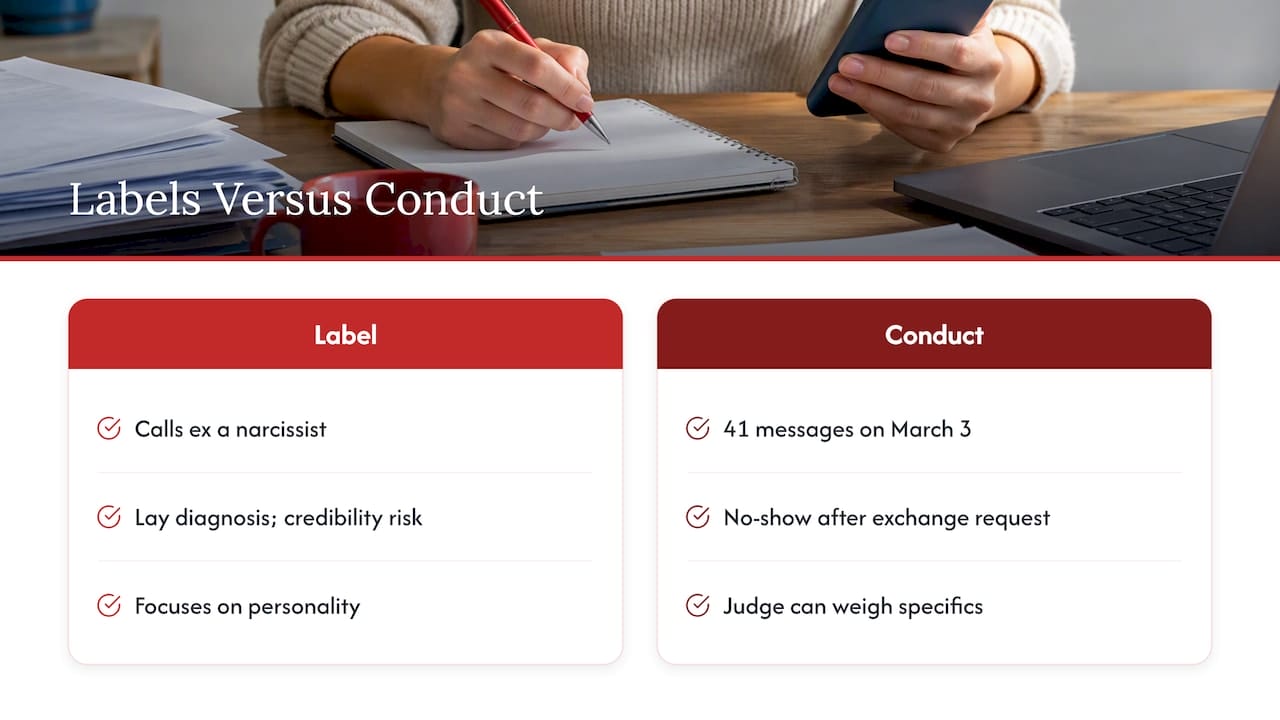
So translate the label into conduct. Instead of “he is a narcissist,” write: “On March 3, he sent 41 messages between 10 p.m. and 2 a.m. after I asked him to confirm the exchange time, and then did not appear.” A judge can weigh that. A judge cannot weigh a adjective.
When a diagnosis can come into the case
Sometimes mental health is genuinely relevant. If so, it belongs in the hands of a professional, typically within a custody or psychological evaluation, not in your own pleadings. Even then, the guidance for evaluators is that they should show their work, explain which standardized tests they used, and connect any diagnosis to observed parenting behaviors and documented child outcomes rather than treating the diagnosis as a stand-in for parenting ability. The same source stresses that a diagnosis is not inherently tied to whether a parent can co-parent or act in the child’s best interest.
For how Florida courts treat mental health in custody disputes, see our page on mental health and child custody in Florida.
What narcissistic behavior tends to look like in litigation
You do not need a label to recognize patterns, and recognizing them lets you plan. Reported tactics in high-conflict cases include failing to comply with court orders, switching lawyers, and making false attempts at reconciliation. Clients also describe:
- Charm toward the judge, hostility toward you. The other party may be composed and likable in the courtroom while the private reality is very different.
- Rewriting history. Events are retold with the roles reversed, sometimes in sworn statements.
- Escalation through procedure. Repeated motions, last-minute requests and delays that drive up your cost and exhaustion.
- Provocation. Comments designed to make you react, so your reaction becomes the story.
- Reputation attacks. Messages to friends, family or your workplace. We cover this in more detail in our guide to facing a smear campaign in divorce.
None of these requires you to prove what is going on inside the other person. Each can be addressed with a record: the order that was violated, the message that contradicts the testimony, the missed exchange.
Build the record before you need it
Courtroom credibility is mostly built months earlier, at your kitchen table. The best evidence is boring, dated and hard to dispute.
Document objectively
Guidance from the High Conflict Institute says to document events promptly and objectively, recording specific statements and behaviors rather than opinions or interpretations. It also advises correcting false statements in a court declaration in writing. A useful log entry has four parts: date and time, what was said or done (quote it), who was present, and any document that backs it up.
Compare:
- Weak: “She was manipulative and cruel at the exchange.”
- Strong: “June 12, 5:40 p.m., school parking lot. She told our son in front of me that I ‘chose work over him.’ Ms. R. (neighbor) was standing beside the car.”
Keep copies of emails, text messages, photographs and other records. Psychology Today’s coverage notes that keeping copies of what the person says and does is critical in long-term divorce litigation. Store backups somewhere the other party cannot reach.
Look beyond your own testimony
It becomes your word against theirs if you have nothing else. The ABA’s domestic-violence evidence guidance recommends seeking witness testimony, photographs, videos, messages and records to corroborate what you say. It points to people who saw or heard incidents, who observed injuries or property damage afterward, who received contemporaneous disclosures, or who noticed changes in behavior.
Think about teachers, coaches, pediatricians, neighbors, coworkers and friends who heard about events as they happened. A text you sent a sister the same night, saying what occurred, carries weight precisely because it was written before any lawsuit.
If safety is part of your situation, our guides on documenting abuse for court and how domestic violence affects custody explain how to gather proof without putting yourself at risk. For manipulation that makes you doubt your own memory, see the six records judges trust in gaslighting custody cases.
Know the evidence rules your lawyer works under
Two federal rules show why “he is a narcissist” is hard to use. Under Federal Rule of Evidence 701, a lay witness’s opinion must be rationally based on what the witness perceived and cannot rest on specialized knowledge. Under Rule 702 in the same document, expert testimony is admitted only if it helps the trier of fact, rests on sufficient facts or data, and reflects reliable principles reliably applied. Florida has its own evidence code and standards, so your attorney will frame things under state rules, but the logic is the same: observations from you, analysis from a qualified expert.
Florida appellate practice also points the same way. A Florida court-system case law update notes that dependency findings must be supported by competent, substantial evidence, and that an order resting only on one parent’s consent without further factual findings can be reversed. The principle: courts want facts.
Behavior in the courtroom
This is where most people are tested. The other party may smirk, interrupt, exaggerate or say something outrageous. Your job is to look like the steady adult in the room.
The ABA’s client guide to courtroom behavior advises keeping a neutral expression, ignoring untrue or unflattering statements while you wait for your turn, and avoiding visible anger because it is inappropriate and unproductive. It suggests writing notes to your lawyer and not speaking unless addressed.
In practice:
- Keep a legal pad. When something false is said, write it down with a page reference or time. Your lawyer decides whether and how to respond.
- Answer the question asked. On the stand, short, factual answers beat speeches. If you do not know or do not remember, say so.
- Do not argue with them directly. You will not out-debate someone whose goal is to provoke you, and the judge is watching how you handle it.
- Refer to behavior, not character. “He did not return the children until 9:15 p.m.” instead of “he is a liar.”
- Dress and arrive as if the judge is watching from the parking lot. Sometimes the judge is.
A reaction does more than embarrass you. It feeds the dynamic the other person is trying to create, and it becomes the version of events the judge remembers.
Protect your credibility against false claims
When the other side makes exaggerated or invented accusations, the instinct is to rebut every one. The ABA’s guidance on gaslighting in litigation suggests the opposite discipline. It recommends presenting yourself as professional, calm, prepared and reasonable, and it cautions that responding point by point to every minor allegation can distract the court from what matters and make you seem defensive.
The same article recommends studying the docket, pleadings, briefs, prior communications and procedural history so that factual distortions can be identified and corrected from the record, not from memory. Pick the two or three misstatements that actually affect the outcome, and answer them with documents.
What to avoid when you want the court to see the truth
The urge to “expose” someone is understandable, and it is the point where otherwise strong cases get damaged.
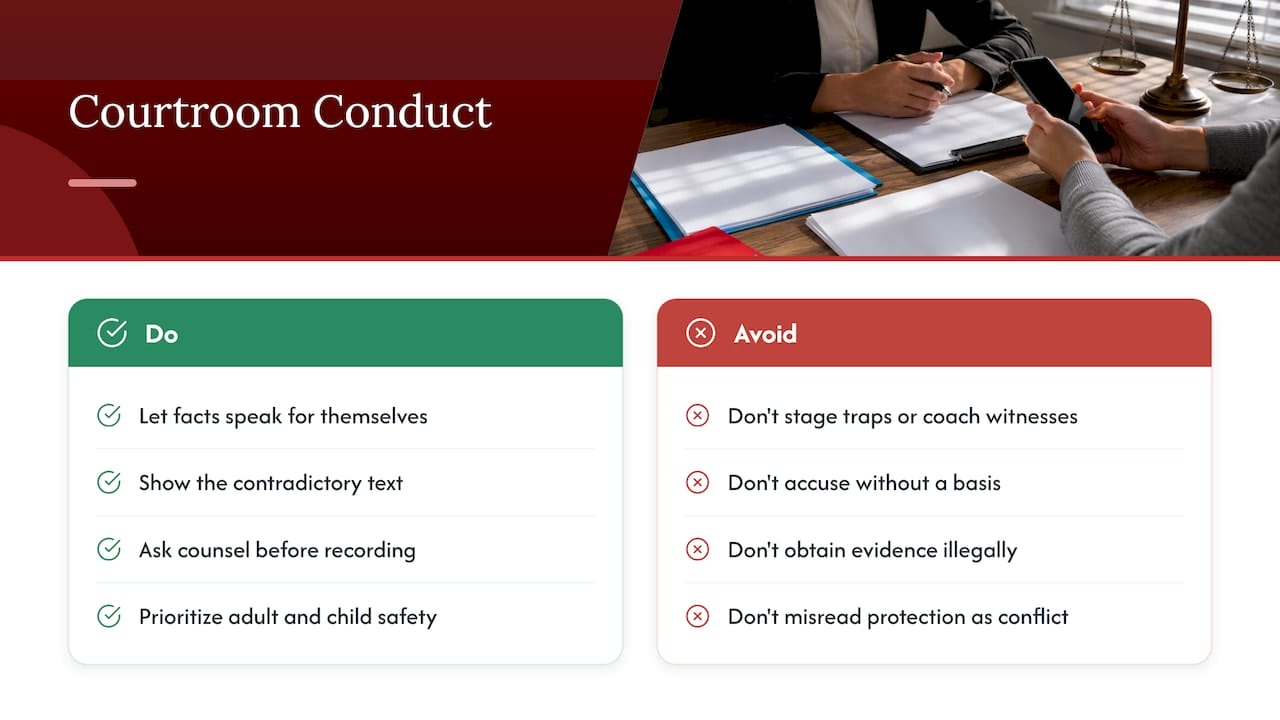
Do not try to bait a meltdown. Videos online promise ways to make a narcissist “lose it” on the stand. Courts do not reward staged traps, and your lawyer’s ethical duties limit what can be done. Cross-examination that lets the facts speak for themselves does more than theatrics.
Do not accuse without a basis. The ABA’s article on impeachment evidence notes that a lawyer needs a good-faith basis for impeachment questions under Model Rule 3.4(e), and warns that aggressively calling a sympathetic witness a liar can backfire. If the contradiction is in a text message, show the text message.
Do not obtain evidence illegally. Secret recordings, logging into someone’s accounts or tracking devices can create civil or even criminal exposure. The ABA’s family-law article on this topic warns that such material may be excluded and can expose you to liability, and advises asking how evidence was obtained and consulting counsel before using it. Ask your attorney before you record anything.
Do not coach your witnesses to say something untrue. ABA reporting on Formal Opinion 508 says truthful witness preparation is permissible, but lawyers must not encourage false testimony or improperly influence it. Honest witnesses are also the most persuasive ones.
Do not mistake safety concerns for “high conflict.” An ABA article on coercive control in custody litigation calls for an individualized, evidence-focused assessment and cautions that trauma-related behavior or protective actions may be misread as high-conflict conduct. It says arrangements should prioritize adult and child safety. If you fear for yours, tell your attorney first, and call 911 in an emergency.
Custody cases: what actually moves the judge
In custody disputes, the question is always the child. Evidence that tends to matter includes:
- School, medical and counseling records showing how the child is doing and who handles what.
- Communication logs showing how each parent talks about the other and about scheduling.
- Records of missed or late exchanges, and of compliance with the existing parenting plan or orders.
- Third-party witnesses who observed parenting directly.
- Where appropriate, a professional evaluation. Screening for coercive control, per the ABA article above, should use multiple sources, and questionnaires or semi-structured interviews when needed.
Structure also reduces the room for conflict. Detailed parenting plans, communication through a written channel and neutral exchange locations take away opportunities for distortion. Florida courts can appoint a parenting coordinator in suitable cases, and our playbook on co-parenting with a narcissist and our guide to custody exchanges in Florida cover day-to-day logistics.
Build a support system outside their reach
High-conflict opponents often work on your support network as well as the case. Psychology Today’s article suggests that a support network outside the person’s regular social circle can help prevent that person from infiltrating it and isolating you. A therapist, a trusted friend who never socialized with your spouse, or a support group gives you somewhere to process what you cannot say in a courtroom, and keeps the emotion out of your filings.
Our perspective
We have spent decades in Florida family courtrooms, and the pattern is consistent: the clients who do best are not the ones with the most dramatic story, but the ones with the cleanest record. When someone arrives convinced their spouse is a narcissist, we take that seriously, because the experience is real and the stress is real. Then we translate it. What happened, on which dates, who saw it, what document proves it, and what order do we need the judge to sign?
Our firm focuses on high-conflict divorce, military family cases and situations involving narcissistic personality disorder, so we know how quickly a hearing can become a stage for someone else’s performance. Our approach is to take the stage away. We keep your tone steady, we answer the allegations that matter, and we put the other party’s own messages, missed exchanges and broken orders in front of the judge.
You also deal directly with your attorney, not a rotating cast, and we are certified in mediation, which matters because some high-conflict cases do settle on firm, enforceable terms when the structure is right. When they cannot, you walk into court prepared and calm.
John
Talk to a Brevard County family law attorney
If you are preparing for a hearing, a custody dispute or a divorce in Brevard County against someone you believe is high-conflict, we can help you turn your experience into evidence a judge can use. Our family law practice covers divorce, custody, child support and military divorce, and we offer a free 30-minute consultation so you can ask about your situation before committing to anything.

If you are weighing settlement against trial, our guide to mediation versus trial in a Florida divorce explains how to choose, and our high-conflict divorce best practices and article on narcissism in divorce go deeper on strategy.
FAQ
Can you call someone a narcissist in court?
You can say it, but it rarely helps. A judge cannot rule on a label, and lay opinions about someone’s psychology carry little weight. Describe specific conduct with dates and proof, and leave any diagnosis to a qualified mental-health professional in a formal evaluation.
How do you expose a narcissist in court?
You do it with documents, not accusations. Keep a dated log, save messages and records, line up neutral witnesses, and let your attorney use the other party’s own statements to show inconsistencies. Staying calm while the other side escalates often exposes the pattern better than any argument.
How should I act when the other party lies or provokes me in the courtroom?
Keep a neutral face, write down what is untrue, and pass the note to your lawyer. Do not interrupt or speak unless addressed. Your attorney can correct the record through cross-examination, documents or testimony at the right moment.
Can I secretly record my spouse to prove their behavior?
Not without first talking to a lawyer. Recordings or electronic access that violate the law can expose you to civil or criminal liability and may be excluded from evidence. Ask an attorney what is lawful in your situation before you record anything.
Sources
- Narcissism or Not Narcissism? That Is the Legal Question, American Bar Association
- The Challenge of Personality Disorders in Custody Evaluations, Spring 2026
- 5 Ways High-Conflict Personalities Affect Court Proceedings, Psychology Today
- Taking the Assertive Approach in Family Court, High Conflict Institute
- Identifying and Utilizing Evidence in Cases Involving Domestic Violence, American Bar Association
- Federal Rules of Evidence, U.S. Courts
- Family Court Case Law Update, August-September 2010, Florida Courts
- A Client’s Guide to Courtroom Behavior, American Bar Association
- Gaslighting in Litigation, American Bar Association
- Impeachment Evidence: A Powerful Way to Discredit an Unfavorable Witness, American Bar Association
- The Admissibility of Illegally Obtained Evidence in Family Law Cases, American Bar Association
- Do this, not that, when preparing witnesses, ABA Journal
- Coercive Control in High-Conflict Custody Litigation, American Bar Association