Funding a trust in Florida means changing the legal owner of your assets from you personally to your trust, so the trustee can manage and distribute them without a court appointment when you die. Signing the trust document is only the first half. The Florida Bar explains that assets not transferred into a revocable trust may be subject to probate, which is the court process the trust was meant to avoid. At the Law Office of John Vernon Moore, P.A., we help Brevard County families with wills, probate and trust administration, and the most common problem we can describe is the same: a well-written trust that holds very little.
TL;DR
- A signed trust is an empty container until you retitle assets into it. Funding is what makes it do its job.
- Real estate needs a properly prepared deed. Bank and brokerage accounts need new titling or a new account in the trust’s name.
- Life insurance, retirement accounts and annuities usually pass by beneficiary designation, so they are coordinated rather than retitled.
- A pour-over will catches forgotten assets, but those assets still go through probate first.
- A trust does not erase every creditor claim. It changes how and where your estate is administered.
Table of Contents
- What funding a trust actually means
- Which assets to fund, and which to leave alone
- How to fund a Florida trust, step by step
- What happens to assets you forget
- What funding does not do
- Special situations in our community
- Our perspective
- Talk to us about funding your trust
- FAQ
- Sources
What funding a trust actually means
A revocable living trust is an agreement in which you (the settlor) place property under the control of a trustee for your benefit during life and for your beneficiaries afterward. Most people name themselves trustee while they are healthy and name a successor to step in later. The Florida Bar’s consumer pamphlet notes that you can manage the assets during your life, and change or end the trust while you are competent.
The trust document alone owns nothing. Under the Florida Trust Code, a trust can be created in three ways: transferring property to a trustee, declaring that you hold identifiable property as trustee, or exercising a power of appointment in favor of a trustee. In practice, the cleanest approach is a record trail: a deed, an account title, an assignment. Each one shows a bank, a title company or a judge that the asset belongs to the trust.
That is why funding matters. At death, the trustee can only act on property the trust owns. Property still in your individual name is a probate asset, and someone has to ask a court for authority to deal with it.
Which assets to fund, and which to leave alone
Not everything belongs in the trust. The Florida Bar points to bank accounts, real estate and investments as the usual candidates, and also cautions that some assets should not be transferred because of possible income tax consequences. That last point is the reason to decide asset by asset instead of retitling everything on a Saturday afternoon.
| Asset | Usual approach | What to watch |
|---|---|---|
| Home or other real estate | New deed into the trust | Mortgage terms, title questions, homestead rules |
| Checking and savings | Retitle to the trust, or open new trust accounts | Bank may require its own forms and a copy or certification of the trust |
| Brokerage and investment accounts | Retitle to the trust | Account type matters for taxes |
| Stock certificates, titled personal property | Reissue or assign | Registered owner must match the trust |
| Life insurance | Coordinate the beneficiary | Trust can be named beneficiary |
| IRAs, 401(k)s, annuities | Coordinate the beneficiary | Income tax rules are strict |
| Jointly owned property with survivorship | Often passes to the survivor automatically | Decide whether that fits the plan |
If you want a deeper breakdown of what goes where, our page on probate versus non-probate assets in Florida walks through it.
How to fund a Florida trust, step by step
1. Inventory everything you own
List every account, parcel, policy and certificate, with the current title and any beneficiary named. Include small accounts and old ones. Forgotten assets are the ones that end up in probate.
Where it goes wrong: people list what they use daily and miss the old savings account, the brokerage account from a previous employer, or a second parcel of land.
2. Sort assets into three groups
Group one is assets you retitle into the trust. Group two is assets that pass by beneficiary designation or survivorship. Group three is assets better left in your name for tax or practical reasons. The Florida Bar notes that jointly owned survivorship property and accounts or policies with designated beneficiaries may pass outside probate under their own terms, so those are not funded the same way.
3. Deed the real estate
The Florida Bar says the statements, certificates, titles or deeds should refer to the trust or to you as trustee, and that a deed moving real estate should be prepared by an attorney who considers existing mortgages, title issues and homestead restrictions.
This is the step with the most room for error. A deed with a wrong legal description, missing signing formalities or ignored homestead consequences can create a title problem that surfaces years later, usually when a family is trying to sell the house. If your home is a Florida homestead and you have a mortgage, the deed needs to be drafted with those facts in mind. Our attorneys handle this work as part of estate planning, and our trusts and trust administration page explains how trusts fit into a Florida plan.
If you own a single Florida house, you may also be weighing another tool. Florida does not have a transfer on death deed, and our guide on the Lady Bird deed compared with a revocable trust helps you see which fits your situation.
4. Retitle bank and investment accounts
Each institution has its own forms. Many want the trust name, the trustee names, the date of the trust and sometimes a copy of the signature pages or a certification. Ask the institution what it needs before you walk in, and keep the confirmation showing the new title.
Where it goes wrong: a new account is opened in the trust’s name but the old account stays open and keeps receiving deposits. Then the money is split between a trust asset and a probate asset, which defeats the purpose.
5. Coordinate beneficiary designations
The Florida Bar says life insurance, retirement accounts, annuities and accounts marked pay on death or in trust for pass according to their designations, and that a trust may be named beneficiary of life insurance or similar arrangements. The designation on file controls, not the trust, so a stale form can send money to a former spouse or a deceased relative.
Retirement accounts need extra care. IRS Publication 590-B says a trust itself cannot be a designated beneficiary of an IRA, but the trust’s beneficiaries can be treated as designated beneficiaries if the trust is valid under state law, becomes irrevocable at the owner’s death, has identifiable beneficiaries, and the custodian receives the required documentation. The same publication states that most designated beneficiaries who are not eligible designated beneficiaries must empty an inherited IRA by the end of the tenth year after the owner’s death, with exceptions for certain eligible beneficiaries. Naming a trust on a retirement account without planning for those rules can create avoidable tax results, so talk to your attorney and the plan custodian before changing a retirement designation.
6. Keep a funding record and update it
Keep a one-page schedule of what is in the trust, with dates and confirmations. Review it after any major event: a home purchase, a new account, a marriage, a divorce, a birth or a death in the family.
What happens to assets you forget
Assets still in your individual name at death may be subject to probate. Most trust-based plans include a pour-over will, which directs leftover assets to the trust. It helps, but according to the Florida Bar, a pour-over will does not make the probate step disappear: the assets go through probate first and only then move into the trust. Our article on pour-over wills and Florida probate explains the statute behind that and why the will is a safety net rather than a substitute for funding.
A practical example: a widow signs a trust, deeds her home into it, and leaves a $60,000 brokerage account in her own name. At her death, the home goes to the successor trustee without a court appointment. The brokerage account needs a probate case before it can reach the same beneficiaries. The family still opens a probate case, only for less money.
For larger estates and out-of-state owners, our overview of Florida probate avoidance covers the other tools that sit alongside a trust.
What funding does not do
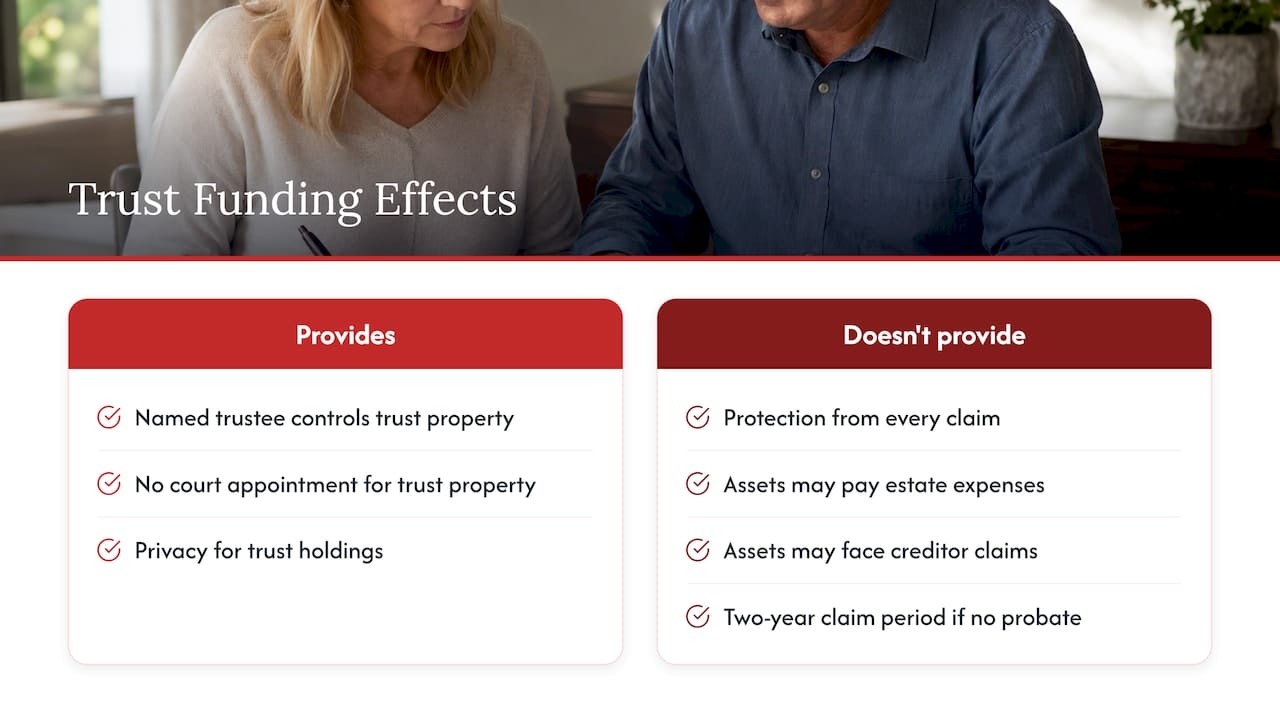
Funding a revocable trust is not a shield against every claim. The Florida Bar’s probate pamphlet says a revocable trust trustee must file a notice of trust after the settlor’s death, and that trust assets may be reachable for estate expenses and creditor claims in some circumstances. It also says that if no probate proceeding is opened, the assets in the decedent’s revocable trust are subject to a two-year creditor claim period.
A Florida Bar Journal analysis adds that revocable trust assets remain reachable by the settlor’s creditors to the extent they would not be exempt if owned individually. So the right way to think about funding is control and continuity: a named trustee, no court appointment for trust property, and privacy for what the trust holds. It is not a way to put assets out of reach.
One more formal point. Under Florida Statutes section 736.0403, the testamentary provisions of a Florida resident’s revocable trust, the parts that dispose of property at death, must be signed with the same formalities as a Florida will, subject to statutory exceptions for certain retirement plan trusts. A trust signed casually can fail on that point, which is a good reason to have it drafted and executed under attorney supervision.
Special situations in our community
A few circumstances change the funding checklist.
- Second marriages and blended families. Retitling a home into your trust can change what your spouse receives. Decide intentionally, and name beneficiaries to match.
- Divorce or separation in progress. Moving assets while a family case is pending can raise serious issues with the court. Speak with your family law attorney before you retitle anything.
- Military families. Frequent moves and out-of-state property mean more accounts, more titles and more chances for something to be missed. Nonresidents who own Florida property may also want to read about ancillary probate in Florida.
- After a death or injury claim. Wrongful death or settlement proceeds that arrive later should be directed into the right ownership structure from the start.
Our perspective
We see the trust as a plan that has two parts, the document and the funding, and clients often pay for the first and never finish the second.
Our approach is to treat funding as part of the engagement, not an afterthought. We go through the inventory with you, talk through each asset and its title, and make sure the deed, account forms and beneficiary designations tell the same story as the trust.
Because we also practice family law, criminal defense and personal injury, we know how quickly a life changes. A divorce, a lawsuit or a new diagnosis is the moment when a funded trust and current designations matter most. You speak directly with your attorney, and you do not have to guess which forms go where.
The first consultation is free and runs 30 minutes. Bring your trust, your latest statements and your deed, and we will show you what is already in the trust and what is not.
John
Talk to us about funding your trust
If you already have a trust, or you are about to sign one, the Law Office of John Vernon Moore, P.A. offers wills, power of attorney, and probate and trust administration for Brevard County families. Our consultations are free for the first 30 minutes. You can see how we work on our estate planning and probate page.

We can review your deed, your account titles and your beneficiary forms in one sitting and tell you what still needs to move.
FAQ
Do I need an attorney to fund a trust in Florida?
The account retitling is often handled through each institution’s own forms. Real estate is different: the Florida Bar says a deed transferring real estate should be prepared by an attorney who considers mortgages, title issues and homestead restrictions. An attorney who drafted your trust can also check that the whole set of changes matches the document.
Should my house go in my living trust?
For many Florida owners it is the most valuable asset, and a deed into the trust lets the successor trustee deal with it without a court appointment. Whether it is right for you depends on your mortgage, your homestead status and your family. If you own a single Florida house, compare the trust with a Lady Bird deed first. Our page on how to create and record a Lady Bird deed shows the process.
What if I forget to fund part of my trust?
A pour-over will sends those assets to the trust after your death, but they still go through probate first. Funding while you are alive avoids that step for the assets you transfer. A yearly review of your accounts is the simplest way to catch the gaps.
Should I put my retirement accounts in the trust?
Usually you coordinate the beneficiary designation rather than retitle the account. IRS rules limit how a trust can be treated as a beneficiary of an IRA, and a ten-year payout period applies to most non-eligible designated beneficiaries. Review the designation with your attorney and the plan custodian before changing it.
Sources
- The Revocable Trust in Florida, The Florida Bar
- Probate in Florida, The Florida Bar
- Designing Trust Systems for Florida Residents, The Florida Bar Journal
- IRS Publication 590-B (2025)
- Florida Statutes, Chapter 736 (Florida Trust Code)
- Florida Statutes section 736.0403