A mediation impasse in Florida means the mediator has declared that the parties cannot reach an agreement in that session. It does not end your case, cost you any legal rights or decide anything. The case goes back to the court process, and what you do in the days after often matters more than the session itself. A lawyer who knows your case can help you use those days well. If your dispute is a divorce, custody matter or injury claim in Brevard County, we can walk you through the next move.
TL;DR
- An impasse is the mediator’s declaration that the parties cannot agree in mediation. Florida’s Mediation Best Practices Handbook says the parties lose none of their legal rights.
- Anything you agreed on can still be written down, signed and filed, which narrows what a judge must decide.
- The mediator reports to the court without comment or recommendation. What was said in the room stays confidential.
- The case then moves on to the normal court process, or you can agree to pause and return to mediation.
Table of Contents
- What an impasse means under Florida law
- Why sessions stall, and what can still be tried before calling it
- What the mediator reports, and what stays private
- Lock in what you did agree on
- What happens to your case after an impasse
- A practical plan for the week after
- Our perspective
- Talk to us about your next step
- FAQ
- Sources
What an impasse means under Florida law
Mediation in Florida is an informal, nonadversarial process in which decisionmaking authority rests with the parties, not the mediator. The mediator cannot force a deal, and cannot rule on who is right. That is why an impasse is simply a statement that no deal was reached.
The mediator declares an impasse by reporting to the court or the parties the lack of an agreement. It can also happen at your request. A Florida Dispute Resolution Center advisory opinion says that when a party asks, the mediator must declare an impasse. The mediator should first explore alternatives and respect your right to decide for yourself, and should not do so before the opening statement.
So you are not trapped. If a session is going nowhere, you may say so. But a premature impasse is often a missed settlement, which is why the next section matters.
Why sessions stall, and what can still be tried before calling it
Most stalls are not about the law. They come from emotion, distrust or numbers that are far apart. The Florida Bar’s handbook lists tools mediators and lawyers use to keep talking, including brackets, contingent offers, combined rounds of offers, attorney-only or client-only conferences, a discussion of litigation costs and your best alternative, and a mediator’s proposal.
In plain terms:
- Brackets: each side gives a range instead of a single number, so you can see whether the ranges overlap.
- Contingent offers: you offer one term only if the other side agrees to another.
- Separate conferences: lawyers talk alone, or clients talk alone, to cool things down.
- Your best alternative: a realistic look at what a trial would likely cost and yield, compared with the deal on the table.
In high-conflict family cases, stalls often come from old grievances bleeding into money or parenting talks. This is where an attorney who has handled narcissistic and controlling opponents earns their place in the room. We have that focus, and we hold mediation certification, so we can help you separate the issues that can be settled from the ones that feed the conflict.
What the mediator reports, and what stays private
After an impasse, the mediator tells the court only the outcome. The Florida rules for certified and court-appointed mediators allow a report of agreement, no agreement, partial agreement or adjournment, with no comment, no recommendation and no opinion about anyone’s good faith. In family cases, Rule 12.740(f)(3) says the same. With the parties’ consent, the report may also identify pending motions, outstanding legal issues or discovery that would help settlement.
The word “impasse” is common in conversation, but a Florida advisory opinion treats it as a term of art that should not appear in a court report, because it can reveal what happened in the session. Expect the paperwork to say “no agreement.”
Confidentiality
Under section 44.405, mediation communications are confidential. A participant may not disclose them to anyone but another participant or counsel, and a party can refuse to testify about them later. Violations in court-ordered mediation can bring sanctions, including costs and attorney’s fees. The statute lists exceptions, such as signed written agreements, threats of violence, mandatory abuse reports and malpractice proceedings. Our guide on Florida mediation confidentiality and its six exceptions covers them in detail.
Practical point: do not post about, text about or tell friends what the other side offered. Your lawyer is the right person to discuss it with.
Lock in what you did agree on
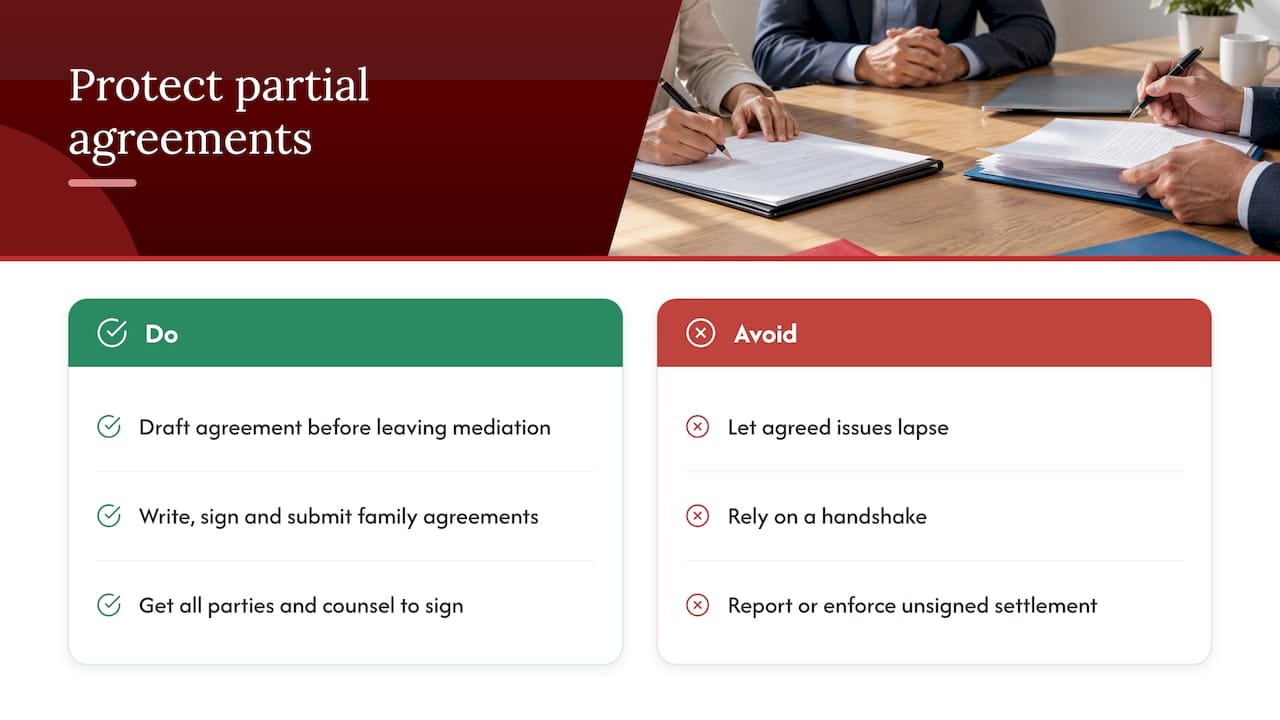
An impasse can be partial. If you agreed on some issues, such as the parenting schedule but not the house, do not let that lapse.
In family cases, an agreement on any matter must be written, signed by the parties and submitted to the court. It binds on filing when court approval is not needed, or on approval when it is, and becomes part of the final judgment. The Bar’s handbook adds that in state court a settlement arising from mediation may not be reported to the court or enforced until all parties and counsel have signed. A handshake at the end of the day is not enough.
Each resolved issue is one less issue for a judge, a smaller trial and a smaller bill. Ask your lawyer to draft the partial agreement before you leave the mediator’s office, while everyone is still there.
What happens to your case after an impasse
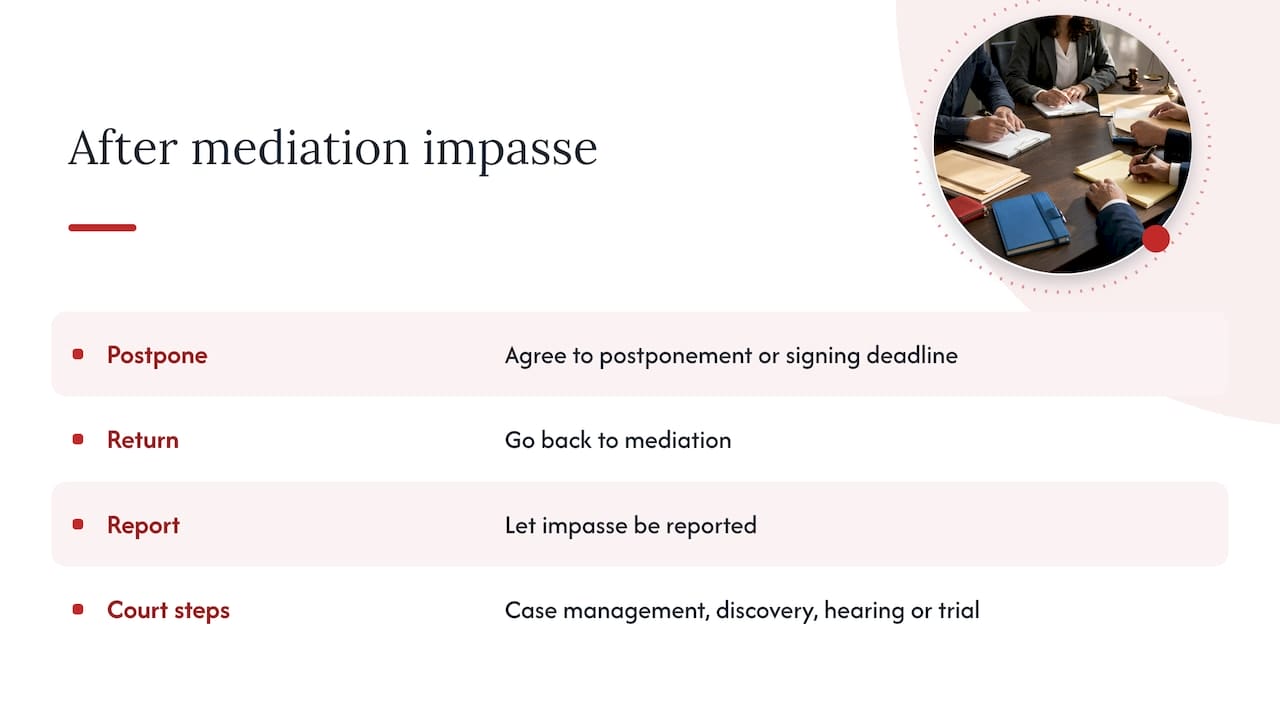
The Eleventh Judicial Circuit explains that when parties cannot agree, the case proceeds through the normal judicial process to be decided by the court. The Bar’s handbook describes your options: agree to a postponement or a deadline to sign a final agreement, return to mediation, or let the impasse be reported. In a family case, expect case management, discovery and a final hearing or trial on what remains.
Divorce and custody
With unresolved issues, discovery matters. Florida requires each spouse to exchange financial information, and our page on mandatory disclosure under Rule 12.285 explains it. If you suspect money was wasted or hidden, see dissipation of marital assets. If you are weighing the courtroom against another try at settlement, read mediation versus trial in a Florida divorce. Some couples also consider collaborative divorce as a structured alternative.
Family mediation must be completed within 75 days of the first conference unless otherwise ordered, under the rule amended effective July 1, 2024. If you or your children have been affected by domestic violence, that rule requires telling the court about injunctions, convictions or a history of violence, and the court may waive mediation or enter protective orders.
Personal injury and other money cases
In a civil case for money damages, a court must refer the case to mediation on one party’s request, if the costs can be paid or divided, subject to exceptions under section 44.102. That statute also says that while a case is in court-ordered mediation, the time to respond to a settlement offer or a demand for judgment is tolled until the mediator declares an impasse or reports no agreement. After impasse, such offers may be made at any time, and an offer is deemed rejected when trial begins.
That last point is important. Formal offers of settlement can carry fee consequences, so the days right after an impasse are when your lawyer may need to act. For background, see our guides on mediation in personal injury cases and common personal injury case mistakes.
A practical plan for the week after
- Write down your open issues. List what is settled and what is not, using your own notes, not the mediator’s.
- Get partial agreements signed and filed. Do this while momentum exists.
- Decide whether to resume. Ask whether a short second session, a deadline to sign, or a mediator’s proposal could close the gap.
- Review your numbers. Compare the last offer with a realistic trial outcome after costs and time.
- Prepare for the next court step. That means discovery, a case management date or a hearing.
- Keep communications clean. Respect confidentiality and avoid conduct that invites sanctions, such as those discussed in our page on Section 57.105 sanctions.
Our perspective
Many people leave an impasse feeling they failed. They did not. Mediation is a negotiation, and a first session is often one step in a longer one.
What we see as the best use of an impasse is a clear head. We sort what is agreed from what is not, put the agreed parts in writing, and decide with the client whether to return to the table or prepare for the judge. Direct attorney contact matters here, because the decision is personal and the clock is running.
In high-conflict divorces, including those involving a narcissistic spouse, and in military divorces, we prepare clients for the tactics that sink sessions, so that if the other side stalls, our client leaves with a record and a plan.
John
Talk to us about your next step
The Law Office of John Vernon Moore, P.A. represents clients in Brevard County in family law, including military divorces, as well as in criminal defense, personal injury and estate matters. We offer free 30-minute consultations and are mediation certified. If your session ended without a deal, bring your notes and any signed paperwork, and we will map the next step with you. See our family mediation services or our family law practice.

FAQ
Does an impasse mean I lose my case?
No. An impasse only means the mediation did not produce a deal. The Florida Bar’s handbook states the parties lose none of their legal rights, and the case continues toward a decision by a judge or jury.
Can I go back to mediation after an impasse?
Yes. Parties may agree to postpone, set a deadline to sign a final agreement or return to mediation. A mediator may also report an adjournment for further mediation, which is different from an impasse.
Can what I said in mediation be used against me at trial?
Generally no. Florida’s statute makes mediation communications confidential and gives parties a privilege to keep others from testifying about them. Exceptions exist, including signed agreements and threats of violence.
Who decides when mediation is at an impasse?
The mediator declares it. A mediator must do so when a party requests it, but should first explore alternatives and respect your right to decide.
Sources
- Florida Mediation Best Practices Handbook, third edition
- Florida Statutes, Chapter 44 (Online Sunshine)
- MEAC Advisory Opinion 2011-005
- MEAC Opinion 2010-007
- Florida Rules for Certified and Court-Appointed Mediators
- Florida Supreme Court opinion SC2023-1472
- 2025 Florida Statutes, Chapter 44
- Fla. Stat. 44.102 (2026)
- Eleventh Judicial Circuit mediation services