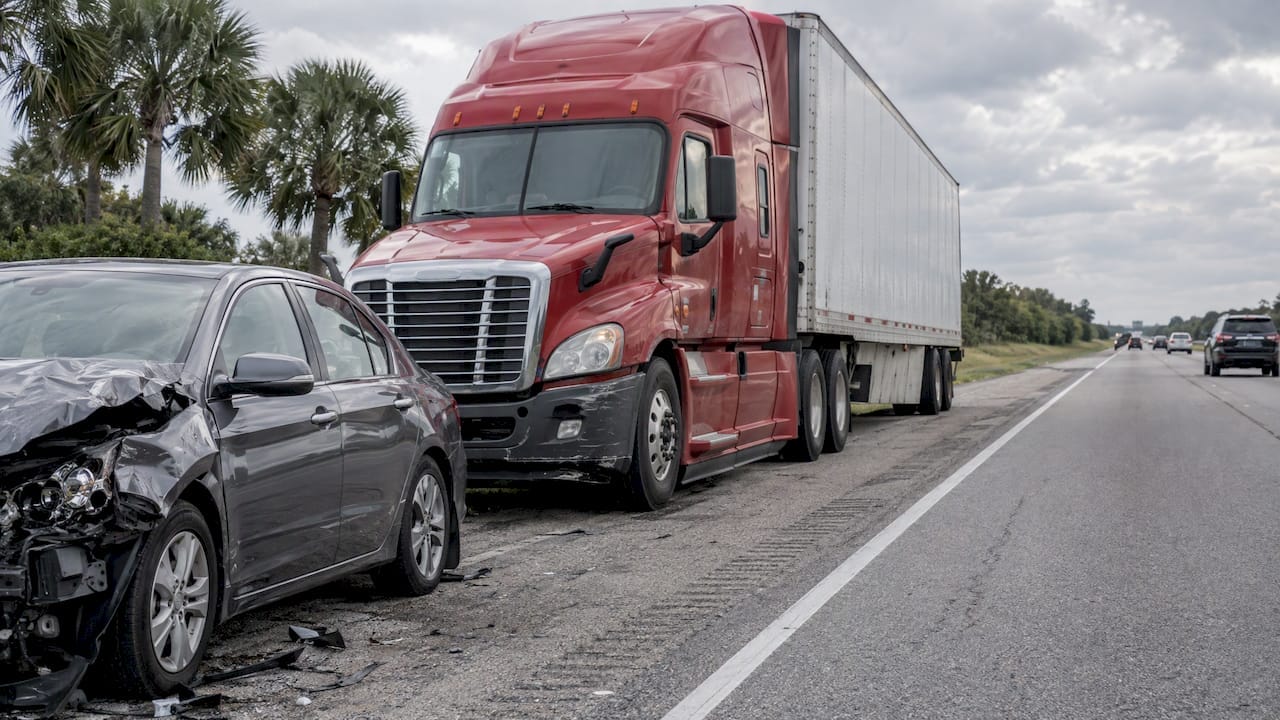
A Florida truck accident claim is built on three things: proving who was at fault, documenting what the crash cost you, and filing inside the legal deadline. Trucking cases are harder than ordinary car claims because more parties can share the blame and the key evidence can disappear quickly. If you were hurt in Brevard County or anywhere in Florida, a personal injury attorney can start protecting that evidence and handle the insurers for you. At the Law Office of John Vernon Moore, P.A., the first 30-minute consultation is free.
This guide explains the rules that decide a Florida truck claim, in plain terms, and what to do in the first days.
TL;DR
- Florida lets you recover money even if you were partly at fault, but if a court finds you more than 50 percent responsible, you recover nothing.
- Your own no-fault (PIP) coverage pays first, up to $10,000 per person per crash, and a truck claim goes beyond that.
- Negligence lawsuits generally must be filed within two years under the 2023 change to Florida law, so waiting costs you leverage.
- Trucking companies and their insurers start investigating almost immediately. You should be protecting evidence just as fast.
- Anything you say to an adjuster can be used to assign you a share of fault.
Table of Contents
- Why a truck claim is not a car claim
- How fault works in Florida: the 51% rule
- What to do in the first days after a truck crash
- The evidence that decides a truck case
- What damages can a truck accident claim cover?
- How the process unfolds
- The filing deadline: two years
- Common mistakes that cost truck accident victims
- Our perspective
- Talk to us about your truck accident
- FAQ
- Sources
Why a truck claim is not a car claim
A collision with a tractor-trailer or a delivery truck usually means heavier vehicles, more serious injuries and a bigger insurance policy on the other side. It also means more people who might be responsible. Depending on the facts, that can include the driver, the company that employs the driver, a company that loaded the cargo, or a business that maintained the truck.
That matters because Florida does not make one defendant pay for everyone’s share. Under section 768.81(3) of the Florida Statutes, the court enters judgment against each liable party according to that party’s own percentage of fault. A defendant who wants to blame someone who is not in the lawsuit has to plead that person’s fault and prove it at trial. In practice, this means a claim against only the driver can leave money on the table if someone else also contributed to the crash.
The way fault is established after any collision is explained in our guide on how liability is determined after a car accident. Truck cases use the same legal idea, negligence, applied to more facts.
How fault works in Florida: the 51% rule
Florida uses a modified comparative fault system. Two rules in section 768.81 work together:
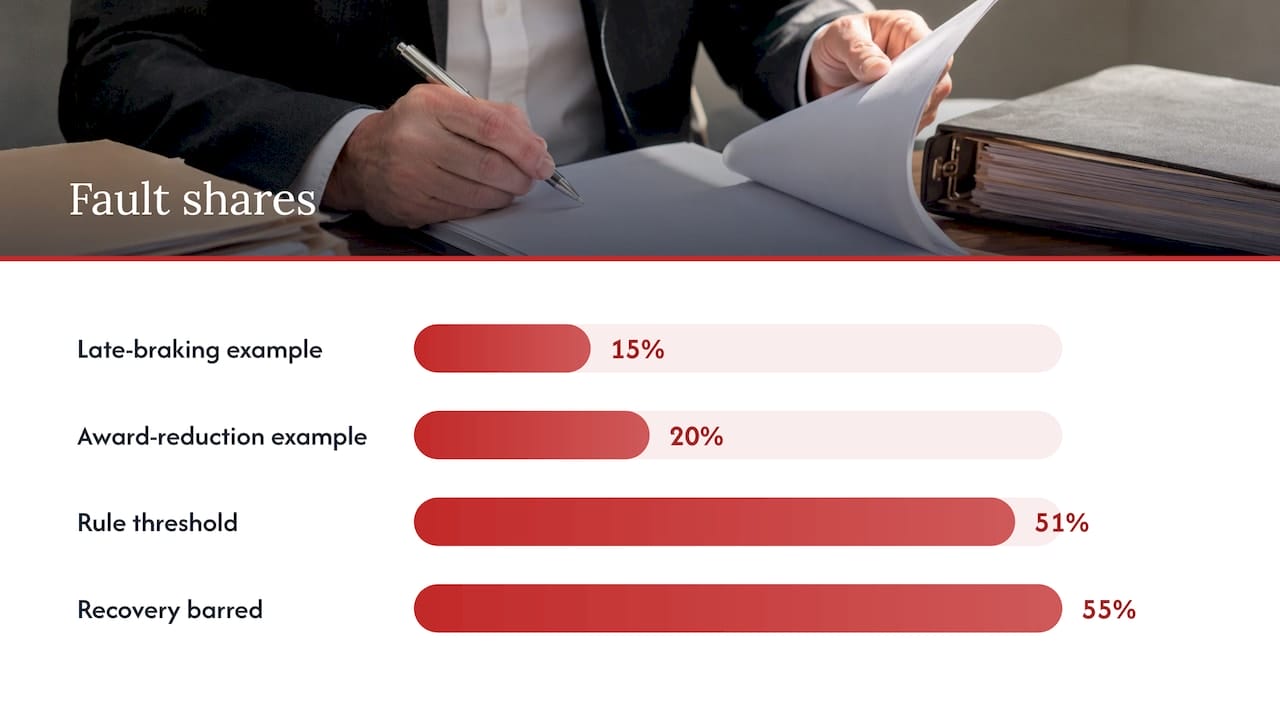
- Your share of fault reduces your award. If a jury finds you 20 percent at fault, your damages drop by 20 percent. Both economic and noneconomic damages are reduced.
- Above 50 percent, you recover nothing. Subsection (6) says a party found greater than 50 percent at fault for his or her own harm may not recover damages. This is the “51% rule.” It does not apply to medical negligence cases under chapter 766.
A worked example. Suppose a jury values your total losses at $400,000 and finds you 15 percent at fault for braking late. You would recover $340,000. If the jury instead found you 55 percent at fault, your recovery would be zero. The same $400,000 in losses produces completely different outcomes depending on one percentage, which is why the fight over blame is usually the center of a truck case.
Our article on comparative negligence in Florida and the 51% rule goes deeper on how these percentages are argued.
How trucking companies try to shift blame
Expect the other side to say you stopped suddenly, drifted between lanes, sat in the truck’s blind spot, or were speeding. Each accusation is an attempt to move your percentage up. Because the 51% line is so consequential, even a modest increase in your assigned fault can change what your case is worth. Never agree with a suggestion of fault at the scene, in a recorded statement or in a text to an adjuster, even to be polite.
What to do in the first days after a truck crash
Get medical care and follow it. Your health comes first, and records created soon after the crash link your injuries to the collision. Gaps in treatment are routinely used to argue you were not hurt as badly as you say.
Make sure the crash is reported. Under Florida Statutes § 316.065, a crash must be reported to law enforcement right away if it involved injury or death, or at least $500 of estimated vehicle or property damage, as the Florida Department of Highway Safety and Motor Vehicles explains. A truck crash with injuries meets that threshold almost every time.
Obtain the crash report. The same DHSMV page says crash-related insurance information is released only to a person involved in the crash, that person’s attorney, or an insurer’s representative for someone involved. If you hire us, we can request it on your behalf.
Document everything you can. Photograph the vehicles, the road, skid marks, the truck’s markings (company name, USDOT number, license plate) and your injuries. Get names and phone numbers of witnesses. Write down what you remember while it is fresh.
Be careful with insurers. The trucking company’s insurer may call within days and sound friendly. A short call can end up as a recorded statement that is later quoted against you. Give only basic identifying information, and refer questions about the crash to your attorney.
The evidence that decides a truck case
Trucking companies and their insurers often send investigators to the scene quickly, sometimes the same day. They are collecting facts that protect the company. You need your own record.
The evidence in a truck case is different from a typical car crash. Beyond the police report and photographs, it can include:
- Driver logs and hours-of-service records. Federal rules limit how long commercial drivers may drive without rest. Records showing a tired driver can support a negligence claim.
- Electronic data from the truck. Many trucks record speed, braking and other information in the moments before a collision.
- Maintenance and inspection records. Worn brakes or tires can point to the company or a repair shop, not only the driver.
- Cargo and loading records. An improperly loaded or overweight trailer can shift responsibility to the party that loaded it.
- Hiring and training files. These can show whether the company screened and trained the driver.
- Dashcam video and witness statements.
Some of this material is kept by the company for limited periods under federal record rules, and vehicle data can be overwritten when the truck returns to service. The practical lesson is to have an attorney send a written preservation request early, asking the company and its insurer to keep these records. The longer a claim waits, the more likely a key record no longer exists.
For the broader picture of what an injury lawyer needs from you, see important things your personal injury lawyer needs to know about your claim.
What damages can a truck accident claim cover?
Florida divides damages into economic and noneconomic losses. Section 768.81 describes economic damages to include:
- past lost income, and future lost income reduced to present value
- medical and funeral expenses
- lost support and services
- the replacement value of lost personal property
Noneconomic damages cover harms that do not come with a receipt, such as pain, suffering and loss of enjoyment of life. Serious truck injuries often involve long-term care and lost earning ability, so the value of the claim depends heavily on how well future medical needs and income loss are documented. Medical records, physician opinions and employer wage records all feed into that number.
Where PIP fits
Florida is a no-fault state for the first layer of medical bills. The DHSMV lists personal injury protection limits of $10,000 per person per crash. That coverage comes from your own policy, regardless of who caused the crash, and it is only the start. A serious truck injury can exceed it quickly, and the claim against the at-fault parties is what addresses losses beyond it.
We explain how PIP, fault and settlement values interact in Florida car accident settlements. The same logic applies to truck cases, usually with larger numbers and more complex proof.
Insurance on the at-fault side
DHSMV notes that Florida’s financial-responsibility law may require an at-fault owner or driver to carry full liability coverage when a moving violation is charged and injuries or possible injuries appear in the crash report. Commercial carriers are also subject to federal insurance requirements. Identifying every available policy early, including the driver’s, the company’s and any other responsible party’s, is part of building the claim.
How the process unfolds
Every case is different, but most follow this order:
- Treatment and investigation. You get care while evidence is preserved and the crash is investigated.
- Claim notice. Your attorney notifies the responsible parties and insurers and requests the records described above.
- Demand. Once your medical picture is clear enough to value, a written demand sets out liability and damages.
- Negotiation. The insurer responds, often with a low first offer and an argument that you share fault.
- Lawsuit, if needed. If negotiation fails, a complaint is filed in court, followed by discovery, mediation and possibly trial.
Most injured people settle before trial, but a case is strongest when it is prepared as if it may be tried. Our stage-by-stage settlement timeline shows what each phase typically involves and why rushing the demand can shortchange you.
The filing deadline: two years
The deadline is the one rule that can end a valid claim no matter how strong the evidence. The text of HB 837 (2023) amended section 95.11 to provide a two-year limitations period for actions founded on negligence, shortening what had been four years for many negligence cases. Truck crashes are negligence cases, so plan on two years, measured from the date of the crash.
Two years sounds long, but truck cases take time to investigate and the best evidence fades sooner. Settlement talks that run late can also leave no room to file. Read more in our explanation of HB 837 and the Florida statute of limitations. Because a missed deadline cannot be fixed, talk to an attorney well before it approaches, especially if a death, a government vehicle or a more unusual defendant is involved, since different rules can apply.
Common mistakes that cost truck accident victims
- Giving a recorded statement before understanding how the insurer will use it.
- Posting about the crash or your activities on social media, where a photo can be portrayed as proof you are not hurt.
- Skipping or stopping treatment, which creates the gaps insurers exploit.
- Accepting an early settlement before the full extent of the injury is known. A release usually ends the claim permanently.
- Waiting to preserve evidence.
We cover more of these in common personal injury case mistakes to avoid.
Our perspective
When someone comes to us after a serious crash, they are usually dealing with pain, missed work and a phone that will not stop ringing. The insurer has a team. The injured person is trying to figure out the rules while recovering.
We believe a case is won by preparation and by honest, direct communication. At our firm, you deal directly with your attorney, not a revolving door of staff, and we build a strategy around your injuries, your income and your family, not a template. Because Florida can reduce or even bar recovery based on a percentage of fault, we treat the fault question as the first thing to protect, not the last.
Our practice covers personal injury, including car accidents and wrongful death, alongside family, criminal and estate matters, and we serve clients throughout Brevard County. That breadth helps because a serious injury often touches more than the claim: a spouse’s income, a custody schedule, a will that now needs updating. Our first 30-minute consultation is free, so you can learn where you stand before making any decision.
John
Talk to us about your truck accident
If you or a family member was hurt in a collision with a commercial truck, our personal injury practice handles car accidents, wrongful death and other injury claims for clients in Brevard County. We offer free 30-minute consultations, where you can describe what happened and learn how fault, deadlines and evidence apply to your situation.

The sooner we hear from you, the more evidence can be preserved. You can also read about Florida auto accident law before you call.
FAQ
What is the 51% rule in Florida?
Under section 768.81(6) of the Florida Statutes, a party found more than 50 percent at fault for his or her own harm cannot recover damages in a negligence action. If you are 50 percent or less at fault, you can still recover, but your award is reduced by your percentage.
How long do I have to file a truck accident lawsuit in Florida?
For negligence claims, Florida law as amended by HB 837 in 2023 provides a two-year limitations period. Because truck cases need time for investigation, you should consult an attorney long before the two years run out.
How can I get a copy of my Florida crash report?
The Florida DHSMV releases crash-related information only to people involved in the crash, their attorneys, or an insurer’s representative for someone involved. If you hire an attorney, your attorney can request it for you.
Does PIP cover all my medical bills after a truck crash?
No. Florida DHSMV lists PIP limits of $10,000 per person per crash, which is the first layer of coverage. Serious truck injuries often involve costs beyond that, which a claim against the at-fault parties can address.
Sources
- Florida Statutes section 768.81, Online Sunshine
- Florida Statutes section 768.81(3), 2026
- Chapter 768, Section 81, 2023 Florida Statutes
- Involved in a Crash? Florida DHSMV
- HB 837 (2023) bill text, Florida Senate