

Gaslighting can absolutely affect a custody outcome, but only when it’s proven as a pattern, not just alleged. Judges do not rule on the word “gaslighting”; they rule on coercive control, credibility, and parental fitness backed by evidence. If you suspect it’s happening to you or your child, start today: preserve every record you have, limit unnecessary direct contact with the other parent, and talk to a family law attorney before you respond to anything else.
TL;DR:
- Courts evaluate coercive control and credibility backed by documented patterns rather than relying solely on allegations or the word “gaslighting.”
- Building a strong, court-ready record involves preserving digital communications, medical notes, school reports, witness statements, and understanding recording laws.
- Evidence connecting consistent incidents across multiple sources, such as teachers or therapists, carries more weight than single allegations or vague claims.
- In cases of false accusations, gathering corroborating evidence and offering documented explanations are crucial to protect your credibility.
- Long-term child recovery depends on early, documented intervention and pattern recognition, as prolonged gaslighting can damage parent-child relationships permanently.
Table of Contents
- What Gaslighting Looks Like in Custody and Co-Parenting
- Why Courts Care About Gaslighting and How Judges Evaluate It
- Your Evidence Checklist: Building a Court-Ready Record
- Turning Your Records Into Courtroom Evidence
- If You’re the One Being Accused: Protecting Your Credibility
- Staying Safe and Sane While the Case Is Pending
- How Gaslighting Affects Kids Caught in the Middle
- The Lasting Damage to the Parent-Child Bond
- Legal Precedent: How the Law Has Treated These Claims
- What Evaluators and Therapists Look For
- Practitioner View: How These Cases Actually Get Built
- How the Law Office of John Vernon Moore, P.A. Can Help
- Select Authoritative Reading and Legal Resources
- Sources
- FAQ
What Gaslighting Looks Like in Custody and Co-Parenting
Gaslighting in custody disputes rarely shows up as one dramatic event. It shows up as a slow campaign of small distortions that, stacked together, rewrite what actually happened. A parent might insist a missed pickup never occurred despite a text trail proving otherwise, or file a court declaration that contradicts their own emails from three weeks earlier.
Recognizable patterns include:
- Denying documented events, like a canceled visitation or a school meeting, that exist in writing.
- Rewriting history in court filings, minimizing prior agreements or admissions.
- Trivializing legitimate safety or parenting concerns as “overreacting” or “dramatic.”
- Reframing a child’s own statements to fit a preferred narrative.
- Coaching a child to repeat a version of events that doesn’t match what the child told a teacher, therapist, or the other parent.
What separates gaslighting from a normal disagreement or a foggy memory is repetition and intent. One inconsistent recollection is human. A consistent pattern that isolates a parent, distorts a child’s sense of reality, and resists correction even when shown contradicting proof is something courts and evaluators treat differently.
Why Courts Care About Gaslighting and How Judges Evaluate It
Family courts don’t have a checkbox for “gaslighting.” They evaluate the conduct underneath the label, usually filed under coercive control, emotional abuse, credibility, or parental alienation, and they weigh facts, not vocabulary. That distinction changes how you should build your case: labeling behavior as gaslighting means nothing to a judge without a documented pattern behind it, as family law commentary on these disputes makes clear.
Mutual accusations complicate things further. When both parents claim the other is manipulative, the case often collapses into a credibility contest, and credibility contests reward whoever has the paper trail, not whoever sounds more convincing on the witness stand.
Courts have tools to help determine whether one parent’s behavior shows a genuine pattern of control. A Guardian ad Litem, appointed to represent the child’s interests independently, can interview teachers, review records, and report findings without the emotional stake either parent carries. Judges lean on these neutral sources precisely because parental testimony alone is the least reliable evidence in the room.
Your Evidence Checklist: Building a Court-Ready Record
Winning a gaslighting claim, or defending against one, comes down to what you can show, not what you can argue. Start building this record the moment you suspect a pattern, not after your next hearing is scheduled.
- Save contemporaneous digital records. Texts, emails, and messages through court-recognized parenting apps create timestamped proof that’s hard to dispute later.
- Collect medical and therapy notes. A child’s counselor or your own therapist can document behavioral changes tied to specific incidents.
- Gather school communications. Teachers and counselors often notice and record changes in a child’s mood or statements that corroborate your timeline.
- Preserve before you confront. Screenshot, back up, and date everything before raising an issue directly, since accounts get deleted or edited once someone realizes they’re being documented.
- Line up third-party witnesses. Neighbors, relatives, or coaches who observed specific incidents can convert your word into corroborated fact.
- Check your state’s recording laws before taping anything. Covert recordings can backfire legally in some jurisdictions. Consult an attorney before you record a conversation, not after.
Digital and documentary evidence, including messages and medical and therapy records, tends to carry more weight with judges than testimony alone, because it doesn’t depend on memory or persuasion.
Pro Tip: Keep a simple dated log, even a private notes app entry after each incident. Courts respond better to a boring, consistent record than to an emotional narrative assembled after the fact.
Turning Your Records Into Courtroom Evidence
A folder of screenshots doesn’t win a case by itself. An attorney’s job is translating that raw material into a timeline a judge can follow in twenty minutes, not two hours. That usually starts with deciding whether the case needs a psychological evaluation, a Guardian ad Litem, or a social investigator’s report, each suited to different kinds of disputes and different levels of urgency.
Experts frame coercive control for a judge by connecting specific incidents to a documented pattern of effect, showing how a child’s grades slipped, how a parent’s isolation from friends and family tracked with escalating conflict, how contradictory statements in court filings line up against dated evidence. Contemporaneous records that contradict a parent’s sworn statements carry particular weight because judges can compare the two side by side.
From there, remedies vary by severity. Courts can modify timesharing, order supervised visitation, issue injunctions, or schedule an evidentiary hearing focused specifically on the disputed pattern. None of these happen from an allegation alone. They happen because counsel built exhibits, exchanged demonstrative timelines, and connected dots the other side couldn’t refute. If parental alienation is part of the picture, understanding how alienation claims are evaluated alongside coercive control allegations helps set realistic expectations for a hearing.
If You’re the One Being Accused: Protecting Your Credibility
Being accused of gaslighting is disorienting, especially when the claim is exaggerated, taken out of context, or flatly false. How you respond in the first few weeks matters more than almost anything else in the case.
- Figure out honestly whether the claim is false, partially true, or a mischaracterization of a real disagreement, since your legal strategy depends on which one it is.
- Gather your own corroborating evidence: your version of the same texts, calendar entries, or witness accounts that show a different context.
- Offer documented alternative explanations rather than emotional denials. “Here’s the email from that day” beats “that never happened.”
- Request neutral procedural tools, like a stipulated timeline or a third-party evaluation, instead of arguing your credibility against theirs.
- Avoid retaliation on social media or through the kids. Anything you post can be read into the record.
Get a family law attorney involved early, especially if the accusation ties into false allegations of abuse or domestic violence claims that could affect timesharing. Escalating the fight yourself, rather than through counsel, tends to hand the other side exactly the pattern evidence they’re trying to build.
Staying Safe and Sane While the Case Is Pending
Litigation can drag for months, and how you communicate during that stretch shapes both your safety and your credibility. Put logistics in writing through a parenting app or, when things are contentious, route messages through your attorney entirely.
- Use a Fact → Source → Next-step reply for disputes: state the fact, point to where it’s documented, and propose the next action. This keeps you from getting pulled into arguing over who’s telling the truth, a tactic that reduces circular conflict in high-conflict co-parenting.
- Keep your own therapy appointments and your child’s, both for well-being and because clinical notes become useful records later.
- Protect your child’s privacy. Don’t discuss case details with or around them, and don’t ask them to relay messages.
- If threats, stalking, or signs of imminent danger appear, contact domestic-violence advocates or law enforcement immediately and consider a protective order rather than handling it through negotiation.
Pro Tip: Draft your replies, then wait fifteen minutes before sending. Gaslighting tactics often aim to provoke a reactive message that looks bad out of context later.
How Gaslighting Affects Kids Caught in the Middle
Children absorb far more of this conflict than most parents realize. When a child is repeatedly told their own memory is wrong, especially about something they witnessed directly, like a parent missing an event or breaking a promise, it teaches them not to trust their own perception. That’s a heavier cost than a single lie; it’s a pattern that reshapes how a child processes reality.
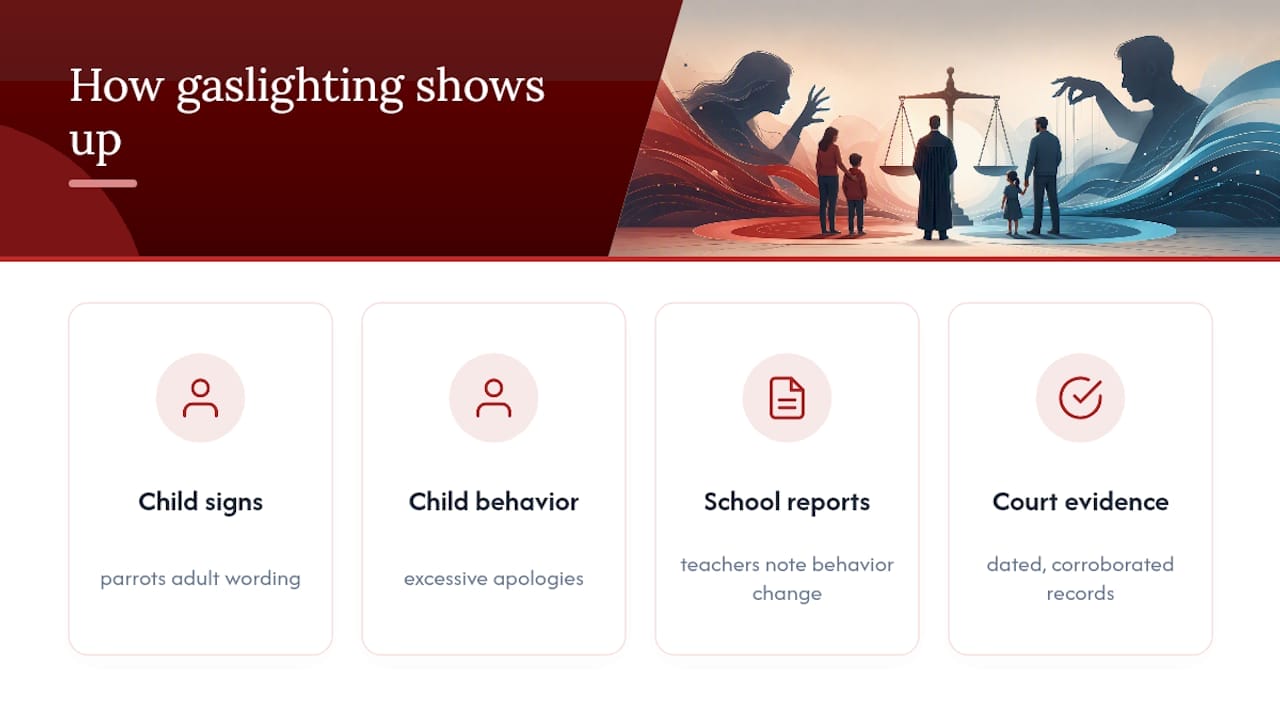
Kids caught in a gaslighting dynamic often show it indirectly rather than saying it outright. Watch for a child who suddenly parrots language that sounds adult and rehearsed, who apologizes excessively for things that aren’t their fault, or who becomes anxious about which version of events to share with which parent. Teachers and school counselors are often the first to notice these shifts, since kids frequently behave differently at school than they do in either parent’s home.
This is exactly why courts weigh Guardian ad Litem reports and school records so heavily. A child’s statement alone, especially a young child’s, is vulnerable to coaching and repetition. But a documented change over time, corroborated by a teacher, a counselor, and dated behavioral notes, tells a judge something a single interview can’t. Custody evaluators are trained to distinguish a child expressing genuine fear from a child reciting a script, though that distinction takes real clinical skill to draw correctly.
The psychological cost isn’t limited to the pending case, either. Kids in high-conflict households with gaslighting dynamics often carry confusion into ordinary decision-making long after a custody order is finalized.
The Lasting Damage to the Parent-Child Bond
A custody order doesn’t erase what happened during the years leading up to it. When one parent has spent months or years telling a child that the other parent’s version of events is a lie, the damage to that relationship often outlasts the litigation itself.
Some children grow into adults who struggle to trust their own judgment, particularly in close relationships, because a formative period of their life involved being told repeatedly that what they saw and felt wasn’t real. Others develop a fractured relationship with the targeted parent, having internalized a distorted narrative during years when they had no way to independently verify it.
This is part of why courts increasingly favor pattern-based, documented interventions over waiting to see if things resolve on their own. A modified timesharing order or a supervised visitation arrangement, put in place while a child is still young enough to benefit, tends to produce a healthier long-term outcome than a case that drags for years without intervention. Contempt motions and enforcement actions, when a parent repeatedly violates custody terms tied to a gaslighting pattern, can also reinforce boundaries the court has already set.
The parent on the receiving end of gaslighting carries lasting effects too, often describing a slow erosion of confidence in their own recollection and judgment during the litigation, followed by a long recovery afterward.
Legal Precedent: How the Law Has Treated These Claims
There’s no single landmark case that created a legal category called “gaslighting in custody.” That’s the point worth understanding: because gaslighting isn’t a standalone cause of action, courts have folded it into existing frameworks, most often coercive control statutes, emotional abuse provisions within domestic violence law, and parental alienation doctrine, that predate the term’s popular usage.
This matters practically. Attorneys building these cases cite precedent on coercive control and credibility determinations, not precedent specifically labeled “gaslighting,” because that’s how appellate courts have actually ruled. A parent’s manipulative pattern gets evaluated the same way a court would evaluate any claim of emotional abuse: through documented incidents, expert testimony, and a comparison between sworn statements and contemporaneous records.
The practical lesson from how courts have handled these disputes is consistent: pattern-based presentations succeed far more often than single-incident claims, because judges are trained to be skeptical of one-off allegations in emotionally charged custody fights. A case built on a chronological, corroborated record of behavior over months tends to hold up on appeal in a way that a single dramatic accusation rarely does.
What Evaluators and Therapists Look For
Mental health professionals assigned to custody evaluations face a genuinely hard task: distinguishing real coercive control from a high-conflict divorce where both parents are simply frustrated and imprecise with language. The strategies that hold up in these evaluations share a few common features.
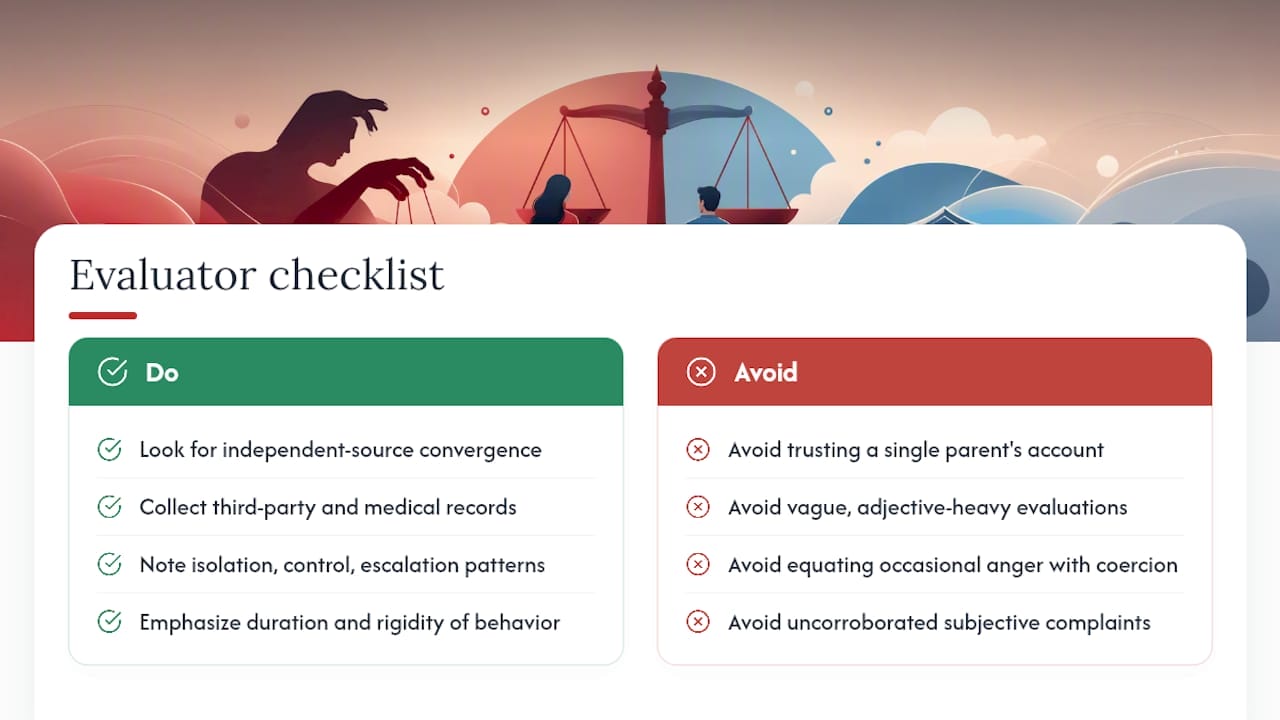
Evaluators typically look for convergence across independent sources rather than trusting either parent’s account. A pattern reported consistently by a child’s teacher, a therapist, and a Guardian ad Litem carries far more weight than the same claim made only by the parent alleging it. Third-party witnesses and medical records turn a subjective complaint into something an evaluator can actually assess.
Trained evaluators also watch for the specific hallmarks of coercive control: isolation from support networks, a consistent effort to control the child’s perception of events, and escalation when the behavior is challenged. They distinguish this from ordinary post-divorce friction by looking at duration and rigidity. Someone who’s occasionally short-tempered during a bitter divorce doesn’t display the same sustained pattern as someone systematically rewriting a child’s memory over years.
A thorough evaluation report typically documents specific dated incidents rather than general impressions, cross-references those incidents against school and medical records, and clearly separates the evaluator’s clinical observations from either parent’s characterization of events. That structure is what makes a report persuasive to a judge who’s seen plenty of vague, adjective-heavy custody evaluations that don’t hold up under cross-examination.
Practitioner View: How These Cases Actually Get Built
Most gaslighting claims fall apart in court not because they’re untrue, but because they’re undocumented. When our firm takes on a case like this, the first move is always the same: sort the client’s existing records, identify the gaps, and get a plan in place to close them before the next filing deadline, not after.
Our experience with narcissistic personality dynamics and military divorces, where deployments and long-distance custody schedules create their own documentation challenges, shapes how we prioritize evidence early. As a mediation-certified firm, we also assess whether a case can be resolved without an extended court battle before assuming it can’t.
A first consultation covers your timeline, your existing records, and what’s realistically achievable given what you have.
— John
How the Law Office of John Vernon Moore, P.A. Can Help
You don’t have to sort through months of texts, school emails, and medical notes alone, and you shouldn’t have to guess which pieces of evidence a judge will actually credit. With extensive combined experience and a practice built specifically around high-conflict divorce, narcissistic personality disorder dynamics, and military family law, experienced attorneys can help Brevard County parents turn a chaotic record into a coherent, court-ready case.

A first consultation with our family law team typically starts with reviewing what you’ve already documented, texts, emails, school and medical records, and identifying what’s missing before your next filing. If litigation isn’t the right path yet, our certified mediation services offer a lower-conflict route to resolving custody disputes without a drawn-out court battle. And if safety concerns intersect with a criminal matter, understanding the bail process for domestic-abuse arrests can help you plan your next steps.
Bring your records, your timeline, and your questions. Some legal services offer free initial consultations to review your situation and discuss potential paths forward.
Select Authoritative Reading and Legal Resources
- Untangling gaslighting allegations in family and child welfare litigation
- Gaslighting in Divorce and Custody Cases — Recognizing and Countering It
- Proving Gaslighting as Evidence in Florida Family Court
- Domestic Violence and Custody: A Complete Guide
- False Allegations of Domestic Violence
This article is general information, not a substitute for advice from a qualified lawyer. Consult a qualified legal professional about your own circumstances before acting on anything here.
Sources
- Untangling gaslighting allegations in family and child welfare litigation
- Gaslighting in Divorce and Custody Cases — Recognizing and Countering It | Carl Knickerbocker Law
- Proving Gaslighting as Evidence in Florida Family Court: A Strategic Legal Guide | The McKinney Law Group Family & Divorce Lawyers
- Examples of Gaslighting in Co-Parenting
FAQ
Can Gaslighting Alone Change a Custody Order?
Gaslighting by itself rarely changes an order unless it’s tied to a documented pattern affecting the child’s well-being or a parent’s credibility. Courts act on evidence of coercive control or emotional abuse, not on the label, so a chronological record matters more than the accusation itself.
How Do I Prove Gaslighting in Court?
Proving it requires contemporaneous digital records, medical or therapy notes, and third-party witnesses that show a consistent pattern over time. Digital and documentary evidence that contradicts a parent’s sworn statements tends to carry the most weight with judges.
What Should I Do if I’m Falsely Accused of Gaslighting?
Gather your own corroborating evidence, provide documented alternative explanations, and avoid retaliating through social media or the children. Speak with a family law attorney early, particularly if the claim overlaps with false abuse allegations.
Does Jmoorelegal Handle Gaslighting-Related Custody Cases?
Yes. Jmoorelegal represents parents in Brevard County facing coercive control, emotional abuse, and parental alienation issues within custody disputes, including cases involving narcissistic personality dynamics and military families. A consultation is available through the firm’s family law practice page.
Is It Safe to Record the Other Parent as Evidence?
Not always. Recording laws vary, and a covert recording can create legal problems of its own depending on your jurisdiction. Consult an attorney before recording any conversation intended for use in a custody case.


