

The strongest cases rest on one system: a contemporaneous incident log linked to numbered exhibits, including dated injury photos, medical records, police reports, and preserved messages. Build it only when it’s safe to do so, and lean on an advocate or attorney if collecting evidence puts you at risk. Everything else in evidence collection for court flows from that foundation.
TL;DR:
- An incident log should be written as soon as it is safe, including specific details like date, time, location, and objective descriptions of events.
- Medical records, especially from forensic exams, strengthen cases when they include photos, direct quotes, and timing details, with certified copies preferred.
- Police reports provide third-party corroboration and should be obtained promptly, carefully cross-referencing with your incident log for consistency.
- Digital evidence must be preserved in full context with timestamps, original files, and metadata, stored securely with trusted parties to prevent tampering or access by abusers.
- Thorough organization using indexed exhibits and witness affidavits enhances admissibility, while careful safety precautions are essential to avoid putting yourself in danger during documentation.
Table of Contents
- How to Keep a Court-Ready Incident Log
- Medical and Forensic Documentation to Request and Preserve
- Filing Police Reports and Obtaining Official Records
- How to Preserve Digital Evidence Safely
- Authentication and Admissibility Basics Survivors Should Know
- Safety, Privacy, and Legal Cautions When Documenting Evidence
- Organizing Exhibits for Court: Evidence Index and Exhibit Folders
- How to Obtain and Use Affidavits or Witness Statements
- Understanding the Importance of Emotional Support and Self-Care During Documentation
- Guidance on Documenting Different Types of Abuse
- Why Careful Documentation Matters
- How the Law Office of John Vernon Moore, P.A. Can Help
- Authoritative Resources to Consult Now
- Sources
- FAQ
How to Keep a Court-Ready Incident Log
An incident log is the backbone of abuse case documentation. Judges and attorneys read dozens of these, and the ones that hold up share a common structure: they’re dated, specific, and written close to the event, not reconstructed weeks later from memory.
Start recording each incident as soon as it’s safe, capturing the date, time, and location alongside what happened, according to Federal Rule 901 authentication guidance. Each entry should include:
- Date and time of the incident, written down the same day if possible.
- Location where it occurred, specific enough to place on a map.
- Objective description of what was said and done, in plain factual language.
- Exact quotes when you can recall them, in quotation marks.
- Witnesses, with names and contact information if available.
- Immediate effects, such as injuries, property damage, or safety impact.
Write facts, not conclusions. “He grabbed my wrist and twisted it until I dropped the phone” holds up better than “he assaulted me again,” according to evidence collection guidance from the National Coalition Ending Domestic and Sexual Violence. Labels invite cross-examination. Specific, sensory detail doesn’t.
Timing matters almost as much as content. Entries written within hours or days of an event carry more weight than a single retroactive summary covering months. If you’re playing catch-up, note the actual date you’re writing the entry and be honest about the gap. A journal that admits its own limits is more credible than one that pretends to be flawless.
Medical and Forensic Documentation to Request and Preserve
Injuries fade. Records don’t, if you ask for them correctly. Seek prompt medical care for any injury, including strangulation, which frequently leaves no visible marks but causes serious internal harm. Ask the provider to photograph injuries and document your account in your own words.
A Sexual Assault Nurse Examiner (SANE) or forensic exam typically produces:
- A recorded history of what happened, in your language.
- Photographs of injuries, taken with a scale reference.
- Forensic samples where relevant to the case.
- A written encounter note describing findings and demeanor.
The U.S. Department of Justice’s National Protocol for Intimate Partner Violence Medical Forensic Examinations notes that these exams exist first for health and safety. Evidence preservation is a secondary benefit, but it’s often the piece that makes a case.
Accurate, comprehensive, and legible medical documentation can strengthen domestic violence cases. Clinicians improve admissibility when they quote the patient directly, record demeanor, and note the timing of the visit relative to the incident, according to the National Institute of Justice.
Request certified copies of your records, not just a printout. Certified records carry weight that photocopies do not when authentication becomes an issue later.
Filing Police Reports and Obtaining Official Records
Call 911 if you’re in immediate danger. Use the non-emergency line to file a report after the fact if the situation has stabilized and you’re safe. Either way, get the paperwork right at the scene.
- Ask for the incident or case number before the officer leaves.
- Get the responding officer’s name and badge number.
- Request copies of any photos officers took at the scene.
- Follow up in writing to request the full written report, which may take days to process.
- If a records request is denied or delayed, ask the department about its public records request procedure.
Police reports work as third-party corroboration. A judge weighing your incident log against an abuser’s denial gives more credibility to an account that lines up with an officer’s independent notes taken the same day. Combine the report number with your log entry for that date so the two documents point to each other.
How to Preserve Digital Evidence Safely
Screenshots feel easy, but they’re also the evidence most likely to get challenged in court. A cropped text thread can look damning or meaningless depending on what’s missing, and opposing counsel will ask what got left out.
- Capture the full conversation, not just the alarming message. Scroll up and down to include context before and after.
- Keep timestamps visible. A screenshot with no date is nearly worthless as save text messages for court evidence.
- Export originals before editing anything. Highlight or annotate only a working copy; keep the untouched original separately.
- Preserve metadata where you can. Export call logs, save email headers, and back up voicemails as audio files rather than just transcribing them.
- Store copies somewhere the abuser cannot reach. A password-protected cloud account tied to a device only you control, a trusted friend’s storage, or an advocate’s office all work better than a shared family cloud account.
Preserving the full conversation and identifying headers matters because a judge or opposing attorney can ask whether a message was edited or taken out of context, and an intact original answers that question before it’s asked, per the DOJ’s national protocol on preservation.
Pro Tip: Assume any device or account you share with your abuser is being watched. Storing evidence with a trusted third party or an advocate is usually safer than relying on your own cloud storage if the abuser has ever had access to your passwords.
Authentication and Admissibility Basics Survivors Should Know
Relevant evidence and admissible evidence aren’t the same thing, and this trips up a lot of self-represented parties. Something can be completely true and still get excluded if nobody can establish that it’s what it claims to be. That’s what authentication means.
- Rule 901 requires enough evidence to support a finding that an item is what you say it is, whether that’s a text thread, a photo, or a recording, according to Cornell Law’s summary of the Federal Rules of Evidence.
- Common authentication methods include witness testimony (“yes, I sent that message”) or certification from the record’s custodian.
- Rule 902 lists categories of self-authenticating records, including certified business and medical records, which can sometimes be admitted without a witness showing up to testify, as long as notice and certification requirements are met.
- Keep unaltered originals, maintain a written evidence index, and jot down brief chain-of-custody notes (who had the device or document, and when) to head off authenticity challenges before they happen.
None of this requires a law degree to execute. It requires consistency: the same habits, applied every time you add to your file.
Safety, Privacy, and Legal Cautions When Documenting Evidence
Documentation only helps if it doesn’t put you in more danger. Before creating or storing any record, run through a quick safety check:
- Can you write, photograph, or save this without your abuser noticing?
- Is there a private place to store copies, physically or digitally?
- Would involving an advocate or attorney now make this safer?
If any answer is no, pause and get support from a domestic violence advocate before continuing. Reporting abuse legally still requires you to stay safe while doing it.
Secret audio recordings carry their own risk. State laws on recording conversations vary widely. Some states permit recording if one party to the conversation consents; others require everyone on the call to agree, and recording without consent in those states can create criminal liability or get the recording thrown out, according to The Hotline’s guidance on recording cautions. Check your state’s law before you hit record.
Pro Tip: If you and your abuser share a phone plan, email account, or cloud backup, treat every device tied to those accounts as compromised. Buy a separate, low-cost device if you can, and use it only for documentation.
Organizing Exhibits for Court: Evidence Index and Exhibit Folders
A shoebox of screenshots doesn’t win cases. An indexed, cross-referenced set of exhibits does. Keep a separate evidence index, a simple spreadsheet works fine, with these fields:
| Field | What to enter |
|---|---|
| Entry number | Sequential number matching your incident log |
| Original file/location | Where the item lives (device, folder, physical location) |
| Date collected | When you saved or received the item |
| Source | Device, account, or person who provided it |
| Description | One line describing what the exhibit shows |
Label exhibits the same way every time, “Exhibit 1,” “Exhibit 2,” and so on, and never renumber once you start. Keep untouched originals in one place and work from copies when you’re annotating or printing for a hearing.
Cross-reference every incident-log entry to its matching exhibit number. A well-organized chronological timeline linked to numbered exhibits is far easier for a judge to follow than a folder of unsorted files, and it’s easier for your attorney to work with too. Before filing anything, confirm the exhibit format and service rules with your attorney or the clerk’s office. Courts differ on how they want exhibits labeled and submitted.
How to Obtain and Use Affidavits or Witness Statements
Witness statements add weight your own account can’t carry alone. An affidavit is a written statement signed under oath, and courts treat it differently than a text message someone sent you saying “I saw what happened.”
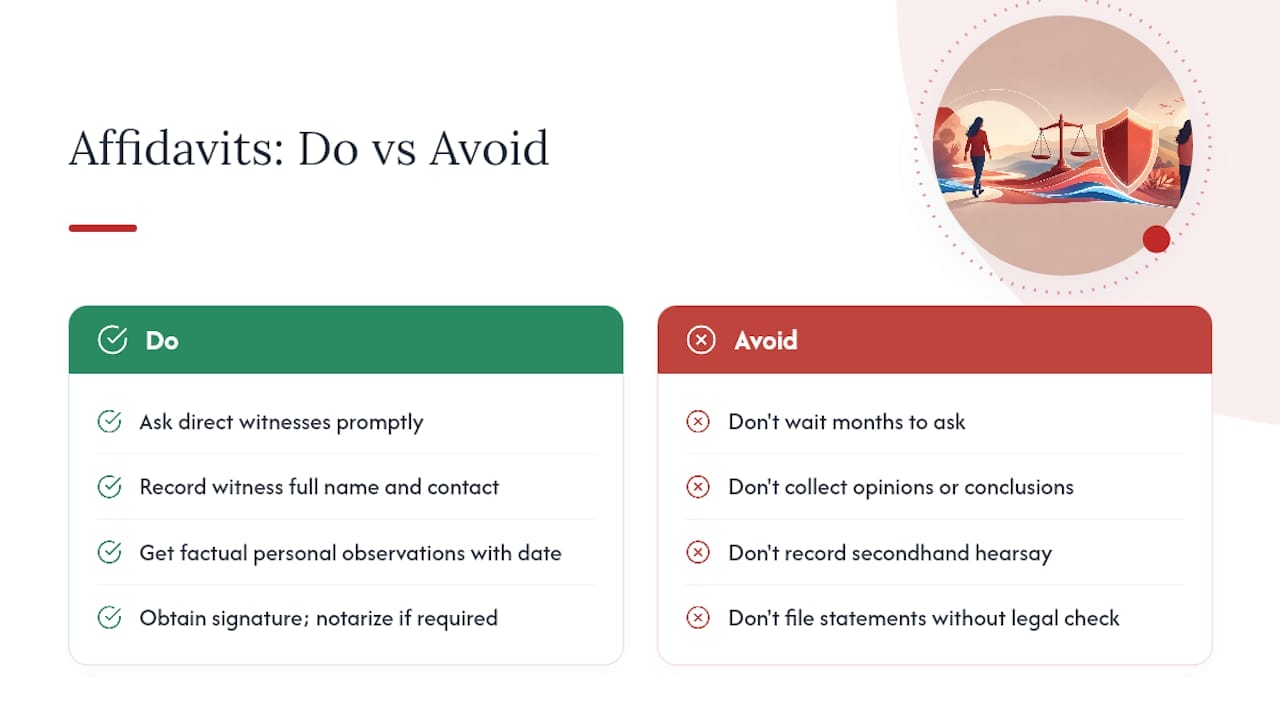
Start by identifying anyone who witnessed an incident directly, heard it happen, or saw its immediate aftermath, such as injuries or property damage. Neighbors, coworkers, family members, and friends who received a call or text right after an event can all provide useful statements. Ask them while the memory is fresh rather than waiting months.
A usable affidavit typically includes the witness’s full name and contact information, a factual account of what they personally observed (not what you told them), the date of the event they’re describing, and a signature, often notarized depending on your court’s requirements. Keep the language factual. “I heard yelling and saw her run out of the apartment holding her arm” is useful. “I know he’s abusive” is not, because it’s an opinion rather than an observation.
Coordinate with your attorney before collecting affidavits if you’re already represented. Some courts have specific formatting requirements, and an improperly prepared statement can create more problems than it solves. If you’re not yet represented, note witness names and contact details in your incident log now. Memories fade, and people move. A name and phone number written down the week of the incident is worth far more than trying to track someone down a year later when your case finally reaches a hearing.
Understanding the Importance of Emotional Support and Self-Care During Documentation
Documenting abuse means reliving it, over and over, in writing. That takes a toll most guides don’t mention, and it’s worth naming directly: building a case file is emotionally exhausting work, and doing it alone makes it harder.
Domestic violence advocates exist specifically for this. They can help you think through what to document, offer a safe place to store copies, and sit with you through parts of the process that feel unbearable to do solo. Many advocacy organizations also connect survivors with counseling, support groups, and safety planning that runs alongside the legal work.
Pace yourself. You don’t have to reconstruct every incident from years past in one sitting. Set aside short, manageable blocks of time for documentation rather than marathon sessions that leave you drained and more likely to make mistakes. If a particular memory is too raw to write about today, note the date and come back to it later. Court proceedings often move slowly, and there’s usually more time than it feels like in the moment.
Tell someone what you’re doing. A trusted friend, therapist, or advocate who knows you’re building a case file can check in on you and help carry some of the emotional weight. Abuse case documentation is not just a legal task. It’s also an act of processing trauma, and treating it that way, rather than as pure paperwork, tends to produce both better records and a steadier person carrying them into court.
Guidance on Documenting Different Types of Abuse
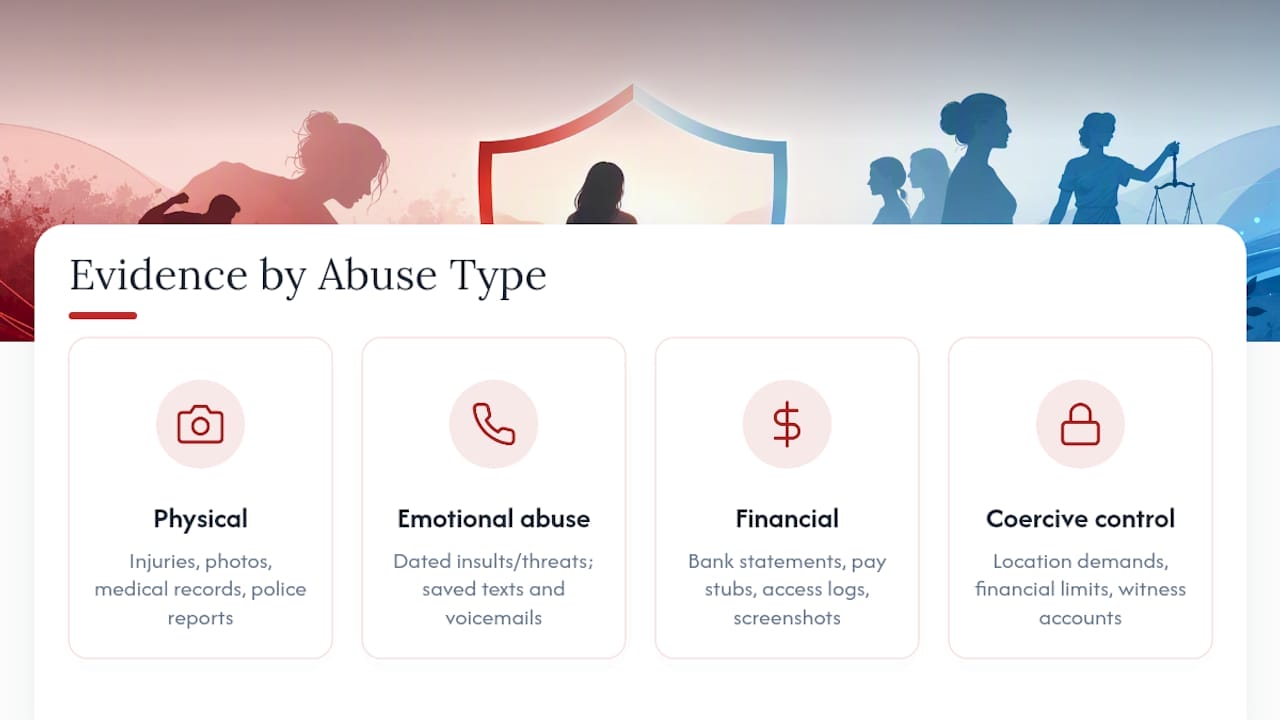
Physical abuse leaves the most obvious trail: injuries, photos, medical records, police reports. But courts increasingly recognize that abuse takes other forms, and each requires its own documentation approach.
Emotional and psychological abuse is harder to prove because it leaves no bruises. Document specific incidents rather than general patterns. Write down exact insults or threats, when they happened, and who was present. Save any texts or voicemails containing threats or degrading language using the digital preservation steps above. A pattern of dozens of small entries over months is far more persuasive than a single summary claiming “he was always controlling.”
Financial abuse shows up in bank statements, pay stubs, and account access logs. Save records showing restricted access to money, unauthorized withdrawals, forced debt, or an abuser controlling your paycheck or benefits. Screenshots of banking apps showing locked-out access, canceled cards, or drained accounts belong in your exhibit file with dates attached.
Coercive control, isolating you from family, monitoring your movements, controlling your phone or car, often shows up through a combination of the categories above: texts demanding your location, financial restrictions, and witness accounts from people who noticed you being cut off. Log each instance separately rather than trying to describe the pattern in one entry.
Whatever the abuse type, the same rule applies: specific, dated, factual entries beat broad characterizations every time a judge reads your file.
Why Careful Documentation Matters
Courts don’t rule on what happened; understanding how much is bail for domestic abuse can be important as cases move through the system. They rule on what can be shown to have happened, and that gap is where cases are won or lost. A well-organized file, incident log, numbered exhibits, medical records, police reports, doesn’t just support a protective order or custody argument. It often determines whether a criminal filing moves forward at all.
I’ve seen how much a clear, contemporaneous record shifts a hearing in a survivor’s favor, and how much a disorganized one costs. If you’re building a file right now, get legal guidance early. It’s easier to build a strong record from the start than to fix gaps after the fact.
— John
How the Law Office of John Vernon Moore, P.A. Can Help
Organizing evidence is only half the job. Turning it into something a Brevard County court will act on is the other half, and that’s where a lawyer earns their fee. Legal professionals can help survivors request medical and police records, build exhibit indexes that hold up under cross-examination, and prepare filings for protective orders, custody disputes, and related criminal matters.

The firm’s family law practice covers divorce, custody, and domestic-violence matters together, since these cases rarely arrive in isolation. When mediation is appropriate, certified mediation services are also available through the mediation practice. Every new client gets a free initial consultation to talk through what’s already documented and what still needs to be gathered. If you’re sitting on a stack of records and unsure how to turn them into a case, reach out to the firm and bring what you have to the first conversation.
Authoritative Resources to Consult Now
Start with The Hotline’s guide to building your case for safety-led documentation steps. The DOJ’s medical-forensic exam protocol explains what a SANE exam covers. NIJ’s guidance for health-care providers covers medical-record admissibility, and Cornell Law’s Rule 902 text explains self-authenticating records. For an evidence-organization framework, see NCEDSV’s evidence collection guidance.
This article is general information, not a substitute for advice from a qualified lawyer. Consult a qualified legal professional about your own circumstances before acting on anything here.
Sources
- U.S. Department of Justice — National Protocol for Intimate Partner Violence Medical Forensic Examinations
- Cornell Law — Federal Rule of Evidence 902
- NCEDSV — Evidence collection guidance
- NIJ — Documenting domestic violence: how health-care providers can help victims
FAQ
What Is the Best Way to Document Abuse for Court?
The most reliable system combines a chronological incident log with numbered exhibits, dated photos, medical records, police reports, and preserved messages, according to The Hotline. Write entries close to when events happen and cross-reference each one to its supporting exhibit.
How Do I Save Text Messages for Court?
Capture the full conversation with visible timestamps, not just the alarming message in isolation. Export or screenshot the original before annotating anything, and keep an unmarked copy stored where your abuser can’t reach it.
Are Police Reports Enough Evidence on Their Own?
Police reports corroborate your timeline but work best combined with medical records, photos, and your incident log. A report confirms an officer responded and documented findings that day, which strengthens your account rather than replacing it.
Do I Need a Lawyer to Document Abuse Properly?
You can start documenting on your own using a safety-led incident log and exhibit index, but a family-law attorney can flag admissibility issues before they become problems in a hearing. The Law Office of John Vernon Moore, P.A. offers a free initial consultation to review what you’ve gathered.
What if It’s Not Safe to Record Evidence Right Now?
Safety comes first. Pause documentation, contact a domestic violence advocate, and resume only when you have a private, secure way to create and store records without the abuser’s knowledge.


