
Hiring an attorney with real military experience protects the things a generalist often misses: your pension, your survivor benefits, and your custody rights during deployment. The core advantages of a military-experienced attorney come down to four things: correctly dividing military retirement pay, securing Survivor Benefit Plan elections, using deployment protections under the law instead of losing time to them, and avoiding drafting mistakes courts frequently refuse to fix later.
Here’s what that actually buys you:
- Pension accuracy. Someone who knows “High-3” pay, DIEMS dates, and USFSPA division rules on sight, not by looking them up mid-hearing.
- Survivor Benefit Plan protection. Decree language that DFAS will actually honor, not language that gets kicked back or ignored.
- Deployment-aware custody strategy. Someone who knows temporary orders tied to deployment have limits, and how to use that.
- Fewer irreversible errors. Improperly drafted pension orders often can’t be fixed after judgment, so getting it right the first time matters more than in almost any other area of family law.
- A faster path through military bureaucracy. Familiarity with base culture, command structure, and federal pay-center timelines that a civilian-only practice rarely has.
Scroll down for the exact interview questions to ask before you hire anyone, plus a full checklist of documents to bring to your first consultation.
Key Takeaways
Correctly drafted pension and survivor benefit language at the time of divorce prevents losses that courts routinely refuse to reverse afterward.
| Point | Details |
|---|---|
| Pension errors are often permanent | Courts frequently decline to reopen improperly drafted military pension orders after judgment. |
| SBP requires exact timing | Survivor Benefit Plan elections must reach DFAS within the required window or coverage lapses permanently. |
| Deployment has legal limits | USC §3938 blocks deployment alone from justifying a permanent custody change and requires temporary orders to expire. |
| Ask specific interview questions | Test any attorney candidate on High-3 calculations and DFAS filing procedures before hiring. |
| Jmoorelegal handles military-specific cases | The firm offers military divorce, pension division, and mediation services with a free initial consultation in Brevard County. |
Table of Contents
- The Real Benefits of Hiring a Military-Experienced Attorney
- Three Cases That Show What’s at Stake
- How to Interview a Military-Experienced Attorney Before You Hire
- What to Expect: Timing and Cost
- Where TRICARE and Commissary Access Fit Into Your Case
- What Military Experience Actually Teaches a Lawyer
- Negotiation Leverage That Comes From Military Knowledge
- The Veteran Legal Network Behind the Scenes
- Clearing Up Misconceptions About Military Attorneys
- Case Patterns That Show the Difference
- Frequently Asked Questions
- Sources
The Real Benefits of Hiring a Military-Experienced Attorney
Most of the damage in military family law happens quietly, in decree language nobody double checked. Here’s where specific experience changes the result.
-
Pension mechanics. Military retirement pay divides differently than a 401(k) or civilian pension. The formula usually hinges on the service member’s “High-3” average pay, years of creditable service, and whether cost-of-living adjustments carry into the divided share. Miss a COLA clause or use the wrong pay base, and the spouse can lose thousands over a 20-year retirement, with courts often unwilling to reopen the order. AAML practitioners note that valuing military retirement correctly usually requires expert attention, which is exactly why general practice attorneys frequently bring in a specialist rather than guess.
-
SBP and DFAS mechanics. The Survivor Benefit Plan pays a continuing income to a former spouse after the service member dies, but only if the decree contains the right election language and it reaches the Defense Finance and Accounting Service inside the required window. Miss that window, and the survivor protection disappears permanently, regardless of what the divorce judge intended.
-
Deployment protections. Federal law under USC §3938 prevents deployment alone from being the deciding factor in a permanent custody change, and requires temporary orders based on deployment to expire when the deployment ends. An attorney who doesn’t work these cases regularly may not think to ask for that expiration language up front.
-
Spillover into criminal, injury, and estate cases. A pending security clearance changes how a criminal charge should be handled. Base reporting requirements affect how an accident claim gets documented. Military survivor benefits and VA disability payments interact with estate planning in ways a civilian-only attorney may not flag.
Pro Tip: Ask any attorney you’re considering to name the exact DFAS form and processing window for your Survivor Benefit Plan election. If they can’t answer without looking it up on the spot, that’s a specialization gap worth noting.
Three Cases That Show What’s at Stake
Real patterns repeat often enough in military family law that they’re worth walking through before you sign with anyone.
The missing COLA clause. A decree divided a Navy pension 50/50 but left out cost-of-living language. Years later, the former spouse’s share stayed frozen while the service member’s portion kept climbing with annual adjustments. Fixing this at the settlement stage, before judgment, is far easier than after: specific language naming the High-3 base and the COLA formula prevents the gap entirely.
The deployment custody trap. A parent deployed for eight months, and the other parent sought a permanent custody modification during that window. Under USC §3938, deployment alone can’t be the sole basis for a permanent change, and any temporary order tied to the deployment has to expire when the deployment does. Counsel who knows the statute requests that sunset clause in the original order, not after the fact.
The SBP that never got filed. A decree ordered SBP coverage for a former spouse, but nobody submitted the required election to DFAS within the statutory deadline. The coverage lapsed. The fix is procedural, not judicial: decree language has to match DFAS’s own submission requirements, which is why the North Carolina State Bar’s own guidance recommends associating military-specialist counsel for exactly this reason.
Addressing military retirement and survivor benefits correctly at the time of divorce isn’t a nice-to-have. It’s often the only chance you get, since courts frequently decline to revisit these orders once judgment is entered.
How to Interview a Military-Experienced Attorney Before You Hire
Ask these questions before you sign anything, and pay close attention to how specific the answers are.
- How many military divorce or custody cases have you personally handled in the past two years?
- Can you explain how you’d calculate my High-3 pension base without looking it up?
- What’s your process for getting SBP elections filed with DFAS on time?
- Have you handled a case involving the 10/10 or 20/20/20 rule for continued TRICARE or commissary access?
- What’s your plan if my case requires interstate enforcement of a military pension order?
- Do you associate co-counsel or a pension valuation expert for complex retirement calculations?
- How do you handle custody timelines when a deployment is scheduled mid-case?
- Can you point to a specific outcome where your military knowledge changed the result?
- What documents will you need from me at the first meeting?
- Are you mediation certified, and would mediation make sense for my situation?
Red flags: vague or generic answers about pension math, reluctance to bring in a specialist for complex division, or no prior experience with a deployed client’s timeline.
Bring your Leave and Earnings Statement, retirement point statements, deployment orders, and a written marriage timeline to the first consult. Any attorney who doesn’t ask for these upfront likely hasn’t handled enough of these cases.
Pro Tip: If your case involves a pension worth reconstructing years of service and pay grades, ask whether a forensic accountant or pension valuation expert should be brought in before settlement, not after.
What to Expect: Timing and Cost
Deployment schedules can compress or delay your case, sometimes triggering a stay in proceedings or pushing certain hearings to priority calendaring once a service member returns. DFAS enrollment for SBP or direct pension payments typically takes a defined processing window after the decree is finalized, so timing your filing matters as much as the language itself.
Cost drivers to expect:
- Pension valuation and any forensic accounting needed to reconstruct High-3 pay
- Expert witness fees if retirement calculations are contested
- Added complexity and cost for interstate enforcement if one spouse relocates
- Mediation, which can meaningfully reduce legal fees compared to a fully litigated custody or division fight
Once you’ve hired counsel, the first moves are simple: secure copies of military personnel and pay records, confirm SBP election status in writing, and update or draft a family care plan if deployment is on the horizon.
Where TRICARE and Commissary Access Fit Into Your Case
Military-specific benefits carry real weight in divorce and estate decisions that a civilian-only attorney can overlook entirely. The 10/10 rule determines whether a former spouse keeps a share of retired pay directly from DFAS, and the related 20/20/20 rule governs continued TRICARE eligibility and commissary or exchange access for former spouses of long marriages overlapping long service. Fall short of the 20-year overlap and those benefits can disappear even when the marriage itself lasted decades.

Estate planning intersects here too. VA disability compensation and certain combat-related pay are typically excluded from divisible retired pay, and settlement or estate documents that fail to protect that classification risk misallocating money the law never intended to divide. A trust or will drafted without accounting for TRICARE survivor coverage or SBP interaction can leave a surviving spouse in a worse position than the service member intended, even when every other provision looks airtight.
These aren’t edge cases. They show up in a meaningful share of military divorces and in estate plans drafted after retirement, which is why attorneys who don’t handle military cases regularly sometimes miss them until it’s too late to fix cleanly.
What Military Experience Actually Teaches a Lawyer
An attorney who has worn the uniform, or who has spent years representing service members, reads a case file differently. They know that a Permanent Change of Station order isn’t just a move, it’s a jurisdiction problem waiting to happen. They know that “leave and earnings statement” isn’t jargon, it’s the single most important document in a pension dispute.
That fluency extends to command structure and timelines. Attorneys with genuine military-practice experience know how bases and commands operate, which speeds up evidence gathering and makes case planning realistic instead of theoretical. A civilian attorney might need weeks to understand why a deployment order changes a hearing date. Someone with military background already knows, and plans around it from day one.
This same fluency carries into criminal defense and personal injury work. A drug charge against an active-duty client can trigger parallel military justice consequences. A car accident involving a service member may need coordination with base legal offices or affect a pending security clearance review. None of that is obvious to someone who has never worked inside that system.
Negotiation Leverage That Comes From Military Knowledge
Negotiation in family law is largely about knowing what the other side actually fears losing, and knowing which threats are real versus bluster. A military-experienced attorney negotiating a pension division knows exactly which clauses opposing counsel is likely to push back on, because they’ve seen the same fight before.
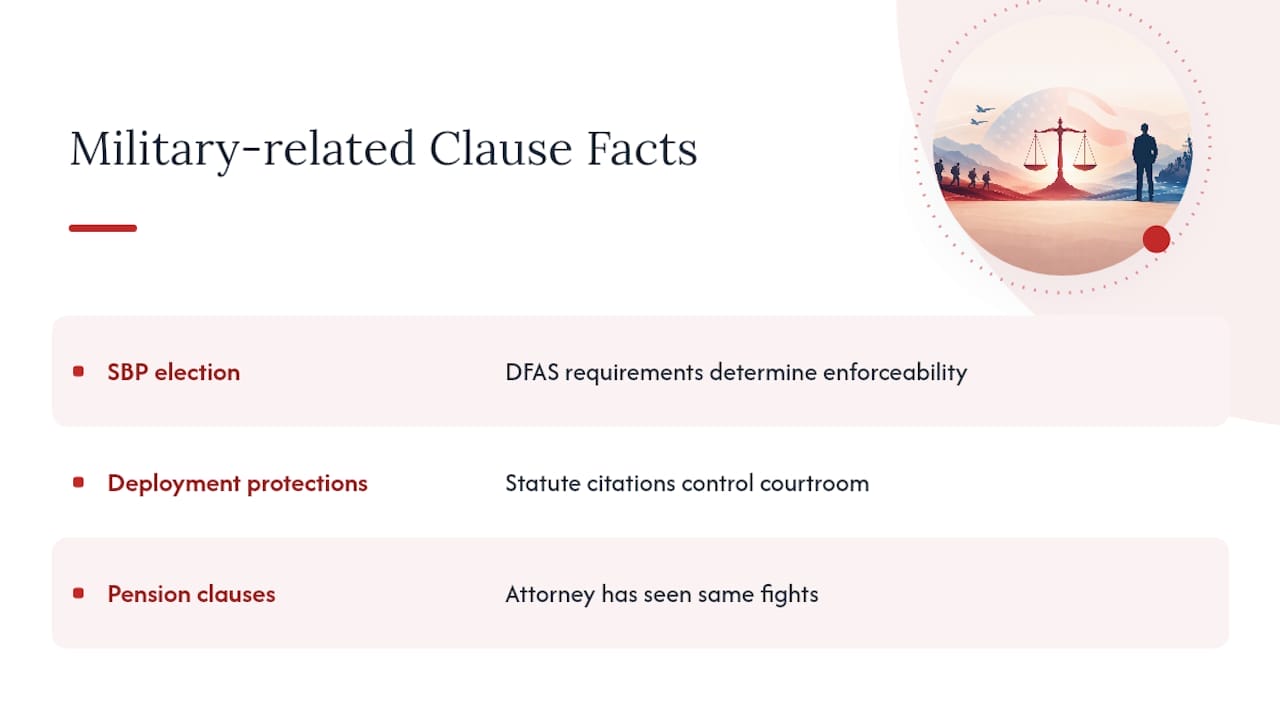
That knowledge changes settlement conversations. Instead of guessing whether a proposed SBP election will hold up, an attorney familiar with DFAS’s own requirements can tell a client in the room whether a proposed decree provision will actually be honored by the federal pay center, or whether it needs to be rewritten before anyone signs.
In litigation, that same specificity shows up in cross-examination and motion practice. An attorney who can cite the exact statutory language behind a deployment-based custody request, rather than arguing generally about fairness, tends to control the courtroom conversation. Judges notice the difference between an attorney reciting statute numbers accurately and one gesturing vaguely at “military rules.”
The Veteran Legal Network Behind the Scenes
Military-experienced attorneys rarely work in isolation. Many maintain relationships with pension valuation experts, forensic accountants familiar with military pay records, and other attorneys who specialize in interstate enforcement of military orders. These aren’t formal referral networks so much as working relationships built over years of overlapping cases.
Military OneSource and base legal assistance offices form the other half of this ecosystem. The strongest approach usually pairs free early guidance from a legal assistance office with private, courtroom-capable representation once a case turns contested. That combination gives service members and spouses both an early sounding board and a lawyer who can actually litigate if settlement talks break down.
Clearing Up Misconceptions About Military Attorneys
A common misconception is that “military-experienced” means the attorney only handles cases on base or only represents active-duty clients. In practice, most of this work happens in civilian courts, representing spouses, veterans, and retirees just as often as active-duty service members.
Another misconception: that any family law attorney can handle a military pension division competently because “it’s just math.” Pension division involves federal statutes, DFAS procedural requirements, and benefit categories that interact in ways general practice attorneys don’t encounter often enough to master by instinct.
A third misconception assumes deployment automatically means a parent loses custody rights while away. Federal law says otherwise, and a knowledgeable attorney uses that protection rather than letting a client panic into a bad settlement.
Case Patterns That Show the Difference
A reservist called up for a nine-month deployment faced a custody petition filed the week before departure. Counsel familiar with deployment protections requested a temporary order with an automatic expiration date tied to the deployment’s end, preventing what could have become a permanent shift in custody based on absence alone.
In another matter, a 22-year Air Force retiree’s divorce nearly excluded VA disability compensation protections from the settlement language, which would have improperly exposed non-divisible benefits to division. Correcting the classification before judgment preserved those payments entirely for the veteran.
A third case involved a spouse who divorced without addressing SBP at all, assuming survivor benefits were automatic. They aren’t. Revisiting the settlement before finalization secured the election and avoided a lapse that would have been extremely difficult to reverse.
A Firm’s Perspective on Military Family Cases
Handling military divorce and custody cases means treating pension division, SBP elections, and deployment timelines as first-priority issues, not afterthoughts. That approach, paired with mediation certification, tends to stabilize cases that might otherwise drag through contested litigation. The firm’s background on JAG-related experience in divorce cases outlines how that specific legal background shapes case strategy from intake through settlement, and client accounts on the firm’s site speak to how that approach has played out for military families in Brevard County.
Get Direct Help With Your Military Family Law Case
Jmoorelegal is the local option in Brevard County for military families who need pension division, custody protection during deployment, or estate planning done right the first time, not fixed after a costly mistake. The firm handles military divorce and pension division, custody matters affected by deployment, mediation, criminal defense, and estate planning, with direct attorney access rather than being routed through paralegals. Every new client gets a free initial consultation, and bringing your LES, retirement statements, and deployment orders to that first meeting lets the firm assess your situation on the spot instead of over multiple follow-up calls. If your questions are specific to survivor benefits, TRICARE eligibility, or the 20/20/20 rule, the firm’s military family law FAQ page covers common scenarios in plain language. Schedule a consultation to get a straight answer on where your case stands before any deadlines pass.
Frequently Asked Questions
Does deployment mean I automatically lose custody of my children?
No. Federal law prevents deployment alone from being the sole basis for a permanent custody change, and any temporary order tied to deployment must expire when the deployment ends.
Can a military pension really be lost permanently over a drafting mistake?
Yes. Courts often refuse to revisit pension division orders after judgment, so language covering the pay base, COLA adjustments, and SBP election needs to be correct the first time.
What’s the difference between the 10/10 rule and the 20/20/20 rule?
The 10/10 rule determines whether a former spouse’s pension share comes directly from DFAS. The 20/20/20 rule governs whether a former spouse keeps TRICARE and commissary access, requiring at least 20 years of marriage overlapping 20 years of service.
Do I need a military-experienced attorney for a straightforward uncontested divorce?
Even uncontested cases benefit from specialized review of pension and SBP language, since those provisions are federal and get enforced by DFAS regardless of how amicable the divorce was.
How much does hiring a military-specialist attorney typically cost compared to a general practice attorney?
Costs can run higher when pension valuation experts or forensic accountants are needed, but mediation and correct drafting up front usually cost less than fixing an unenforceable order later.
Sources
- UNL digital commons: legal scholarship on military divorce pitfalls
- USC §3938 — Child custody protections for servicemembers
- How to find a military divorce attorney — North Carolina State Bar Legal Eagle
- Military OneSource — family legal issues guidance
- AAML article: Fairness and the military divorce
Recommended
- JAG Attorney Role in Divorce: A Military Family Guide – The Law Office of John Vernon Moore, P.A.
- Military Legal Assistance for Brevard County Families – The Law Office of John Vernon Moore, P.A.
- Why Expert Witnesses Matter in Criminal Defense Cases – The Law Office of John Vernon Moore, P.A.
- Military Divorce Process in Florida | Patrick SFB Attorney