You can bring an injury claim against a Florida city, county or state agency, but only on the terms the Legislature allows. Sovereign immunity is the old rule that the government cannot be sued without its consent. Section 768.28 of the Florida Statutes is the consent, and it comes with a written notice step, a denial or waiting period, a damages cap and a fee limit. Miss one step and the claim can end before a judge ever hears it. That is why a crash with a county truck, or a fall in a city building, should be handled differently from an ordinary injury case, and why it helps to have a Brevard County personal injury attorney involved before the first notice goes out.
TL;DR
- Florida has waived sovereign immunity for negligence claims against the state, counties, cities and similar bodies, but only under section 768.28, and only where a private person would be liable in the same situation.
- You must give written notice to the agency (and usually the Department of Financial Services) before you sue. Most negligence notices are due within 3 years, but wrongful-death notice is due within 2.
- Under the 2025 statute, recovery is capped at $200,000 per person and $300,000 per incident, with no punitive damages. A 2026 bill would raise those caps for claims accruing on or after October 1, 2026.
- Attorney fees are limited to 25 percent of any judgment or settlement.
- Anything above the cap generally needs a claim bill passed by the Legislature.
Table of Contents
- What sovereign immunity means for an injured person
- Who you can bring a claim against
- What kinds of injuries qualify
- The notice and filing steps
- Damages caps and what you cannot recover
- Attorney fees on a government claim
- Other barriers that can stop a government claim
- A worked example
- How we handle government injury cases
- Our perspective
- FAQ
- Sources
What sovereign immunity means for an injured person
The Florida Legislature’s own claim bill manual describes sovereign immunity as a doctrine that prohibits suits against the government without its consent. The Florida Constitution lets the state waive that immunity through general law, and the Legislature did so in 1973 when it enacted section 768.28.
The practical result: the government is not off limits, but it is not treated like a private defendant either. Miami-Dade County’s attorneys explain that the doctrine exists to keep courts from interfering with government affairs, to protect decision-making discretion and to manage the effect of tort awards on public money. Those goals explain why the rules feel stricter than a normal injury claim.
Who you can bring a claim against
The statute’s list of covered bodies is wide. Under section 768.28(2), the “state agencies or subdivisions” include:
- executive departments and the Legislature
- the judicial branch, including public defenders
- independent state establishments, including university boards of trustees
- counties and municipalities
- corporations primarily acting as instrumentalities of the state, a county or a city
The last category is where disputes arise. Miami-Dade’s sovereign immunity presentation notes, for example, that a Public Health Trust counts as a state agency or subdivision, while a private university was found not to be one in Jaar v. University of Miami, 474 So. 2d 239 (3d DCA 1985). Whether a hospital, transit operator or contractor counts can change which rules apply to your claim, so identify the exact entity early.
The employee is usually not the defendant
For conduct within the scope of the job, the agency, not the individual employee, is the proper defendant. The exception in § 768.28(9)(a) is an employee who acted in bad faith, with malicious purpose, or with wanton and willful disregard of human rights, safety or property. In that situation the agency is not liable for the act, and the employee may be.
What kinds of injuries qualify
Section 768.28(1) allows actions for personal injury, death, or loss of property caused by an employee’s negligent or wrongful act or omission within the scope of employment, where a private person would be liable under Florida’s general laws. In everyday terms, the claims usually look like these:
- a crash with a city, county or school-district vehicle
- a fall caused by an unrepaired hazard in a public building or on public property
- a death caused by government negligence (wrongful death)
The Florida Supreme Court has also held that some “discretionary” governmental functions stay immune even after the waiver. In Commercial Carrier Corp. v. Indian River County (1979), the court said the statute waives immunity broadly, but certain discretionary functions remain protected. Broadly, a decision about policy or planning is protected, while carelessly carrying out a task, such as driving a vehicle or maintaining a walkway, is where liability usually arises. How a court draws that line depends on the facts, which is one reason to have an attorney review the incident before you decide what to file.
The notice and filing steps
This is the part that trips people up. Here is the sequence the statute sets out, based on § 768.28(6) and (14):
- Identify the agency. Find out which entity owned, operated or controlled the vehicle, property or program involved.
- Send written notice. The notice goes to the agency and, except for claims against a municipality, county or the Florida Space Authority, to the Department of Financial Services (DFS). It is due within 3 years after the claim accrues. For wrongful death, notice to DFS is due within 2 years.
- Wait for a written denial. The statute requires a written denial before you can file suit. The Florida Senate’s 2011 analysis of an earlier amendment describes the agency as having 6 months (90 days for medical malpractice) to dispose of the claim, after which inaction is treated as a denial.
- File suit on time. Under § 768.28(14), suit must generally be started within 4 years, with exceptions for contribution actions and for medical-malpractice or wrongful-death actions governed by § 95.11(5).
Those are the rules for the 2025 and 2026 statutes as published. Legislative changes can alter deadlines for claims that accrue later, so confirm the version that applies to your date of injury. We also cover how the general clock works for private defendants in our guide to the Florida statute of limitations after HB 837; government claims run on their own track, so do not assume the private-defendant deadline applies.
A practical point: the notice is where claims are most often damaged. A vague or late notice, or one sent to the wrong office, gives the agency an easy argument. Keep the incident report, photos, witness names and medical records together before you write it. Our list of common personal injury case mistakes applies fully here.
Damages caps and what you cannot recover
Under § 768.28(5)(a) of the 2025 statute:
| Limit | Amount |
|---|---|
| Per person | $200,000 |
| Per incident | $300,000 |
| Punitive damages | Not recoverable |
| Pre-judgment interest | Not recoverable |
The caps limit what the agency can be required to pay. A judgment above them can be paid only through a further act of the Legislature.
The 2026 cap increase
The Florida Senate’s 2026 bill summary for SB 1366 says the bill would raise the caps to $350,000 per person and $500,000 per incident, revise presuit procedures and limitation periods for several claim types, and apply to causes of action accruing on or after October 1, 2026. The Senate’s bill analysis shows the figure moved up during the process: the original bill proposed $300,000 and $450,000 before the committee substitute set the higher amounts.
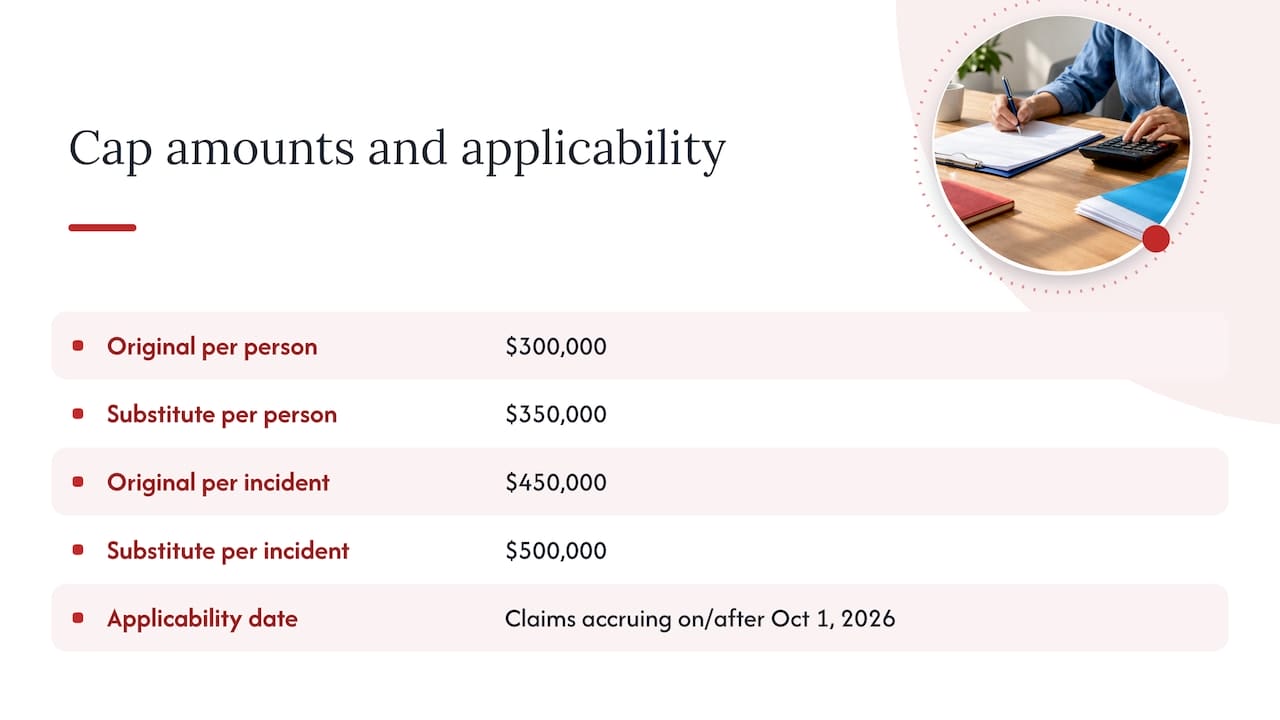
What matters for you is the date your claim accrued. Caps are tied to that date, so an injury before October 1, 2026 and one after it may be measured differently. Check the current text of section 768.28 on the Legislature’s website for the version in force, and have an attorney confirm which applies.
Claim bills for amounts above the cap
If a judgment exceeds the cap, the claimant can petition the Legislature for a claim bill. The Legislature’s manual explains that a senator must file a claim bill by the first Friday in August under Senate Rule 4.81(2), and House bills are due by 5 p.m. on the Friday before the regular session begins. Special masters from both chambers usually hold a joint hearing for each bill. It is a political and procedural path with its own timing, and it is separate from the lawsuit itself.
Attorney fees on a government claim
The statute limits what any attorney can collect. Section 768.28(8) bars fees above 25 percent of any judgment or settlement in a sovereign-immunity action. The Senate’s 2026 analysis adds that for amounts above the caps, the Legislature has sole discretion over fees and costs in a claim bill.
Because the fee ceiling is fixed by law, the question to ask any attorney is not how much they charge, but how thoroughly they will prepare the notice and the case behind it. We offer a free 30-minute consultation, so you can have the facts of your incident reviewed before you commit to anything.
Other barriers that can stop a government claim
Beyond the caps and deadlines, these issues come up most:
- Discretionary functions. Policy-level decisions can remain immune, as the Commercial Carrier decision explains.
- Outside the scope of employment. The agency is not liable for acts outside the course and scope of employment or committed in bad faith or with malice.
- Wrong defendant. Naming a private contractor or private university as if it were a government body, or the reverse, can change the rules entirely.
- Defective notice. Missing the agency, the DFS copy or the deadline.
- No private analog. The statute applies where a private person would be liable under Florida’s general law.
If your injury involved a car, our overview of Florida auto accident law covers PIP and fault rules that also feed into a claim against a government driver.
A worked example
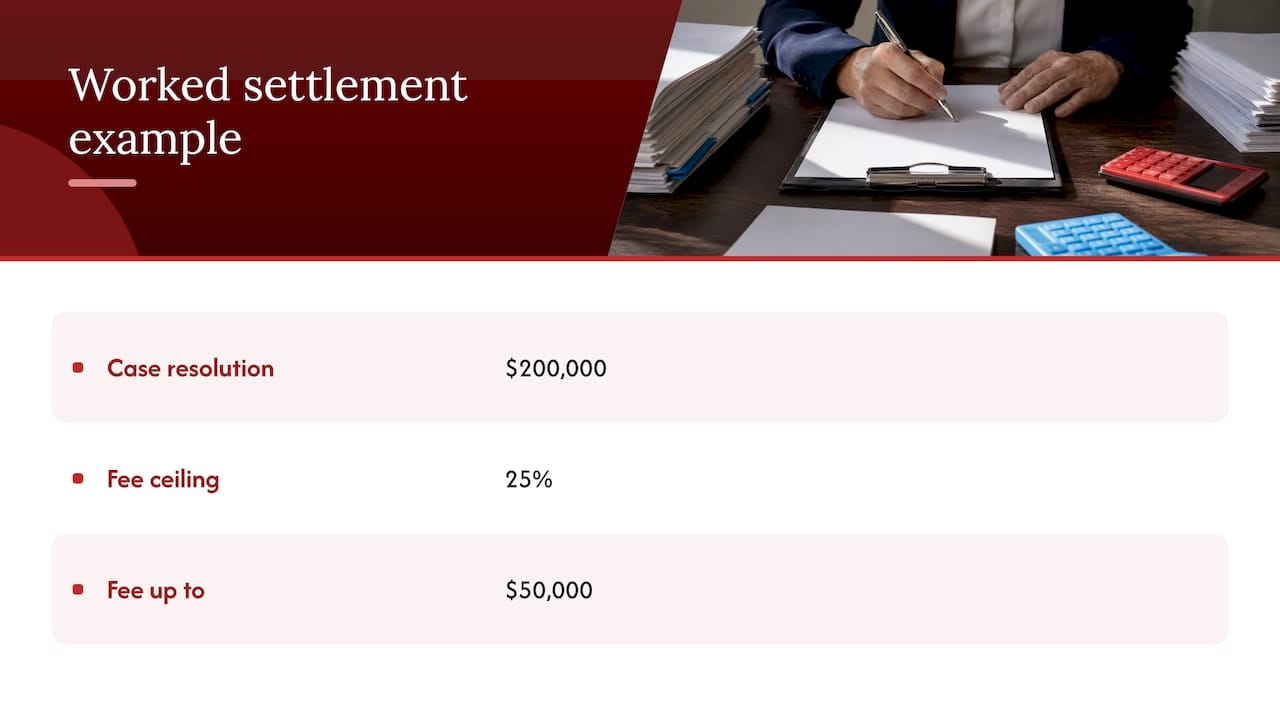
Suppose a county work truck rear-ends you on a Brevard County road and you are injured. Say the accident happened in a year covered by the 2025 caps. The county, not the driver, is the defendant for ordinary negligence. You send written notice to the county and DFS as the statute requires, and you wait for a written denial or the end of the agency’s response period. If the case later resolves at $200,000, the cap and the 25 percent fee ceiling both shape what you actually keep: a fee of up to $50,000 comes out of that amount. If your damages were far higher, the excess depends on a claim bill, not a court order. This is an illustration of how the statute works, not a prediction for any case.
How we handle government injury cases
Our personal injury practice in Brevard County covers car accidents, slip and falls and wrongful death. When the other party is a government body, we start with the entity, the notice and the clock, because those decide whether the claim is heard at all. You deal directly with an attorney, and the first 30-minute consultation is free.

If you were hurt by a city, county or state employee or property, contact our personal injury team and bring any photos, reports and medical records you have.
Our perspective
Government claims reward the person who treats the paperwork as seriously as the injury. The caps are set by statute, the fee ceiling is set by statute, and the notice rules are strict. That leaves one thing in your control: how well the case is prepared before anyone files anything.
When people come to us after a crash or fall involving a public agency, we want to know three things first: who the proper defendant is, when the clock started, and what the medical record shows. Those answers shape every decision after that.
You should not have to decode section 768.28 on your own while you are recovering. Direct attorney contact means you talk to the person responsible for your case, and we take that seriously.
John
FAQ
Can I sue the City of Melbourne or Brevard County for an injury?
Yes, in many negligence situations. Counties and municipalities are covered by the waiver in section 768.28, but the claim must follow the notice, denial and filing steps and stay within the statutory caps.
How long do I have to give notice?
For most negligence claims, written notice is due within 3 years after the claim accrues. For wrongful death, notice to the Department of Financial Services is due within 2 years. Check the current statute for the version covering your date of injury.
Can I get punitive damages from a government agency?
No. Section 768.28(5)(a) excludes punitive damages and pre-judgment interest from recovery against the state and its subdivisions.
Is there a limit on what my lawyer can charge?
Yes. Section 768.28(8) caps attorney fees at 25 percent of any judgment or settlement in a sovereign-immunity action.
What if my damages are higher than the cap?
A judgment above the cap can be paid only by further act of the Legislature, through a claim bill. That process has its own filing deadlines and hearings, so raise it with your attorney early.
Sources
- Section 768.28, 2026 Florida Statutes
- Section 768.28, 2025 Florida Statutes
- Legislative Claim Bill Manual, Florida Senate
- Sovereign Immunity outline, Miami-Dade County Attorney
- Sovereign immunity presentation, Miami-Dade County
- 2026 Bill Summaries, SB 1366, Florida Senate
- CS/SB 1366 Bill Analysis, Florida Senate, 2026
- SB 594 Bill Analysis, Florida Senate, 2011
- Commercial Carrier Corp. v. Indian River County, Florida Supreme Court, 1979