A negligent security claim in Florida is a premises liability lawsuit against a property owner or operator. It says the owner failed to take reasonable steps to protect you from a foreseeable crime, and you were hurt by that crime on the property. The claim is harder to win than it was before March 2023, because Florida now gives you two years to sue, bars recovery if you are more than 50% at fault, and gives some apartment owners a presumption against liability. This guide explains how the claim works, what you have to prove, and what to do first.
TL;DR
- Negligent security is a form of premises liability: you are hurt by a third party’s crime, and the owner’s failure to provide reasonable security helped make it possible.
- You must show the crime was foreseeable, the security was inadequate, and that the failure caused your injuries.
- Under HB 837, the general negligence deadline dropped from four years to two, so waiting costs you leverage and possibly the claim.
- Florida juries can assign fault to the criminal, and some multifamily owners who meet specific security requirements get a presumption against liability.
- We offer free 30-minute consultations to people hurt in Brevard County, so you can learn where you stand before deciding anything.
Table of Contents
- What negligent security means under Florida law
- Where these claims come up
- What you have to prove
- How the 2023 tort reform changed these cases
- Defenses property owners raise
- What to do after being hurt
- Our perspective
- Talk to a Brevard County injury lawyer
- FAQ
- Sources
What negligent security means under Florida law
The Florida Senate’s bill analysis for the 2023 legislation describes a negligent security claim as an action by someone injured by a third party’s criminal act on another person’s property. The injured person tries to hold the owner liable for not providing adequate security. The analysis treats it as a form of passive negligence: the complaint is not that the owner committed the crime, but that the owner failed to act to prevent foreseeable harm.
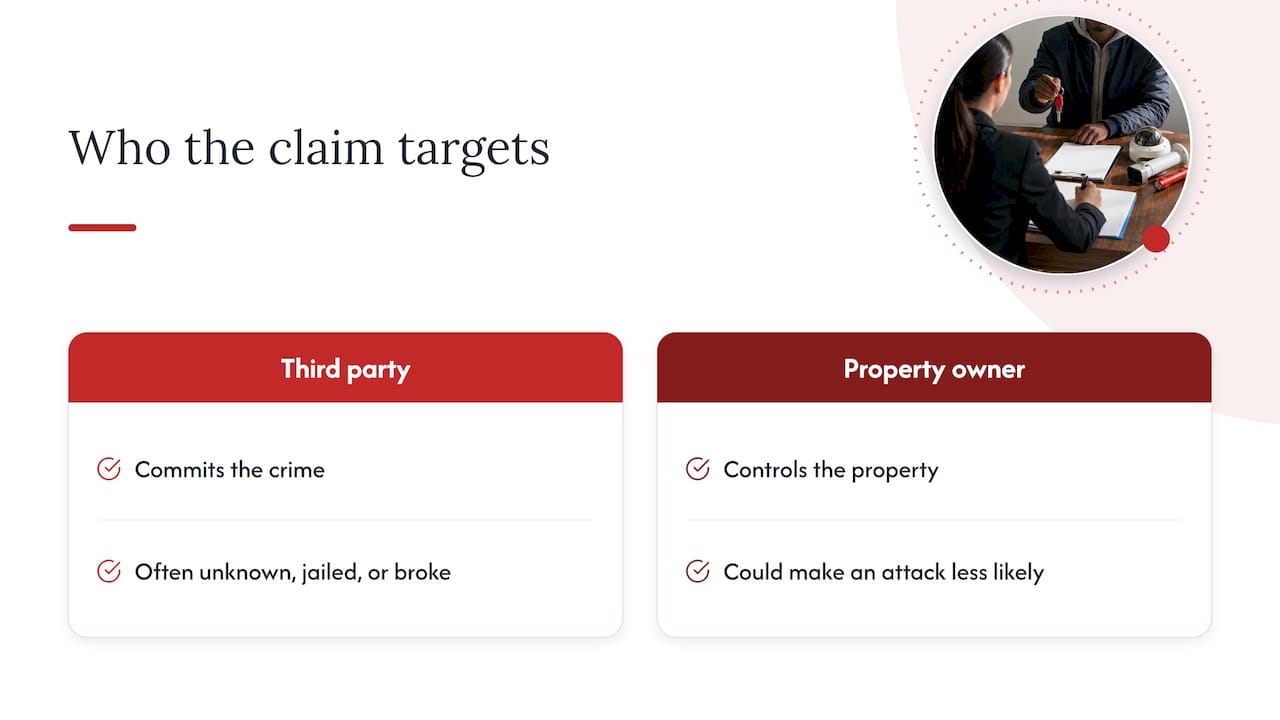
That distinction matters. The person who stabbed, robbed or shot you is the primary wrongdoer, and he or she is often unknown, in jail or without money. The civil claim targets the party that controlled the property and could have made an attack less likely: lighting, locks, cameras, patrols, repairs, or a warning to people on site.
Florida courts generally treat negligent security as a subset of premises liability. The Third District Court of Appeal, in a 2024 opinion, noted that earlier cases debated whether ordinary negligence or premises standards applied. It then explained that the duty owed to an invitee is to keep the premises reasonably safe, citing Nicholson v. Stonybrook Apartments, LLC (2015). If you want the broader picture first, our explainer on what premises liability means covers the foundation.
Where these claims come up
A negligent security case needs two things: a crime and a property where the owner had some control over safety. The crimes that lead to these cases are violent ones. Typical examples are assault, robbery, stabbing and shooting, and the same pattern applies to sexual assault or abduction.
The properties are usually places where the public or residents are expected to be, often at night, and where an owner could reasonably take protective steps:
- Apartment complexes and other multifamily housing
- Hotels and motels
- Parking lots and parking garages
- Shopping centers, convenience stores and gas stations
- Bars, nightclubs and event venues
- Hospitals, campuses and office buildings
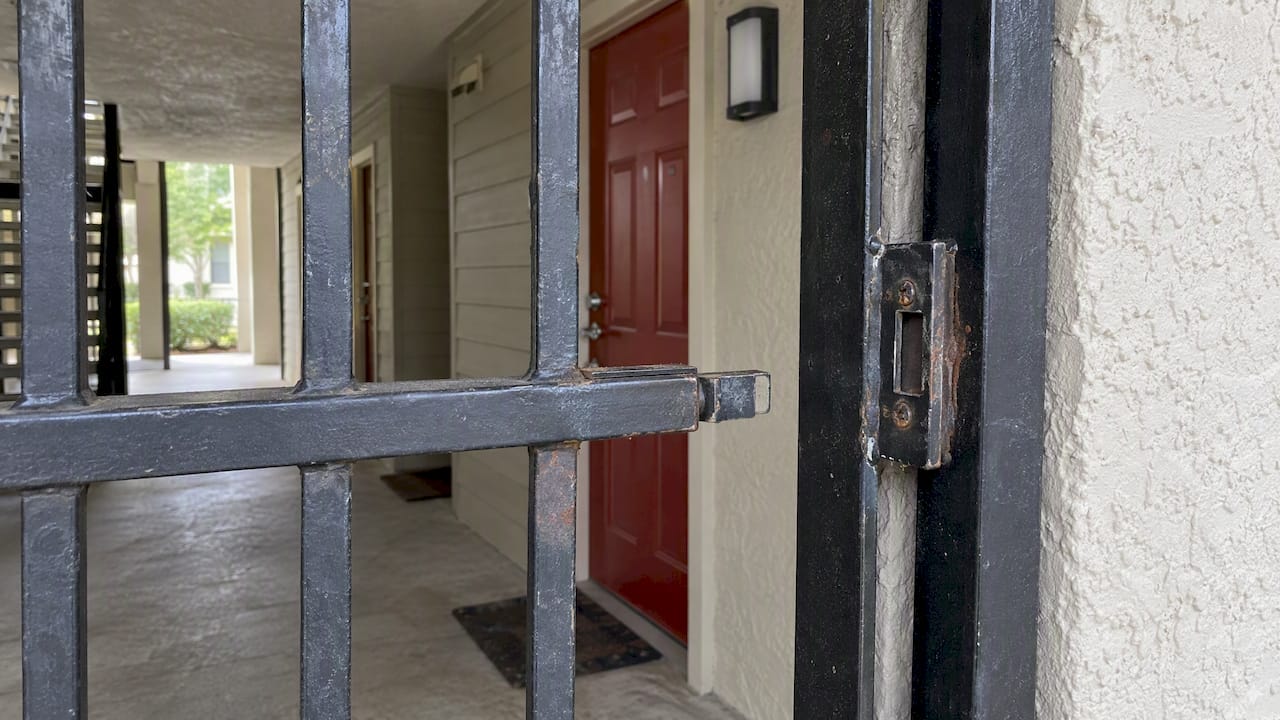
No property type automatically produces liability. A crime on a property does not make the owner responsible. The question is always whether that kind of harm was foreseeable at that place and whether the owner’s response was reasonable. A well-lit, gated complex with working cameras and a clean incident history is a very different case from one with broken gates, dark stairwells and a string of police calls.
What you have to prove
Google’s “people also ask” box asks about the “four proofs of negligence.” In Florida they are duty, breach, causation and damages. Here is how each plays out in a security case.
Your status on the property
Duty depends on why you were there. Florida law distinguishes between invitees, licensees and trespassers, and the owner owes the highest duty to invitees, such as tenants, guests, customers and patrons. In a 2026 decision involving a hospital, the Second District Court of Appeal discussed how that status can be a fact question for a jury. In a borderline case, such as a visitor who stayed past an invitation, expect a fight over this point.
Foreseeability and the zone of risk
Florida courts ask whether the defendant’s conduct created a broader foreseeable “zone of risk” that posed a general threat of harm. The owner does not need to have foreseen your exact injury. In a 2026 appellate opinion, the court explained that foreseeability plays two roles. When it supports duty, it is a legal question for the judge. When it relates to proximate cause, it is a factual question for the jury. The court also said these roles should not be blurred.
The same line of cases recognizes an exception to the general rule that nobody has a duty to control another person’s conduct. It can apply when a special relationship exists with the person who needs controlling or with a foreseeable victim, or when the defendant creates a foreseeable zone of risk, according to the Second District’s opinion.
In practice, foreseeability is shown with evidence like:
- Prior similar crimes on or near the property
- Police call logs and incident reports
- Resident or customer complaints
- Internal emails, maintenance requests and security reports
- The owner’s own security policies, and whether staff followed them
Inadequate security and breach
Breach means the owner’s security was not reasonable given what the owner knew. That might be burned-out lights that stayed dark for months, a broken gate, a guard who was supposed to patrol and did not, no cameras at an entrance with a known history of break-ins, or no warning about a danger the owner knew about. Experts in security practices are common in these cases, and they compare what was in place to what a reasonable operator of that kind of property would have done.
Causation and damages
You must connect the security failure to the harm. Defense lawyers often argue that the attacker would have struck anyway, so better lighting or a working lock would have changed nothing. The strongest cases show how the specific failure made this specific attack easier: an unlocked door the attacker walked through, a dark corner where he waited, or a camera that was never monitored.
Damages can include medical bills, lost income, future care, and pain and suffering. In a death case, certain family members may pursue a wrongful death claim. Our personal injury practice handles wrongful death along with car accidents and slip and fall cases.
How the 2023 tort reform changed these cases
HB 837 took effect in 2023 and touched negligent security directly. Three changes matter most.
A two-year deadline
The American Tort Reform Association’s summary of 2023 enactments reports that HB 837 cut the statute of limitations for general negligence cases in Florida from four years to two. Our page on Florida’s injury statute of limitations walks through how that deadline is counted. Wrongful death follows its own rules, so do not assume the same clock applies.
Two years sounds like plenty. It is not, because evidence disappears quickly. Video is overwritten, witnesses move, and property managers change. Security investigations also take time: obtaining crime data, sending preservation letters and consulting experts.
Fault of the criminal goes on the verdict form
Florida law requires the trier of fact to consider the fault of all persons who contributed to the injury, and in a negligent security action against an owner, lessor, operator or manager of commercial or real property, that includes the criminal actor, according to Chapter 768 of the Florida Statutes. Under section 768.81, a judgment is entered against each liable party based on that party’s percentage of fault, not joint and several liability.
Here is what that means in numbers. Suppose a jury finds your damages are $500,000 and assigns 80% of the fault to the attacker and 20% to the property owner. The owner’s share is $100,000, even though the attacker may never pay a dollar. This is why these cases now turn so heavily on proving how much of the harm the owner’s failure caused.
Your own fault can bar recovery
HB 837 also changed comparative negligence. If a jury finds you more than 50% at fault, you generally cannot recover damages. Our guide to Florida’s 51% comparative negligence rule explains how it works. Owners sometimes argue that the injured person ignored warnings, walked through a dangerous area at night, or was involved in the confrontation. Be careful about what you say to anyone on the other side about what you were doing before the attack.
Defenses property owners raise
Expect the owner and the owner’s insurer to push back. Common defenses include:
- No foreseeability. They say nothing like this had happened before, so they had no reason to act.
- Reasonable security. They point to cameras, lighting, locks or guards they did have.
- The attacker’s fault. They ask the jury to put most of the blame on the criminal.
- Your fault. They argue you share responsibility, ideally above the 50% bar.
- Status. They argue you were a trespasser or licensee, which lowers the duty owed.
- The multifamily presumption. This one is new and deserves its own explanation.
The apartment presumption under section 768.0706
Florida Statute 768.0706 gives the owner or principal operator of a multifamily residential property a presumption against liability for third-party crimes when it substantially implements specified security measures. Those measures include cameras, lighting and locking requirements, according to the Florida Statutes. The owner must also have a crime prevention through environmental design assessment no more than three years old, and must provide crime deterrence and safety training to employees.
A presumption is not immunity. It shifts the burden, and it only applies if the owner actually did the work. A claim against an apartment complex now often starts by checking whether the locks worked, whether the lights were on, whether the cameras recorded, whether the assessment exists and is current, and whether employees were trained. Paper compliance that does not match reality is something we would look at closely.
Can a security company or guard be liable?
People also ask whether security officers can be charged with negligence. A guard or a security contractor can be a defendant in a civil case if the guard’s own failure, such as abandoning a post or ignoring an obvious threat, contributed to your injury. The contract between the owner and the security company often decides who owed what. Under the fault rules above, a jury can divide responsibility among the owner, the contractor and the attacker. Criminal charges against a guard are a separate matter and are rare.
What to do after being hurt
If you were hurt in a crime on someone else’s property in Florida, these steps protect both your health and your claim.
- Get medical care and report the crime. Call 911, and make sure a police report exists. The report date and details become evidence.
- Document the scene. Photograph broken locks, dark areas, missing cameras and signage, if you can do so safely. Do it soon, because owners repair things quickly.
- Write down witnesses. Names, phone numbers and what they saw.
- Do not give a recorded statement to the owner’s insurer. Talk to a lawyer first.
- Ask for evidence to be preserved. A lawyer can send letters demanding that video, incident logs and security contracts be kept.
- Watch the clock. Count two years from the date of the incident as your working deadline, and confirm the exact deadline for your situation.
Our article on common personal injury case mistakes covers the errors that most often weaken claims, like posting on social media and delaying treatment.
Our perspective
We handle personal injury, criminal defense and family law in Brevard County, and what we see is that people injured in a violent incident are rarely thinking about the property. They are thinking about getting well, paying bills and feeling safe again. The legal question comes later, often after a landlord or manager has already told them it was nobody’s fault.
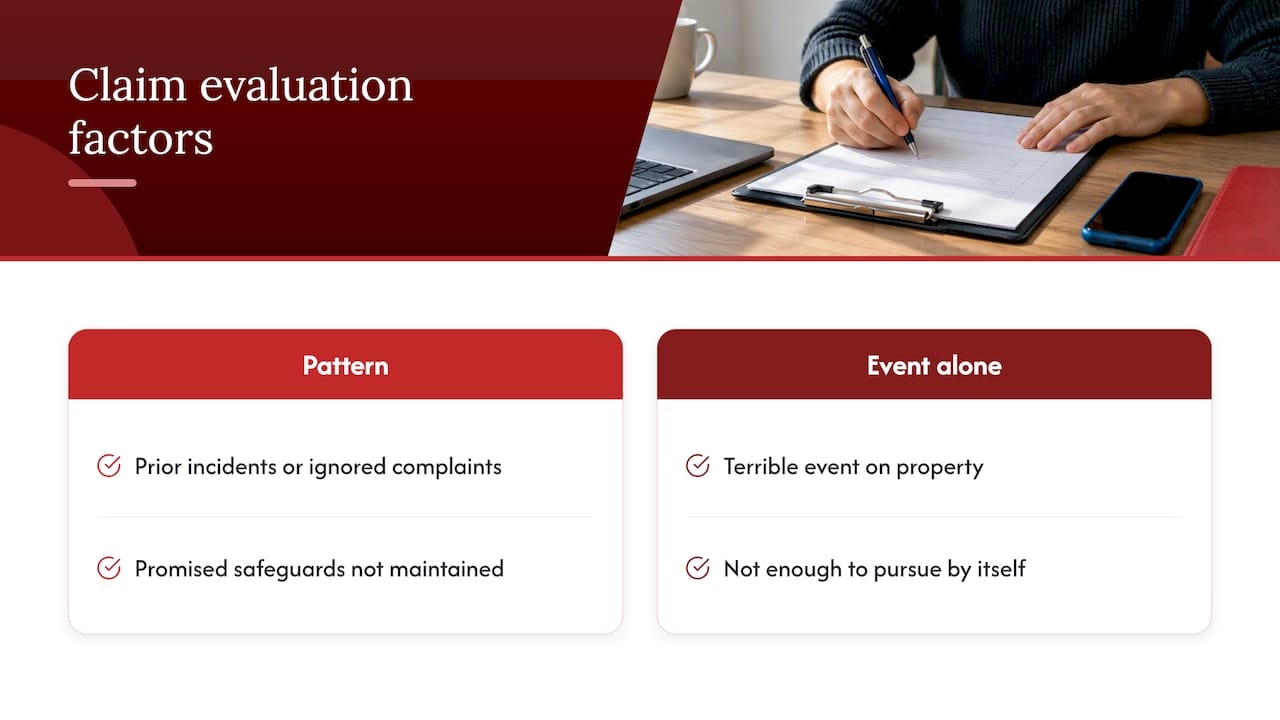
Our view is simple. A negligent security case is worth looking at when there is a pattern: prior incidents, ignored complaints, or basic safeguards that were promised and not maintained. It is not worth pursuing just because something terrible happened on a property. After 2023, a weak case costs more and leaves less room for error, so we think an honest early evaluation is the most valuable thing a lawyer can give you. If the facts do not support a claim, we would rather tell you that on day one.
We also know these cases involve trauma. You will deal with an attorney directly, not just a case manager, and you can decide how much detail you want to go through at each stage.
— John
Talk to a Brevard County injury lawyer
If a crime on someone else’s property left you or a family member hurt, we can review what happened, what evidence may exist and how soon you need to act. The Law Office of John Vernon Moore, P.A. offers a free 30-minute consultation, and the details of your situation stay with you and your attorney. Learn more about our personal injury practice or start from our main page.

Bring the police report if you have one, any photographs, your medical records and the names of anyone who saw what happened. If you are not sure what counts, bring what you have.
FAQ
What is the negligence rule in Florida?
Florida uses comparative negligence. Each party’s share of fault is measured, and under section 768.81 judgment is entered against each liable party according to its own percentage of fault. Since HB 837, a person found more than 50% at fault generally cannot recover damages.
What does negligent security mean?
It means a property owner or operator failed to provide reasonable protection against foreseeable crime, and someone was hurt as a result. Florida treats it as a type of premises liability. The owner is not accused of committing the crime, only of failing to take reasonable steps to prevent harm that should have been expected.
How long do I have to file a negligent security lawsuit in Florida?
HB 837 reduced the general negligence statute of limitations from four years to two, as reported by the American Tort Reform Association. Because wrongful death and other special situations can follow different rules, speak with a lawyer as soon as you can rather than relying on the two-year figure.
Can I sue if the attacker is never caught?
Yes, the claim is against the property owner or operator, not the attacker. But the jury can assign fault to the attacker even if he or she is unknown or not a party, and the owner pays only its own percentage. The evidence about the property is what carries the case.
Can a security officer or company be held responsible?
Potentially, yes. If a guard or contractor failed to do what the job required and that failure contributed to your injury, the company may share civil liability with the owner. The security contract and the facts of the incident decide how fault is divided.
Sources
- Florida Senate bill analysis, 2023 (CS/SB 236)
- Third District Court of Appeal opinion (premises liability and invitee duty)
- Florida appellate opinion on foreseeability and the zone of risk, 2026
- Second District Court of Appeal opinion on invitee status and special relationships, 2026
- Florida Statutes, Chapter 768 (Negligence)
- Florida Statutes, section 768.81
- American Tort Reform Association, 2023 enactments