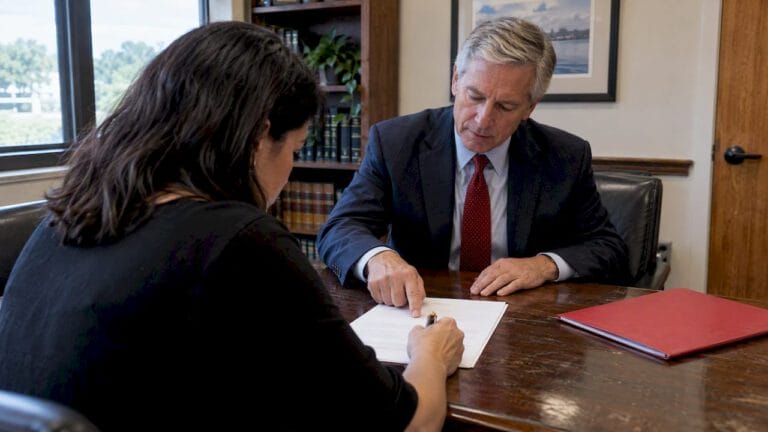
Ask about your distribution goals, who will act for you if you become incapacitated, how your assets are titled, who your beneficiaries are, and how the attorney charges for the work. Bring an itemized asset list with estimated values and account contacts, along with your IDs, prior estate documents, and insurance or retirement statements so the attorney can give you a real answer instead of a guess.
TL;DR:
- Bring an itemized asset list with estimated values and account contacts, identification, existing estate documents, beneficiary forms, recent statements, and secure digital access notes.
- Ask who can make financial and health care decisions during incapacity, what authority they receive, and whether your directives work across states if you relocate.
- Before signing, confirm flat versus hourly fees, whether revisions and paralegal work cost extra, who drafts documents, and response times in a written engagement letter.
- Review beneficiary forms and account titles every three to five years and after major life changes; wills do not update retirement or insurance designations.
- If your family includes an unmarried partner, stepchildren, or chosen family, ask how default inheritance laws affect them and whether mediation could prevent court disputes.
Table of Contents
- Priority questions to ask, grouped by theme
- What to bring to the appointment: documents and information checklist
- How to evaluate attorney fit, fees, and who does the work
- After the consult: realistic next steps, timeline, and coordination with advisors
- How we run an efficient, client-centered first consult
- Considerations for digital assets and online account management
- Strategies for business succession planning
- How military benefits and considerations affect estate planning
- The one question most people skip
- Talk to our estate planning team
- FAQ
- Sources
Priority questions to ask, grouped by theme
A good consultation moves through five areas. Working through them in order keeps the meeting focused and gives the attorney what they need to scope your plan accurately.
- Goals and priorities: What do you want this plan to achieve, probate avoidance, support for a spouse, separate shares for children from different relationships, or protection for a beneficiary who cannot manage money directly?
- Incapacity planning: Who will make health care and financial decisions if you cannot, and what specific powers will that person have under your power of attorney and health care directive?
- Asset and account questions: How is each asset titled, are your beneficiary designations current, and who besides you can access the accounts right now?
- Beneficiaries and family dynamics: How should the plan handle a blended family, a child with special needs, a pet, or a gift to a charity you care about?
- Trusts, probate, and taxes: Does a trust make sense for your situation, how much probate exposure would it actually remove, and are there estate tax issues worth flagging early?
You can use these almost verbatim. Try: “If I do nothing else this year, what’s the one document I need signed first?” or “Who has legal authority to pay my bills if I’m hospitalized next month?” Those two questions alone surface most of the planning gaps attorneys see in a first meeting, according to the American Bar Association’s guidance on time-sensitive estate planning, which recommends prioritizing a basic will, powers of attorney, and an advance health care directive when time is short.
Family structure deserves its own question. If your household does not match the traditional nuclear model, say so directly, because intestacy laws (the default rules that apply when there is no valid will) often do not reflect unmarried partners, stepchildren, or chosen family the way you would want, as the American Bar Association’s discussion of non-traditional families points out. Ask directly how your plan would hold up if it were ever challenged, and whether a mediation clause makes sense for resolving future disputes among beneficiaries without going to court.
What to bring to the appointment: documents and information checklist
The more complete your paperwork, the less time you spend on follow-up calls. Bring:
- Government ID and dates of birth for you, your spouse, and anyone you plan to name as an agent or guardian.
- An itemized list of assets with estimated values and contact information for each account.
- Deeds, titles, recent statements for bank and retirement accounts, and insurance policy summaries.
- Any existing will, trust, or power of attorney, even an outdated one.
- Beneficiary designation forms and notes on digital account access, including usernames stored securely.
- Contact information for your CPA or financial advisor, and recent tax returns if your assets are complex.
Arriving with an itemized asset list and digital account notes is the single biggest time-saver in a first meeting, according to the ABA’s guidance on financial planning for death, which also warns that a safe deposit box can become inaccessible after death unless someone else already has legal authority to open it.
Pro Tip: Keep your original documents with your attorney or a trusted person, not locked alone in a safe deposit box, so your executor isn’t stuck waiting on a court order to retrieve them.
How to evaluate attorney fit, fees, and who does the work
Choosing an attorney is as much about process as credentials. A few direct questions reveal whether this is the right fit before you sign anything.
- Ask what share of the attorney’s practice is estate planning and whether they’ve handled situations like yours, such as a blended family or a special needs beneficiary.
- Ask for fee options up front: a flat fee for standard packages versus hourly billing, and whether revisions are included.
- Clarify who actually drafts your documents, whether paralegal time is billed separately, and how quickly you can expect responses to questions.
- Request an engagement letter that spells out scope, total cost, and who handles updates down the road.
- Watch for an attorney who gives you an honest, specific assessment rather than a guaranteed outcome.
A transparent engagement letter and a direct line to the attorney (not just a paralegal) are two of the clearest signals you’re dealing with a well-run practice, according to the ABA’s consumer guidance on questions to ask a lawyer, which also flags fee reasonableness and conflict-of-interest checks as core ethical obligations attorneys owe their clients. If you’re vetting attorneys broadly, the same fee and communication questions apply whether you’re hiring for a divorce case or an estate plan.
After the consult: realistic next steps, timeline, and coordination with advisors
- Expect a first draft within a few weeks of your consultation, with signing scheduled once you’ve reviewed and approved the language.
- If your estate is large or includes a business, your attorney may loop in a CPA or appraiser before finalizing values or tax strategy.
- You should leave with signed originals, execution instructions, and copies for your own records.
- Plan to revisit your documents every three to five years, or sooner after a marriage, divorce, birth, or major asset change.
If your estate could approach federal estate tax thresholds, ask early who handles the Form 706 filing if it becomes necessary, since the IRS generally requires that return within nine months of death. For readers whose plan involves eventual probate, our overview of Florida’s formal administration timeline walks through what to expect after the documents are signed.
How we run an efficient, client-centered first consult
Our process is built around direct attorney access from the first call, avoiding handoffs to case managers so clients always know who’s working on their file.
- We offer an initial consultation that includes direct attorney interaction rather than a call with non-attorney staff.
- Our firm draws on 85 years of combined experience, which our attorneys state as part of their positioning, and we hold mediation certification for clients who want dispute resolution built into their plan.
- Our process moves through a pre-consult questionnaire, a full asset review, a written engagement letter, document drafting, and a scheduled execution appointment.
This sequence exists so nothing gets drafted before we understand your actual goals and your full asset picture.
Considerations for digital assets and online account management
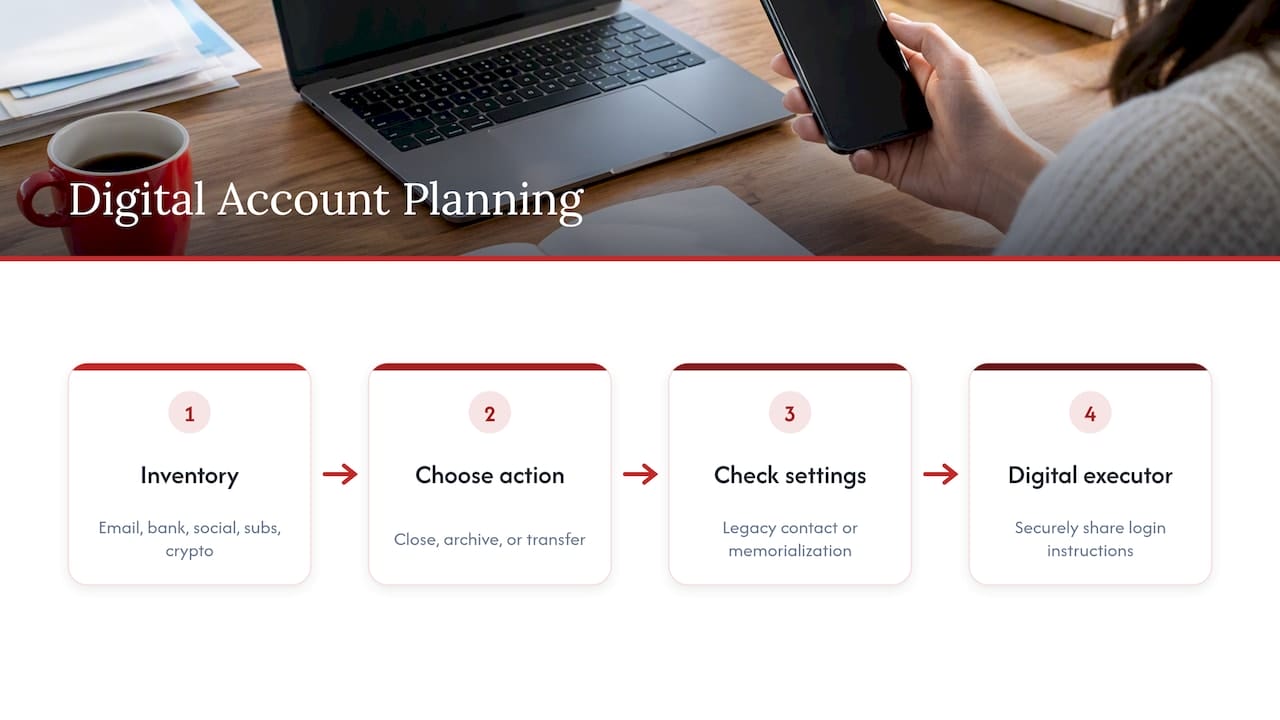
Digital accounts rarely show up on a paper asset list, but they often hold financial and sentimental value, from cryptocurrency wallets to photo archives stored only in the cloud. Start by inventorying every account that matters: email, banking apps, social media, subscription services, and any crypto exchange or digital wallet.
Decide who should have access and what they should do with each account: close it, archive it, or transfer the asset. Many platforms have their own legacy contact or memorialization settings, so check those directly rather than assuming your will covers it automatically. Store login information securely, through a password manager or a sealed document held by your attorney, and update your estate plan’s language to name a digital executor if your state or your attorney recommends it.
The practical risk is access, not legality: without login credentials or explicit authorization, an executor may face delays or dead ends trying to locate or close accounts, echoing the same access problem the ABA’s guidance on financial planning for death describes for safe deposit boxes. If your executor will need to manage a deceased relative’s physical property alongside digital accounts, a resource like HouseGoodbye’s guide to executor duties in an estate sale covers the practical side of that process.
Strategies for business succession planning
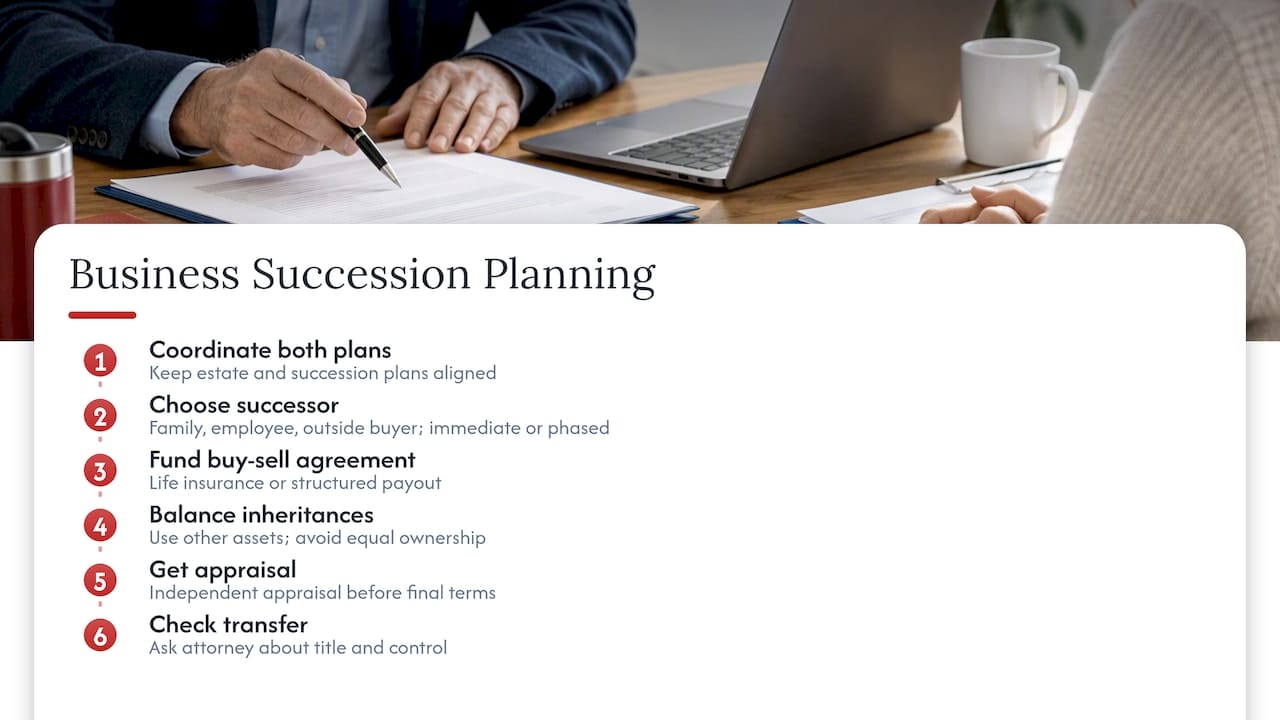
If you own a business, your estate plan and your succession plan need to work together, not sit in separate drawers. Start by deciding who takes over operations: a family member, a key employee, or an outside buyer, and whether that transition happens immediately or is phased in over time.
A buy-sell agreement, funded by life insurance or a structured payout, keeps co-owners or heirs from being forced into a fire sale to cover estate costs. If multiple children are involved and only one works in the business, consider balancing their inheritances with other assets rather than splitting ownership evenly by default, which often creates friction down the line.
Valuation matters too: a business is rarely worth what the owner assumes, so an independent appraisal before you finalize succession terms avoids disputes later. Ask your attorney directly how your business interests are titled and whether your current plan actually transfers control the way you intend, or whether it just transfers value.
How military benefits and considerations affect estate planning
Military families face planning questions that civilian estate plans don’t always address. Survivor Benefit Plan elections, Servicemembers’ Group Life Insurance (SGLI) beneficiary designations, and Thrift Savings Plan accounts all pass outside a will through their own beneficiary forms, so those need to be checked and updated separately from your core estate plan.
Frequent relocation across states adds complications too, since powers of attorney and health care directives drafted in one state don’t always transfer cleanly to another. Deployment timelines also matter: if you’re preparing to deploy, ask your attorney what can realistically be finalized before you leave versus what needs power of attorney coverage while you’re away. For families navigating these issues alongside a military divorce, our overview of military family law questions addresses related concerns that often come up alongside estate planning.
The one question most people skip
Most consultation advice focuses on documents: wills, trusts, powers of attorney. The more useful question is what happens between signings, because that’s where plans actually fail. A will sits untouched for a decade while beneficiary forms on a 401(k) still name an ex-spouse, and no document fixes that except the form itself.
The conventional advice to “get a will” undersells the work. The real priority is building a habit of checking beneficiary designations and account titling every few years, not treating the signing appointment as the finish line. If you walk into a consultation with one goal, make it this: ask your attorney how they’ll flag you when it’s time to review, not just how they’ll draft the documents today. A plan that’s accurate on day one and stale by year five protects no one.
— John
Talk to our estate planning team
We handle wills, trusts, powers of attorney, and probate and trust administration for clients working through exactly these questions, with a free initial consultation and direct attorney involvement from the start.

If you’re ready to put a plan in place or review one that’s gotten out of date, reach out through our estate planning and probate page to schedule your consultation.
This article is general information, not a substitute for advice from a qualified lawyer. Consult a qualified legal professional about your own circumstances before acting on anything here.
FAQ
How do you pick the right estate planner?
Look for an attorney whose practice focuses substantially on estate planning, who offers a clear fee structure, and who commits to direct communication rather than routing everything through staff. A written engagement letter that spells out scope and cost is a strong sign you’re dealing with a transparent practice, as the American Bar Association notes.
Why do people want to avoid probate court?
Probate can take months to resolve, adds court filing and administration costs, and makes certain estate details part of the public record. Trusts and properly titled accounts are common tools attorneys use to reduce how much of an estate passes through that process.
What is the biggest mistake people make with wills?
The most common mistake is signing a will once and never updating it, so beneficiary designations on retirement accounts or life insurance still reflect an old marriage or outdated family situation. Reviewing documents every few years, or after a major life change, prevents this gap.
What should you bring to a probate hearing?
Bring the original will if one exists, a certified death certificate, identification, and any paperwork related to the estate’s assets and debts. Our overview of Florida’s probate process walks through the documents and steps involved in more detail.
When should an estate plan involve a CPA or tax professional?
Bring in a CPA or enrolled agent when the estate approaches federal estate tax thresholds or includes complex assets like a business or multiple real estate holdings. The IRS outlines when a Form 706 filing is required and the factors that signal you need added tax expertise alongside your attorney.