Refusing a lawful breath test in Florida triggers an immediate administrative suspension, 1 year for a first refusal and 18 months for a repeat refusal, and since October 1, 2025, a qualifying refusal can also be charged as a misdemeanor. The single most urgent step is requesting a BAR review within 10 days, because missing that window closes your chance to challenge the suspension administratively.
TL;DR:
- The officer usually takes your license at the scene and issues a temporary driving permit that lasts only 10 days.
- Submit your BAR request with your citation, suspension notice, witness contacts, and supporting records, such as medical files or breath machine maintenance logs.
- Prosecutors must establish a lawful arrest, a proper implied consent warning, and an actual refusal; hesitation or a clarifying question alone may not suffice.
- Winning a BAR challenge does not automatically resolve the criminal case, and a criminal outcome does not itself erase the administrative suspension.
- Hardship license eligibility depends on whether the refusal is a first or repeat offense, and waiting periods may apply before restricted driving begins.
Table of Contents
- Florida’s implied consent law: what §316.1932 and §316.1939 require
- What happens at the scene and your short term driving privileges
- How to challenge the suspension: BAR review and hardship license options
- When refusal becomes a criminal charge and how it’s defended
- What to do in the first 10 days after a refusal
- An attorney’s view on refusal case triage
- How we help with refusal and DUI cases in Brevard County
- FAQ
- Sources
Florida’s implied consent law: what §316.1932 and §316.1939 require
Florida’s implied consent framework is built on a trade: drive on Florida roads and you agree in advance to submit to an approved breath, blood, or urine test if you’re lawfully arrested for DUI. §316.1932 spells out the mechanics, and it only applies when the test request is incidental to a lawful arrest, meaning the officer needed probable cause first.
- The officer must warn you that refusal results in a 1 year suspension for a first refusal or 18 months for a subsequent one, and that the refusal itself can be used against you in court.
- The test must be requested after a lawful arrest, not as a fishing expedition before one.
- §316.1939 lays out the separate criminal elements prosecutors must prove: a lawful arrest, the required warning, and an actual refusal, with prior suspension or fine history raising the stakes further.
The statutory warning language matters because a defective or missing warning can undercut both the administrative suspension and any criminal charge built on top of it.
What happens at the scene and your short term driving privileges
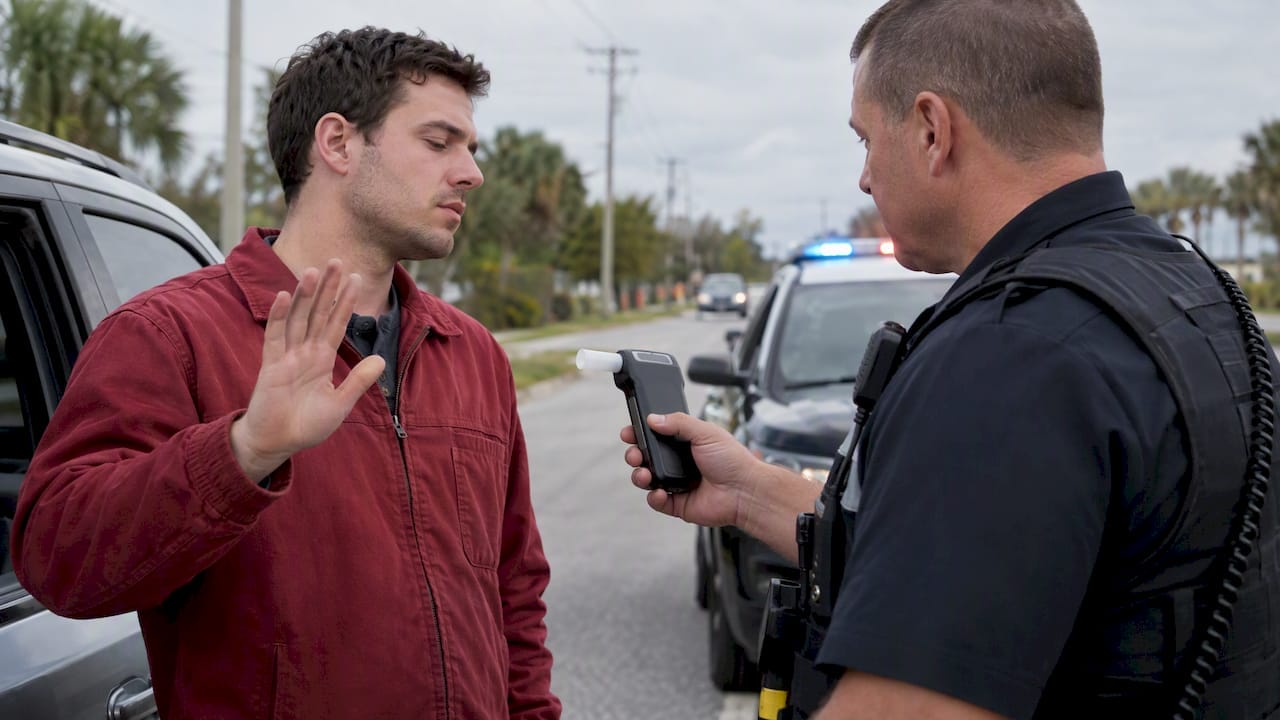
Once you refuse, the officer typically takes your physical license on the spot and hands you a 10 day temporary driving permit along with an official notice of suspension. That notice starts the clock, not the date you get around to reading it carefully.
A first refusal carries a 1 year administrative suspension, while a second or subsequent refusal carries 18 months, under FLHSMV’s administrative suspension guidance. Commercial driver’s license holders face their own, often harsher, disqualification rules on top of this.
- The suspension is recorded on your driving history immediately, separate from any criminal case outcome.
- Insurance carriers typically see this record when they pull your driving history at renewal.
- The 10 day temporary permit is not a grace period to delay action, it’s a deadline to act within.
How to challenge the suspension: BAR review and hardship license options
The Bureau of Administrative Reviews, or BAR, is the body that hears challenges to your suspension, and FLHSMV’s BAR procedures spell out what that process looks like.
- File a request for a formal or informal review with BAR within 10 days of your arrest, using the notice of suspension paperwork the officer gave you.
- Gather supporting documents: the officer’s affidavit, breath machine maintenance records, and any medical records if you physically couldn’t provide a sample.
- Ask about restricted or hardship license eligibility, since waiting periods and eligibility depend on whether this is a first or subsequent refusal.
- Understand that waiving the hearing waives your chance to contest the suspension on the record, so don’t do it reflexively.
Pro Tip: Request your BAR review the same week as your arrest, don’t wait until day nine to start gathering paperwork.
When refusal becomes a criminal charge and how it’s defended
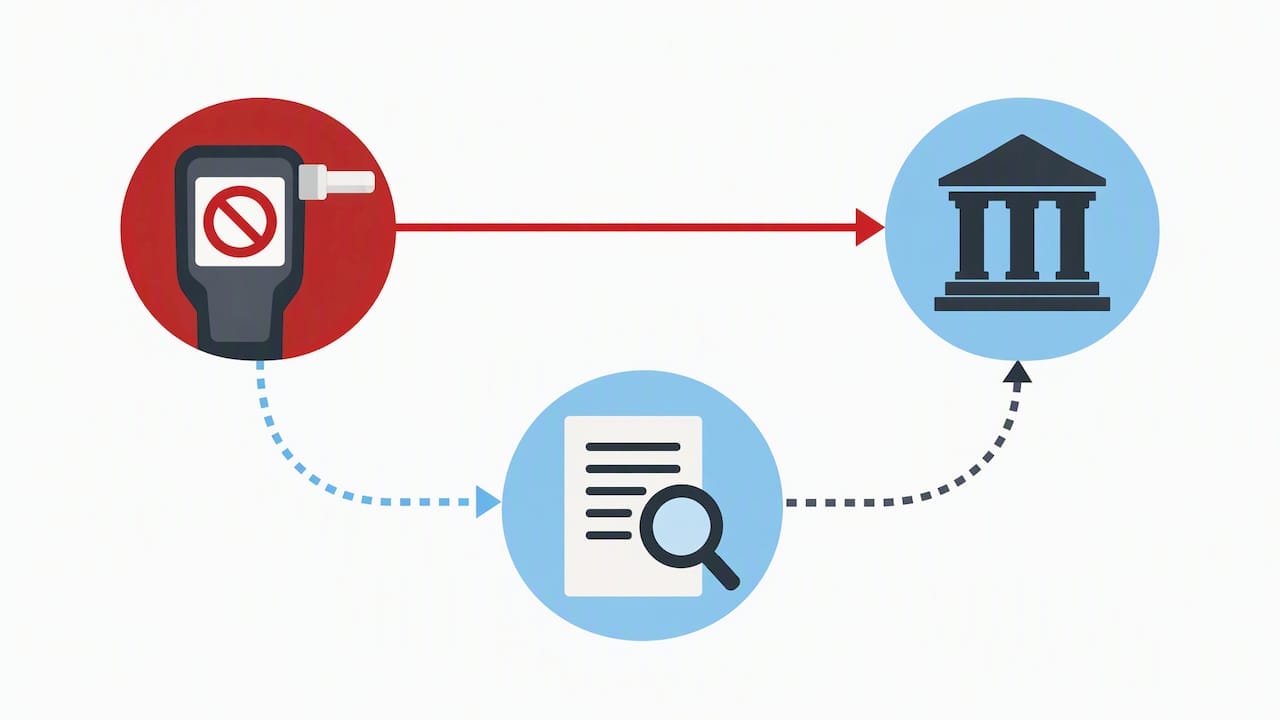
Losing your license administratively and facing a criminal charge are two separate tracks, and resolving one doesn’t automatically resolve the other. Florida’s legislature changed the stakes here: effective October 1, 2025, a qualifying first refusal is a second degree misdemeanor, and a qualifying second or subsequent refusal becomes a first degree misdemeanor when prior suspension or fine history applies under the current implied consent statute.
To convict, the State has to prove the arrest was lawful, that you were properly warned, and that you actually refused, not just hesitated or asked a clarifying question.
- A common defense attacks the lawfulness of the arrest itself, arguing the officer lacked probable cause.
- Another challenges whether the implied consent warning was given correctly or at all.
- Medical inability to provide a breath sample, due to a respiratory condition or injury, can undercut the refusal element entirely.
- Defects in breath machine maintenance logs or incomplete paperwork can weaken the State’s evidentiary foundation.
Courts have generally treated refusal evidence as admissible at trial, following reasoning similar to federal appellate authority on implied consent, so expect the refusal itself to come up in front of a jury.
What to do in the first 10 days after a refusal
The clock starts the moment you refuse, and the choices you make in the following days shape both your license and your criminal exposure.
- Submit your BAR review request within 10 days, attaching your citation copy, the notice of suspension, and contact information for any witnesses at the scene.
- Preserve evidence before it disappears: request breath machine maintenance logs through discovery, pull any dashcam or body camera footage, and collect medical records if illness or injury affected your ability to test.
- Contact an attorney as early as possible, since coordinating the administrative filing with criminal defense strategy within the same short window often determines what options remain open.
If you hold a commercial driver’s license, the stakes compound quickly, and our CDL-specific deadline guidance covers what else is at risk.
Pro Tip: Call an attorney before you call anyone else, the paperwork clock doesn’t pause for insurance calls or work schedules.
An attorney’s view on refusal case triage
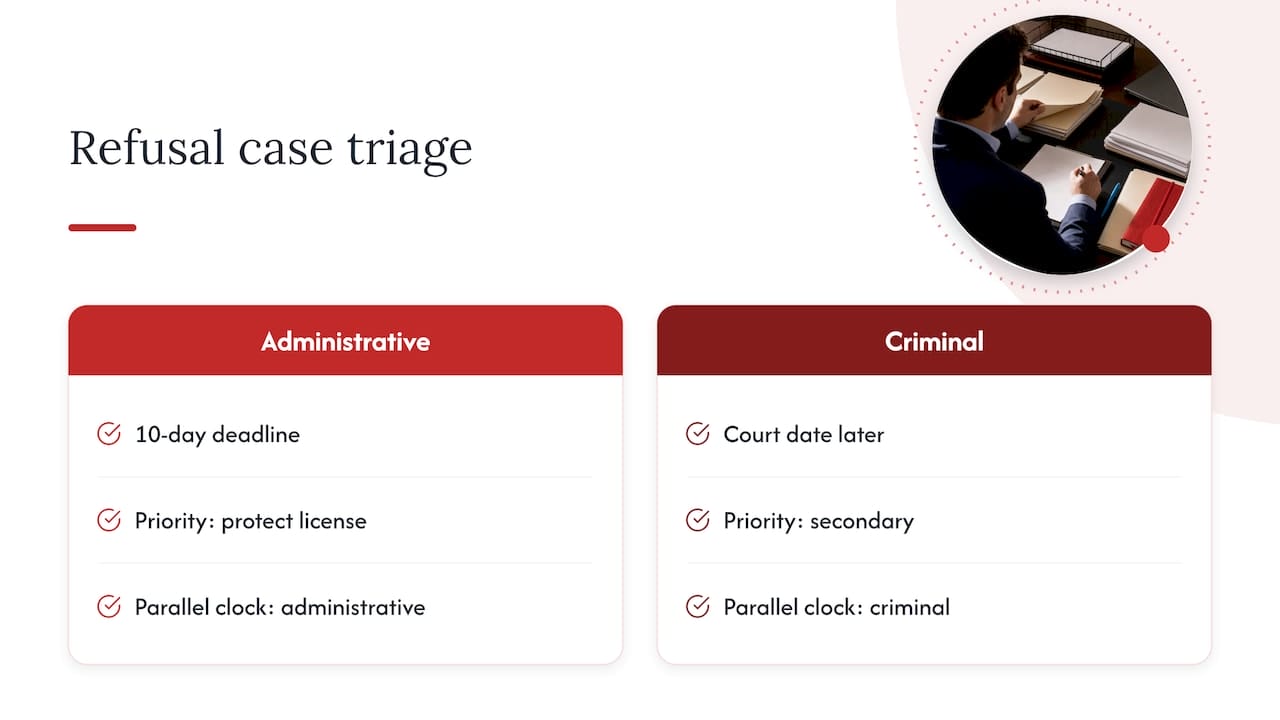
The administrative deadline is unforgiving, and in our experience the biggest mistake drivers make after a refusal is treating the 10 day window as optional. We built our approach around protecting the license first, then turning to the criminal charge, because losing driving privileges often causes more immediate damage than the eventual court date.
We treat every refusal case as two parallel clocks running at once.
— John
How we help with refusal and DUI cases in Brevard County
A breath test refusal puts your license and your record at risk at the same time, and we handle both sides of that fight under one roof. Our DUI defense practice files BAR administrative reviews to protect your driving privileges while building the criminal defense in parallel, so neither deadline gets missed while you’re focused on the other.
- We offer a free initial consultation so you can learn your options before committing to representation.
- Direct attorney interaction means you’re working with the lawyer handling your case, not a rotating staff member.
- Bring your citation, notice of suspension, and arrest paperwork to your first call so we can move quickly on the 10 day clock.
If bail is part of your immediate concern after an arrest, general guidance on typical DUI bail amounts can help you understand the process, though bail practices vary by jurisdiction. Reach out through our main contact page to get started today.
This article is general information, not a substitute for advice from a qualified lawyer. Consult a qualified legal professional about your own circumstances before acting on anything here.
FAQ
What happens in Florida if you refuse a breathalyzer test?
You face an immediate administrative suspension, 1 year for a first refusal or 18 months for a repeat refusal, under FLHSMV’s suspension rules. Since October 1, 2025, a qualifying refusal can also result in a separate misdemeanor charge.
Can you refuse a breath test in the US?
You can physically refuse, but most states, including Florida, penalize that refusal through implied consent laws tied to your driving privileges. In Florida, the refusal itself can trigger a license suspension and be used as evidence in a criminal case under §316.1932.
Is a refusal worse than a DUI?
It depends on your situation: a refusal avoids creating a breath test result, but it adds its own administrative suspension and potential misdemeanor exposure on top of the underlying DUI investigation. Many defense attorneys weigh this tradeoff case by case rather than treating refusal as automatically better or worse.
Can you get a hardship license if you refuse a breathalyzer in Florida?
A restricted or hardship license may be available depending on whether it’s your first or a subsequent refusal, and eligibility typically involves a waiting period. Our hardship license guidance walks through the filing steps for readers exploring this option.
Sources
- Chapter 316 §1932 – 2026 Florida Statutes – Tests for alcohol, implied consent; refusal.
- FLHSMV — BAR procedures and review guidance (PDF)