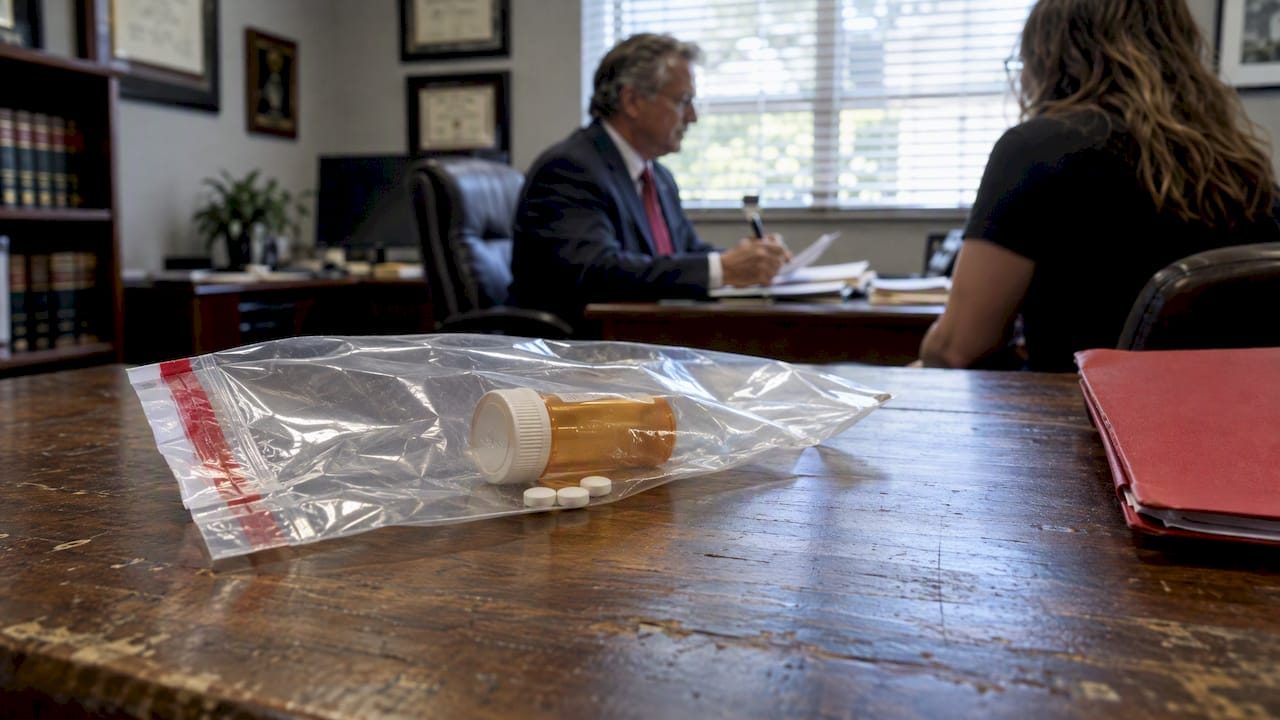
Constructive possession under Florida law means you can face criminal charges for drugs or contraband you never physically touched, as long as prosecutors can show you knew it was there and had the ability to control it. Florida Statutes §893.13 governs these cases, and penalties range from a misdemeanor to a serious felony depending on the substance and amount. If you are under investigation or already charged, talk to a defense attorney before you say anything to police.
TL;DR:
- Evidence of shared access to a space or container, without exclusive control, weakens the case for constructive possession under Florida law.
- The prosecution must prove knowledge of the contraband’s presence and ability to control it, but sharing access complicates establishing these elements.
- Small amounts of cannabis, under 20 grams, are usually charged as misdemeanors, while other controlled substances often lead to felony charges depending on quantity.
- Evidence like incriminating statements, fingerprints, or visual proximity alone is insufficient without proof of knowledge and control, especially in shared environments.
- Defenses focus on challenging the state’s evidence by proving lack of knowledge, control, or ownership, or by suppressing illegally obtained evidence.
Table of Contents
- What counts as constructive possession under Florida law
- Florida statute and penalties for possession charges
- Common scenarios where constructive possession charges arise
- How prosecutors build and prove a possession case
- Defenses attorneys use against constructive possession charges
- What to do right after an arrest or charge
- What a Brevard County defense attorney sees in these cases
- A note from Attorney John on defending these charges
- How The Law Office of John Vernon Moore, P.A. can help
- FAQ
- Sources
What counts as constructive possession under Florida law
Florida law recognizes two ways a person can “possess” something illegal: actually holding it, or being in a position where they know it exists and can control it. Actual possession is simple: drugs in your pocket, your hand, or your bag. Constructive possession covers everything else: drugs found in your car’s glove box, your bedroom closet, or a shared kitchen drawer.
The doctrine exists because contraband is often found in a space a person uses or controls rather than on their body. Courts have built a two-part test to decide whether the law reaches that far. According to Cornell Law’s Legal Information Institute, constructive possession applies when a defendant lacks physical custody of contraband but has both knowledge of its presence and the ability to exercise dominion and control over it. Florida courts apply that same framework, and appellate rulings have shaped how prosecutors and defense attorneys argue these cases.
The elements prosecutors must prove are:
- Knowledge: the defendant knew the contraband was present, not just that something was in the area.
- Dominion and control: the defendant had the actual ability to exercise control over the item, not merely access to the space where it sat.
- Identity of the substance: the item in question is in fact a controlled substance as defined by Florida law.
A Florida court document synthesizing Brown and Smith explains that these elements become harder to prove as more people share access to the same space. Florida’s statutory possession offense once required proof that the defendant knew the substance was illicit, but that element was removed by legislative amendment, shifting the burden toward knowledge of presence and control rather than knowledge of illegality. That change matters because it narrows what a defense has to disprove, while widening what a prosecutor can charge.
Florida statute and penalties for possession charges
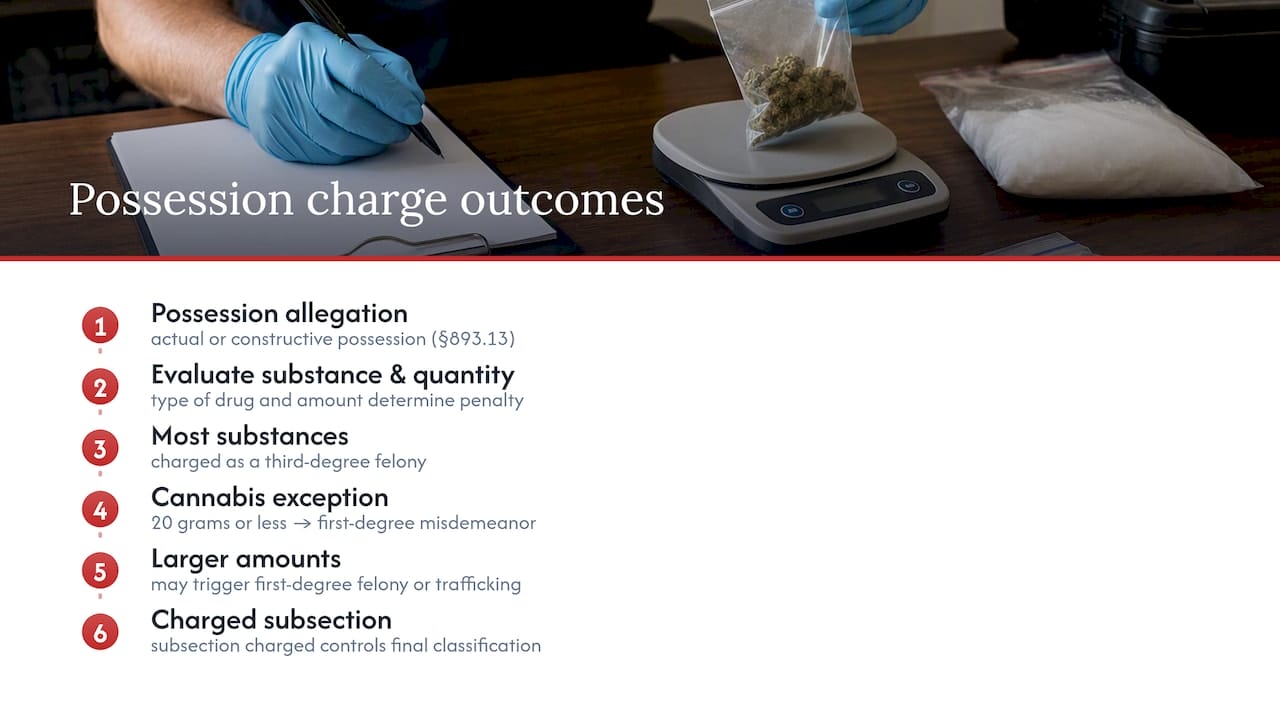
Florida Statutes §893.13 makes it unlawful to be in actual or constructive possession of a controlled substance, and the statute’s penalty structure depends heavily on what substance is involved and how much of it there is.
Possession of most controlled substances is a third-degree felony in Florida, according to §893.13, which carries exposure tied to Florida’s sentencing framework under sections 775.082 through 775.084. There is an exception: possession of 20 grams or less of cannabis is charged as a first-degree misdemeanor rather than a felony under the same statute.
Quantity and substance type can push a case in the opposite direction, too. Larger amounts of certain drugs may trigger first-degree felony classification or fall under trafficking statutes, which can carry mandatory minimum sentences in some circumstances. The exact subsection charged determines the classification you are facing, and that subsection should be the first thing you and your attorney confirm. Two people found in the same room with the same pill bottle could be charged under different theories depending on what the substance is, how much there is, and what else is discovered during the investigation.
Because the penalty structure branches so many ways, nobody should assume their exposure based on a general description of “drug possession.” A drug possession charge defense guide can help you understand next steps, but the charging document and lab results in your specific case control the real exposure.
Common scenarios where constructive possession charges arise
Constructive possession cases tend to fall into a handful of recurring fact patterns. Recognizing which one applies to your situation helps you understand how strong or weak the state’s case might be.
- Shared home, common area: drugs found on a coffee table or kitchen counter in plain view are easier for the state to link to everyone with access to that room, while drugs hidden in a closet or drawer that only one resident uses point more clearly to that person alone.
- Vehicle stops: a driver is presumed to have more control over the entire vehicle than a passenger, so contraband found in a closed glove box or trunk raises tougher questions when there are multiple occupants and no one admits ownership.
- Joint occupancy of an apartment or dorm: when a space is shared by roommates or family members, Florida courts require independent evidence tying a specific person to the contraband rather than letting mere occupancy carry the case.
- Backpacks, purses, and other containers: prosecutors often try to connect a defendant to a specific bag or box because ownership of the container is a stronger link than simply being near it.
Appellate courts have reversed convictions where the only evidence was that a defendant was physically near contraband in a space used by multiple people. A 4th District Court of Appeal opinion illustrates this pattern: the court found that proximity alone, without proof of knowledge or control, did not meet the state’s burden where the defendant was not in exclusive possession of the premises. That distinction between exclusive and joint occupancy shows up again and again in Florida case law, and it is often the hinge on which these cases turn.
How prosecutors build and prove a possession case
Prosecutors rarely have a confession to work with, so they build constructive possession cases out of circumstantial evidence and try to stitch it into a coherent picture of knowledge and control.
Common types of evidence include:
- Incriminating statements, such as a defendant acknowledging ownership of an item or a space during questioning.
- Plain view location, where contraband is visible without a search, strengthening the inference that anyone in the room could see it.
- Container or ownership links, such as mail, identification, or personal items found next to the contraband tying it to one specific person.
- Physical evidence, including fingerprints or DNA on packaging.
- Flight or evasive behavior at the time of discovery, which prosecutors often argue shows guilty knowledge.
Florida law allows circumstantial evidence to support a conviction, but appellate courts have held that when the state’s case rests entirely on circumstantial proof, that proof must be inconsistent with any reasonable hypothesis of innocence. The 4th DCA’s reasoning reflects this standard directly.
Proximity to contraband, standing alone, is not sufficient to establish constructive possession when the premises are not in the exclusive possession of the defendant.
That single idea, that nearness is not the same as control, shows up throughout Florida’s appellate history on this subject and is often the strongest point a defense attorney can make before a jury or a judge.
Defenses attorneys use against constructive possession charges
A constructive possession charge is built entirely on inference, which means it can often be attacked at more than one point in the case.
- Lack of knowledge: arguing the defendant genuinely did not know the item was present, especially in shared vehicles, rentals, or guest rooms.
- Lack of dominion and control: showing the defendant had no real ability to access or control the specific location where contraband was found.
- Third-party possession: presenting evidence that another occupant owned or controlled the item, which is often strongest in joint-occupancy cases.
- Illegal search or seizure: challenging how officers found the evidence in the first place, which can lead to suppression if the stop, search, or seizure violated constitutional protections.
- Mistaken identity or insufficient linkage: disputing that the contraband was ever connected to the defendant rather than simply located near them.
Beyond these substantive defenses, attorneys use procedural tools to test the state’s case before trial. A motion to dismiss challenges whether the state has enough evidence to proceed at all, while a motion for judgment of acquittal asks a judge to rule, often at the close of the state’s case, that the evidence as a matter of law cannot support a conviction. Suppression motions target evidence obtained through an unlawful search, which can gut a case built on what officers found in a car or home.
Pro Tip: Write down everything you remember about the search and seizure (who said what, what was searched, whether you consented) as soon as possible, since those details fade fast and often decide suppression motions.
Readers building a defense should hold onto photos, text messages, receipts, and names of witnesses who can speak to who actually used the space where contraband was found. Our guide to defending drug possession charges walks through these steps in more depth.
What to do right after an arrest or charge
What you do in the first hours after an arrest can shape the entire case that follows.
- Stay silent and ask for an attorney immediately. Anything said to police, even casually, can be used against you later.
- Do not consent to any search of your car, phone, or home beyond what officers are legally entitled to do without your permission.
- Preserve evidence on your own side, including photos of the scene, receipts, text messages, and contact information for anyone who witnessed the search or can speak to who controlled the space.
- Avoid deleting anything on your phone or in messaging apps, since that can create separate legal problems even if the original charge is weak.
- Write down the timeline of what happened, including times, officer names if available, and exactly what was said.
- Ask your attorney about diversion options, since Brevard County offers programs that can resolve some cases without a conviction on your record. Our page on Brevard County drug court explains how those programs typically work.
What a Brevard County defense attorney sees in these cases
The Law Office of John Vernon Moore, P.A. has represented Brevard County clients across criminal defense, including constructive possession charges tied to vehicle stops, shared housing, and joint occupancy situations. The firm’s approach in these cases centers on testing the state’s proof at every stage: challenging the stop and search that led to the discovery, pushing for dismissal when evidence shows only proximity, and negotiating diversion or drug court resolutions when a conviction is possible but avoidable. Our guide to how the criminal defense process works lays out what clients can expect from arraignment through resolution, step by step, so there are no surprises along the way.
A note from Attorney John on defending these charges
Most people facing a constructive possession charge are scared, and understandably so, because the law lets the state build a case out of circumstances rather than direct proof. In my practice, the strongest cases for clients usually come from careful early work: locking down the search facts, identifying who else had access to the space, and challenging weak links before they harden into a narrative at trial. Every case depends on its own facts, so I’d rather talk through yours directly in a free consultation than guess at your odds here.
— John
How The Law Office of John Vernon Moore, P.A. can help
A constructive possession charge moves fast, and the earliest decisions you make often matter more than anything that happens later. Some law offices offer criminal defense services with experienced attorneys and emphasize direct attorney access from the first conversation rather than being passed between staff.

| Service | What it covers |
|---|---|
| Florida Criminal Defense Lawyer | Representation for drug possession, constructive possession, and related charges |
| DUI Lawyers | Defense for driving under the influence charges |
| Free initial consultation | A no-cost first conversation to review your case and options |
We offer a free initial consultation so you can understand your options before committing to anything. Visit our criminal defense practice page to schedule a conversation about your case.
This article is general information, not a substitute for advice from a qualified lawyer. Consult a qualified legal professional about your own circumstances before acting on anything here.
FAQ
What is constructive possession in Florida?
Constructive possession in Florida means a person can be charged with possessing a controlled substance even without physical custody, as long as the state proves they knew the item was present and had the ability to control it. The doctrine is defined in general terms by Cornell Law’s Legal Information Institute and applied to drug cases under Florida Statutes §893.13.
How hard is it to prove constructive possession?
Proving constructive possession can be difficult when a space is shared by multiple people, since Florida courts require independent evidence linking a specific defendant to the contraband rather than relying on proximity alone. A 4th DCA opinion reversed a conviction on exactly this reasoning, finding that nearness to drugs in a jointly occupied space was not enough.
Can you go to jail for constructive possession?
Yes, constructive possession of a controlled substance in Florida can lead to jail or prison time, since most possession offenses under §893.13 are classified as third-degree felonies. An exception exists for 20 grams or less of cannabis, which is typically charged as a first-degree misdemeanor instead.
Can you give me an example of constructive possession?
A common example is drugs found in a car’s center console during a traffic stop where the driver, not any passengers, is presumed to have control over that part of the vehicle. Another example is contraband found in a bedroom closet in a shared apartment, where courts look for evidence tying the closet specifically to one resident rather than assuming everyone in the home had access.
What’s the difference between actual and constructive possession?
Actual possession means the drugs or contraband were found directly on a person’s body or in their hands, while constructive possession applies when the item is found somewhere the person did not physically hold it but still knew about and could control. Florida treats both as forms of unlawful possession under §893.13, and the practical difference usually comes down to how directly the evidence ties a person to the item.
Sources
- The 2026 Florida Statutes — §893.13
- 4th DCA pre-opinion (M.D. appellate opinion reversing constructive possession adjudication)
- Florida court JurisIni document (discussion of Smith and Brown and joint-occupancy principles)
- Constructive possession — Legal Information Institute (Cornell Law)