If you’re facing a drug possession charge, the bottom line is this: hire an experienced criminal defense attorney immediately and stop talking to police before you do. The strongest cases against you usually fall apart in one of five places: an illegal stop or search, a lack of actual knowledge or control over the drugs, an unreliable field test that was never confirmed in a lab, a broken chain of custody, or a disputed weight calculation that inflated the charge. A single well-argued motion targeting any one of these can end the case or shrink it dramatically.
Here’s what to do in the first hours:
- Say nothing beyond your name and ask for a lawyer, out loud, clearly.
- Do not consent to any search of your car, home, phone, or bags.
- Write down everything you remember about the stop while it’s fresh: time, location, what officers said, whether a K-9 was used.
- Stay off social media entirely. Prosecutors read it.
- Contact a defense attorney before your first court date, not after.
A motion to suppress evidence, when it succeeds, doesn’t just weaken a case. It can eliminate the drugs as evidence entirely, which often means the state has nothing left to prosecute.
Pro Tip: Tell family members to stop discussing your case by phone from jail. Recorded jail calls are routinely used as evidence, and well-meaning relatives asking “did you have anything on you?” can do real damage.
This article provides general legal information, not legal advice for your specific situation. Talk to a licensed criminal defense attorney in your jurisdiction as soon as possible.
Key Takeaways
Fighting a drug possession charge effectively means acting fast, targeting the state’s weakest evidentiary link, and letting an attorney control communication with police from day one.
| Point | Details |
|---|---|
| Silence protects you | Say nothing beyond your name and ask for a lawyer immediately after arrest. |
| One strong defense often wins | Focus on the single strongest challenge, illegal search, lab failure, or custody gap, rather than every possible theory. |
| Field tests aren’t proof | Demand confirmatory lab testing since presumptive field tests routinely produce false positives. |
| Diversion can mean dismissal | Eligible defendants who complete diversion program requirements can possibly have charges dismissed entirely. |
| Jmoorelegal offers direct access | Jmoorelegal provides a free initial consultation with direct attorney contact for Brevard County drug charges. |
Table of Contents
- What Does the Prosecution Have to Prove in a Drug Possession Case?
- What Should You Do in the First 48 to 72 Hours After Arrest?
- What Are the Strongest Defenses Against a Drug Possession Charge?
- What Pretrial Options Exist Before You Go to Trial?
- What Evidence Should Your Attorney Request in Discovery?
- How Long Do Drug Possession Cases Take, and What Do They Cost?
- How Does an Experienced Attorney Build a Possession Defense?
- Does Cooperating With Police Actually Help Your Case?
- How Does Bail Work in Drug Possession Cases?
- Why Early Counsel Changes Everything
- How Jmoorelegal Can Help With Your Drug Possession Case
- Frequently Asked Questions
- Sources
What Does the Prosecution Have to Prove in a Drug Possession Case?
Prosecutors carry the entire burden here, and that burden is heavy: they must prove every element of the charge beyond a reasonable doubt. Your defense doesn’t need to prove innocence. It only needs to knock out one piece of their case.
Typical elements include:
- Possession or control — actual physical possession, or “constructive possession” where drugs were found in a space you controlled.
- Knowledge — you knew the substance was present and knew (or should have known) it was illegal.
- Identity of the substance — the state must prove, through lab testing, that the item really is what they claim.
- Weight or quantity thresholds — many jurisdictions set specific weight cutoffs that separate simple possession from trafficking.
Constructive possession cases and valid prescription defenses often hinge on exactly what the state can prove about knowledge and identity, which is where a lot of possession charges quietly collapse.
What Should You Do in the First 48 to 72 Hours After Arrest?
The choices you make in the first three days shape everything that follows.
- Invoke your right to remain silent and ask for counsel before answering any questions, including “informal” conversations at the jail.
- Refuse consent searches of anything not already searched, even if an officer implies cooperation will help you.
- Write a detailed account of the arrest while your memory is sharp: exact statements, timing, who was present, and any inconsistencies you noticed.
- Identify and contact witnesses before they forget details or become hard to reach.
- Limit communication about the case to your attorney only. No calls, texts, or posts describing what happened.
- Decide on representation quickly — a public defender if you qualify, or private counsel if you want more direct control over case strategy and timeline.
Pro Tip: Ask whoever was with you at the time of arrest to write down their own account within 24 hours, separately from yours. Two independently written statements carry more weight than one shared memory.
What Are the Strongest Defenses Against a Drug Possession Charge?
Most possession cases turn on one of a handful of recurring weaknesses in the state’s evidence. A defense attorney’s job is to find the one that fits your facts and press it hard.
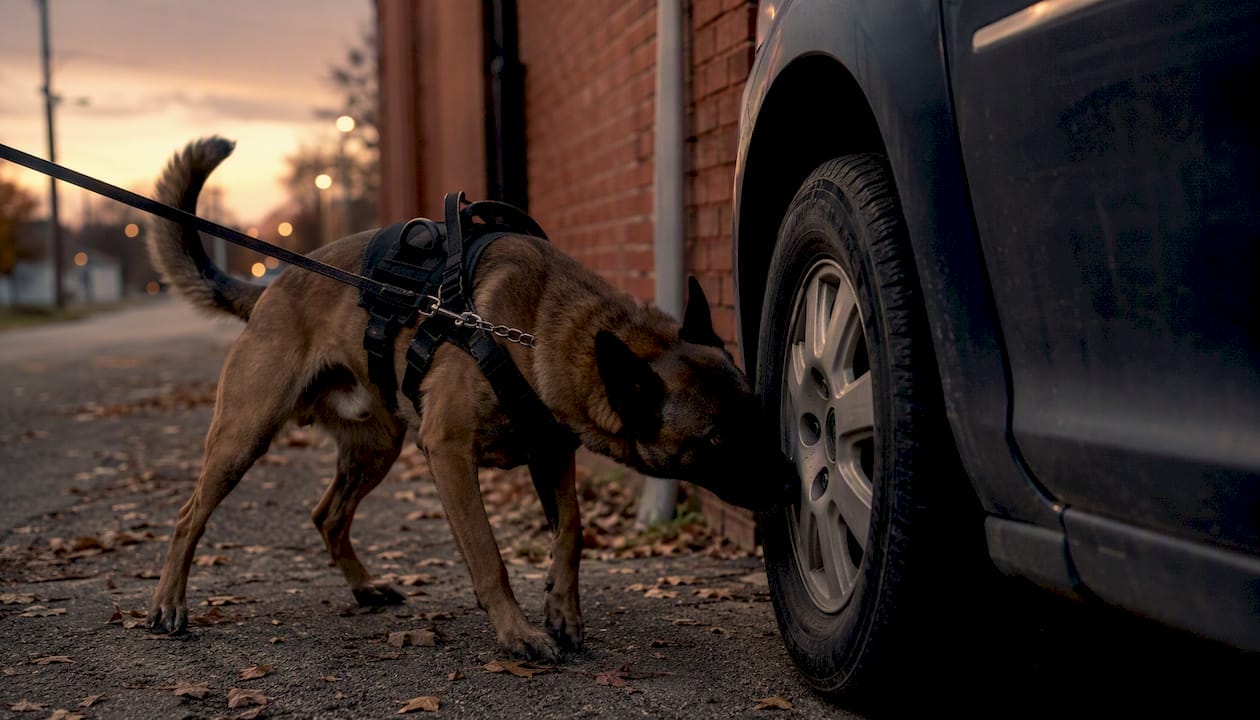
Illegal search and seizure. The Fourth Amendment bars unreasonable searches, and if police lacked a warrant, valid consent, or probable cause, your attorney can file a motion to suppress everything found in that search. This includes challenging a K-9 sniff that didn’t follow proper protocol, a traffic stop extended past its original purpose, or consent given under pressure. When suppression succeeds, the drugs themselves often can’t be used as evidence, and without them the state usually has no case left to try.
Lack of possession or knowledge. If drugs were found in a shared car, apartment, or bag, prosecutors have to prove you knew they were there and had control over them, not just proximity to them. Cases involving multiple occupants, borrowed vehicles, or recently rented spaces are especially vulnerable to this challenge.
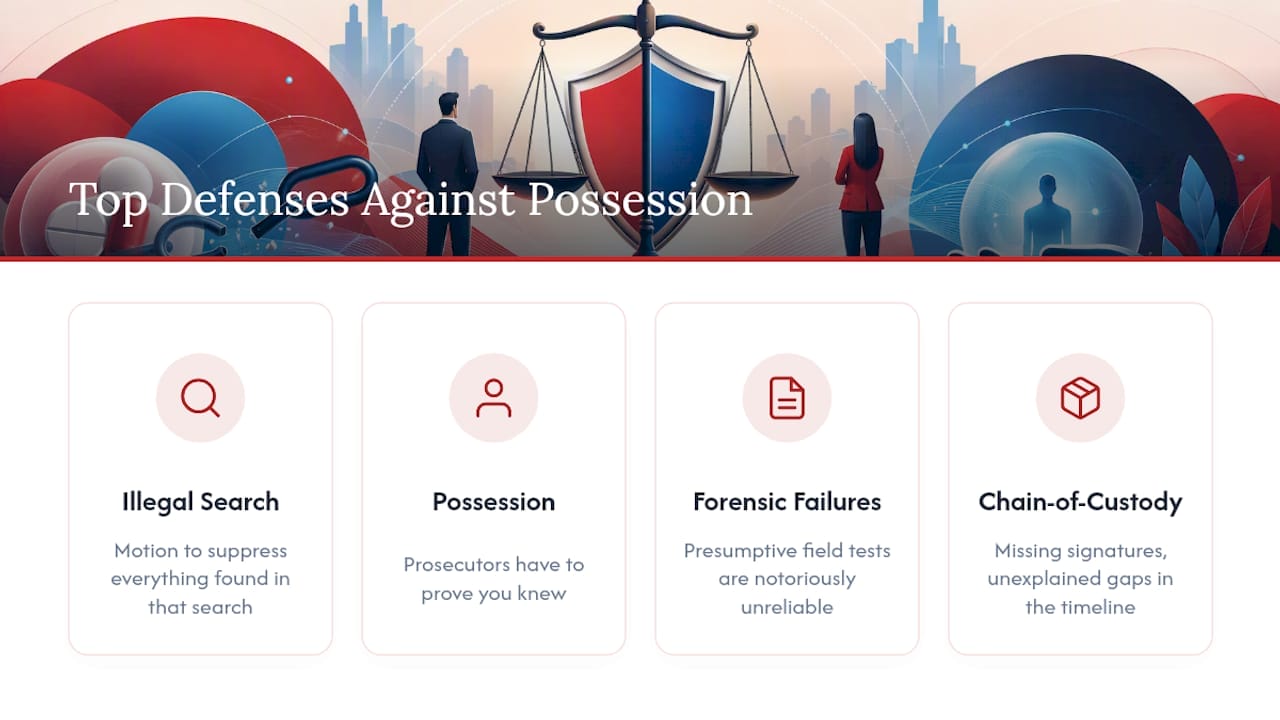
Forensic and lab failures. Presumptive field tests are notoriously unreliable and regularly produce false positives from substances as common as certain soaps or over-the-counter medications. Confirmatory lab testing is required for a conviction to hold, and your attorney can subpoena the analyst’s training records, the lab’s quality control logs, and testing protocols to look for cracks.
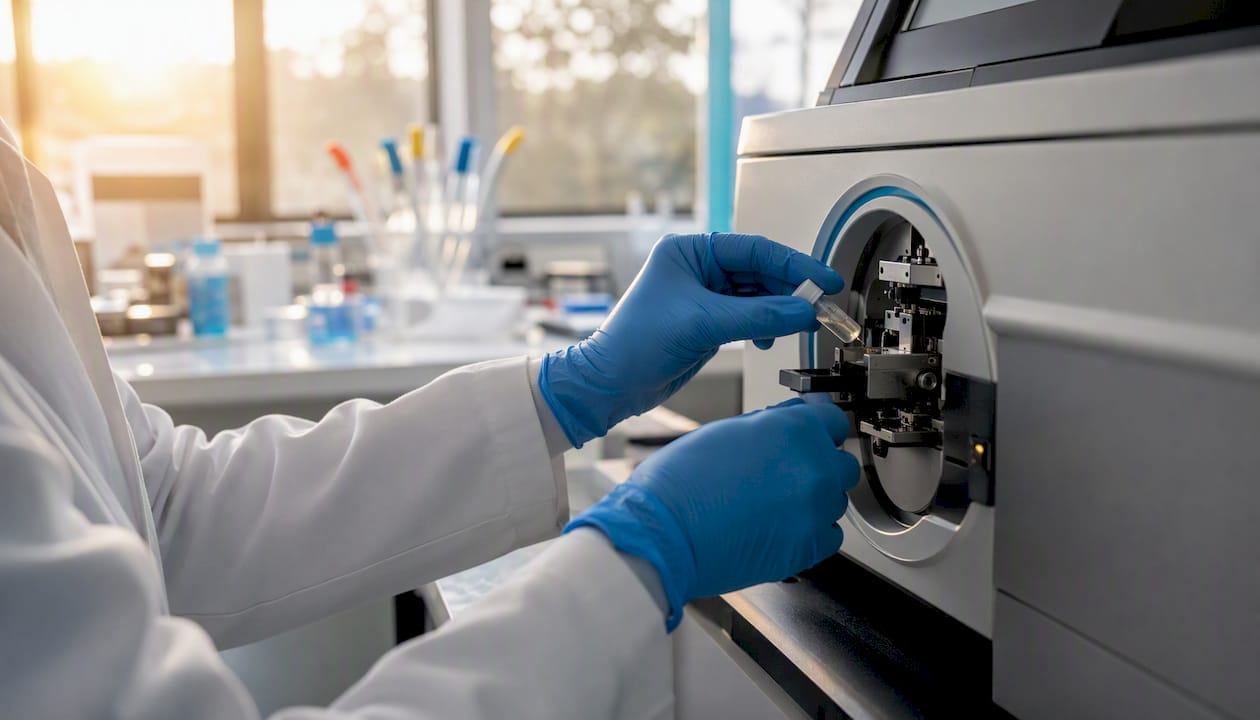
Chain-of-custody gaps. Every time evidence changes hands, from the arresting officer to the evidence locker to the lab, there should be a signed, dated record. Missing signatures, unexplained gaps in the timeline, or storage irregularities can raise real doubt about whether the substance tested is the substance seized.
Weight and intent disputes. Charges often escalate from possession to distribution or trafficking based on weight thresholds that vary by jurisdiction. Prosecutors sometimes use gross weight, meaning drugs plus packaging plus moisture content, which can artificially inflate a number past a legal cutoff. Demanding full weight logs at each custody transfer is standard practice for a reason.
Informant reliability. When a case relies on a confidential informant, that informant often has something to gain, a reduced charge, a payment, and defense counsel can challenge their credibility and the controlled-buy procedures used to build the case.
A drug case rarely needs ten different defenses to succeed. It needs one strong point of failure, pursued all the way through.
What Pretrial Options Exist Before You Go to Trial?
Before a case ever reaches trial, several moves can reshape the outcome.
- Motion to suppress — challenges illegally obtained evidence; if granted, key evidence disappears from the case entirely.
- Motion for discovery — forces the state to hand over everything it plans to use, plus any exculpatory material under Brady/Giglio rules.
- Diversion or deferred prosecution — eligible first-time or low-level offenders complete program requirements, often over several months to a year, and can walk away with charges dismissed.
- Plea negotiation — sometimes the smartest move, especially when it secures record sealing or probation instead of a formal conviction.
Weighing your options:
- Diversion avoids a conviction record but often requires admitting responsibility and completing strict conditions.
- A plea can resolve a case faster and limit exposure, but usually leaves a record affecting employment or immigration status.
- Trial preserves your full defense but carries the most uncertainty and the longest timeline.
What Evidence Should Your Attorney Request in Discovery?
A thorough discovery request is where cases actually get won. Your attorney should demand the police report, arrest affidavit, bodycam and dashcam footage, 911 call recordings, K-9 deployment logs, field test records, lab reports, chain-of-custody documentation, booking weight records, and any witness statements.
Each document serves a purpose. Footage tests whether the officer’s written report matches what actually happened. Lab paperwork verifies proper testing procedures were followed. Chain-of-custody logs expose gaps that raise doubt about the evidence itself.
A single missing signature on a chain-of-custody form, or a booking weight that doesn’t match the lab’s final number, has been enough to push a felony charge down to a misdemeanor.
How Long Do Drug Possession Cases Take, and What Do They Cost?
Cases move through predictable stages, though the pace varies widely by court and jurisdiction.
- Arrest to arraignment: days to a few weeks.
- Discovery and pretrial motions: several weeks to a few months.
- Plea negotiation or trial: a few months to over a year, depending on court backlog.
- Post-trial motions or appeals: additional months to years if pursued.
Penalties scale sharply with charge severity. Simple possession is typically a misdemeanor in many jurisdictions, while larger quantities or intent-to-distribute allegations become felonies carrying far heavier consequences, including collateral fallout for employment, housing, and immigration status.
Cost varies by case complexity, attorney experience, and whether the case resolves early or goes the distance; diversion programs typically carry their own program fees on top of court costs.
Penalty ranges and program costs differ significantly by state and county, so treat any general figure as a starting point for a conversation with local counsel, not a final answer.
How Does an Experienced Attorney Build a Possession Defense?
A methodical defense typically follows this sequence:
- Immediate intake and evidence preservation before memories fade or footage is overwritten.
- Full discovery review to identify the case’s weakest evidentiary link.
- Targeted motions, including suppression requests and lab subpoenas.
- Expert retention when forensic testing is disputed.
- Negotiation strategy built around leverage, followed by trial preparation if needed.
The firm that finds the case’s single weakest point first, and pursues it hardest, usually gets the best outcome for the client.
Jmoorelegal offers a free initial consultation and direct attorney access from day one, not a rotating cast of case managers.
Does Cooperating With Police Actually Help Your Case?
Officers often frame cooperation as your best move: tell us where you got it, name who else was involved, and things go easier for you. Sometimes that’s true. Often it isn’t, and the risk runs in one direction, toward you.
Anything you say can be used against you regardless of what an officer promises informally. Only a formal, attorney-negotiated cooperation agreement, put in writing and approved by the prosecutor, carries real legal weight. A verbal assurance from an arresting officer means nothing once your case reaches a prosecutor’s desk.
There are situations where cooperation genuinely helps, particularly when it’s negotiated as part of a plea agreement that trades information for a reduced charge or lighter sentence. The difference between that and simply talking to police at the scene is enormous. One is a calculated legal strategy built with counsel present. The other is a defendant giving away leverage before they even know what evidence exists against them.
If an officer or detective asks you to become an informant, name suppliers, or provide information about other cases, tell them you’ll discuss it with your attorney. That single sentence protects you completely, and it costs you nothing. Prosecutors and detectives negotiate with lawyers every day. They rarely resent a defendant for having one.
How Does Bail Work in Drug Possession Cases?
Bail amounts in drug cases typically depend on the charge classification, the quantity involved, your criminal history, and whether the court considers you a flight risk. Misdemeanor possession often carries lower bail or even release on your own recognizance, while felony charges involving larger quantities or distribution allegations tend to come with substantially higher amounts or, in some jurisdictions, no bail at all pending a hearing.
Getting released quickly matters for more than comfort. A defendant out on bail can meet with their attorney in person, help locate witnesses, gather evidence, and maintain employment, all of which strengthen the defense and keep life from unraveling while the case proceeds. Someone held in custody loses access to most of that, and prosecutors know it. Extended pretrial detention creates real pressure to accept a plea just to go home, regardless of whether that plea reflects the actual strength of the case.
Your attorney can request a bail reduction hearing, argue for release on recognizance, or negotiate conditions like drug testing or check-ins instead of a cash bond. The faster this happens, the more control you retain over how your defense unfolds. Bail decisions made in the first 48 hours often shape the entire trajectory of a case, which is exactly why prompt legal representation matters as much for your freedom during the case as for the outcome at the end of it.
Why Early Counsel Changes Everything
I’ve seen the same pattern play out again and again: the clients who call within hours, not weeks, keep the most options open. Evidence gets preserved, witnesses stay reachable, and motions get filed while they still matter. That’s not a sales pitch. It’s how these cases actually work.
How Jmoorelegal Can Help With Your Drug Possession Case
If you’re weighing a public defender against private counsel, or wondering whether you can afford to fight this at all, Jmoorelegal gives Brevard County defendants something both paths often lack: direct access to the attorney handling your case, from the first phone call through resolution, with no rotating case managers in between.

The free initial consultation covers exactly what this guide walked through: whether the stop or search was lawful, whether the state can prove knowledge and possession, and whether the lab work and chain of custody will hold up. Bring whatever paperwork you already have, an arrest report, a bond receipt, court dates, and Jmoorelegal will map out where your strongest challenge likely sits.
Reaching out early gives your attorney time to request bodycam footage before it’s purged and file motions before deadlines close. Visit the drug crimes defense page or the criminal law practice page to schedule your consultation, and bring your discovery materials with you the day you call.
Frequently Asked Questions
What is the fastest way to fight a drug possession charge?
The fastest path usually runs through a motion to suppress. If the search or stop that led to the discovery of drugs was unlawful, a successful motion can remove that evidence entirely and end the case without a trial.
Can a drug possession charge be dismissed?
Yes. Charges get dismissed through successful suppression motions, forensic challenges that undercut the state’s proof, or completion of a diversion program for eligible defendants.
Do I need a lawyer for a first-time drug possession charge?
Even first offenses benefit enormously from counsel, since diversion eligibility, plea terms, and record sealing options are often strongest the first time you’re charged and weaken with each subsequent case.
What’s the difference between actual and constructive possession?
Actual possession means the drugs were found on your body. Constructive possession means they were found in a space you controlled, like a car or apartment, and the state must still prove you knew they were there.
How does a lab error affect my case?
A lab error, whether it’s a chain-of-custody gap, a mishandled sample, or an unqualified analyst, can raise enough reasonable doubt about whether the tested substance matches what was seized to defeat the charge outright.
This article is general information, not a substitute for advice from a qualified lawyer. Consult a qualified legal professional about your own circumstances before acting on anything here.
Sources
- Pretrial diversion program — U.S. Department of Justice
- Assessing the reliability and impact of presumptive field drug tests — WCSJ, Duke Law
- beyond a reasonable doubt — Legal Information Institute
Recommended
- Drug Crimes & Drug Charges – The Law Office of John Vernon Moore, P.A.
- Domestic Violence Charge Defense Strategy: 2026 Guide – The Law Office of John Vernon Moore, P.A.
- How the Criminal Defense Process Works: A Clear Guide – The Law Office of John Vernon Moore, P.A.
- Out-of-Town Defendant? Brevard Criminal Defense Lawyer