When someone dies in Florida without a valid will, Florida Statutes Chapter 732 determines the heirs through a fixed priority order: spouse, descendants, parents, siblings, and more remote relatives. A surviving spouse may inherit everything or only half, depending on whether the descendants are shared. Homestead status and nonprobate ownership (like trusts or joint accounts) can change who actually receives what.
TL;DR:
- If there are shared descendants, the surviving spouse inherits everything; otherwise, the estate is divided among heirs in a strict order of priority.
- Heirs inherit per stirpes, meaning each family branch receives an equal share, with deceased children passing their portion to their own descendants.
- The surviving spouse can claim a 30% elective share of the estate within applicable deadlines, even if the estate’s distribution would differ under intestacy laws.
- Probate assets exclude trust-held property, payable-on-death accounts, and joint ownership, which pass outside the probate process directly to beneficiaries.
- Small estates under certain value limits or with minimal assets can bypass formal probate using simplified affidavits or disposition without administration procedures.
Table of Contents
- Statutory order of intestate heirs and how per stirpes distribution works
- Surviving spouse, homestead rules, and the elective share
- Probate administration routes: formal administration and summary administration
- Small estates: disposition without administration and the affidavit process
- Creditor claims, notice to creditors, and payment priority
- Nonprobate assets and title issues that change intestate outcomes
- Immediate checklist for heirs and personal representatives
- What complicates Florida intestate cases in practice
- How the Law Office of John Vernon Moore, P.A. can help with intestate probate
- Authoritative statutes, court forms, and consumer guides
- Sources
- FAQ
Statutory order of intestate heirs and how per stirpes distribution works
Florida’s intestacy statute lays out a strict line of succession, and courts follow it without exception once probate assets are identified. If a decedent leaves a spouse and descendants who are shared by both, the spouse inherits everything. If there is no spouse, the estate goes to descendants, then parents, then siblings, and on down a defined chain until a distant relative qualifies or the property escheats to the state.
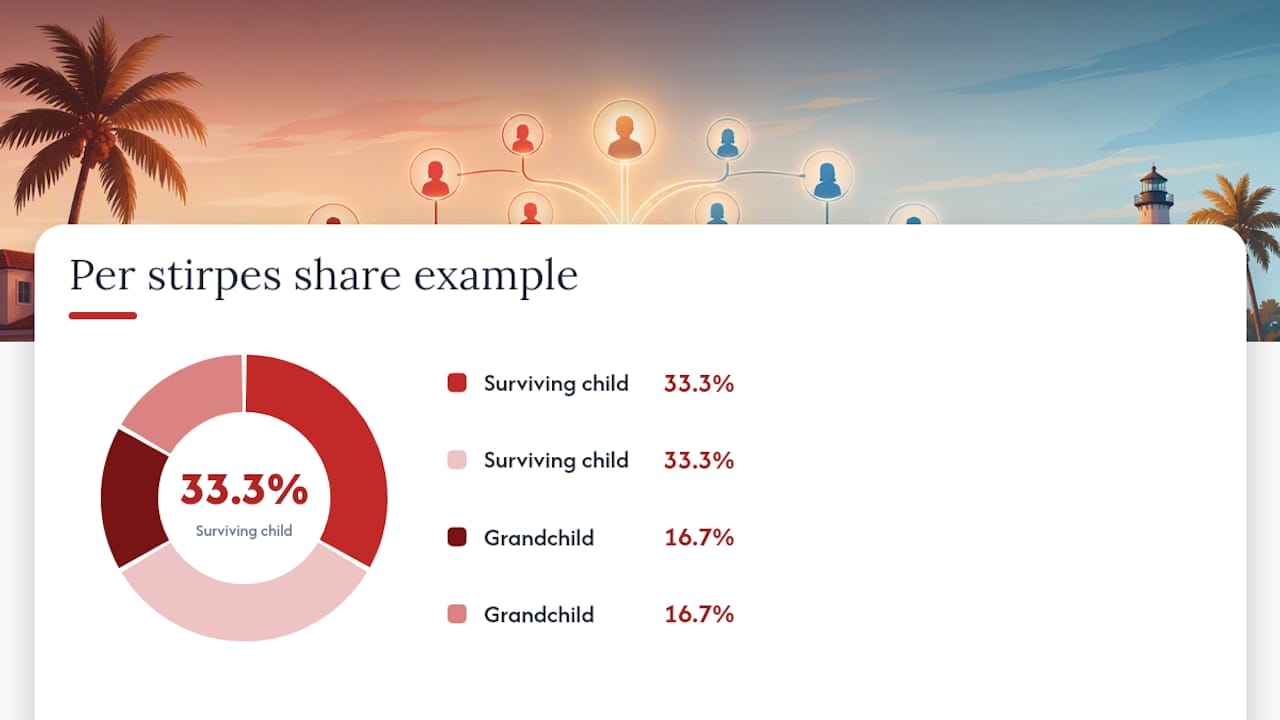
Descendants inherit per stirpes, meaning each branch of the family gets an equal share, and a deceased child’s portion passes down to that child’s own children. Picture a decedent with three children: one died before the parent but left two children of her own. The estate splits into three equal shares, one for each of the surviving two children, and the third share splits again between the two grandchildren.
Florida law also addresses categories that trip up many families:
- Adopted children inherit the same as biological children, and adoption cuts off inheritance rights from the biological family in most cases.
- Children born after a parent’s death (posthumous children) inherit as if born during the parent’s lifetime.
- Half-blood relatives receive half the share of a full-blood relative in the same degree.
- Heirs who are not U.S. citizens generally retain inheritance rights under Florida law.
These rules and the escheat provision that sends unclaimed estates to the state appear throughout Chapter 732 of the Florida Statutes, including the sections covering per stirpes descent and half-blood shares.
Surviving spouse, homestead rules, and the elective share
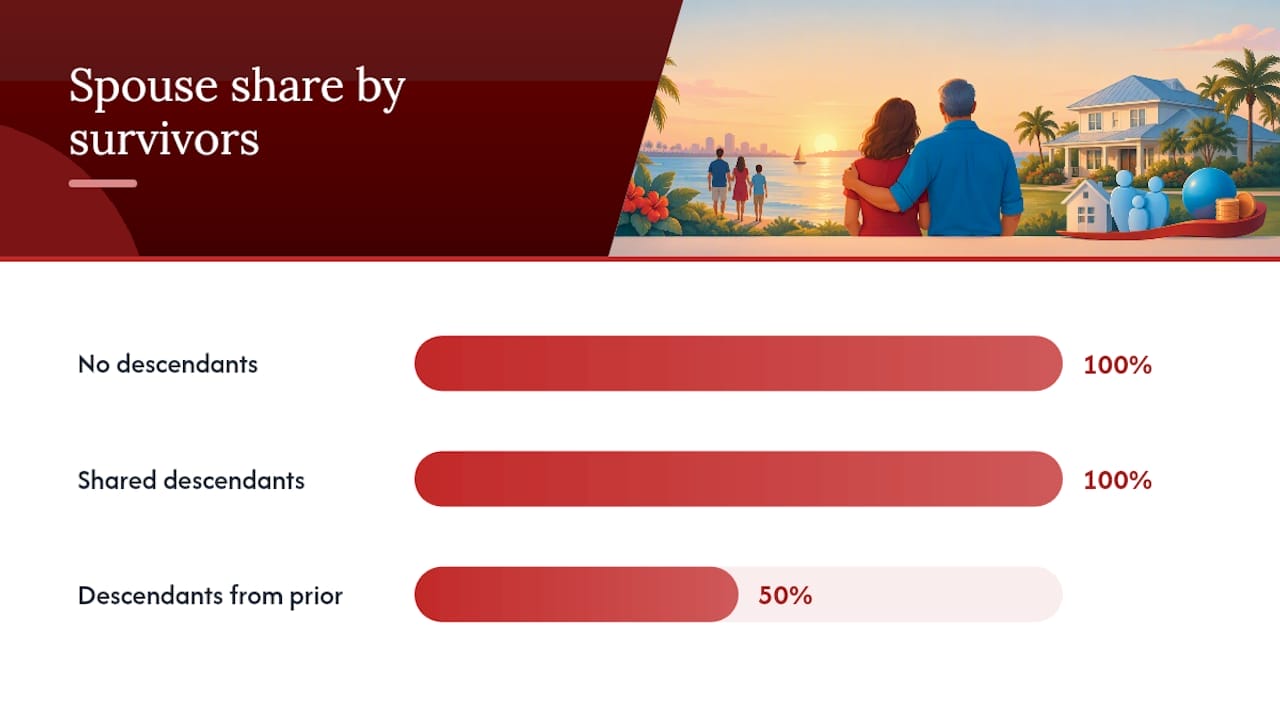
The spouse’s share depends entirely on who else survives. Under Florida Statutes §§ 732.102 and 732.103, a surviving spouse inherits the entire probate estate when there are no descendants, or when every descendant is also the spouse’s descendant. When the decedent leaves descendants from another relationship, the spouse receives half and the descendants split the remainder.
- No descendants at all: spouse takes everything.
- Descendants shared by both spouses only: spouse takes everything.
- Descendants from a prior relationship: spouse takes half, descendants take half.
Homestead property follows different rules than other probate assets. A surviving spouse typically chooses between a life estate in the homestead or an undivided one-half interest, and that choice depends on how title was held and whether descendants survive, as The Florida Bar’s homestead guidance explains.
Florida also gives a surviving spouse the right to an elective share regardless of what intestacy or a will would otherwise provide.
A surviving spouse can claim an elective share equal to 30% of the elective estate, but the election must generally happen within six months of receiving notice of administration or two years of death, whichever comes first. Missing that window can forfeit the right entirely.
Probate administration routes: formal administration and summary administration
Which probate track applies depends mostly on the estate’s size and how long ago the person died. Formal administration is the standard path for larger or more complicated estates.
- An interested party petitions the circuit court and asks to be appointed personal representative.
- The court issues letters of administration, giving the representative legal authority to act.
- The representative files an inventory of estate assets and publishes notice to creditors.
- Creditors file claims within the statutory window, and the representative pays valid claims in priority order.
- Once debts and taxes are resolved, remaining assets distribute to heirs under Chapter 732.
Summary administration offers a shortcut. It applies when the probate assets total $75,000 or less%20-%20Final%20(sent%20to%20PRC)%20-%20Accessible.pdf), excluding exempt property, or when the decedent has been dead for more than two years. There is no personal representative appointment, no formal inventory, and distribution can happen far faster, often in weeks rather than months. The clerk’s office typically wants a certified death certificate, a list of assets and their values, and information identifying every heir before the petition moves forward.
Small estates: disposition without administration and the affidavit process
For very small estates consisting mostly of exempt or minimal personal property, Florida offers an even narrower option. Under Section 735.304, a person who paid funeral expenses or final medical bills can seek disposition without administration, bypassing formal or summary probate entirely.
- The estate must consist largely of exempt personal property and assets that do not exceed funeral and medical expense reimbursements.
- The affidavit must detail the assets, and the filer must conduct a diligent search for creditors and heirs before distribution.
- Signers who omit a known heir or fail to account for a valid creditor claim can face personal liability, including potential attorney-fee awards against them.
Our detailed breakdown of Florida’s small-estate options covers how to weigh this path against summary administration.
Creditor claims, notice to creditors, and payment priority
Heirs rarely receive anything until creditors have their chance to file claims. Formal administration requires published notice to creditors, and summary administration carries its own notice obligations under standardized Florida Courts forms. Claims filed more than two years after death are generally barred outright, regardless of whether notice was published.
- Funeral expenses and administration costs are typically paid first.
- Taxes and secured debts follow, then unsecured claims in the order the statute sets.
- Heirs should avoid distributing or spending estate assets until the claims period closes to limit personal exposure.
Nonprobate assets and title issues that change intestate outcomes
Intestacy statutes only reach probate assets, and a surprising share of a person’s property often bypasses probate entirely. Assets held in a revocable trust, payable-on-death or transfer-on-death accounts, life insurance with a named beneficiary, retirement accounts, and property held as joint tenants with right of survivorship or tenancy by the entirety all pass outside the intestacy scheme.
- Trusts, TOD and POD accounts, and life insurance proceeds go directly to named beneficiaries.
- Property titled JTWROS or as tenancy by the entirety passes automatically to the surviving co-owner.
- A Lady Bird deed lets an owner keep control during life while property transfers to a named beneficiary at death without probate.
- Real property can still require probate when title was held solely in the decedent’s name or when a named beneficiary predeceased the owner.
Understanding how to structure ownership to avoid probate matters as much for future planning as it does for sorting out a current estate.
Immediate checklist for heirs and personal representatives
Acting quickly protects the estate and limits disputes down the line.
- Secure the home, vehicles, and valuables, and locate the death certificate, deeds, and account statements.
- Identify all potential heirs, including children from prior relationships, and gather marriage and birth certificates.
- Check for beneficiary designations on retirement accounts, life insurance, and bank accounts before assuming anything is a probate asset.
- Determine whether the estate qualifies for the affidavit process, summary administration, or requires formal administration.
- Contact an attorney once real property, a business, or a blended family is involved, since these situations raise the stakes for mistakes.
Pro Tip: Bring every document you can find to the first meeting, even ones you think are irrelevant. Title language and beneficiary forms often decide the outcome before the intestacy statute ever applies.
What complicates Florida intestate cases in practice
Blended families cause the most disputes we see, since a surviving spouse’s share shrinks the moment stepchildren are not also the spouse’s own children. Outdated beneficiary forms are a close second: an ex-spouse still listed on a retirement account can override what a family assumes intestacy will provide. Homestead disputes and elective share timing deserve attention early, before a deadline quietly closes a spouse’s options.
— John
How the Law Office of John Vernon Moore, P.A. can help with intestate probate
Sorting out an estate without a will means navigating statutory deadlines, title questions, and creditor notices at the same time grief makes careful decision-making hard. The Law Office of John Vernon Moore, P.A. handles probate and trust administration for Brevard County families, from small-estate affidavits to formal administration involving homestead and elective-share disputes.

- Probate and trust administration for formal and summary cases.
- Small-estate affidavit guidance under Section 735.304.
- Elective-share calculations and homestead title review.
The firm offers a free initial consultation. Bring the death certificate, any deeds or account statements, and a list of potential heirs so the conversation can start with the facts that matter. Visit the probate and trust administration practice page to schedule a consultation and find out which path fits your family’s situation.
Authoritative statutes, court forms, and consumer guides
For the exact statutory language and current forms, go directly to the source.
- Chapter 732, Florida Statutes, the full intestacy law.
- The Florida Bar’s probate pamphlet for a consumer-level overview.
- IRS estate tax FAQs for federal filing thresholds.
This article is general information, not a substitute for advice from a qualified lawyer. Consult a qualified legal professional about your own circumstances before acting on anything here.
Sources
- Chapter 732 – 2025 Florida Statutes – The Florida Senate
- Probate in Florida — The Florida Bar
- Frequently asked questions on estate taxes — IRS
FAQ
What are the changes in Florida’s probate system for 2026?
Florida’s core intestacy rules under Chapter 732 remain the framework for 2026, with the statute continuing to set spouse shares, descendant priority, and per stirpes distribution as described in the 2026 statutory text. Readers should check the current legislative session for any amendments before relying on prior-year summaries.
How much money can you inherit in Florida without paying taxes?
Florida does not impose a state inheritance or estate tax, so heirs owe nothing to the state regardless of amount. A federal estate tax return may still apply to very large estates, since the federal exclusion is about $15,000,000 for 2026.
Who inherits property if there is no will in Florida?
Property passes according to the priority order in Florida Statutes Chapter 732: a surviving spouse and descendants come first, followed by parents, siblings, and more remote relatives if none of the closer heirs survive. The surviving spouse’s exact share depends on whether the descendants are shared by both spouses or come from a prior relationship.
What is the next of kin order after death in Florida?
The order starts with the surviving spouse and descendants, then moves to parents, siblings and their descendants, and further out to grandparents and their descendants if no closer heir exists. If no qualifying relative can be found, the estate escheats to the State of Florida under Chapter 732.